, A Breath of Life in Unediting. IMS Clarice Lispector, 2026. Disponível em: https://site.claricelispector.ims.com.br/en/2026/03/12/a-breath-of-life-in-unediting/. Acesso em: 02 April 2026.
A little known concept in Portuguese, unediting is less a theory and more a practical way to support complex publishing cases, such as the publication of A Breath of Life, a posthumous novel by Clarice Lispector organized by Olga Borelli.
While the term still seems obscure, or perhaps slippery within the areas of textual criticism and editorial theory, it has been used in the past few decades to reread, above all, works by Renaissance and modern authors such as Shakespeare, John Keats, Christopher Marlowe, and John Milton.
The aim of unediting is to undo the illusion of transparency that the ready, finished, and linear book, with a minimally stabilized narrative, conveys to readers. It concerns adjusting the focus of analysis to physical evidence that is generally banished from the abstract debates of editors (Beal, 2008, p. 426), thus being able to develop “a fresh perception of details otherwise overlooked, and leads [sic] to an understanding of what is perceived” (ibid.). At the same time, this practice allows one to face areas of textual and material instability in a more instigating way, by observing how graphic aspects have semantic impacts and can provide clues not only to the historical moment of writing but also to the biography of the author being studied.
The manuscripts that make up the dossier A Breath of Life – held by the IMS since 2018 – are placed at the center of analysis and, through unediting, a critical space is carved out less with imbroglios from the narrative and from the comparison with what is published and more with what is confused, incomplete, and noisy in itself.
All Editing Fails in Some Way
Jerome McGann
By placing A Breath of Life on a timeline, one sees that the novel was not duly accompanied by Clarice Lispector until publication. Actually, of the five phases that can be identified in the theory of composition – whose boundaries are fluid, of course, but useful for understanding writing as a process – the author would have played a part in the pre-composition but not so much in the composition. This participation becomes evident in the outlines, lists, and excerpts (pre-composition), and leaves with sequential texts (composition) that can be found among the 823 folios of the dossier. The two collections of writings translate what Lispector called “inspiration” and “concatenation.” 1 On the other hand, the material evidence shows that Borelli accompanied the stages of composition, pre-publication, and publication. She was also part of post-publication, participating, for example, in the adaptation of the novel into a theatrical play released at that time in São Paulo. She even produced an ambiguous biography that, over the past four decades, has become a primary source of research for other papers, theses, and dissertations.
If the author was absent from the publication process, both the comparison between the manuscript and the edited book, and “the author’s intention,” which can only be inferred speculatively and interpretively, become secondary. To circumvent such a trap and be able to offer new contours for a slice of this literary history, the manuscript comes to assume a central position in the research: how does this text behave and how is it conveyed? How can a new edition account for this apparent paradox?? How to edit that which has remained silent? (Dionísio, 2021, p. 62)
The Visible Over the Legible
Editing is a way of visualizing, Elena Pierazzo asserts. In this sense, the analytical framework for the 823 folios is organized so that the legible dialogues closely with the visible, following what several authors of the area recommend: “Looking at books, instead of (or at least before) reading them” (Dell’Oso, 2018, p. 132); “You have to look at the text, not just read for ‘sense’” (idem, p. 135); “the closer we look at a text, the more variation we see” (Van Hulle, 2017, p. 38); “looking in the eyes of manuscripts” (Werner, 2022).
Intentions to act spring from the page, and from it one can understand the construction of meaning not only through the words from the pages, but also in the way that the words have been inscribed on the pages (Shillingsburg, 2017, p. 36). The folio then becomes a complex semiotic object, in which the writing materials are a condition of existence for the text itself: the texture of the leaf, the positioning of the letters, graphic signs, rubrics, empty spaces – all that which somehow escapes the interest of the editorial tradition participates in the articulation between matter, creation, and life, revealing both semantic systems of graphic relations and graphic expressions that make relations of meaning visible (Drucker, 2013).
By placing the manuscripts in circulation and in relation, the collection itself imposes, by its very nature, chaos and disorientation as modes of being. There is no prior reading order that says “next page, next, next”—as a certain tradition of linear and stable reading envisions; there is only a temporality of the “while,” of the provisional, of the possible (Werner, 2022).
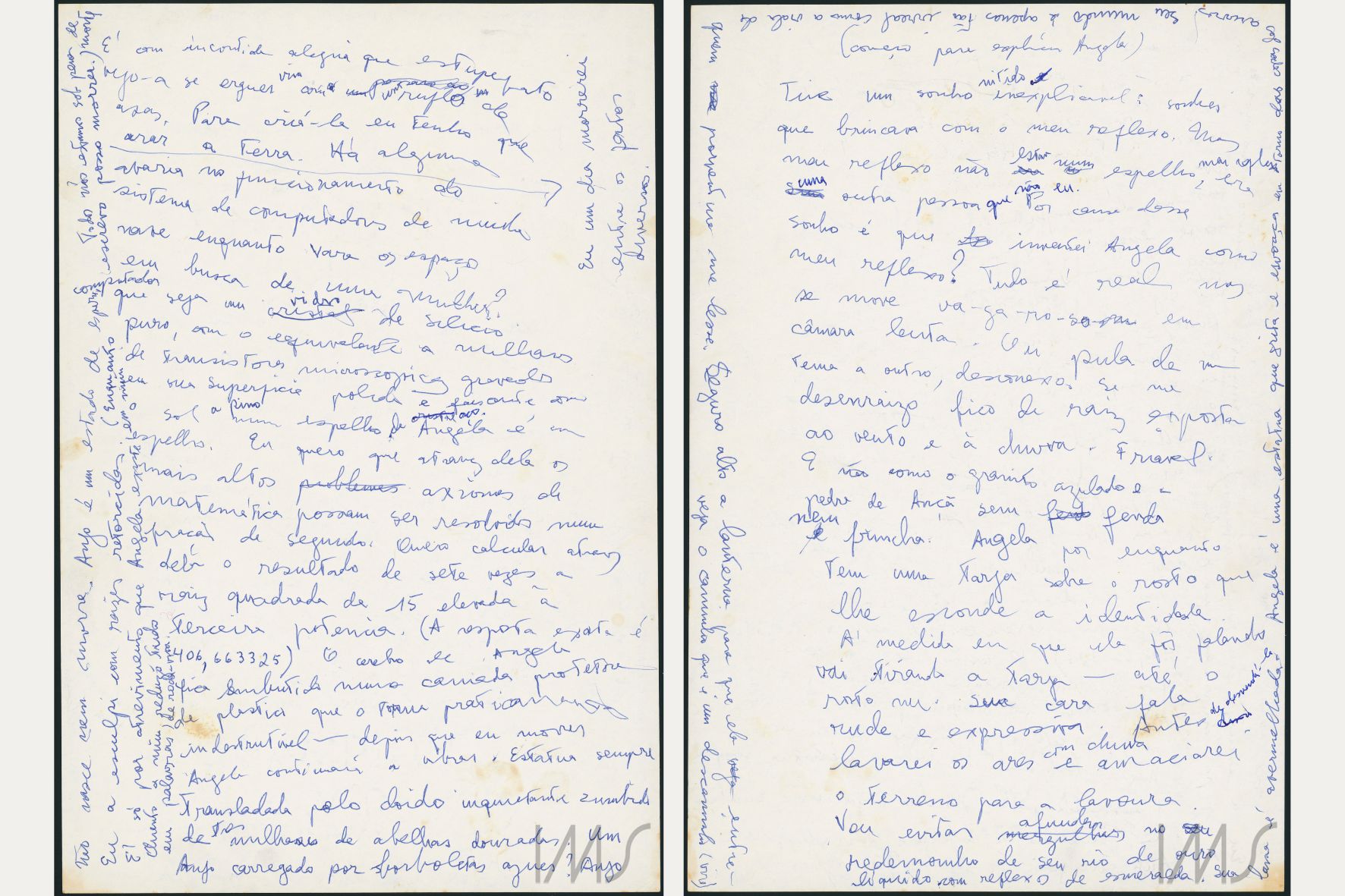
This materiality, Chartier asserts, translates and guides the reading (2021, p. 23). Tears, pen colors, handwriting, blank spaces, paper stock, watermarks, and size become invisible for being a kind of conditio sine qua non of writing, but they will be points to highlight here.
Materiality matters
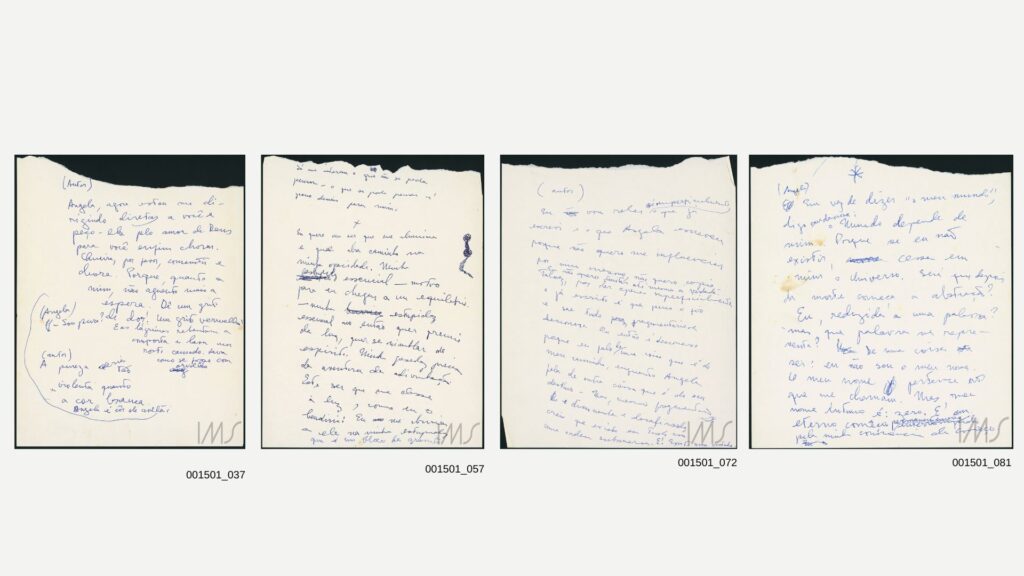
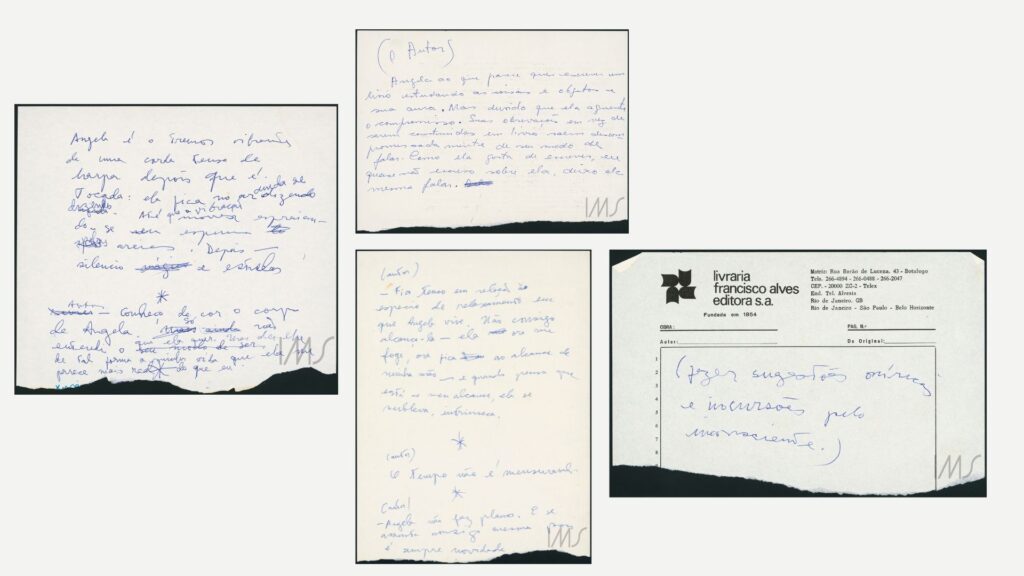
Although it may seem like a material aspect of lesser interest, the papers with some level of tearing constitute about 33% of the total amount of A Breath of Life – around 274 folios. It is possible to distinguish in them a few patterns of motion: upper tears (the upper part of the page is missing); lower tears (the lower part of the page is missing); free-form tears (a page with missing pieces, in a more rounded shape); and narrow tears (pieces of a page with a strip of text).
Upper Tears
Lower Tears
Free-form Tears
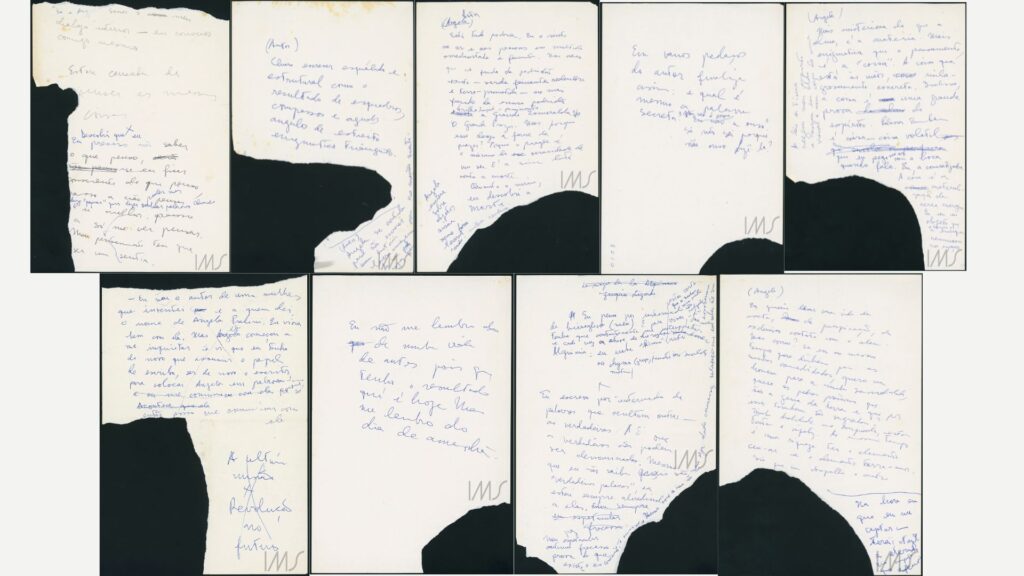
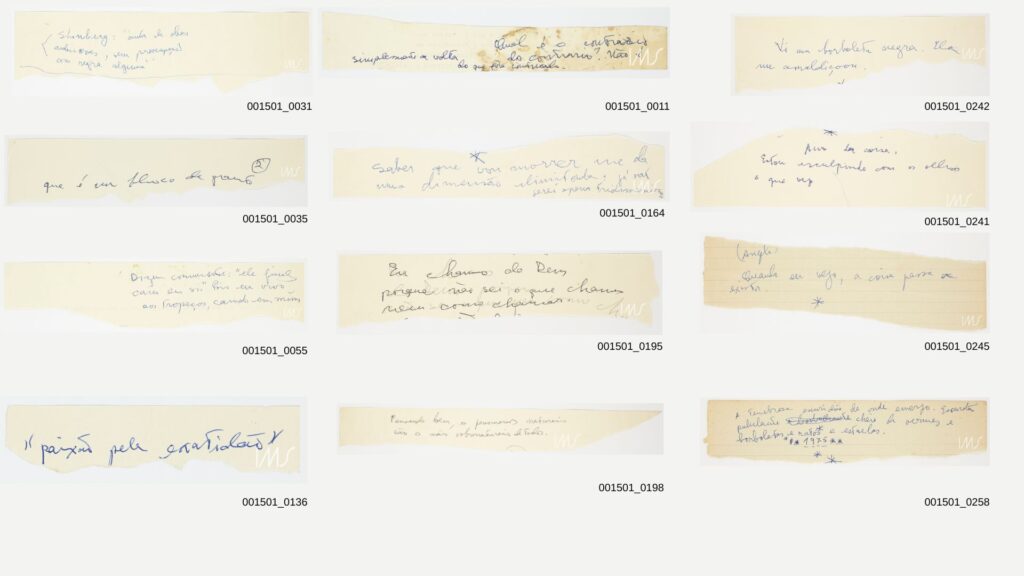
Narrow Tears
“I ended up tearing it up and throwing it away,” Clarice Lispector asserts to the journalist Júlio Lerner upon telling him about a short story that had no end. He asks if the writer still tears up things that she has produced. The answer is short and ambiguous: “I set them aside… No, I do tear them up.” The ellipsis in the middle indicates the silence of someone whose mind has changed. Two years earlier, in another interview, this one for the Museum of Image and Sound, Clarice asserts: “I learned not to tear anything up. My maid, for example, has orders to leave any little piece of paper with something written on it as it is.”
Supported by her words, it is worth embracing what the paper gives: tears become silent witnesses to gestures that wish to deny what has been done, what has been written. “Tear it up in a fit of mild anger,” Lispector will say to Lerner. In her words, the reference to a “little piece” seems to account for the tiny pieces of mutilated paper that are only 3 cm high. In any case, the torn pieces can either become an archive or trash, depending on their fate. If these leaves were kept in the archive, would it have been because Clarice tore them up and still kept them? Or were the discarded manuscripts rescued from the debris by others?
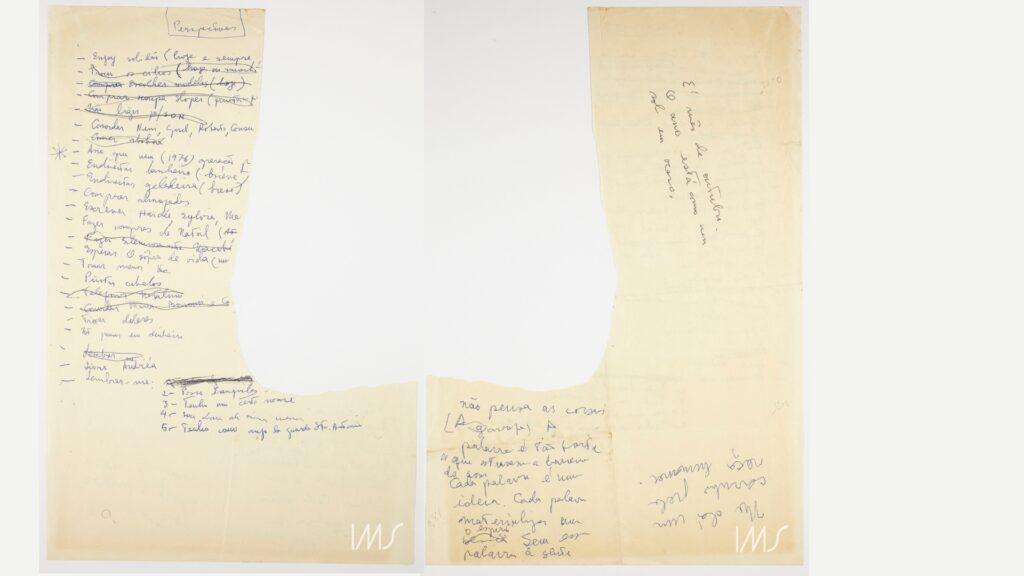
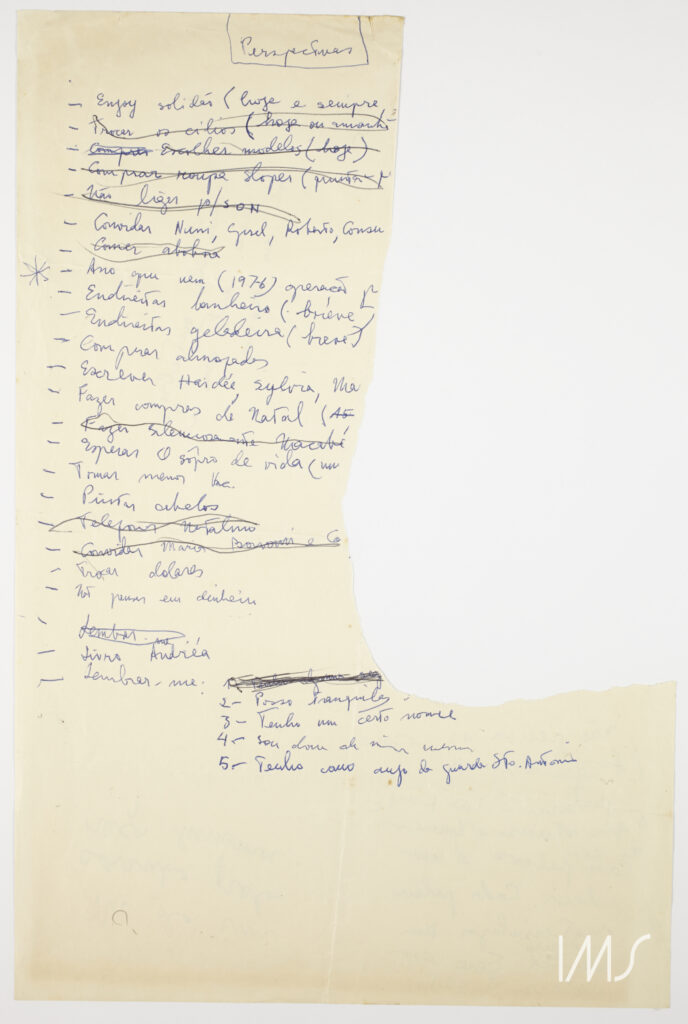
It is worth revisiting the previously discussed double motion that is made evident in the document with the code 001501_0169: that of tearing up what she wrote and that of making use of a torn piece of paper to write on. If the side titled “Perspectives” has a vertical tear that removed part of its content, leaving incomplete sentences, on the other side there are three small blocks of writing that occur around the tear, in the surrounding area. The tear becomes a margin and imposes an invisible limit that is respected by the written blocks.
Examples of folios with losses of paper and text. In the first column, 001501_0031, 001501_0035, 001501_0055, and 001501_0136. In the second column, 001501_0011, 001501_0164, 001501_0195, and 001501_0198. In the third, 001501_0242, 001501_0241, 001501_0245, and 001501_0258.
“I ended up tearing it up and throwing it away,” Clarice Lispector asserts to the journalist Júlio Lerner upon telling him about a short story that had no end. He asks if the writer still tears up things that she has produced. The answer is short and ambiguous: “I set them aside… No, I do tear them up.” The ellipsis in the middle indicates the silence of someone whose mind has changed. Two years earlier, in another interview, this one for the Museum of Image and Sound, Clarice asserts: “I learned not to tear anything up. My maid, for example, has orders to leave any little piece of paper with something written on it as it is.”
Supported by her words, it is worth embracing what the paper gives: tears become silent witnesses to gestures that wish to deny what has been done, what has been written. “Tear it up in a fit of mild anger,” Lispector will say to Lerner. In her words, the reference to a “little piece” seems to account for the tiny pieces of mutilated paper that are only 3 cm high. In any case, the torn pieces can either become an archive or trash, depending on their fate. If these leaves were kept in the archive, would it have been because Clarice tore them up and still kept them? Or were the discarded manuscripts rescued from the debris by others?
It is worth revisiting the previously discussed double motion that is made evident in the document with the code 001501_0169: that of tearing up what she wrote and that of making use of a torn piece of paper to write on. If the side titled “Perspectives” has a vertical tear that removed part of its content, leaving incomplete sentences, on the other side there are three small blocks of writing that occur around the tear, in the surrounding area. The tear becomes a margin and imposes an invisible limit that is respected by the written blocks.
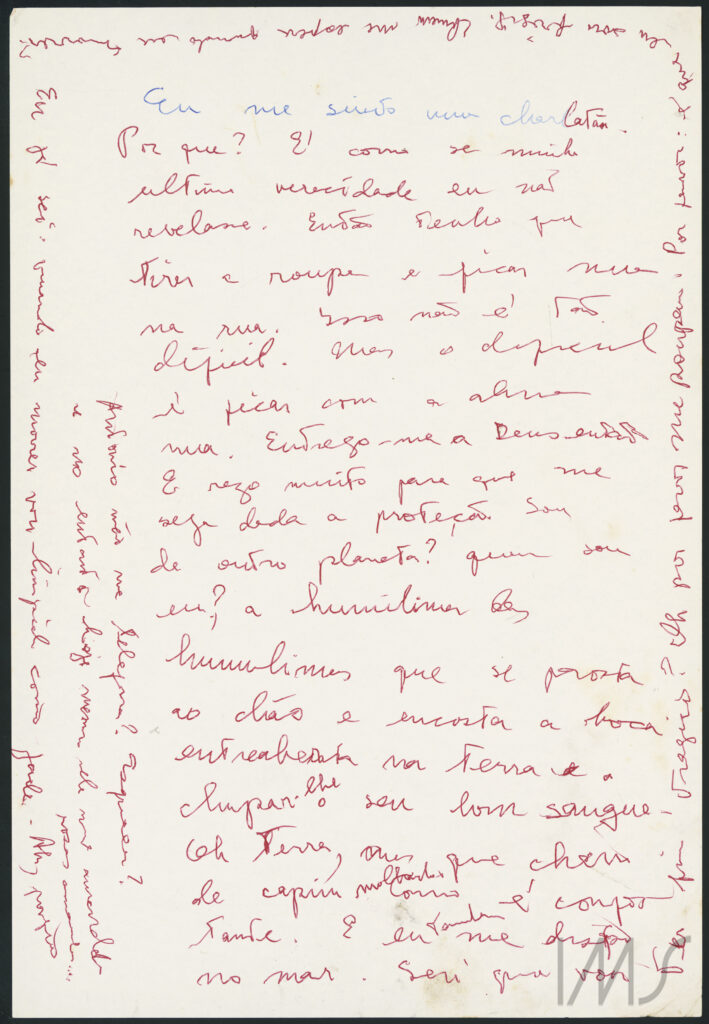
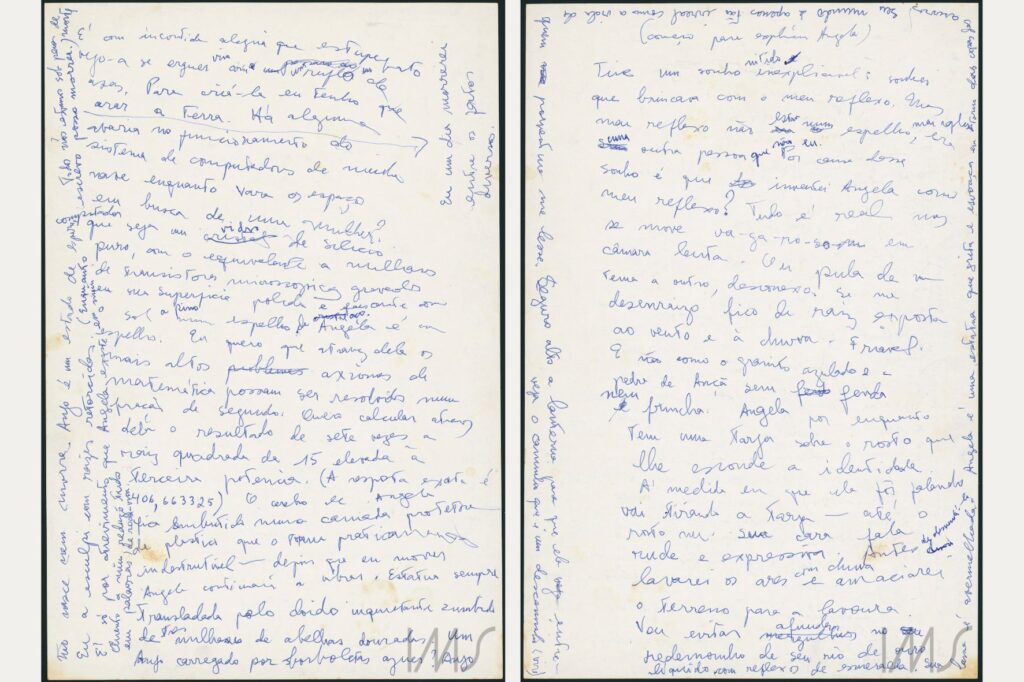
Something similar happens right in the middle of the syllable, but now it is the red ballpoint pen that completes the word where the blue one fails: “I feel like a charlatan.” But if the ink ends, the urge to write does not end, it does not cool, not even having to get up from the table to look for another pen, who knows ask someone to bring her a pen that works or stretch to reach a desk organizer on top of the table. On the contrary, the urge to write intensifies and not even the end of the page means the end of the thought. Insistent, the words invent other margins, climbing up the edges and taking advantage of the whole surface of the page.
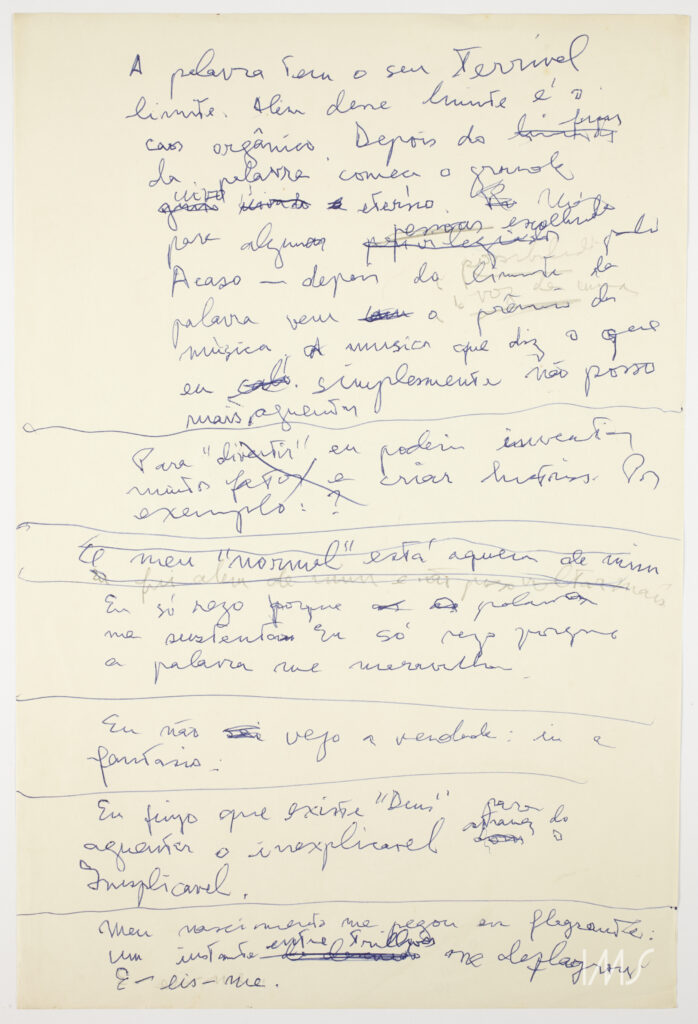
Of the more than 800 folios, there only 15 with pencil inscriptions, of which 5 occurrences contain passages that belong to A Breath of Life. In terms of duration, what is written in pencil conveys the idea of transience, and in terms of importance, an idea of secondariness, hence a certain notion that pages in pencil do not have the strength of a final word, a final version. If what is written matters, what is written in pen matters even more, as in folio 001501_0276, in which the blue felt-tip pen swallows the excerpt in pencil.
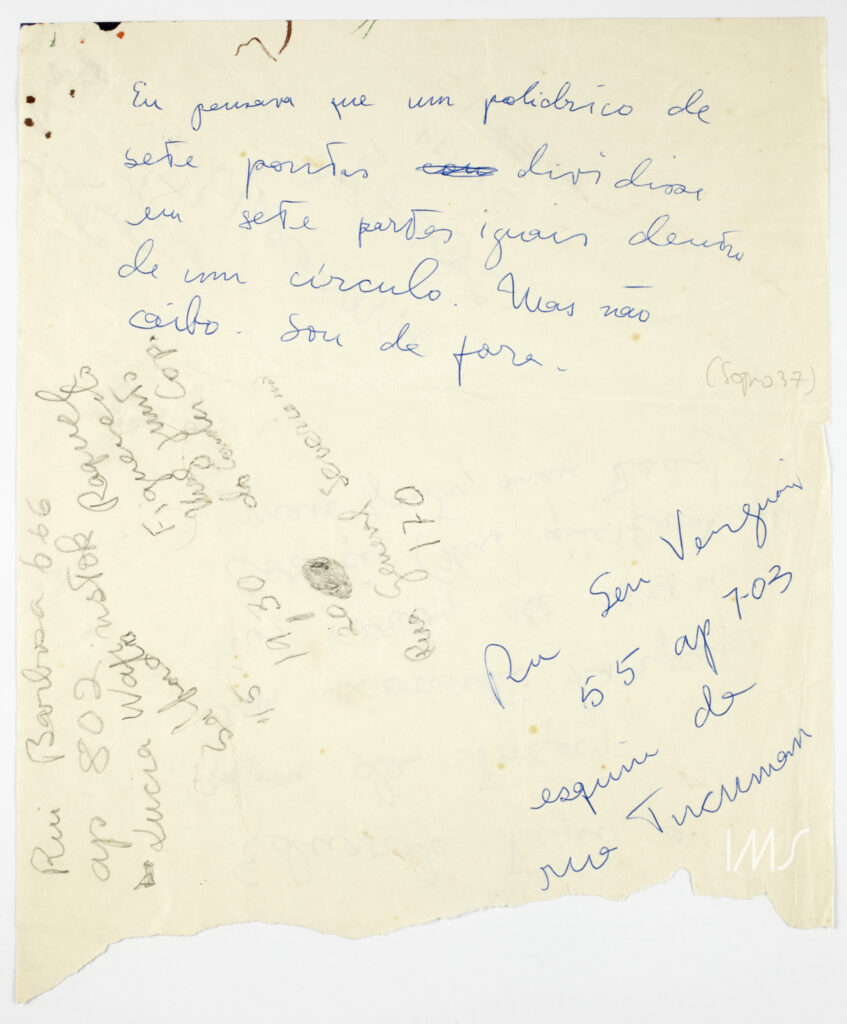
Generally, these instruments record everyday information, such as addresses and telephone numbers. While this data seems almost irrelevant from the perspective of constructing and analyzing a novel, it is within this “minor importance” that one can trace a network of sociability that happens at the same time that a novel is being written – in an eternal gerund.
It is precisely due to the reduced importance given to what is in pencil that, in the manuscripts, there is recurring information: it concerns a a code, generally at the edge of the page, that identifies whether a certain passage was published in A Breath of Life or in Esboço para um possível retrato [A Sketch for a Possible Portrait]. Without a doubt, the code was not written by Clarice Lispector and is from after 1978, but before the donation made to the Moreira Salles Institute in 2018. The pencil there is not merely a writing instrument, but a way of making the information almost transparent, invisible: this information does not wish to compete for space. The stage of the page is still guaranteed for Lispector’s text; it is to it that the eye should turn.
Folio 001501_0323 covers both the situation of recording the address and telephone number, in the area at the lower left, and that of the code, written in a lighter pencil stroke, around the middle of the page on the right.
There is a category that I call “emptiness;” it refers to that which, on the surface of the page, does not exist: it is the absence of inscription, regardless of the handwriting, the pen color, or the paper format.
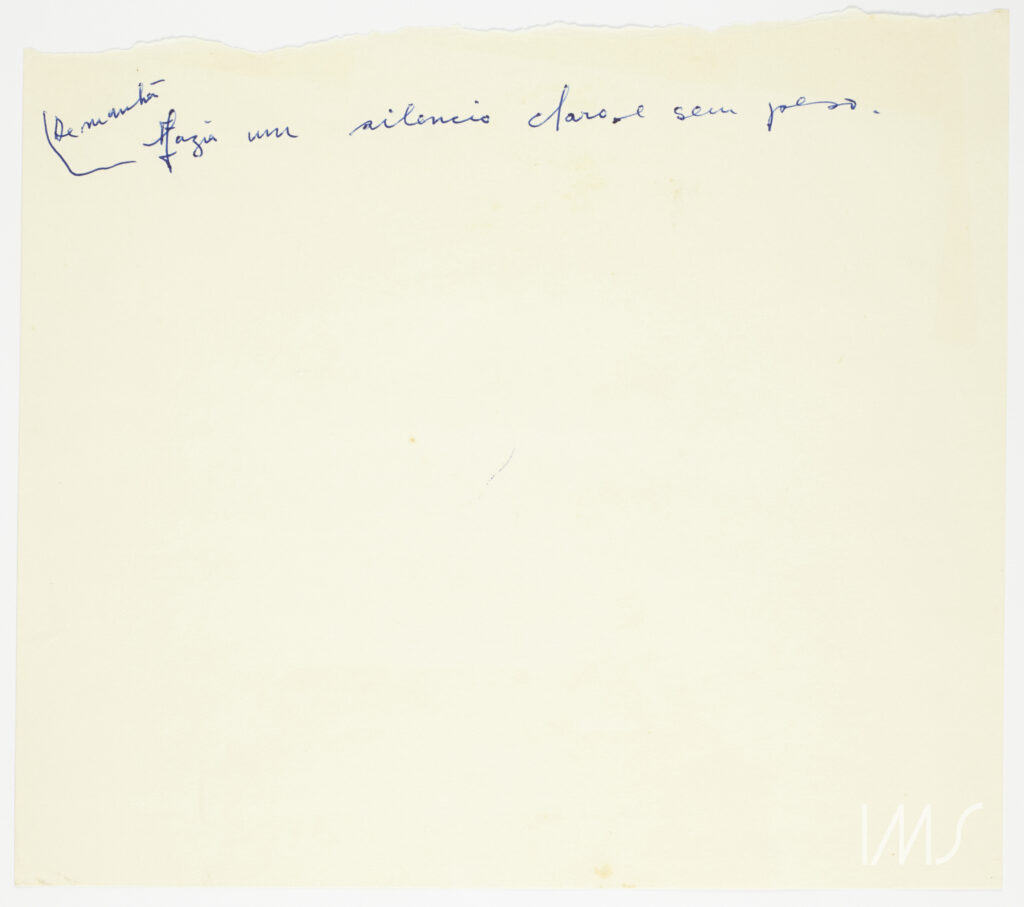
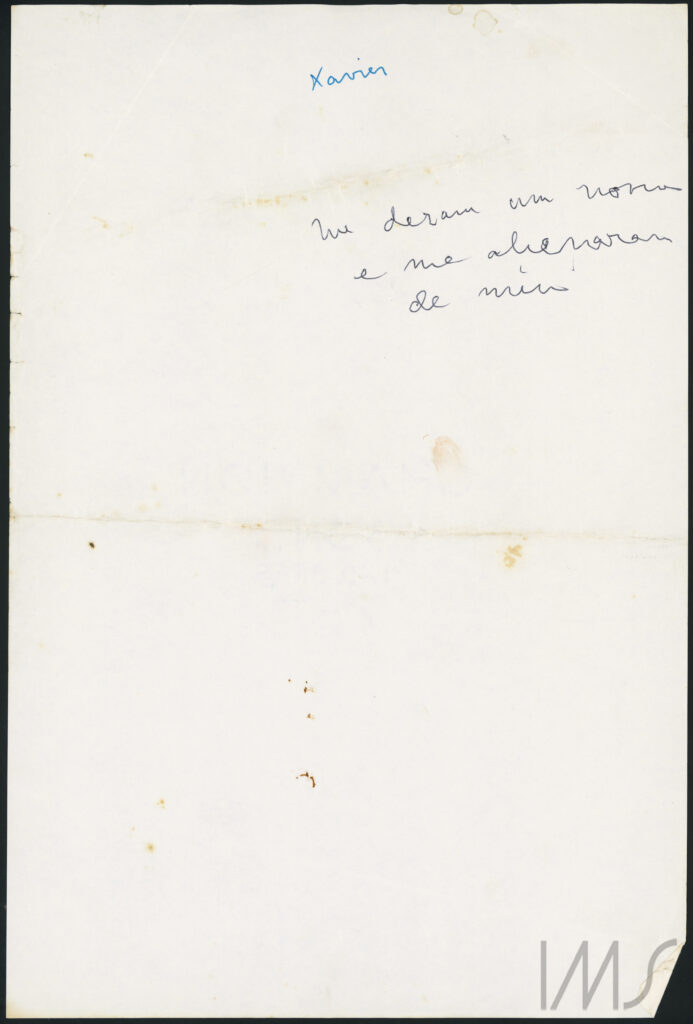
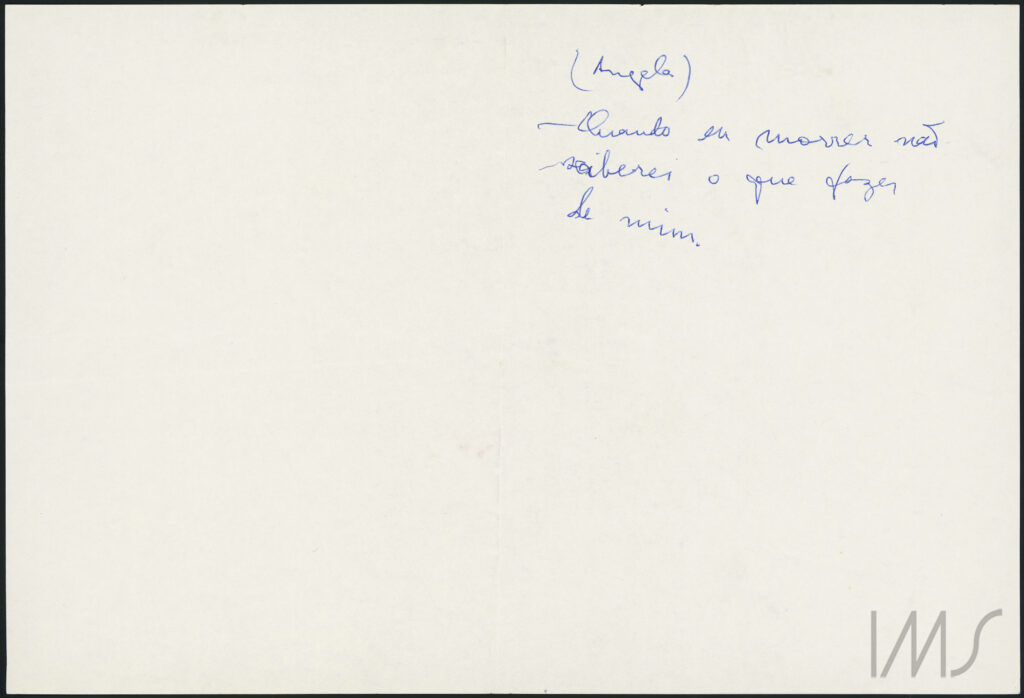
What draws attention is the scale of the writing – which creeps along the edges – in relation to the medium. The few words are located at the top or bottom of the pages, also occupying the middle timidly. As if it were a title or an idea, the text deposited there resembles an atom: it is the fundamental unit of fictional matter, the smallest thing of that which one day will be.
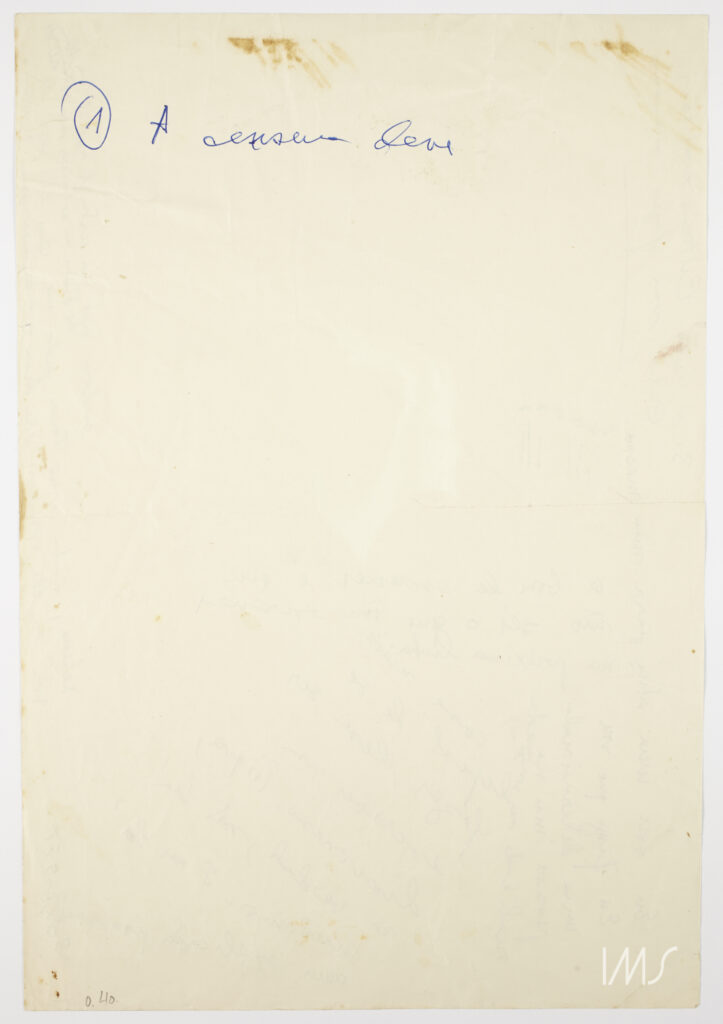
An example is folio 001501_0282-02, in which nothing else is written besides “1 Censorship must.” The number 1 starting the text indicates that the argumentative structure would be based on 1+N: that is, there would be at least two points or, at least, the idea to be developed had a cadence that would begin at 1: that which censorship must.
Brazil lived under a military dictatorship between 1964 and 1985, and it was probably in this context that Lispector wrote this folio. It is not difficult to guess why: in 1975, 82% of the books sent to the Division of Censorship of Public Entertainment were banned. In 1976 and 1977, the ban rate was 61% for both years. 2
Now, in a grammatical structure in which there is a definite article (The), a noun (censorship), and a verb (must), the direct object is missing: what censorship must do is what Lispector fails to write. The direct object is blank, just as the page is blank. The empty surface functions not only as a silence but as an ironic gesture: there are no words for that moment, and even if there were, no word would be sufficient to argue with a military regime that silenced – or rather, that left empty – so many families, activists, and artists.
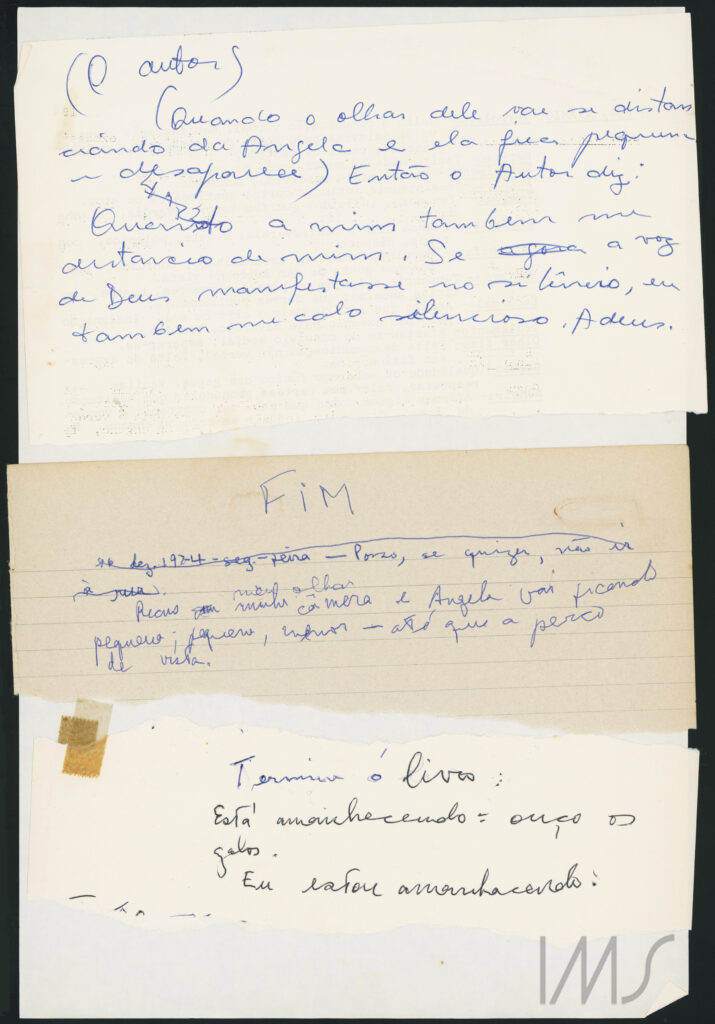
The next class seems to dialogue with the category of the torn, but it is a conversation that is both complementary and opposing. It concerns mends, and here the stitching between the pieces is visible: the fragments are affixed to an A4 sheet with adhesive tape whose glue has yellowed and lost its strength.
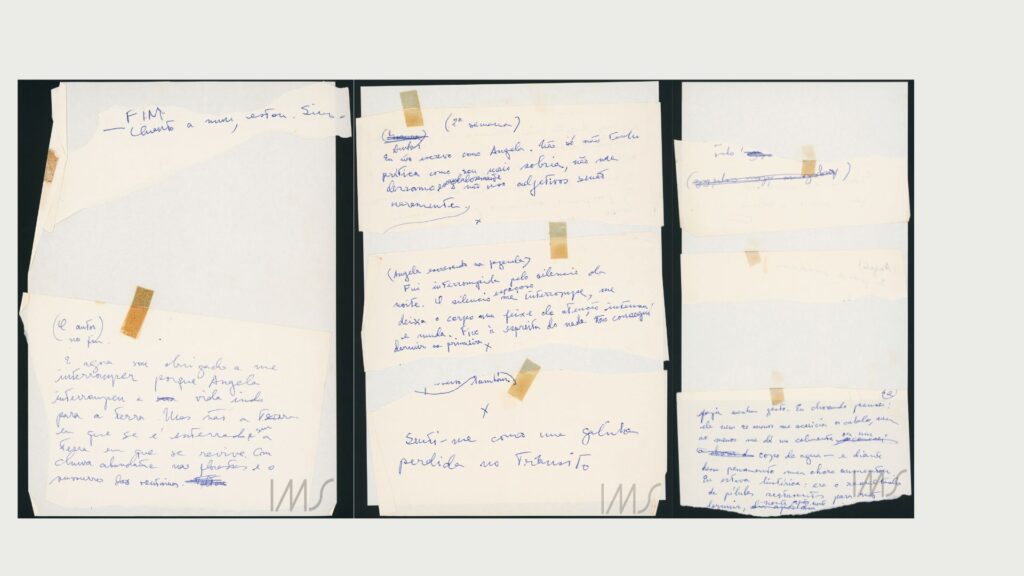
Perhaps the torn items would, little by little, make up larger blocks following these visible mending marks – a form of assembly, a desire for completeness. To gather what was similar: a process that is difficult to determine whether done by Lispector or by Borelli, but, notwithstanding their authorship, it is without a doubt the unquestionable testament to a physical presence. There was someone in front of a table, where, on one side, there was a stack of letter-sized paper that would be used as a base; on the other, a small holder with a serrated edge to easily cut the tape, so that the adhesive pieces would be more or less the same size. And on all sides of this table are the tiny fragments, of multiple orders, that run the risk of being blown away by the wind.
Unlike a typewriter, which presupposes a composition in straight lines, the quartet formed by creative act + hand + instrument + surface can yield something beyond the content itself. How does the dynamic that unites these four points unfold? How is the idea manifested visually on the page? How many margins fit into four margins? It is possible to look at the whole of A Breath of Life based on the analysis of writing motions, a motion that is itself fragmentary (for Portela and Gimenez, “fragmentary kinetics”).
Folio 001501_0296-02 presents four different sections on a page divided in half: on the left side, there is the pink section with the block of text titled “O grito vermelho” [The Red Cry], which according to the pencil inscription on the side – of unidentified authorship – would appear on page 114 of A Breath of Life; the right side contains the 3 remaining sections, which in terms of scale highlight the information in the green and purple blocks, respectively, “Cali” and “168 Bloco 2 cobertura 1” [168 Block 2 Penthouse 1].
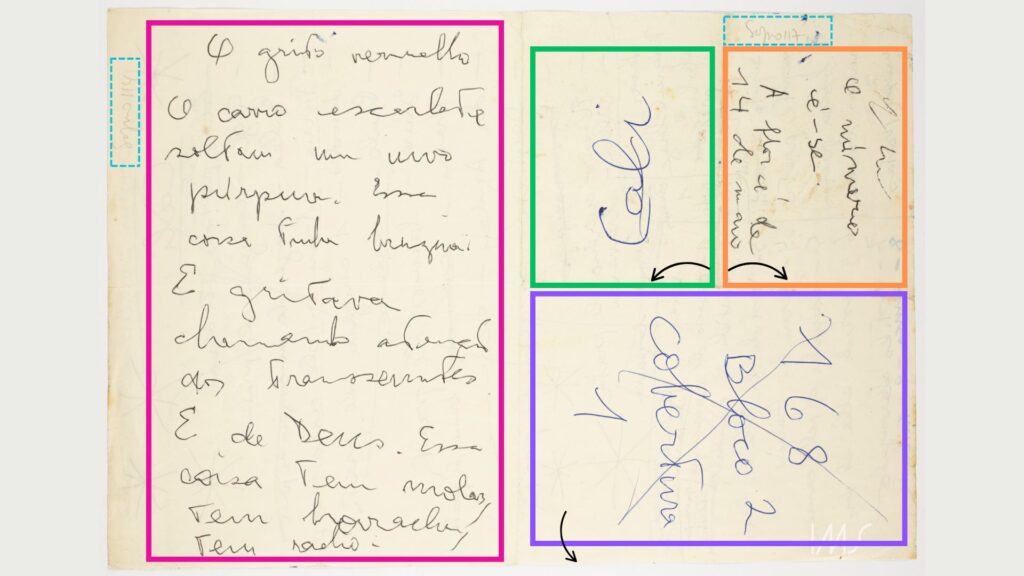
From this colorful panorama emerges a hypothesis: the blocks in purple and green were written first, and only later came the texts in the green and orange sections. The pen colors may lead to a similar conclusion, given that the text group written with a blue pen is of the order of everyday life – an address, a place – while the second group, written with a black pen, is of the order of literary creation. To avoid straining her neck to read all the parts, this writing method forces the researcher to copy the motion that the author once made to write all the parts. With both hands, it is necessary to reorient the sections: green, turn to the right; orange and purple, turn to the left.
These writing units generally correspond to units of time, as Portela and Gimenez showed in their analysis of the autographs of Book of Disquiet, that is, to face the fragment is to face time. And this fragmentary sectorization of the writing may well correspond to the flash of a loose idea in the space of the page. It is a textual hiccup: “alchemical egg,” “I see the thing in the thing,” “Transmutation.”
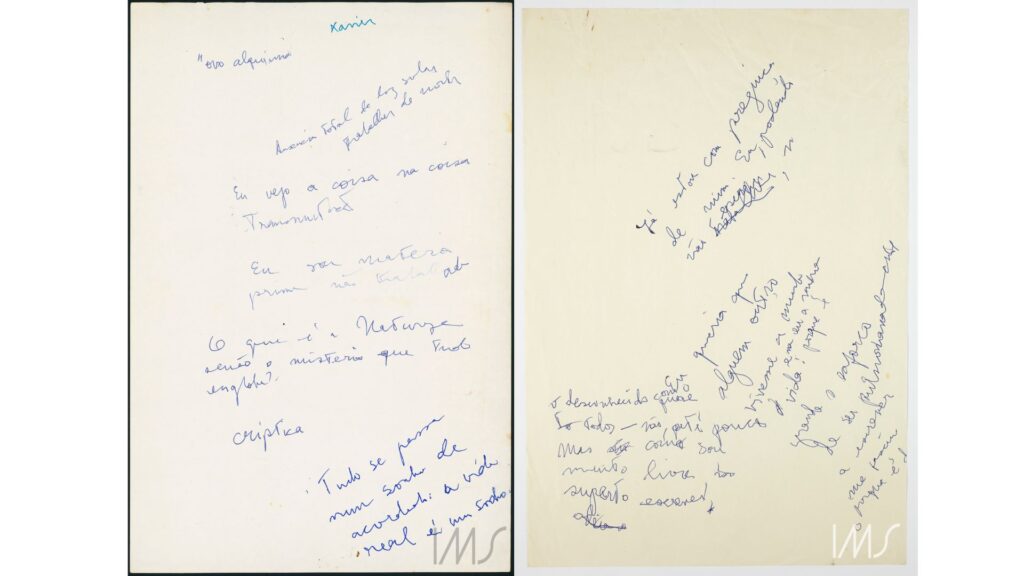
One last motion, based on the analysis of writing behavior, is the invention of a margin. The text is not considered finished when the page ends, but spreads along the sides, even when the other side of the leaf – entirely blank – is a silent invitation to continue writing. The verso is an option denied by the author so that the text can be seen entirely on a single face.
Elena Ferrante, in In the Margins (2021), comments on the stifling experience of learning how to write during her childhood, when, faced with a lined notebook, she felt threatened by the red line that limited how far the text could reach: “The writing was supposed to move between those lines, and those lines – of this I have a very clear memory – tormented me [….] I was punished so often that the sense of the boundary became part of me, and when I write by hand I feel the threat of the vertical red line even though I haven’t used paper like that for years.” (p. 20).
This threat does not seem to be part of Lispector’s repertoire: she is not frightened by the end of space, but invents others, whether by going up, going down, or flanking the base text. If the margins exist as a physical limitation, her text – without any limitation whatsoever – revolves around itself, whose end only finishes with the end of the idea.
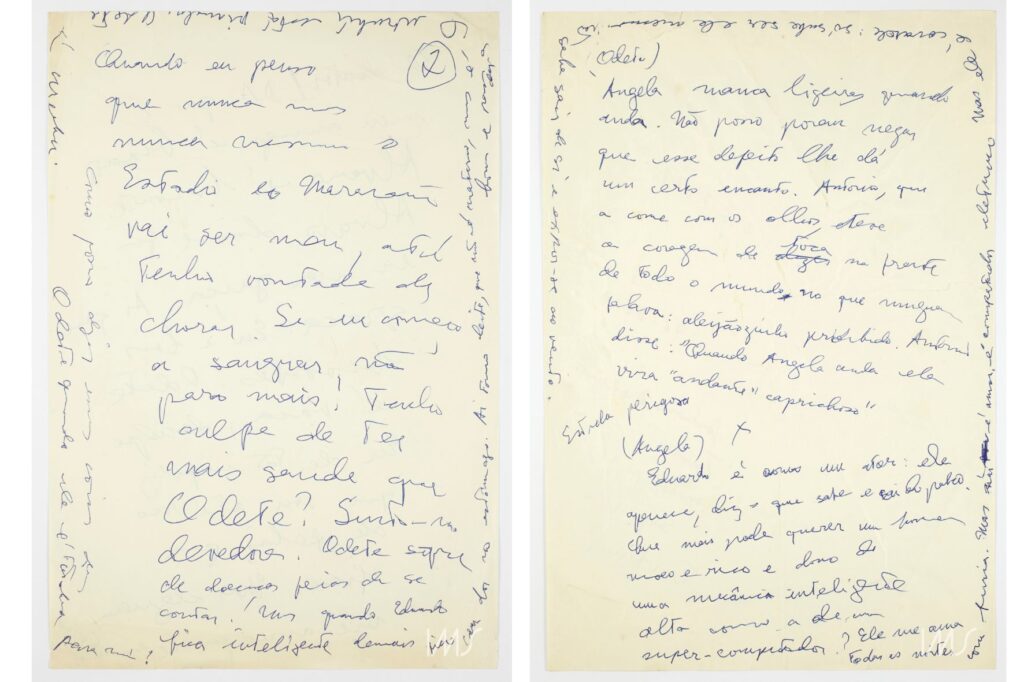
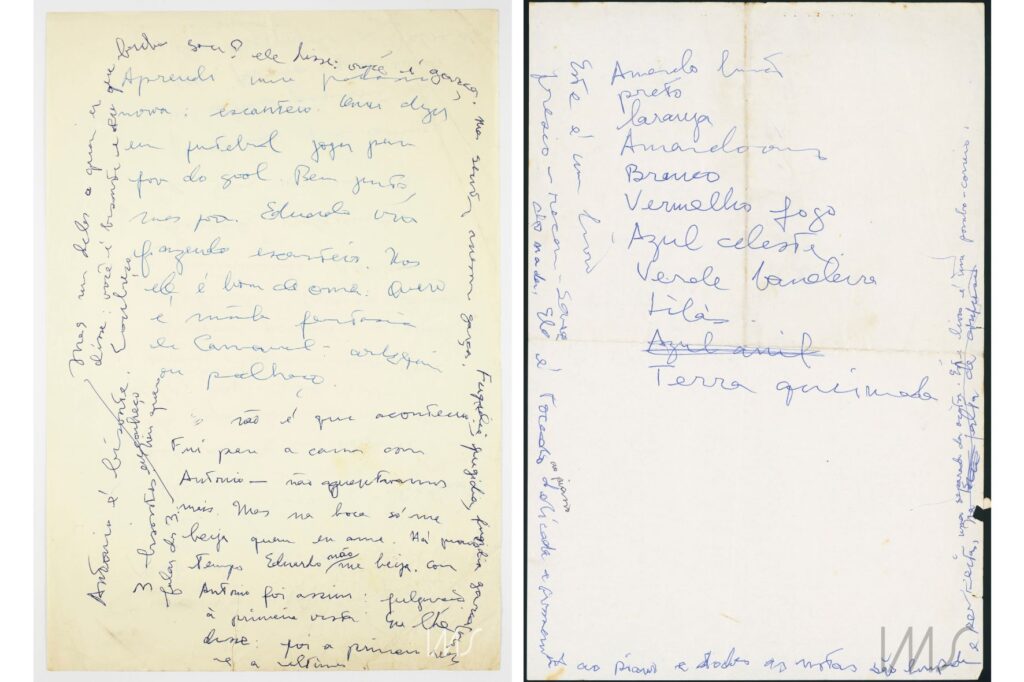
Reading these manuscripts in motion is, in a sense, allowing oneself to be guided by the author’s compass. If she rotates the page once, twice, three times to complete her composition, the reader must repeat the same gesture decades later: clues left along the way that, seen together, convey a radical idea of speed.
While the manuscripts do not allow one to fix a narrative procedural memory of A Breath of Life, they do preserve a procedural memory of life itself. The types of records multiply in the space of the page, which sometimes serves as a diary, sometimes contains arrangements for a particular trip, besides documenting recipes, prayers, songs, as well as sheltering characters in a book that is in a phase of growth and concatenation.
Folio 001501_121_verso allows one to accompany the activities scheduled between May 12 and June 11, 1975. 3 But instead of starting with tasks, the first quarter of the page is a request to Saint Anthony, for him to “find P.M.C.” – an acronym that probably refers to Paulo Mendes Campos, a writer from Minas Gerais with whom Clarice had a brief romantic relationship.
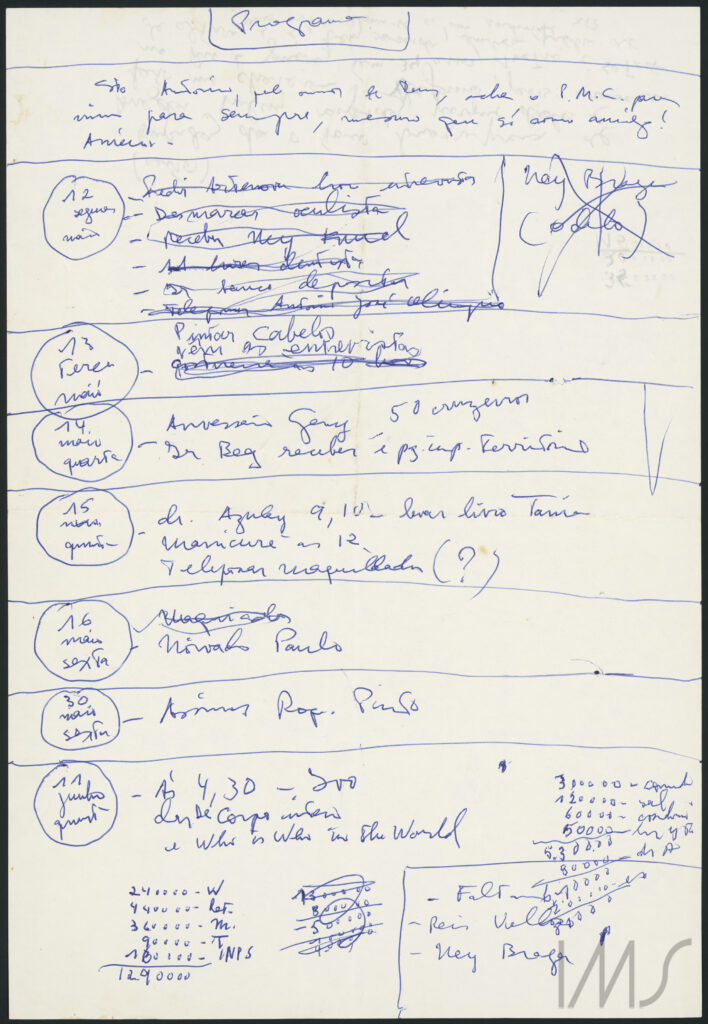
The activities listed there can be organized into three main groups:
a) personal: going to the eye doctor, dentist, dyeing hair, makeup artist, seamstress – probably a crescendo of actions with a view to the social event “Paulo’s engagement” that will take place on Friday, May 16th;
b) social: visiting or calling Geny, Dr. Azulay, Ivo [Pitanguy]; and
c) professional-literary: “asking Artenova to read interviews;” “calling Antônio José Olympio;” “giving De corpo inteiro [With the Whole Body] and Who is Who in the World;” “missing Ney Braga, Reis Velloso;” “subscribing to Roquete Pinto;” “the interviews are coming.”
Upon turning the folio over, rotating it, and analyzing the other side, there is a passage from A Breath of Life that begins with a line from Angela: “No one rests in the dentist’s chair.” Somehow, this character – dentist – will appear not only as an appointment on May 12th, but will be repeated in folios of a similar nature. Would the phrase have arisen on one of these occasions?
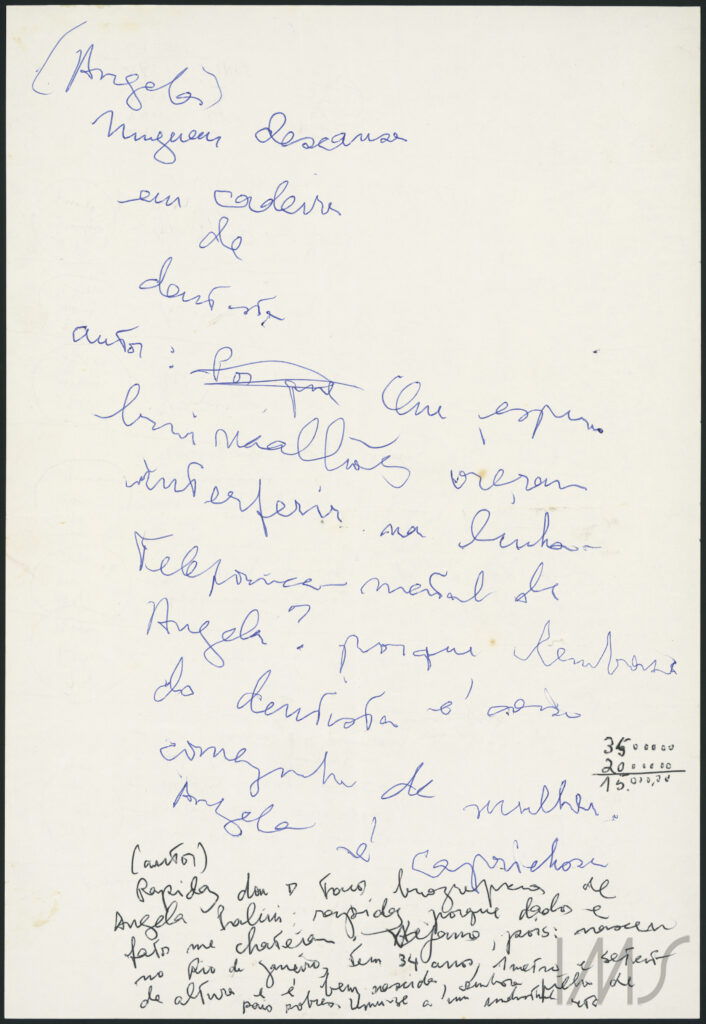
The pen colors – blue and black – also compute at least two periods. In black, by this point, Angela Pralini acquires her first biographical features: “quickly because data and facts bore me. Let us see, then: she was born in Rio de Janeiro, is 34 years old, 1.70 meters tall, and is well-born, although the daughter of poor parents. She married a student, etc.”
The calculation in the margin, incidentally, is a visual structure that will be repeated both on the other side of this folio and in several other documents; always there, at the edge, in smaller handwriting. Most of the time, the addition and subtraction notations do not have a description of the cost or payment to which they refer – and that is not necessary. It is only necessary to be aware that the genre of “calculations” permeates Lispector’s thought in an insistent and unsettling way, as will be seen in folio 001501_0169 as follows.
There, instead of numbers, the theme comes in the form of a comment: “Don’t think so much about money.” However, the note that follows almost annuls the previous one because, although she does not want to think so much about money, it is necessary to “Exchange dollars.” Placed side by side, the contradiction has almost a humorous tone, and whoever read it years later did not know what to make of this apparently confusing list of “Perspectives,” arranged on a torn piece of paper. This reader’s doubt, which came after Lispector and before this research, is materialized in the lower left corner with an almost imperceptible question mark in pencil.
Briefly presented here, these manuscripts open up the possibility of articulating the items with other units of the collection, being, at the same time, everything that there is on A Breath of Life and the parts that participate in this whole. In a way, what instigates me is being able to trace lines of analysis that aid in reading beyond narrative stabilization, understanding that unediting is only one among many possible interpretive agendas, but one that seeks to stir the gentle tedium of order, both in the institutionalized archive and in the published book version, by placing the texts in relation, whether of conflict or agreement.
- Olga Borelli, for her part, assumed not only the composition but also the continuity of the other stages, even though she herself restricts her role to the ordering of the manuscripts according to a duty assigned by Clarice and Paulo Gurgel Valente. The material evidence shows Borelli present in the composition, pre-publication, publication, and post-publication, including in the theatrical adaptation of the novel and in the preparation of a biography that, over decades, has become a fundamental reference for subsequent research. [Translator’s note: the original text in Portuguese reads “inspiração” and “concatenação.”][↩]
- Reimão, Sandra. “Proíbo a publicação e circulação…– censura a livros na ditadura militar”. Estud. av., São Paulo , vol. 28, no. 80, pp. 75-90, Apr. 2014. Accessed Feb. 26, 2024. Available at: https://bit.ly/3wqpgnu.[↩]
- Although the year is not explicit on any of the A4-sized folios that the author will use to record her appointments, it is possible to affirm the year accurately by cross-referencing the day of the month and the day of the week: considering the 1970s, the only year in which May 12th – the first date on this folio – fell on a Monday was 1975.[↩]