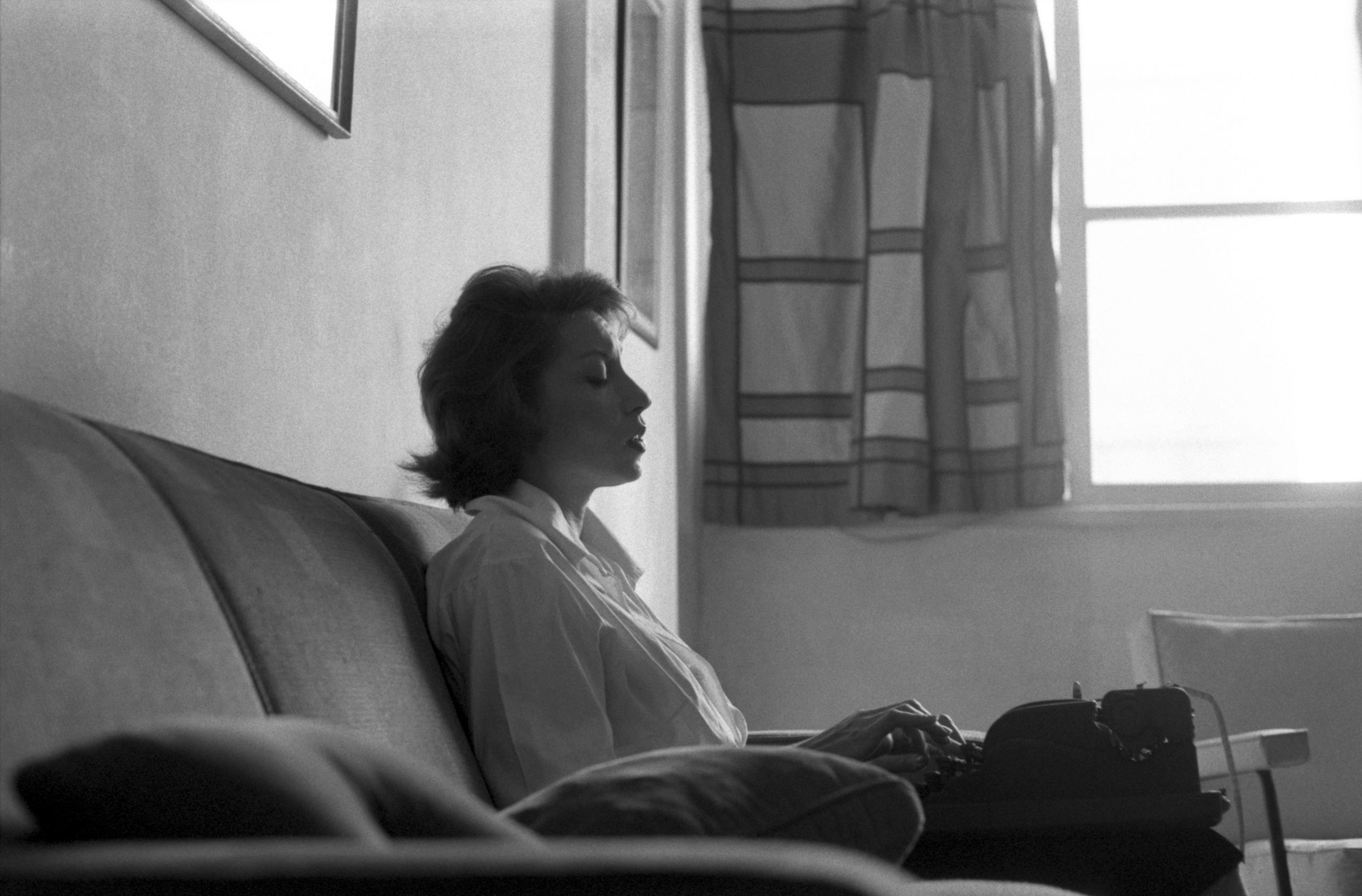
, Thanks,Typewriter. IMS Clarice Lispector, 2017. Disponível em: https://site.claricelispector.ims.com.br/en/2017/10/09/gratidao-a-maquina/. Acesso em: 05 December 2025.
When we had no way of knowing that the hashtag gratitude would be one of the terms referring to two strong traits of the future (social media sharing and the new hippie wave of pure gratitude), Clarice, prophetic, published in 1968 the short text “Gratidão à máquina” (“Thanks, Typewriter”), in the Jornal do Brasil newspaper.
Between demonizing the technology available at that time (“I don’t feel mechanized for using a typewriter”) and joining the tendency, Clarice, with appreciation, chooses the second.The author, who even wrote “some eight copies” of The Apple in the Dark, a novel that would be published in 1961, alternated between the Underwood and Olympia models. The habit of typing was adopted above all during the period when she lived with two small children in the United States. For those who love the fetish, there will be a third machine, an Olivetti, which can be seen today in the collection of the Fundação Casa de Rui Barbosa.
I use an Olympia portable typewriter that is light enough for my strange habit: that of writing with the machine on my lap.
It runs well, runs smoothly. It transmits me, without my having to get caught up in the tangle of my letters. It provokes my feelings and thoughts, so to speak. And it helps me as a person. And I don’t feel mechanized for using a typewriter. It even seems to capture subtleties. Besides, through it, what I write is printed immediately, which makes me more objective. The low noise of its keyboard discreetly accompanies the loneliness of the writer.
I would like to give my typewriter a gift, but what can you give to something that modestly remains a thing, without any pretension of becoming human? This current trend of praising people by saying they are ‘very human’ is tiring me. In general this ‘human’ means ‘nice,’ ‘affable’, if not ‘honeyed.’ And that is all that the typewriter does not have. I don’t even feel that it wants to become a robot. It is satisfied just to keep its role.
See also
by Bruno Cosentino
The second part of the original manuscripts of Um sopro de vida (A Breath of Life) was delivered by the writer's son, Paulo Gurgel Valente, to be incorporated into the Clarice Lispector Collection
by Equipe IMS
On December 10th, IMS Rio celebrates Clarice Lispector’s birthday. This year, we will present, in a single screening, the short film Perto de Clarice (Close to Clarice), by João Carlos Horta, from 1982, in a new digital version based on the 35mm original preserved by the Audiovisual Technical Center (CTAv). After the film screening, there will be a conversation between the writer Heloisa Buarque de Holanda, who was involved in the making of the film and is the director's widow, and Teresa Montero, author of the most recent biography of the writer, À procura da própria coisa (In Search of the Thing Itself – Rocco, 2021), mediated by the IMS literature consultant, the poet Eucanaã Ferraz.
by Matildes Demetrio dos Santos
In addition to confirming the value of the biographical genre as a privileged means to meet the demands of a curious public about the past of famous personalities, Teresa Montero challenges the genre’s conventions by reconstructing the family life, personal experiences, friendships, and creative process of Clarice Lispector, an author who, with all her strengths, gave life to her vocation for literature as a fatality and a salvation.
by Eucanaã Ferraz
The chronicles of Clarice Lispector were collected in a book for the first time in 1984, in The Discovery of the World, a volume edited by Paulo Gurgel Valente, the author’s son, who arranged in chronological order 468 texts published in the Jornal do Brasil between 1967 and 1973.
by Mell Brites
More or less fantastic in their plots, these children’s stories reveal narrators who, stripped almost completely of their fictional character, are very similar to the author: they are mothers, writers, they go by the initials “C.L.,” or even say their name is Clarice. Thus, if there is a horizontal posture in these narrators in which respect for the particularities of childhood is presupposed, this same movement also shows the desire to become a little more like a child.
by Victor Heringer
Organized by Professor Claire Williams, the conference After Clarice: Lispector’s Legacy will gather the greatest experts of Clarice's work.