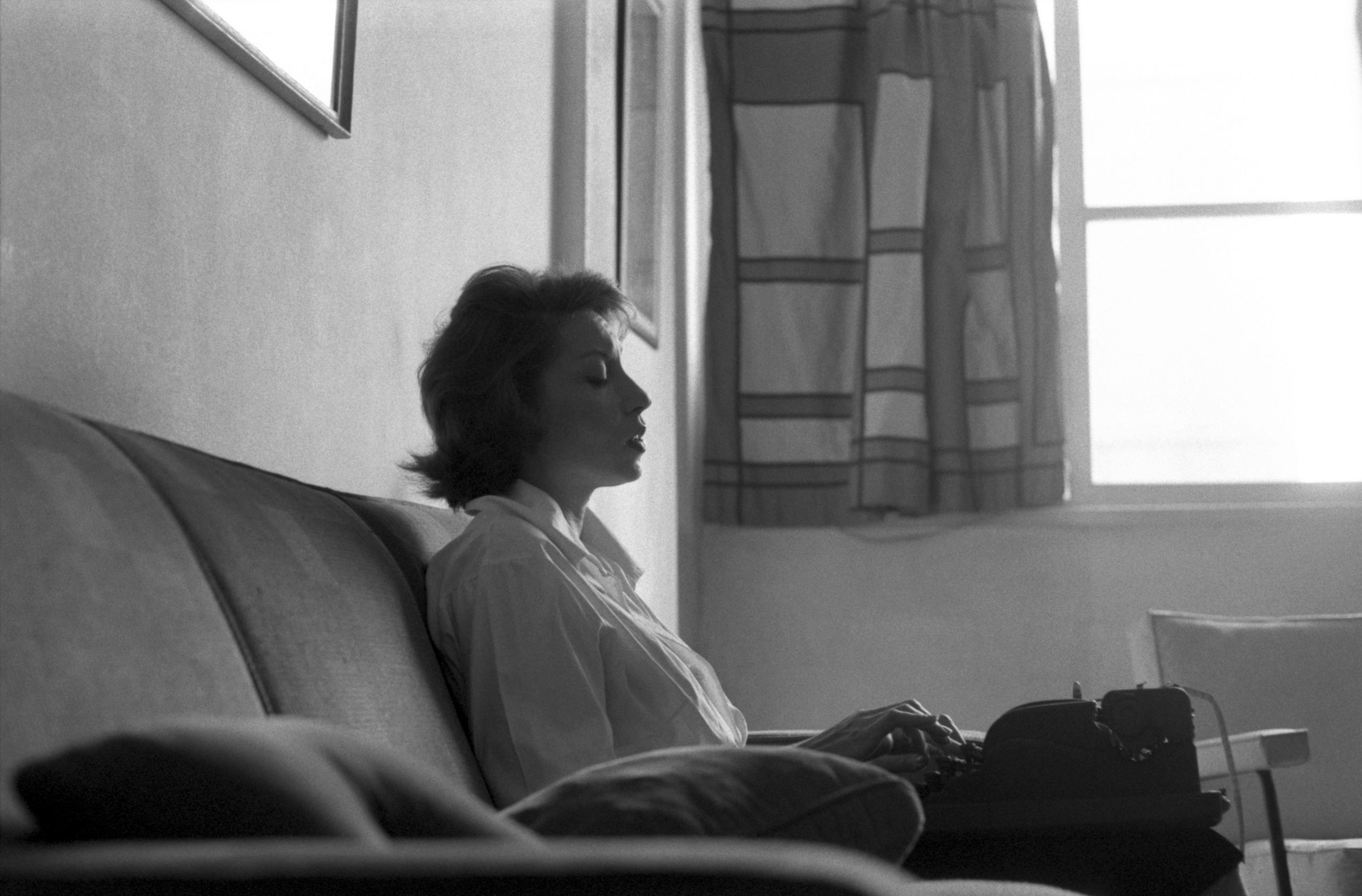
When we had no way of knowing that the hashtag gratitude would be one of the terms referring to two strong traits of the future (social media sharing and the new hippie wave of pure gratitude), Clarice, prophetic, published in 1968 the short text “Gratidão à máquina” (“Thanks, Typewriter”), in the Jornal do Brasil newspaper.
Between demonizing the technology available at that time (“I don’t feel mechanized for using a typewriter”) and joining the tendency, Clarice, with appreciation, chooses the second.The author, who even wrote “some eight copies” of The Apple in the Dark, a novel that would be published in 1961, alternated between the Underwood and Olympia models. The habit of typing was adopted above all during the period when she lived with two small children in the United States. For those who love the fetish, there will be a third machine, an Olivetti, which can be seen today in the collection of the Fundação Casa de Rui Barbosa.
I use an Olympia portable typewriter that is light enough for my strange habit: that of writing with the machine on my lap.
It runs well, runs smoothly. It transmits me, without my having to get caught up in the tangle of my letters. It provokes my feelings and thoughts, so to speak. And it helps me as a person. And I don’t feel mechanized for using a typewriter. It even seems to capture subtleties. Besides, through it, what I write is printed immediately, which makes me more objective. The low noise of its keyboard discreetly accompanies the loneliness of the writer.
I would like to give my typewriter a gift, but what can you give to something that modestly remains a thing, without any pretension of becoming human? This current trend of praising people by saying they are ‘very human’ is tiring me. In general this ‘human’ means ‘nice,’ ‘affable’, if not ‘honeyed.’ And that is all that the typewriter does not have. I don’t even feel that it wants to become a robot. It is satisfied just to keep its role.
See also
by Elizama Almeida
Among the items that make up the Clarice Lispector Collection, which has been at the IMS since 2004, are two paintings by the author.
by Equipe IMS
On December 10th, IMS Rio celebrates Clarice Lispector’s birthday. This year, we will present, in a single screening, the short film Perto de Clarice (Close to Clarice), by João Carlos Horta, from 1982, in a new digital version based on the 35mm original preserved by the Audiovisual Technical Center (CTAv). After the film screening, there will be a conversation between the writer Heloisa Buarque de Holanda, who was involved in the making of the film and is the director's widow, and Teresa Montero, author of the most recent biography of the writer, À procura da própria coisa (In Search of the Thing Itself – Rocco, 2021), mediated by the IMS literature consultant, the poet Eucanaã Ferraz.
by Bruno Cosentino
The second part of the original manuscripts of Um sopro de vida (A Breath of Life) was delivered by the writer's son, Paulo Gurgel Valente, to be incorporated into the Clarice Lispector Collection
by Bruno Cosentino
This August, Todas as crônicas will be released, a volume that brings together for the first time all the chronicles written by Clarice Lispector for newspapers and magazines.
by Augusto Ferraz
I died. I found out when, one day, on the sidewalk of Praça Maciel Pinheiro, I lifted my head, opened my eyes, and saw myself dead, there on the plaza’s sidewalk, the two-story house on the other side of the street. My broken heart inside my chest, the two-story house on Rua do Aragão, 387, where, on the second floor, Clarice Lispector lived a happy childhood here in Recife, despite the pains of the world and experiencing and feeling, mainly, the pains of an implacable disease that would one day take Mania, her mother, away from her. I found out when, laid out on the sidewalk there under the scorching Sunday sun, I turned my head to the right and saw a man beside me, who was also looking at the house.
by Lilian Hack
That was the first sensation which I had when I saw Clarice’s paintings: my whole body shivered in a flush that was shared with these two women who worked every day at the archive. A kind of slip, a discomposure, a “human dismantling.” As Clarice wrote, “She needs to move her whole boneless head to look at an object.”