, 50 years of The Mystery of the Thinking Rabbit. IMS Clarice Lispector, 2017. Disponível em: https://site.claricelispector.ims.com.br/en/2017/06/26/50-anos-de-o-misterio-do-coelho-pensante/. Acesso em: 06 December 2025.
Written in the 1950s, during the period in which she lived in Washington, The Mystery of the Thinking Rabbit was the first children’s book written by Clarice Lispector. After a question by her son Paulo– “Why do you only write books for adults? Not for children?” – the text, initially not intended for release, was written in English and shelved until 1967, when it was published by José Álvaro.
The narrator in The Mystery of the Thinking Rabbit is named Paulo, which evokes the name of Clarice’s son and will strengthen the close ties with the reader, since the narrative is constructed like an intimate conversation, where the one who listens/reads is constantly engaged.
The plot focuses on Joãozinho the rabbit, who smelled of ideas, and invents a way to leave his cage when there is no food. The humans notice and do not forget to feed him. Nonetheless, the rabbit wants much more than what the humans offer him, and his life comes to be “eat well and escape, and always with a beating heart.” More than for the adventure, the rabbit had acquired a taste for freedom, and it is outside the cage that he really manages to be a thinking rabbit.
According to Rosa Gens, “Lispector’s poetics is evident in the fluid plot, in the doubts and inquiries, in the presence of a narrator who is always together with the reader and does not know all the answers, allowing the doubt to be prolonged. Mystery narratives commonly lead the reader to investigate clues, elaborate solutions, solve enigmas. In Clarice Lispector’s writing, the mystery is different. It does not concern an enigma related to facts, only the possibility of pretending to be a rabbit, of climbing into someone else’s skin, of thinking from different angles. In the text, which emphasizes fantasy and imagination, playing and thinking provide the tone, and the contamination between rabbit and human, emphasized at the end of the narrative, makes way for the marvelous.”
A book only for those who like rabbits, according to Clarice Lispector, who moreover asks adults for a little patience and understanding for the many questions that cannot be answered in rabbit terms.
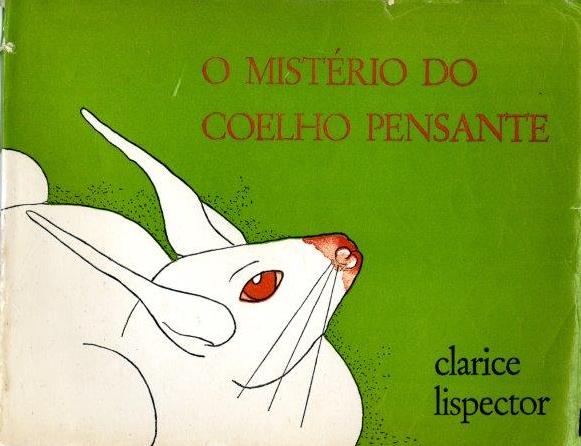
Original cover for The Mystery of the Thinking Rabbit, 1st edition
Ulysses was Clarice Lispector’s last dog, a mongrel who stole cigarette butts and queued for Coca-Cola and whiskey for visitors. He was so eccentric that he earned a robust note in the infamous periodical O Pasquim.
Benjamin Moser, one of the most significant biographers of Clarice Lispector, said in an interview that one of his goals in writing Why This World, published in the United States and translated into Portuguese as Clarice, uma biografia, was to make space for a theme rarely explored by literary critics, commentators, and biographers: the writer’s “Judeity.” Most tend to limit themselves to reflecting on her “Brazilianness,” “as if one had to choose between being Jewish and being Brazilian.”
I died. I found out when, one day, on the sidewalk of Praça Maciel Pinheiro, I lifted my head, opened my eyes, and saw myself dead, there on the plaza’s sidewalk, the two-story house on the other side of the street. My broken heart inside my chest, the two-story house on Rua do Aragão, 387, where, on the second floor, Clarice Lispector lived a happy childhood here in Recife, despite the pains of the world and experiencing and feeling, mainly, the pains of an implacable disease that would one day take Mania, her mother, away from her. I found out when, laid out on the sidewalk there under the scorching Sunday sun, I turned my head to the right and saw a man beside me, who was also looking at the house.
Acclaimed by critics and a popular phenomenon on the internet, Clarice Lispector is considered, internationally, one of the great names in 20th century literature. Mysterious, obscure, revealing, experimental, strangely mystical, or philosophical – how to define the writing of the author of The Hour of the Star? This podcast, conceived and presented by Bruno Cosentino and Eucanaã Ferraz, covers Clarice’s life and work in five episodes, in which they talk to great specialists, professors, and researchers.
The day I met Clarice was not the same day she met me. I was all adoration, observing her. She had no reason to even lay eyes on me. Leaving the Jornal do Brasil newsroom together, the journalist Yllen Kerr, a great friend of mine, said he was going to visit Clarice and asked if I wanted to go. Did I ever!