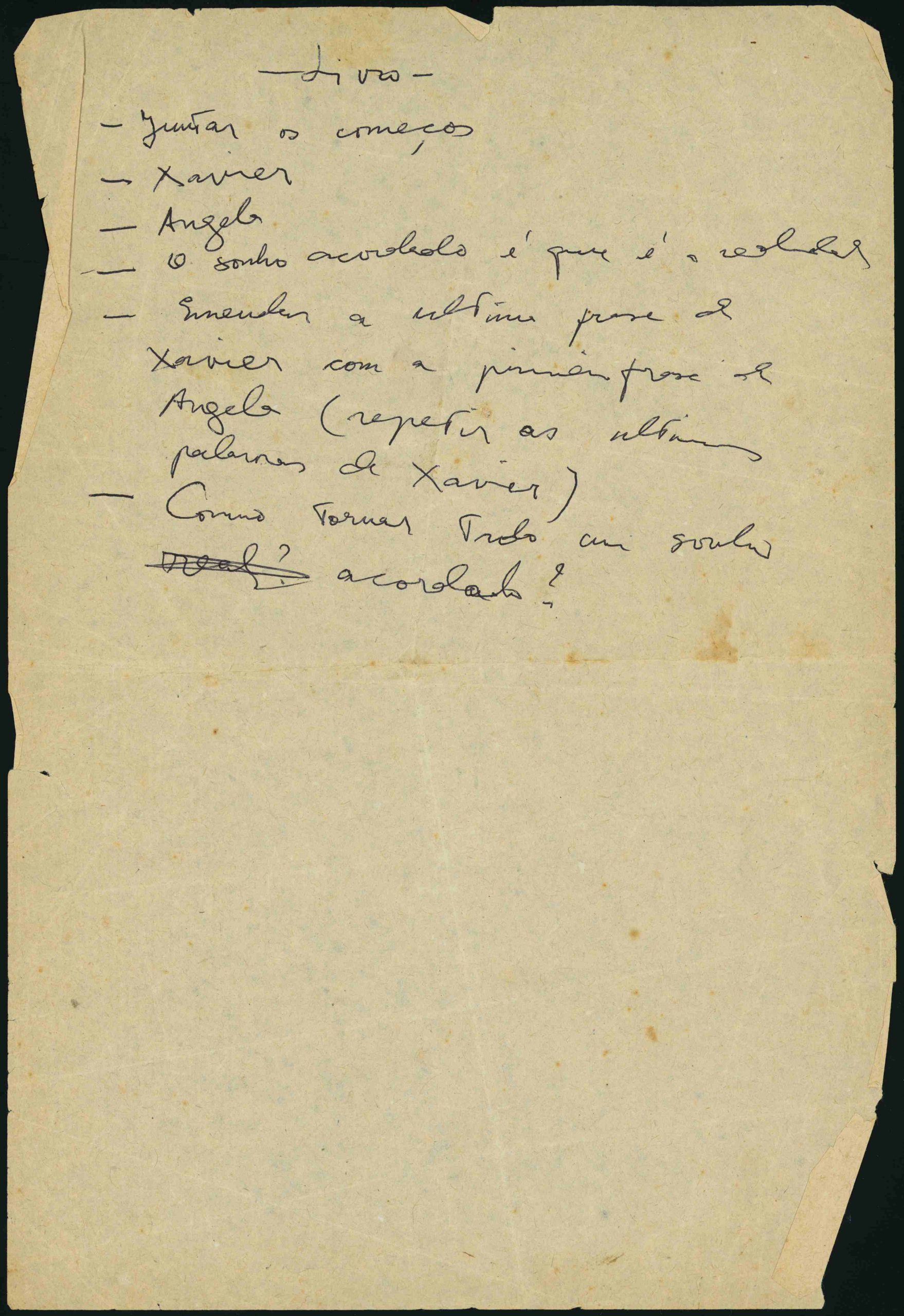
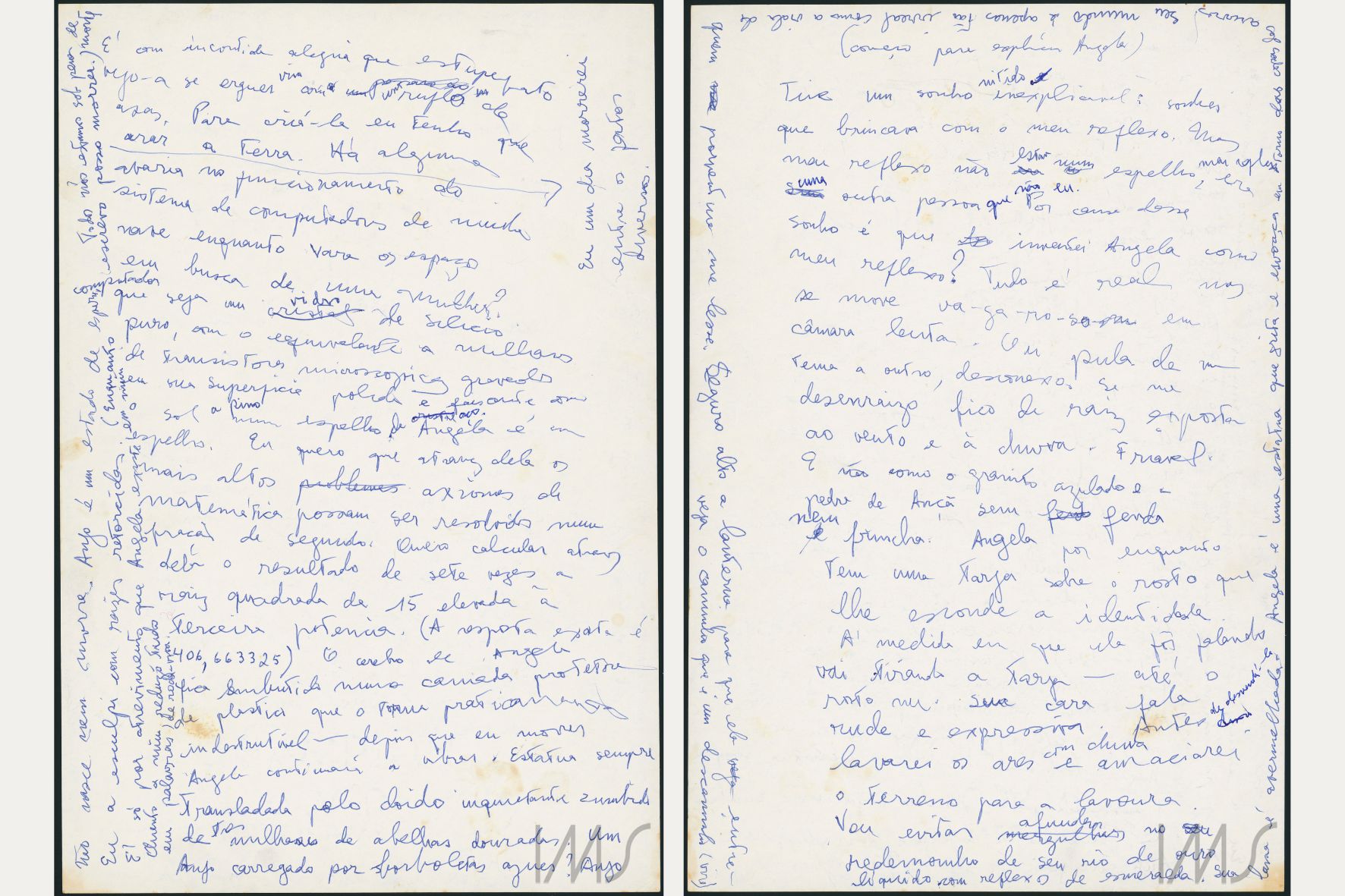
, Manuscripts of A Breath of Life. IMS Clarice Lispector, 2018. Disponível em: https://site.claricelispector.ims.com.br/en/2018/05/15/manuscritos-de-um-sopro-de-vida/. Acesso em: 27 April 2026.
In February of this year, the second part of the original manuscripts of A Breath of Life was delivered by the writer’s son, Paulo Gurgel Valente, to be incorporated into the Clarice Lispector Collection, which, under the care of the IMS, has contained the first part of the novel since 2004, when it arrived here alongside other documents.
This is a complex book to edit. In 1977, the year of the author’s death, the writings, at that time sparse and on separate sheets, had not yet been organized by Clarice. The posthumous publication was the responsibility of Olga Borelli, according to her opening note to the first edition, in 1978:
For eight years I lived with Clarice Lispector, participating in her creative process. I wrote down her thoughts, typed her manuscripts and most of all shared in her moments of inspiration. As a result, she and her son Paulo entrusted me with the organization of the pages of A Breath of Life.
This explanatory note, however, disappeared from the most recent editions, leaving new readers with the impression that Clarice had conceived the book as published. Invited by the Moreira Salles Institute, Portuguese professor and critic Carlos Mendes de Souza – a specialist of Lispector’s work and author of Clarice Lispector: figuras de escrita (Clarice Lispector: Figures of Writing) – came to Rio with the task of examining the manuscripts and comparing them with the book. The scholar noted that some observations can already be made:
Most of these fragments show an indication of belonging to the lines of Angela and the author, but we also come across some fragments that refer to names and speeches of characters not included by Olga Borelli in the book. It was probably an aborted project on Clarice’s part, since in the work A Breath of Life, as we know it, we only find indications of Angela and the author. On the other hand, there are still some manuscripts with an explicit reference to these characters that were not included by Olga Borelli in A Breath of Life, but were in the book Clarice Lispector: Esboço para um possível retrato (Clarice Lispector: A Sketch for a Possible Portrait).
The study of the originals of A Breath of Life, which go back to the same writing period as The Hour of the Star (1974 to 1977), also under the care of the IMS, will continue next year, in Portugal, where Mendes de Souza is a professor at the University of Minho.
See also
by Matildes Demetrio dos Santos
In addition to confirming the value of the biographical genre as a privileged means to meet the demands of a curious public about the past of famous personalities, Teresa Montero challenges the genre’s conventions by reconstructing the family life, personal experiences, friendships, and creative process of Clarice Lispector, an author who, with all her strengths, gave life to her vocation for literature as a fatality and a salvation.
by Betty Bernardo Fuks
Benjamin Moser, one of the most significant biographers of Clarice Lispector, said in an interview that one of his goals in writing Why This World, published in the United States and translated into Portuguese as Clarice, uma biografia, was to make space for a theme rarely explored by literary critics, commentators, and biographers: the writer’s “Judeity.” Most tend to limit themselves to reflecting on her “Brazilianness,” “as if one had to choose between being Jewish and being Brazilian.”
by Elizama Almeida
A little known concept in Portuguese, unediting is less a theory and more a practical way to support complex publishing cases, such as the publication of A Breath of Life, a posthumous novel by Clarice Lispector organized by Olga Borelli. The aim of unediting is to undo the illusion of transparency that the ready, finished, and linear book, with a minimally stabilized narrative, conveys to readers.
by Equipe IMS
The Brazil LAB is an interdisciplinary initiative at Princeton University that considers Brazil to be a crucial nexus for us to understand today’s most pressing issues. Based at PIIRS (Princeton Institute of International and Regional Studies), the LAB brings together professors, researchers, and students from more than 20 different university departments (from the social to the natural sciences, from engineering to the arts and humanities) in interaction with dozens of researchers from academic institutions of excellence.
by Equipe IMS
In the 2025 edition of Clarice’s Hour, we will celebrate, through the voices and presentations of kids, the children's story “Laura’s Intimate Life,” published as a book by Clarice Lispector in 1974. In this film, six children retell, act, illustrate, and co-direct the story of Laura the hen, her husband Luís, and their son Hermany in Dona Luísa's henhouse.
by Patrick Gert Bange
In a small, vast, and brilliant book called Three Steps on the Ladder of Writing, by Hélène Cixous (1993), the author is taken to three schools by writers that she loves: the School of the Dead, the School of Dreams, and the School of Roots. One of the books that transport Cixous to the School of Dreams is Clarice Lispector’s second published novel, The Chandelier.