I
At the center of the short story “The Smallest Woman in the World,” there is a reference to a photograph that was allegedly published in a report about an explorer’s expedition to Equatorial Africa in the “Sunday papers.” 1 This information could be taken as a fictional invention, but the existence of a supposed report is reinforced by “The Useless Explanation,” a text published in the “Back of the Drawer” of The Foreign Legion (1964) about the genesis of the stories that make up Family Ties (1960), the author’s previous volume.
“The Smallest Woman in the World” reminds me of Sunday, springtime in Washington, child falling asleep on my lap in the middle of an outing, the first heat of May—while the smallest woman in the world (an item read in the newspaper) was intensifying all this in a place that seems to me the birthplace of the world: Africa. (p. 628)
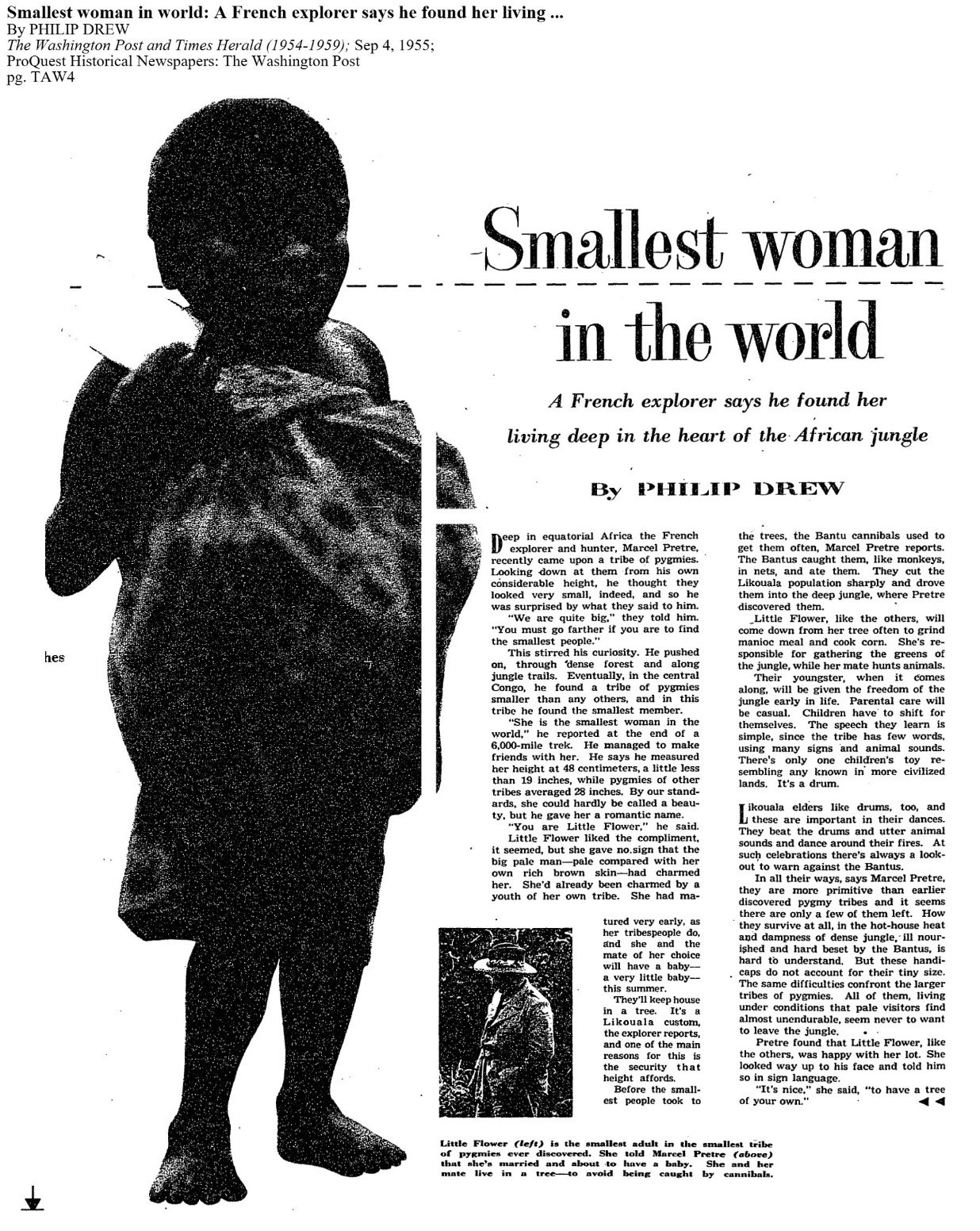
“Washington,” “springtime,” “Sunday,” “item read in the newspaper,” plus the specification, given by the short story, that the photo of Little Flower had appeared in a “the color supplement of the Sunday papers:” these were four or five clues that, though few in number, were significant and that we therefore decided to follow. The “useless explanation” provided a spatiotemporal marker, situating Clarice’s reading of the news item in Washington, that is, according to what is said in Nádia Gotlib’s biography, between 1952 and 1959. Her correspondence with Fernando Sabino allowed us to reduce the possible time frame of the supplement’s publication to the interval between March 1955, when the writer confirmed the receipt of new short stories that Clarice had sent him, which did not include “The Smallest Woman in the World,” and July 12, 1956, when she had already mentioned it to her friend. Regarding the report’s outlet, once the date and city were established, it seemed most likely that the report had been published in one of the two biggest newspapers at the time: the Washington Evening Star or The Washington Post and Times-Herald (the result of the 1954 merger between the Times-Herald and the Post). Another widely circulated newspaper at the time, The Washington Daily News, did not circulate on Sundays. Once the search had been narrowed, it was possible to find, in a “color supplement of the Sunday papers,” as the short story says, The American Weekly, inserted in the September 4, 1955 edition of The Washington Post and Times-Herald (that is, not in the spring month of May, as the “explanation” says, but in the summer), the text, accompanied by a photo, “Smallest Woman in the World,” credited to Philip Drew.
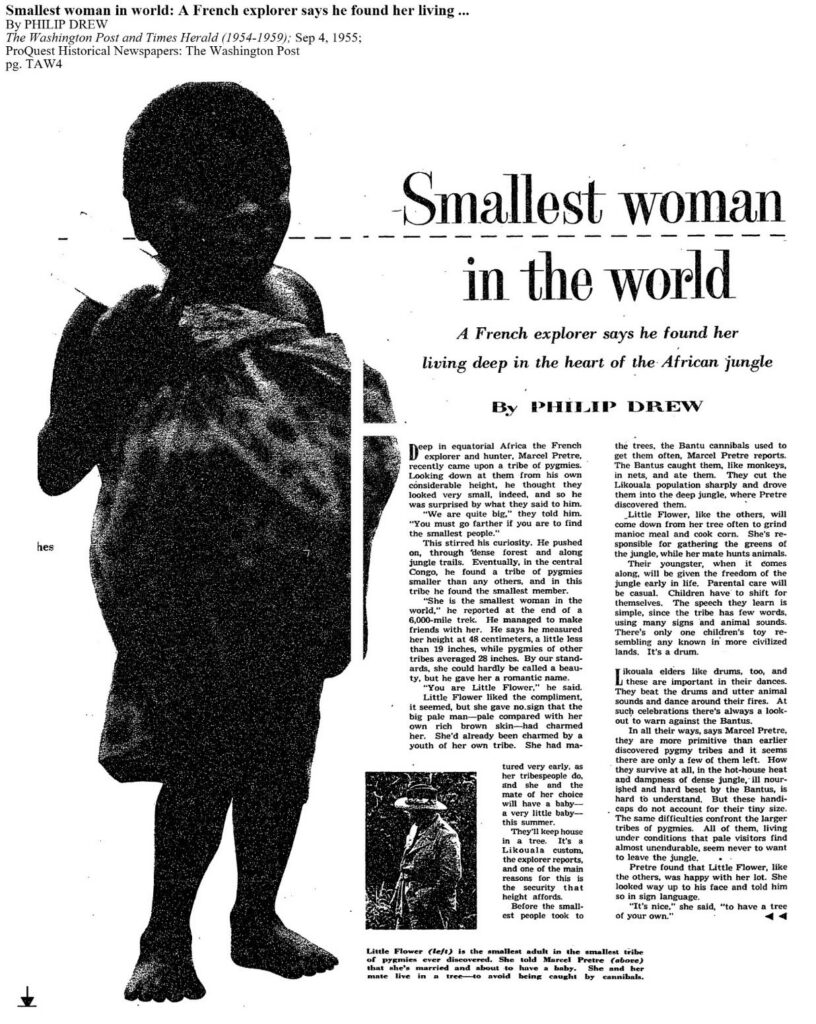
First of all, the discovery of The American Weekly report revealed that Marcel Prêtre, besides being a character in the story, was an actual historical figure, and that the expedition was not (only) a fictional creation of Clarice Lispector, as was often imagined. The very photograph mentioned in the story, a fictional photo to which the characters in the apartments react in the middle of the story, at one of the most well-known moments in the narrative, encountered its real counterpart, as can be seen in the facsimile reproduction, which features a huge photo of the “smallest woman in the world” (called “Little Flower”) that spanned almost the entire height of the newspaper (which measured around 50 cm), thus making her representation correspond to the supposed actual height mentioned in the report, as if it were life-size, exactly as the story affirm edited .
The discovery of the report on the “smallest woman in the world” sounded paradoxical from the very start. On the one hand, it provided a fact to discuss in the short story, constituting the proof that the narrative was based on an actual newspaper article which gave rise to the characters (the report is organized around the meeting between Marcel Prêtre and Little Flower, and intermediated by the characterization of the “Likouala” people) and even the very title of the story, “Smallest Woman in the World.” Moreover, it became clear not only that Clarice had been impacted by a news item, as one might assume, but also that the writing of the story took place after handling the newspaper: it was the fruit of hands-on work with the report, including passages that are practically literal translations, thus making it certain that she had kept the Sunday supplement and not simply read the article and “been inspired.” That is, the discovery of the report offered material data for research, it being possible to palpably see there the genesis of Clarice’s fiction in “reality:” a field of analytical possibilities opened up about the type of transformation, of refraction, to which she submitted this real, concrete report.
On the other hand, this “real” material, which allegedly gave origin to the short story, at the same time seemed to be a hoax. Passages that in the story previously sounded like an exaggerated caricature of journalistic discourse now showed themselves on occasion to be close translations of the text. Everything in the report—the affirmation about the Pygmy woman’s size, its tone, its exoticizing rhetoric—sounded false. While the article was real, in the sense that it had effectively been published and that Clarice Lispector’s “useless explanation” was truthful, its content nonetheless seemed inconsistent and hardly credible. Our early research on the short story’s origins thus unfolded into a second one, on the origin of that origin.
A piece of information from Raquel Wandelli Loth’s doctoral dissertation (2014), at which we arrived when searching for the news item or source text for the short story, would aid us in this second endeavor. In a footnote, Loth raised the hypothesis of a connection between the “French explorer” in Clarice Lispector’s story, Marcel Prêtre, and the Swiss writer Marcel Georges Prêtre, author of Calibre 475 Express, a book of “adventure stories” originally published in 1954 that allegedly contained the account of episodes occurring “among the Pygmy peoples in Africa.” At first, while researching the report, the indication that the Marcel Prêtre in the story was probably not an invented name revealed itself to be essential, for we could include an additional keyword to use in our digital archive search. But now, in addition, in this second stage, it was the book actually that presented itself as an important source for historical research on the report’s origin.
As we had somewhat expected, in Marcel Prêtre’s book we found an account of an expedition to the heart of the forest, into regions “still unexplored in Equatorial Africa,” where there allegedly occurred an encounter with Pygmy peoples, including a group of especially small stature. The report published in The American Weekly thus spoke of the same expedition recounted in the book, and the photo used also came from it. 2
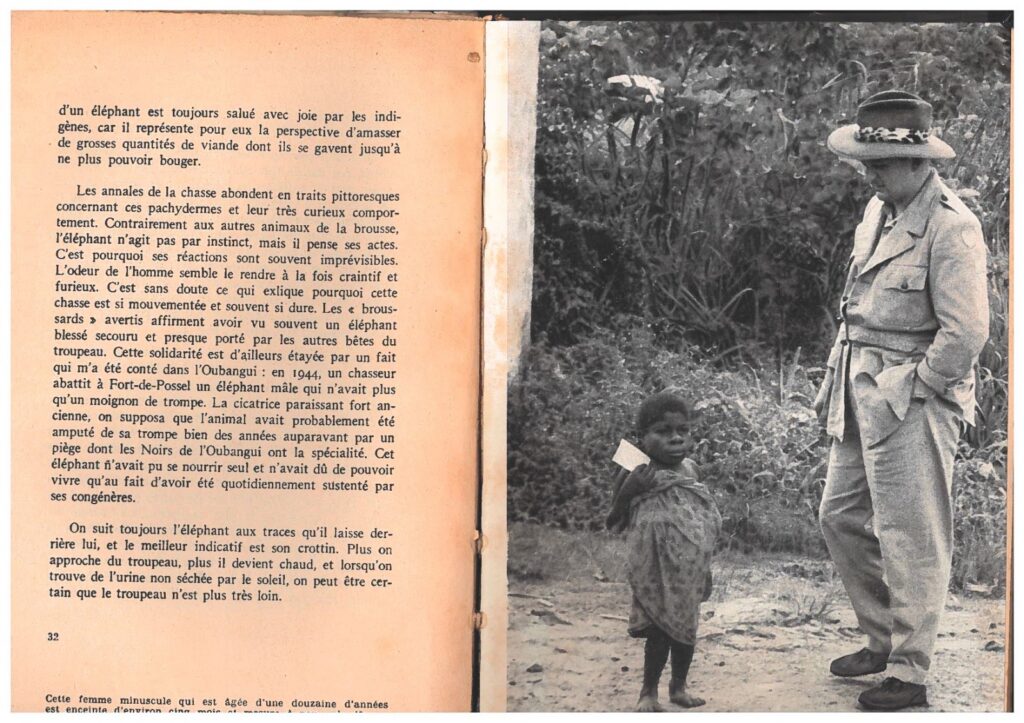
Nonetheless, upon finishing the book, what a surprise it was to discover that there was no account whatsoever of “Little Flower” or a pregnant Pygmy woman, and that the photograph, though reproduced in the book, was not unfolded in any narrative passage, such that the encounter between these two characters (the explorer and the pregnant Pygmy woman, the smallest woman in the world), which organized the entire American narrative, was absent from the pages authored by Prêtre. At this point, of course, despite presenting itself as a documentary travel account, backed by abundant photographic material (the French edition was part of the “La Marche du monde” collection, an explicitly non-fiction series), the book, with its array of unacceptable affirmations (which were at once patently false and offensively racist) 3 , immediately lent itself to be read as a hoax. Yet it was not only this sort of ghostly absence of “Little Flower” that was strange, an orphan image with a name and history. For even that which The American Weekly report and the book had in common, the sensationalist account of Marcel Prêtre’s “discovery” of the “smallest pygmies in the world,” was not really the same: the would-be ethnographic descriptions of the supposed people did not coincide with each other, constituting openly incompatible versions (to cite only one example, the Likouala, menacing cannibals in the book, come to be victims hunted and eaten by the Bantu). It was as if the “fact” that we had brought to light lost consistency the more it was investigated.
And the discovery of a new document made the factual origin of Clarice’s narrative even less firm: even before publishing the book, Prêtre had already announced his “scientific find,” with great fanfare, in a report for the Swiss newspaper L’Impartial on July 19, 1954. 4
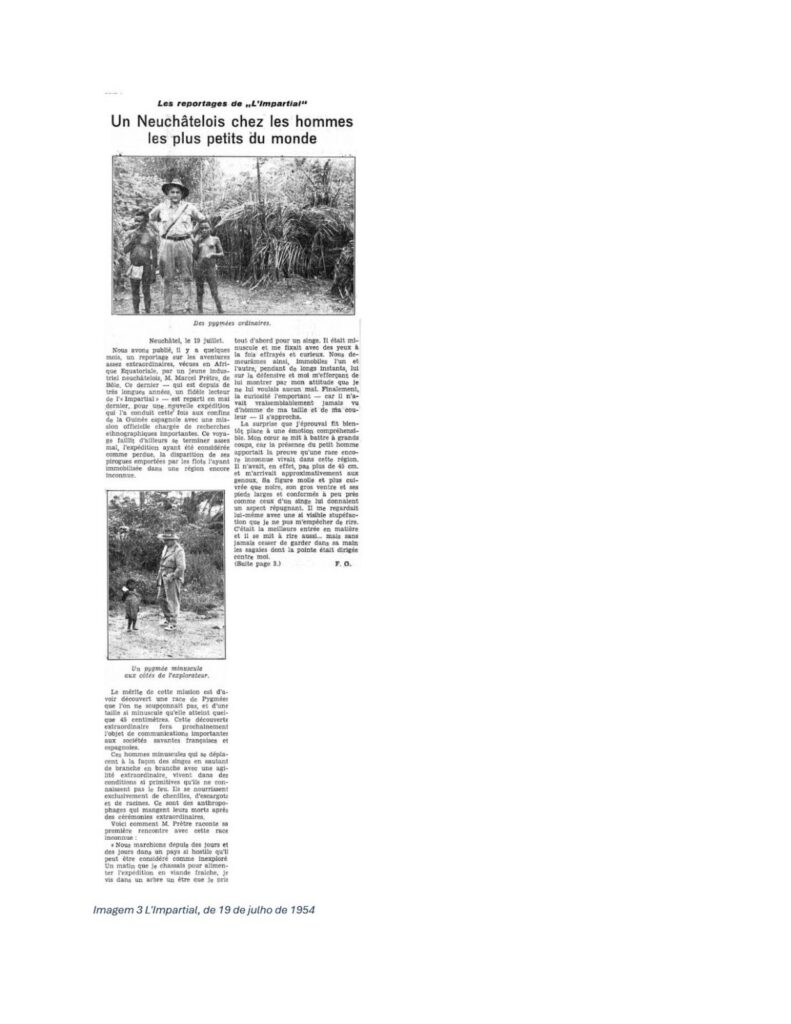
And, once more, adding a new piece (the earliest variant that we located) to the chain of texts that would culminate in the short story only opened up new rifts between the versions. The first glaring contradiction was spatial: the expedition, which the Swiss newspaper article located “in the confines of Spanish Guinea,” migrated in the book to the border of Portuguese Guinea, two “Guineas” at distinct points, particularly distant from each other, on the map drawn by European colonial empires. What might have been taken as a mere slip, a confusion between the names, no longer seemed casual in the face of another alteration, a particular difference in the version, which indicated a deliberate rewrite: in the Swiss report, Prêtre recounts his encounter with pygmies measuring 45 cm; in the book, however, that same paragraph—which describes the first time that he catches sight of the people—is reused almost verbatim: the same source text, now only edited to raise their stature to 75 cm, as if to make the finding more credible.
And as if the contradictions between the documents in this chain were not enough, they appeared even within a single link. The fact is that the work Calibre 475 Express itself, when examined more closely, turned on itself. There were, for instance, inconsistencies between the book’s editions: in the French edition, the one that we initially accessed, the caption for the photo of the pregnant Pygmy woman informed, as we have seen, that she measured 48 centimeters; in the Swiss edition, his nationality, the same image for its part reappeared with a practically identical caption but with a significant alteration: the pregnant Pygmy woman was allegedly now “more or less 80 cm in height.” It is tempting to assume that, far from home, Prêtre allowed himself to make affirmations that he saw himself obliged to attenuate when facing his own compatriots, as if an eventual skeptical reception of the report, which had been announced with a great fuss in L’Impartial, had already led him to moderate his bluster in his own country. Yet another complication comes to be added to all this. Strictly speaking, referring here to “Prêtre,” as we have been doing, is not so simple: Calibre 475 Express, though bearing Marcel Prêtre’s name, was not written by him but by a ghostwriter, Frédéric Dard. As one discovers in Dard’s biography, authored by François Rivière, the then-young French writer received from Prêtre a commission “which consisted of rewriting a collection of hunting memoirs in Africa.” “The novelist devoted himself to the task as best he could, at times carried away by his overflowing imagination.” In another twist in this story, Dard, this young man at the beginning of his career who had received Prêtre’s notes and the assignment to turn them into a book, would later become one of the most commercially successful and prolific French writers of the 20th century, a huge publishing phenomenon. Nothing seemed to hold up; not even the book’s authorship could be trusted.
Perhaps only the photograph would remain, in its indexicality. The fact is that, repeating the same script, a newfound item would show that not even the photo was out of reach of the falsifications accumulating around this episode: an image held in the Fonds Marcel Prêtre, a personal archive donated to the University of Fribourg, compromised that which had been presented as his only “material proof”.
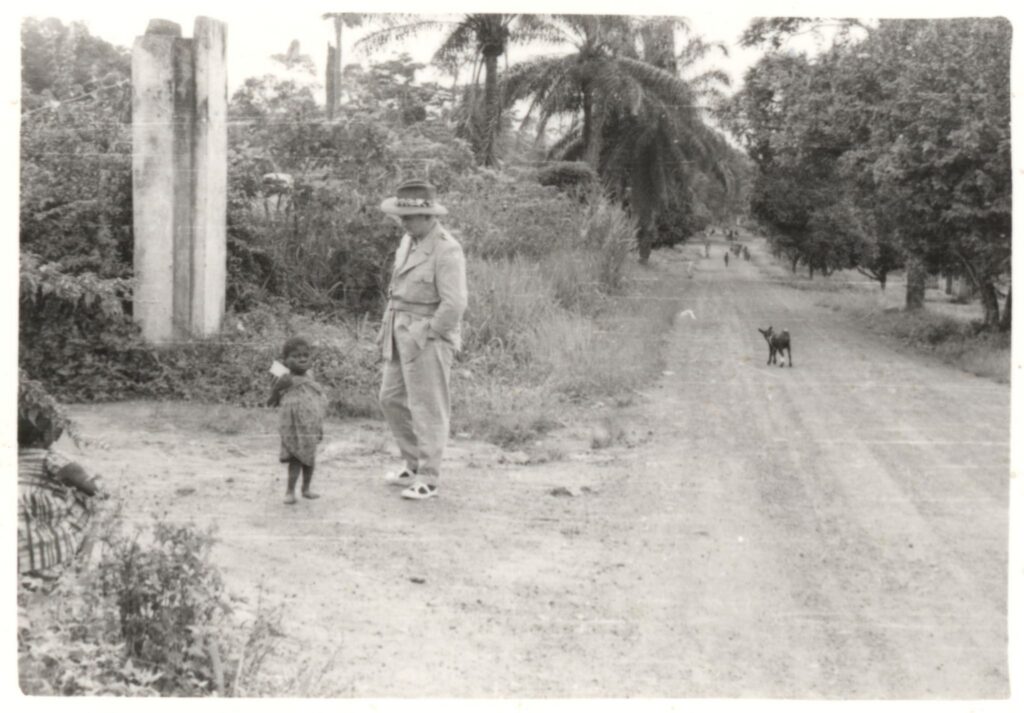
As can be seen, the image that Marcel Prêtre used as the basis for the successive versions of the episode was a crop of a larger photograph. While the cropped version that is present in Calibre 475 Express and that he circulated in the press featured a close-up, drawing our attention to the two figures and reducing the background to a vague suggestion of an indefinite forest, the original photograph from which it was taken, for its part, restores a context that had been conveniently suppressed, as it was incompatible with the narrative in the heart of the forest. 5 The light-colored strip on the left, which in the cropped version went unnoticed due to its illegibility, becomes recognizable as a concrete construction, while the vague background forest, previously flattened by the loss of the vanishing point, comes to show itself, with the added depth, as roadside vegetation, in which we see a dog in the foreground and, further back, a group of people walking: the wide-angle shot unveils a world completely different from the one fabricated by the account. And there was not only this reframing of the original photograph. A minor yet revealing detail indicates that care was taken to retouch the image in order to adjust it to the idea of an “explorer on a mission:” while in the cropped photo reproduced in Calibre 475 Express he appeared wearing a dark, closed-toe, sober shoe, a work shoe, for expeditions, the original photograph shows a lighter, more casual, modern-style footwear, which demonstrates that the image had been patiently hand-painted and that, in effect, not even its condition as an index remained intact.
II
It could reasonably be said that this whole movement in which we have piled refutation upon refutation may seem a bit redundant; it was already possible to glimpse the hoax from the start, and, recalling the response of a renowned physicist, when faced with a falsehood, one refutation should suffice; the hundredth rebuttal must sound excessive. The issue, however, is not simply to reiterate ad nauseam that the fraud was fraudulent, but also to examine its form, which allows for a better understanding of the type of operation that Clarice’s fiction performs upon this series of colonial images and discourses. One of the things that this movement allows one to glimpse, although it is not possible to develop it more extensively here, is that the article that arrived in Clarice’s hands, from which she constructed her short story, revealed itself to be not only invented, but also a stratified construction, as if it had been produced through different layers of fabrication, of narrative arrangement and rearrangement. “The Smallest Woman in the World,” Lispector’s short story, is, in part, a reproduction of Philip Drew’s report, which was already a reconfiguration of the book Calibre 475 Express, which, in turn, was a rewrite, by the professional novelist Frédéric Dard, who would become famous, of the notes of another, of Marcel Prêtre. 6
Also note that it does not concern saying that in this whole web of lies there is no truth at play, but rather shifting the issue. These statements certainly lie, as a news item about a supposed, inexistent Pygmy people or about a certain imaginary Africa, but they do not lie by any means. There is a repertoire of recognizable forms, rules, a grammar at play, such that they still give news of something, of a certain regime of representation, a backdrop that makes these discourses possible (publishable, credible). Reference to the work of V. Y. Mudimbe is unavoidable here, in the sense that this chain of texts which will culminate in the short story could, in almost exemplary fashion, occupy the shelves of what the philosopher will call the “colonial library:” “a body of knowledge generalizing conceptual rules, some historical paradigms and a political project.” Another way to formulate it is that, faced with a “fabulation,” it is less interesting to question the truth of its objects (which we know to be false) than to investigate the fantasy that produced it.
It is worth adding that this factoid, the fabricated story of the supposed Likouala pygmy people, would furthermore have an afterlife. The same photo and account would once again return in the 1980s in a book by Bernard Heuvelmans, the founder of the pseudoscience of cryptozoology, in a text that was skeptical of the claims in Calibre 475 Express, but that still analyzed them armed with the conceptual machinery of “scientific racialism.” Finally, in a recent 2007 edition of a French encyclopedia, the photograph reappeared to certify the supposed “discovery” in a sensationalist manner (as an “exclusive document”), a reappearance whose absurd credibility would astonish Dasen and Minder, authors of a brief article on Calibre 475 Express who had accompanied part of the uncontrolled circulation of the photograph and the story, as if the initial hoax had continued, much later, to produce new volumes for the “colonial library”.
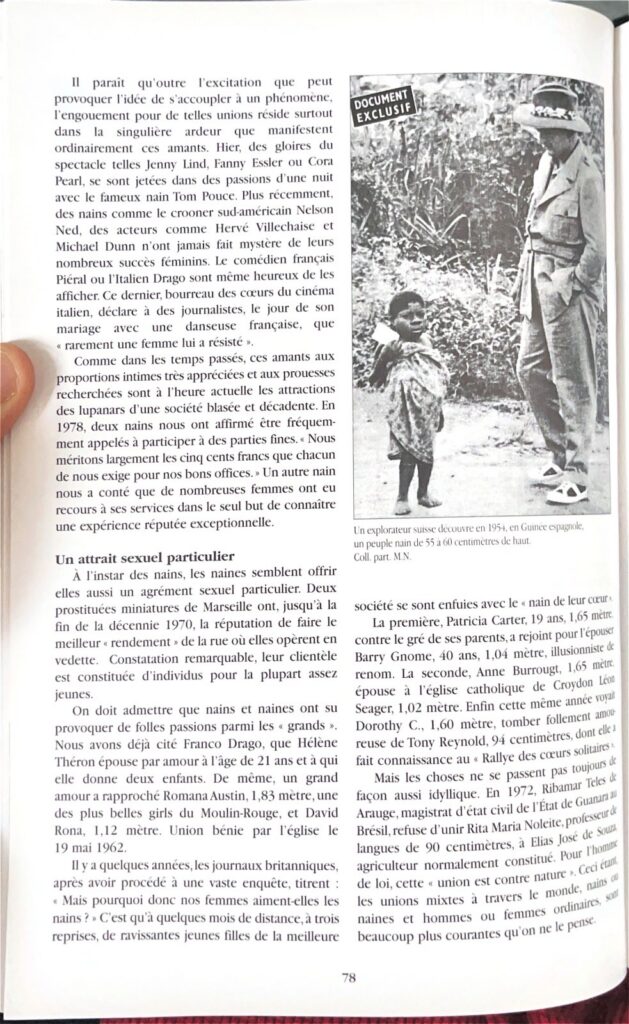
(2007).
Once this proliferating series to which the short story is linked has been revealed, one approach would be to survey the underlying similarities that Mudimbe’s concept seeks to apprehend and to question the extent to which “The Smallest Woman in the World” might also be considered as yet another volume in that library, to question the narrative’s “colonialism.” The issue of the narrative’s colonialist assumptions, which was raised in a certain way by Daphne Patai in an important essay on the story 7, is pertinent and delicate. Nonetheless, as difficult as simply denying it would be the alternative of treating Clarice’s narrative as an undifferentiated element in this series, as if it were equally difficult not to recognize that there is also something of another nature and voltage occurring in the story, linked in part to its fictional condition, a specificity that would also be necessary to investigate.
III
Thus far, we have privileged the presentation of this material surrounding the short story, in the extent to which it may serve as a starting point for varied research. In the remainder of this essay, however, we will attempt, albeit in a rough outline, to consider the singularity of Clarice’s text in this series.
The piece that Clarice effectively had before her was the report in The American Weekly (Image 1). The image that illustrates it is the edited version of an already edited photo, which will radicalize the decontextualization of the first intervention: the background is eliminated, the figures separated, and their relative sizes inverted. Needless to say, if the “Pygmy woman” appears enormous, it is like an exoticizing procedure: precisely to be “totally contained” by the newspaper, she would supposedly be life-size. The newspaper’s decision is to place something like a duplicate of her entire body, exposing it to the reader’s exoticizing gaze. Marcel Prêtre, for his part, in a smaller image, has only his “upper half” represented, from the waist up. The photo symbolizes only the idea of the explorer; the report is not interested in his body, in exposing him, but only in his testimony: he is the report’s guarantor. Splitting the photograph into two separate images points out its distinct functioning. There are two modes of representation relative to each character, one that captures and spectacularizes the woman’s body (which appears entirely exposed, as an object for visual consumption) and another that indexes the explorer as the author (who appears in half-figure and minimized; we only see his “upper” half, since he is there as the subject of the statement of the discovery). It is worth noting that this dynamic is rigorously the same as that of the news item. The figure of Prêtre appears in the body of the article as the guarantor of the account. This can be seen in a particularly clear manner due to the use of evidential markers (“a French explorer says,” “Marcel Prêtre reports,” “says Marcel Prêtre,” “he reported,” “he says”) that punctuate the text so as to signal his role: he is the source of what is recounted. The text does not concern itself with looking at him, since it is constructed from him; its very condition as news, its claim to factuality, is anchored in his testimony, a perceptual position that the text assumes without ever actually thematizing.
The short story, which revisits and translates much of the report, above all in its first part, right from the start introduces, however, a seemingly trivial difference: it is that while incorporating Marcel Prêtre’s point of view, his own figure will also be the narration’s object of attention. Throughout the story, we will see the explorer blushing demurely, flustered, concealing himself, feeling uneasy, and shy. From the first scene of the encounter between Prêtre and Little Flower, the narrative will even allow itself to penetrate his soul to see it at risk of overflowing (“it was only because he wasn’t insane, that his soul neither fainted nor lost control”). Note that it is not only that he is being seen, but that he is also an object of derision, of mockery. This first scene is narrated through the lenses of one of the most familiar topoi in Clarice’s work: a character who, faced with something that risks destabilizing him, pathetically attempts to protect himself through his intellect. The narrative repeatedly places him in this embarrassing situation, with the explorer employing several subterfuges (“averted his eyes,” an appeal to his “symbolic helmet,” “blinked,” “taking notes”). While the report was narrated in a way basically consonant with Prêtre, in which he was never called into question, he was not judged, the short story, for its part, despite starting from the explorer’s angle, which was inherited from the article, also allows itself to evaluate him, as if he were oscillating from the origin of the gaze to the object scrutinized by the narration.
It would be difficult to describe the experience of the short story without employing the idea that there is different order of complexity in relation not only to the American newspaper report but also to all the other discourses in this series, which will become even more accentuated. After the first part of the story, in which there is the account of Marcel Prêtre’s expedition, we will have a fold, a kind of change in narrative level: “Little Flower’s photograph was published in the color supplement of the Sunday papers, where she fit life-size.” We had been coming from the narration of how Prêtre had “discovered the smallest pygmies in the world” (in large part based on the actual report), but here there is not only a spatial cut (we leave the forest) but also a cut in plane, in which we leap from the primary sphere of the account to being placed before the very publication in which this story that we are reading would be disseminated: a kind of fictional The American Weekly, now internal to the diegesis, which retroactively alters the status of what we had read at the beginning of the story. And if we recall how Marcel Prêtre’s gesture of writing is figured in the story, as a defense mechanism of the character (taking notes is a way of averting his eyes from Little Flower, of not suffering the impact of the existence of the other), then we could say that the story not only incorporates the account in the report, but also allows itself to speculate on its libidinal genesis as a protective fantasy, a way of not seeing. If we wish to consider the story in relation to the series, what singularizes it is not simply that Marcel Prêtre’s factoid is no longer asserted as in the other links of the chain (that, therefore, in this case there is no lie, but a fictional text), but also its greater latitude, which allows it at the same time to incorporate the hoax and interrogate the fantasy that brings it to life.
What matters in this reflexive operation, however, is not simply the news item there reposted, its appearance as a fictional object, but, of course, the scene it inaugurates. What the fold puts at stake is, above all, the social circulation of the news item: the second part of the short story superimposes on the account of the discovery of “the smallest woman of the world” a plane that echoes it, the scene of reading, the panorama by the various families faced with the report in the open newspaper. It is as if the scrutiny of the story did not stop at the representation, taken statically, but followed its trail, its whole movement, until its reception. And this superimposition of planes is evidently not innocuous: it places them in interaction inside the story, producing a kind of reciprocal mirroring. On the one hand, it would be possible to say that this second part, which performs a sort of X-ray of the soul of the readers, somewhat deepens that libidinal examination of the explorer, the subject of the account of the discovery. This can be seen in particular through a reference to Prêtre’s “delicacy of feeling,” a reference both ironic and suspicious, situated right at the moment of transition to the tableau with the various scenes of the urban families who receive the news. This panorama which runs through the different reactions of the newspaper’s readers will be concerned above all with probing a certain “delicacy of feeling;” that is what seems to interest the narration as it visits the various families: if there is something that unites these different scenes, it is what is being examined, it is the recurrence of a certain “sensibility.” It is as if something initially belonging to the protagonist reappeared in the inhabitants of these houses and apartments, was reflected in them to be better investigated. In a first line of equivalence, produced by this juxtaposition of planes, we would have, then, “Marcel Prêtre is like these newspaper readers:” the core of the story would deepen, in darker tones, the examination of a certain inability to see, revealing its perverse depths. On the other hand, however, the equation can be read the opposite way, in which we would have “these readers are like Marcel Prêtre:” we are invited to read those scenes through the issue of colonialism, which is brought inside the homes. And, indeed, one of the things that the cut to the apartments does is make clear the expansion of the scope of the “colonialism” that the short story places under examination. While the initial scene can be read as gravitating around a colonial scene in the strict sense (that is, a European explorer faced with peoples of Equatorial Africa in a French-administered territory), the transition to the scenes of the urban families also indicates that what seems to be at stake in the story is not (only) territorial or economic domination, but colonialism as a way of perceiving and representing the other. Furthermore, it should be added that, although there is no actual geographical reference for these homes, Brazilian readers will likely feel a sensibility that is quite familiar in the examination of the delicate souls inhabiting them, which repeatedly reveals a certain conjunction of tenderness and racial violence. And herein lies perhaps the main analogy between the protagonist and the newspaper readers, for it is as if the story, in its structure, draws a parallel between two colonialisms, in which we cut from one setting, which refers to European neocolonialism, Marcel Prêtre’s expedition in Equatorial Africa, to urban apartments, whose X-ray reveals a cruelty full of “tenderness,” which is the persistence of this other colonial past. 8
These mirrorings between Prêtre and the newspaper readers, however, do not exhaust the effects of the short story’s reflexive fold. For it is as if the scene of reading that the story encloses does not remain contained in the diegesis or in this relation between characters; it turns toward its very enunciation, exploring the analogy with the actual reader. The story makes it very clear that its readers are in a position analogous to that of those urban families that it so ruthlessly lays bare. This is revealed most distinctly in the conclusion, in which a lady will close the newspaper, mirroring what the reader of the narrative is also about to do: we, too, will turn the page and close the story, the book, after finishing it. It is as if both readers simultaneously, reflecting one another, were performing the exact same gesture. The lady’s movement can be seen as yet another of the forms of “not seeing” under examination, and, in this sense, the implicit suggestion is that we, the effective interlocutors of the story’s enunciation, are about to make a gesture whose meaning is analogous to that of those characters: we close the story to avert our eyes from the existence of the Pygmy woman. There is a desire to implicate the readers themselves in the issue, which the narrative does by offering a series of unsettling doubles, in the various scenes of the urban families.
In one more play in this specular game, finally, it would be possible to see in the fifth family a double of Clarice’s own home, deepening this dizzying momentum in the short story that drags everything into itself. The scene features a boy who has the macabre idea to use Little Flower as a “toy,” as a thing, to frighten his younger brother: “we could play so much with her.” It occurs that a biographical trait, a name, could be taken as betraying the author’s inscription in the scene: “Paulo,” the little brother that the boy wants to frighten, is precisely the name of Clarice’s youngest son, such that, following this same trail, her eldest son Pedro would be the one speaking, and therefore, the woman before the mirror, who occupies the narrative’s exact center, would be a double of the author herself. It is a writing that does not remain uncommitted, whether in the sense that its authorship is not an abstract, non-thematized vanishing point, since it is also staged, or in the more current sense of the expression, that it refuses a safe position, it does not exempt itself. In this sense, it does not concern taking speech as an alleged fact, as if it had really occurred, disregarding its fictional dimension. On the contrary, the appeal to biographical data, far from leading the story into a regime of assertion, which would approximate it to other documents in the series, is actually and precisely a deeper dive into a certain power of the fictional. It further radicalizes the abyss of mirrors that we had been attempting to describe, being yet another of the instances of this problematizing spiral that allows nothing to escape.
IV
To further this investigation into the singularity of “The Smallest Woman in the World” in the series would also involve addressing the third part of the short story, the return to the forest, in which the narration finally assumes Little Flower’s point of view. 9 In my judgement, it would also resort to Alexandre Nodari’s reflections on fiction, particularly his concept of obliquation, which was elaborated, not coincidentally, through reading the work of Clarice Lispector. It is that one way to consider the story’s difference in this chain world be precisely to observe that, in the other links, a univocal relation of a subject over an object prevails, whereas in Clarice’s narrative, the relations do not cease to fold upon themselves, both in the sense that they continually multiply, unfold into new points of view, and in the sense that they become reversible, in a constant movement in which each term that occupied the position of the seer is simultaneously redirected to that of the seen.
* Editor’s note: We would like to thank João Camillo Penna for the information that Mateus Toledo Gonçalves, during his doctoral research, had found the report that gave rise to Clarice Lispector’s short story “The Smallest Woman in the World,” as well as for the contact with the author.
** The IMS has made every effort to identify and locate the holders of image rights for the individuals depicted (shown/published/disseminated) and would appreciate any supplemental information with regard to this.
- The initial research that resulted in the material exhibited here was conducted over the course of my doctorate (defended in late 2025 and developed in the preceding years) not only with the support but also with the partnership of Alexandre Nodari, having been partially presented in the dissertation. The use of the first-person plural, above all in the first part, is not rhetorical but a vestige of this collaboration. Locating these documents would also not have been possible without the fundamental help of Juana Medus. A more robust and extensive unfolding of this research, which is still in its early stages, is currently being conducted with the assistance of Professor Yudith Rosenbaum, with the aim of producing a book.[↩]
- The caption featured: “This tiny woman, around twelve years old, is approximately five months pregnant and measures around 48 cm in height. She is holding in her hand a photograph that I gave her.” This same photo was presented by Šárka Grauová in a recent text for this site, “Circle and Vortex in ‘The Smallest Woman in the World.’” https://site.claricelispector.ims.com.br/2026/05/07/circulo-e-voragem-em-a-menor-mulher-do-mundo/?utm_source=rss&utm_medium=rss&utm_campaign=circulo-e-voragem-em-a-menor-mulher-do-mundo [↩]
- Temperatures over 60 degrees Celsius; the racist characterization of the tiny people who would live in trees, who would not know fire and had almost no language.[↩]
- As one can see in Image 3, the Swiss report features, for the first time, the same photograph that we have been pursuing. It is the only “evidence” that Prêtre would use and reuse to support his accounts. One notes, however, that in this first appearance it operates differently, coming with the caption “a Pygmy” (un pygmée), and serves to illustrate the passage that narrates Prêtre’s encounter with a male Pygmy, and not a “pregnant Pygmy woman.” We do not have time to elaborate the argument here, but our hypothesis is that the character of “Little Flower” is an invention by Philip Drew based on the photograph, as if he were supplementing a story that the book had promised but did not deliver.[↩]
- The report in The American Weekly, for example, placed the encounter with the Likouala people “in the depths of Equatorial Africa,” advancing “through dense forests;” the book similarly described a country that was “absolutely unexplored and unknown,” “ferociously isolated” by the “incredible difficulties that the traveler encountered” in reaching it, consisting of “impenetrable jungles” and accessible only after weeks of hiking, clearing “tunnels through the vegetation,” in a location where even the “compasses stopped working.” [↩]
- For example, besides the inconsistencies and discrepancies between the versions, a comparison between The American Weekly report that arrived in Clarice’s hands and Calibre 475 Express shows that these alterations were not haphazard, that more than adapting the book’s account, Philip Drew was producing a distinct “fiction,” inscribed in the tradition of the “noble savage.” Drew affects a condescending lyricism, narrows the enunciative distance, singularizes the unknown people into a character inexistent at the source, to whom he confers speech in direct discourse, to give his narrative the closure of a moral fable, deploying familiar motifs of “being naturally self-sufficient,” content with few needs, and free of the weight of possessing. The way that the colonial discourse appears in the report, the type of fantasy that is constructed there, is entirely distinct from that of the book.[↩]
- PATAI, Daphne. L’essentialisme de Clarice Lispector. Études françaises, 25(1), 1989 https://www.erudit.org/en/journals/etudfr/1989-v25-n1-etudfr1062/035772ar/ [↩]
- A possible allusion in the short story to the “playmate,” a slavery practice that Gilberto Freyre describes multiple times in his The Masters and the Slaves, may serve to deepen this question of the historical-geographical circumscription of this colonialism, see the PhD dissertation Laços de família: exercícios de leitura. https://www.academia.edu/161274868/Laços_de_família_exercícios_de_leitura [↩]
- And, above all, it would involve taking seriously the “love argument” regarding the Pygmy woman at the end of the story, as João Camillo Penna does in “A cosmopolítica de Clarice Lispector (A política das coisas)” [The Cosmopolitics of Clarice Lispector (The Politics of Things)], a chapter from O símbolo e a coisa [The Symbol and the Thing], a forthcoming book on Clarice’s work.[↩]