When we think about the books that make up a writer’s library, we first imagine works that have influenced the author, or at least dialogue with his or her literary production. When speculating about how Clarice Lispector’s bookshelf would look, a reader could assume the presence of Virginia Woolf’s novels, stories by Katherine Mansfield… and, in fact, in Clarice’s library, which is in the IMS Collection, the two modernists are present.
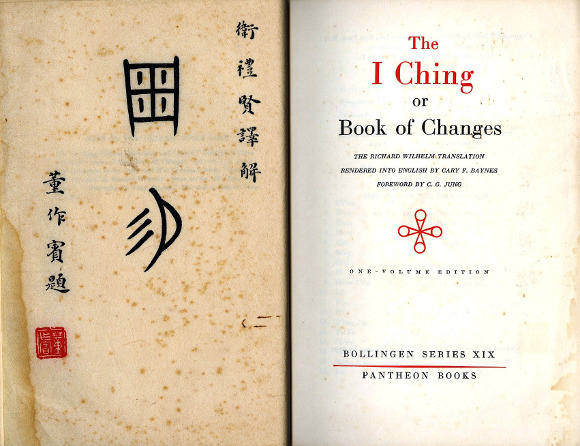
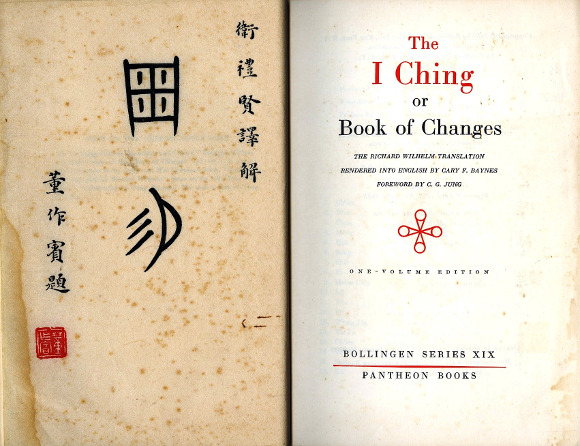
Unexpected books included various works with Buddhist themes, such as “Introduction to Zen-Buddhism,” “Zen and the Infinite,” and The Tibetan Book of the Dead. The author’s interest in eastern philosophy is evident when we handle her copy of the I Ching, “the book of changes,” a Chinese classic that, among other things, also serves as an oracle.
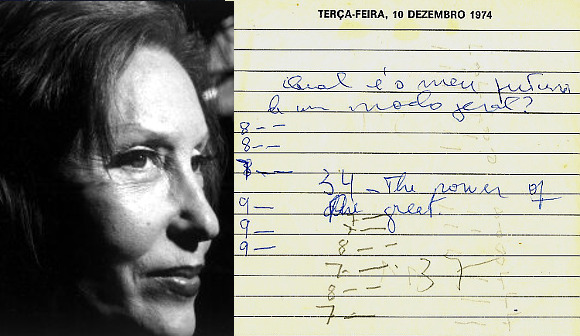
Clarice left various papers with drafts to calculate responses provided by the I Ching. Some of the questions are scribbled, such as “What’s my future in general?” Curiously enough, this question is on a page in her planner dated December 10, 1974, the author’s 54th birthday. It is also hard to imagine Lispector purchasing the nutritional guide Let’s Eat Right to Keep Fit, by Adelle Davis, or the fitness guide Exercise and Keep Fit, by Terry Hunt.
In addition to these curiosities, we have two books with styles much different from Lispector’s: Stories, by Ernest Hemingway, known for his dry style and faithful to the notion that “to write is to cut words” [as the Brazilian poet Carlos Drummond has said] and Breakfast of Champions by Kurt Vonnegut, a hilarious novel, written in a simple style defined by the author himself as writing “in the voice of a child.”
Revealing some of the author’s very idiosyncratic interests, we have Fun with Mathematics, by Jerome S. Meyer, and Ten Perfect Crimes, by Hank Sterling, who presents particularly ingenious true crime cases. This latter book is perhaps not so strange considering that it keeps company with many works of detective fiction in Clarice Lispector’s extremely diverse and unusual library.
The writer Ana Maria Machado had an unusual and emotional episode with Clarice Lispector. This happened in 1975. After having read an article by Ana Maria, published that very day in the Jornal do Brasil, about the birthday of the writer Roland Barthes, Clarice, who did not know her personally, insistently asked her for help to organize what in two years would be the book The Hour of the Star.
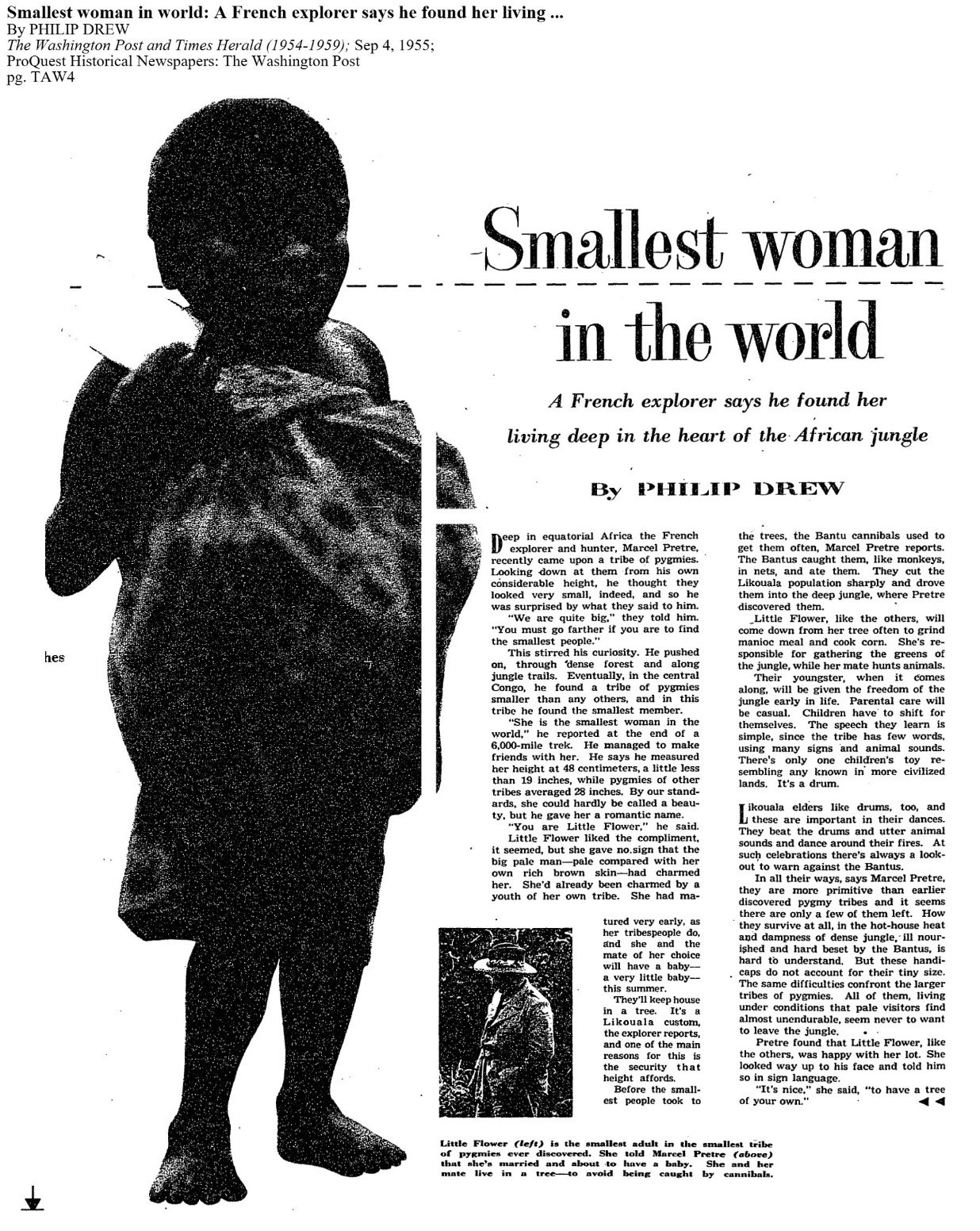
At the center of the short story “The Smallest Woman in the World,” there is a reference to a photograph that was allegedly published in a report about an explorer’s expedition to Equatorial Africa in the “Sunday papers.” This information could be taken as a fictional invention, but the existence of a supposed report is reinforced by “The Useless Explanation,” a text published in the “Back of the Drawer” of The Foreign Legion (1964) about the genesis of the stories that make up Family Ties (1960), the author’s previous volume.
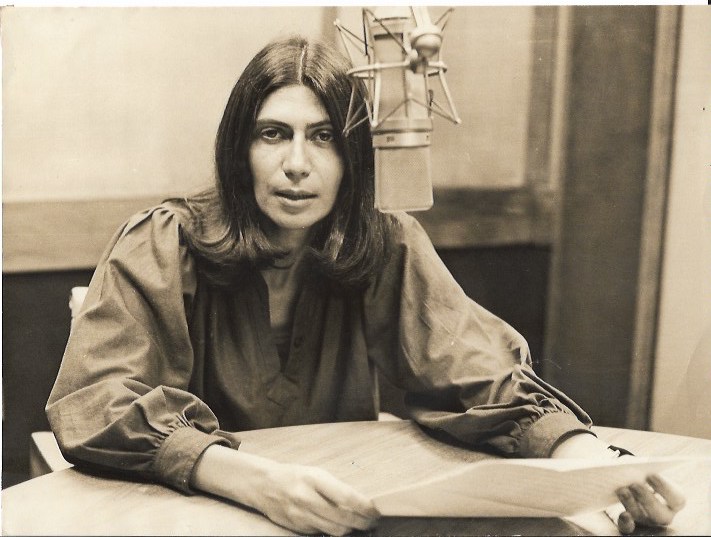
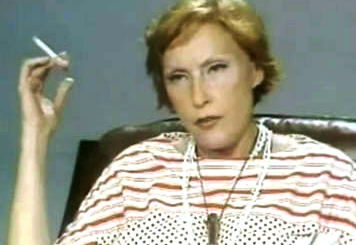
In February of 1977, Clarice visited the studios of TV Cultura and accepted the invitation to be interviewed by the journalist Júlio Lerner, host of the program “Panorama Especial”
Michel de Certeau, in his La fable mystique, addresses an important aspect in the relation between idiocy and holiness in the first centuries, particularly in Christian literature, namely: a mode of isolation in the crowd. Idiocy, in the form of madness, is attributed to the crowd, and additionally, is established as a provocation, a transgression in the field of the “right-minded.”
Clarice Lispector spent her childhood in Recife, but at the age of 15 she moved with her father and two sisters to Rio de Janeiro. It was in the then capital of Brazil that the writer lived her youth and early adult life: she completed high school, graduated from law school, had her first professional experiences in the press, got married, and in 1943, released her first book Near to the Wild Heart.