, Comments on In the Cavity of the Rock: The Post-Philosophy of Clarice Lispector. IMS Clarice Lispector, 2013. Disponível em: https://site.claricelispector.ims.com.br/en/2013/03/06/comentario-sobre-na-cavidade-do-rochedo-a-pos-filosofia-de-clarice-lispector/. Acesso em: 16 June 2026.
Here are one hundred and eleven pages of enjoyment of Clarice Lispector’s works. Unlike the kind of literary criticism of her work that we are accustomed to reading, Roberto Corrêa dos Santos, in his broad interpretation spread over twelve chapters, some extensive, others just two pages – but fortunately converting the reading into hours of reflection–, guides the reader on a flight free of dangers, ensuring total freedom without requiring the reader to hold on to hard theoretical supports. Instead he constructs, with smooth but underscored movements, readings and de-readings, illuminating several of Clarice’s texts with integrity and grandeur. To his credit he does not suffocate the texts.
Proceeding through the lyricism Roberto Corrêa dos Santos uses in his presentation, the more attentive reader feels the pleasurable need to stop, breathe, and – if so inclined – underline the text due to the intensity of the readings. It is not difficult to agree with the author who, in glossing over just one title or another in Clarice’s production, manages to not repeat what at this point is already known from what literary criticism of the past few decades has endeavored to examine. Roberto goes to the boundary of what Clarice’s texts suggest, guarding himself from possible mistakes influenced by exaggerated affirmations. Clarice’s own writing, for example, is effectively an instruction manual for “detaching” from norms and stereotypes. It is this writing that institutes a new knowledge that for us cannot – must not – be, according to the author, “civilized” or “deprived of the happy anguish it causes.”
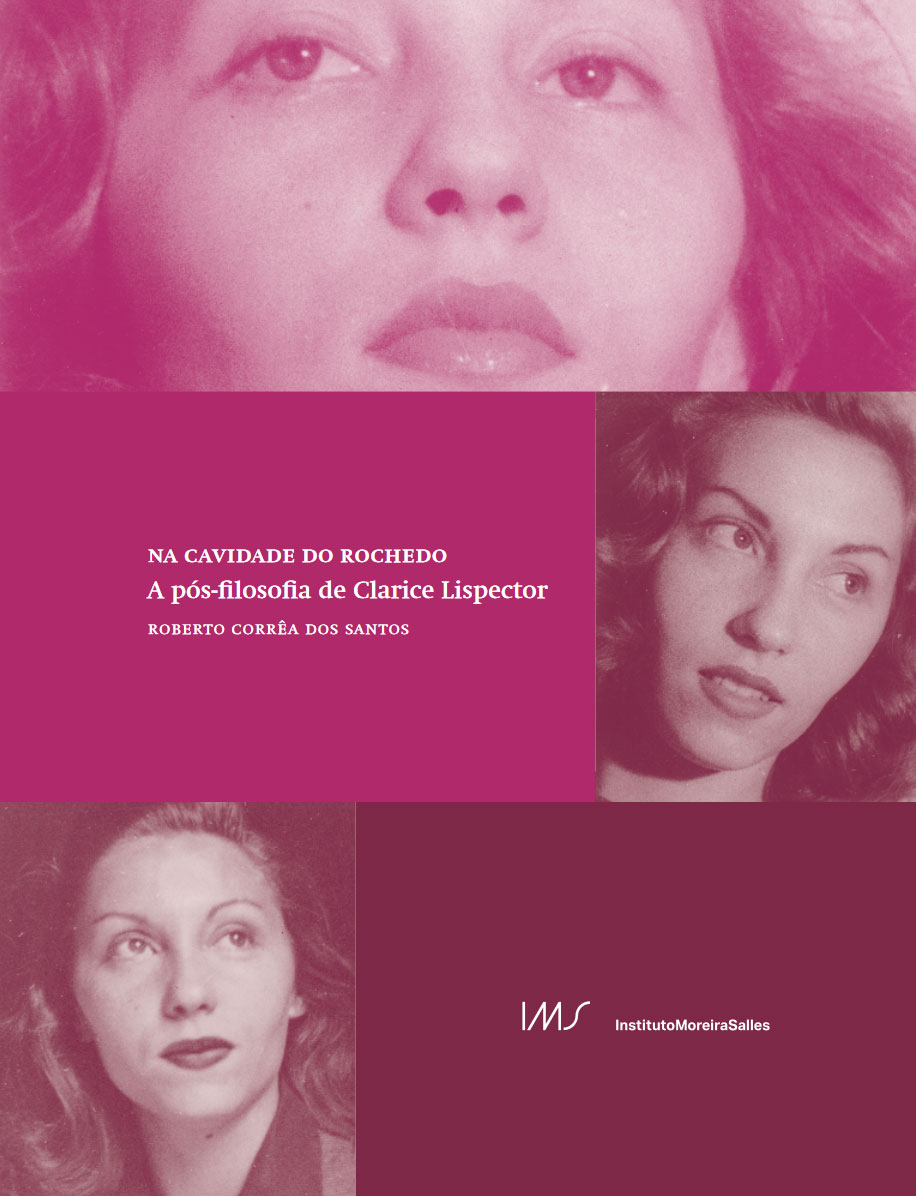
Upon reading Na cavidade do rochedo (In the Cavity of the Rock: The Post-Philosophy of Clarice Lispector), we are promptly placed in the condition of explorers-readers. Between enchantment and astonishment, we are ready to face Clarice’s cave—or work—, which by its very nature is ferocious, slippery, and does not allow itself to be taken in its entirety.
Na cavidade do rochedo: a pós-filosofia de Clarice Lispector (In the Cavity of the Rock: The Post-Philosophy of Clarice Lispector) is a study published exclusively in electronic format and available for download here.
See also
by Bruno Cosentino
Clarice Lispector wrote about sex only once. It was in the book A via crúcis do corpo (The Via Crucis of the Body).
by Veronica Stigger
In January 1975, Clarice Lispector received an invitation letter, signed by Simón González, a Colombian businessman, politician, and mystic, inviting her to take part in the First World Congress of Witchcraft, which would be held between August 24 and 28 of that same year in Bogotá, Colombia. [...] But why was Clarice Lispector invited to the First World Congress of Witchcraft?
by Elizama Almeida
At the 35th edition of the Paris Book Fair, Brazil was the country of honor. The program was marked by an exhibition dedicated to Clarice Lispector at Éditions des Femmes,
by Equipe IMS
The Brazil LAB is an interdisciplinary initiative at Princeton University that considers Brazil to be a crucial nexus for us to understand today’s most pressing issues. Based at PIIRS (Princeton Institute of International and Regional Studies), the LAB brings together professors, researchers, and students from more than 20 different university departments (from the social to the natural sciences, from engineering to the arts and humanities) in interaction with dozens of researchers from academic institutions of excellence.
by Augusto Ferraz
I died. I found out when, one day, on the sidewalk of Praça Maciel Pinheiro, I lifted my head, opened my eyes, and saw myself dead, there on the plaza’s sidewalk, the two-story house on the other side of the street. My broken heart inside my chest, the two-story house on Rua do Aragão, 387, where, on the second floor, Clarice Lispector lived a happy childhood here in Recife, despite the pains of the world and experiencing and feeling, mainly, the pains of an implacable disease that would one day take Mania, her mother, away from her. I found out when, laid out on the sidewalk there under the scorching Sunday sun, I turned my head to the right and saw a man beside me, who was also looking at the house.
by Equipe IMS
On December 10th, IMS Rio celebrates Clarice Lispector’s birthday. This year, we will present, in a single screening, the short film Perto de Clarice (Close to Clarice), by João Carlos Horta, from 1982, in a new digital version based on the 35mm original preserved by the Audiovisual Technical Center (CTAv). After the film screening, there will be a conversation between the writer Heloisa Buarque de Holanda, who was involved in the making of the film and is the director's widow, and Teresa Montero, author of the most recent biography of the writer, À procura da própria coisa (In Search of the Thing Itself – Rocco, 2021), mediated by the IMS literature consultant, the poet Eucanaã Ferraz.