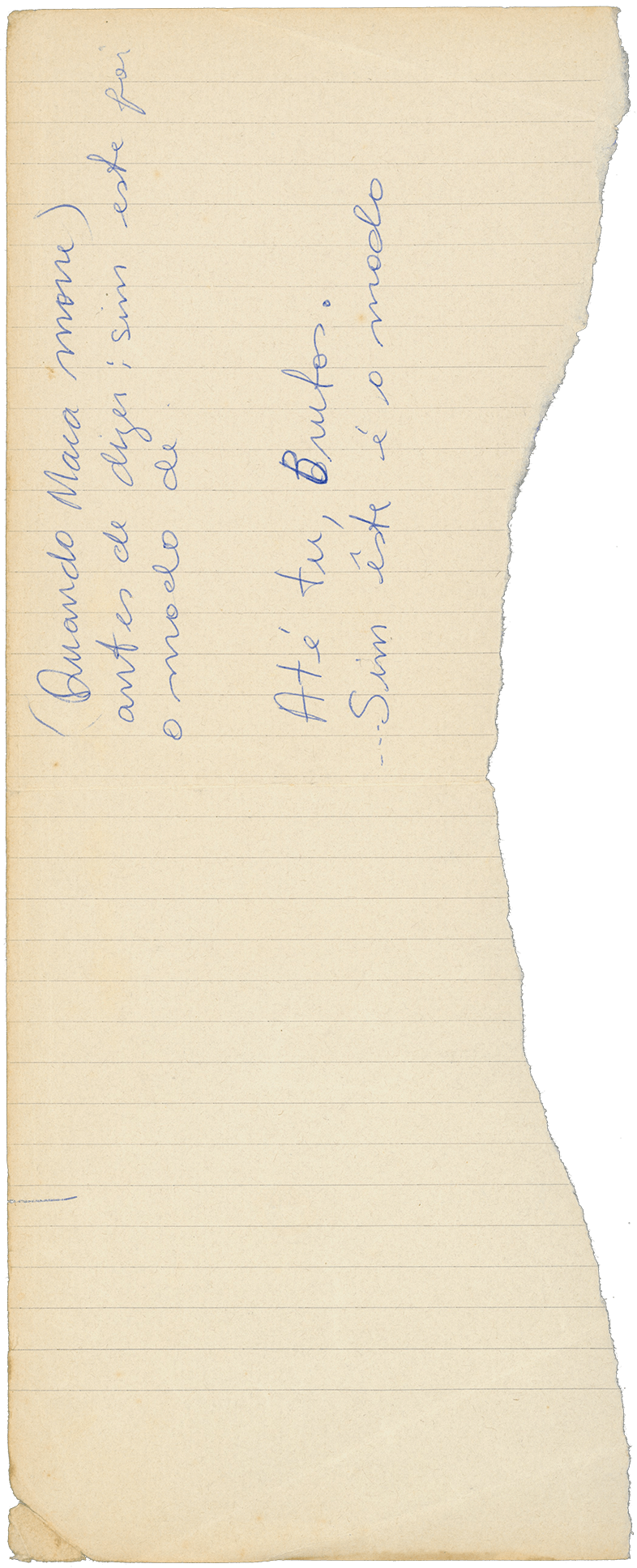
“Et tu, Brute?! Yes, that’s how I wanted to announce that — that Macabéa died. The Prince of Darkness won. Finally the coronation.”
Note used in the 481st and 482nd paragraphs of The Hour of the Star. The handwriting is by Olga Borelli.

Originais & Documentos
“Et tu, Brute?! Yes, that’s how I wanted to announce that — that Macabéa died. The Prince of Darkness won. Finally the coronation.”
Note used in the 481st and 482nd paragraphs of The Hour of the Star. The handwriting is by Olga Borelli.
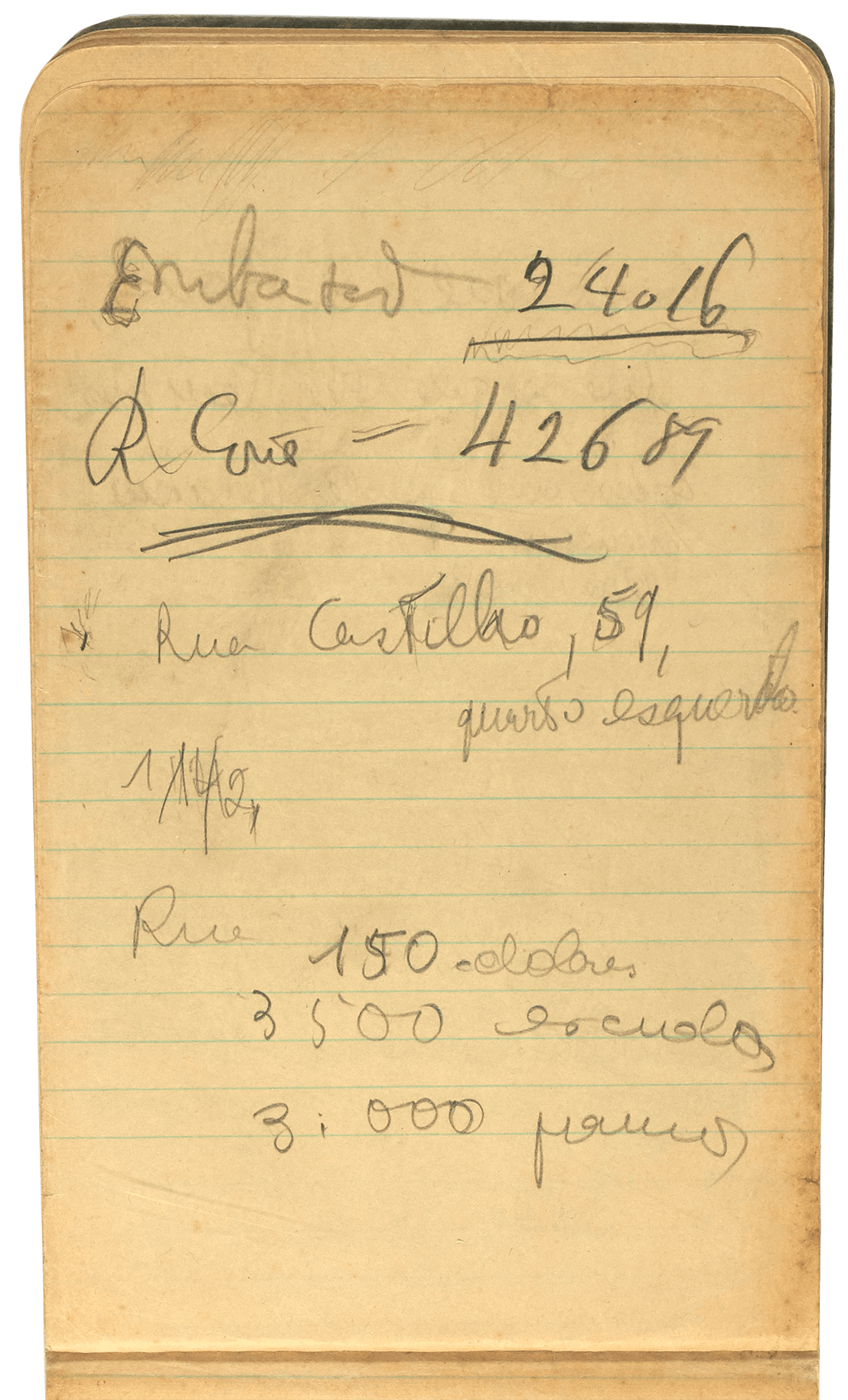
Embaixada 24016 / R. [ilegível] – 42689 / Rua Castilho, 59, quarto esquerdo / RU / 150 dólares / 3.500 escudos / 3.000 francos
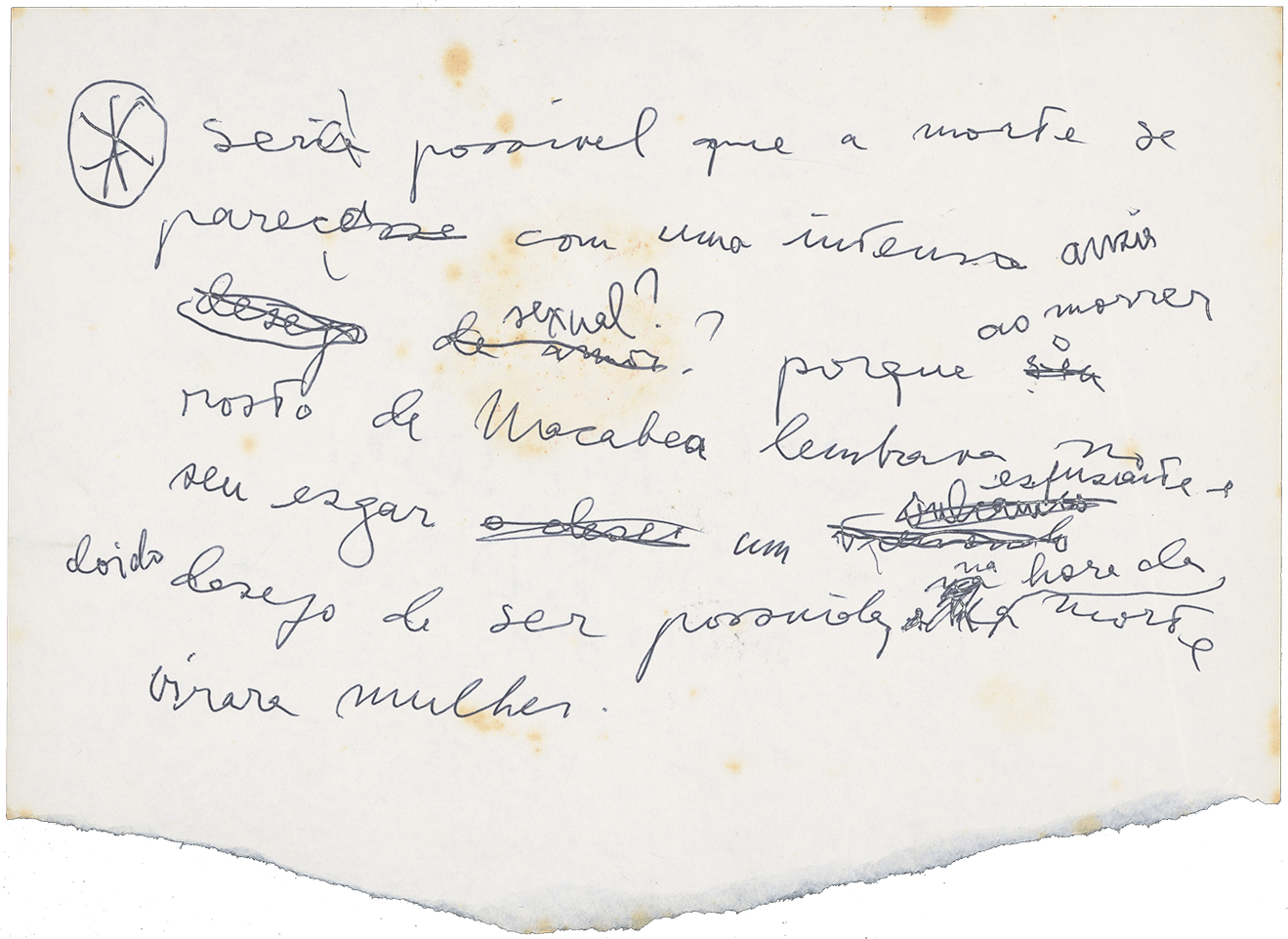
“Then — lying there — she had a moist and supreme happiness, since she had been born for the embrace of death. Death which is my favorite character in this story. Was she going to say farewell to herself? I don’t think she is going to die because she wants to live so much. And there was a certain sensuality in the way she’d huddled up. Or is it because pre-death resembles intense sensual throes? Because her face looked like a grimace of desire. Things are always days before and if she doesn’t die she is like us on the day before her death, forgive me for reminding you because as for me I can’t forgive my clairvoyance.”
Note used in the 474th paragraph of The Hour of the Star. The handwriting is by Clarice.
“You could tell perfectly that she was alive from the constant blinking of her big eyes, from the thin chest that was rising and falling in perhaps difficult breathing. But who can tell if she wasn’t needing to die? Because there are times when a person needs a little bitty death and doesn’t even know it. As for me, I substitute the act of death for a symbol of it. A symbol that can be summed up in a deep kiss but not on a rough wall but mouth-to-mouth in the agony of pleasure that is death. I, who symbolically die several times just to experience the resurrection.”
Note used in the 470th paragraph of The Hour of the Star. The handwriting is by Clarice.
“In the sudden gush (explosion) of a vivid impulse Macabéa, half ferocious, half clumsy, planted a cracking kiss on Madame Carlota’s cheek. And she felt again that her life was already getting better, right then and there: because it was good to kiss. When she was little, since she didn’t have anyone to kiss, she’d kissed the wall. When she caressed someone else she was caressing herself.”
Note used in the 447th paragraph of The Hour of the Star. The handwriting is by Olga Borelli.
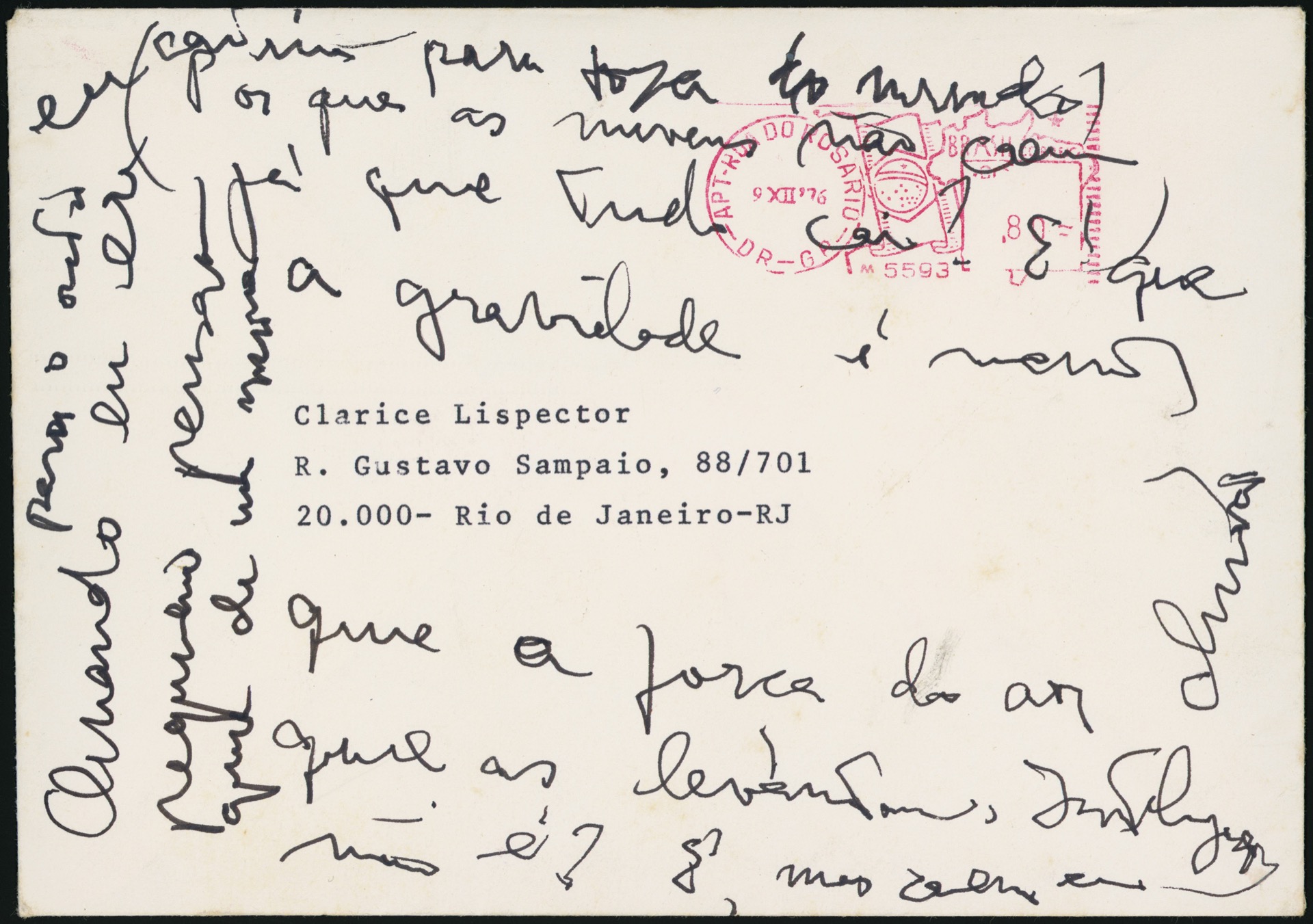
“As for me, I’m only truthful when I’m alone. When I was a little boy I thought that from one minute to the next I could fall off the face of the earth. Why don’t clouds Why don’t clouds fall, since everything else does? Because gravity is less than the strength of the air that keeps them up there. Clever, right? Yes, but one day they fall as rain. That is my revenge.”
Note used in the 382nd paragraph of The Hour of the Star. The handwriting is by Clarice.
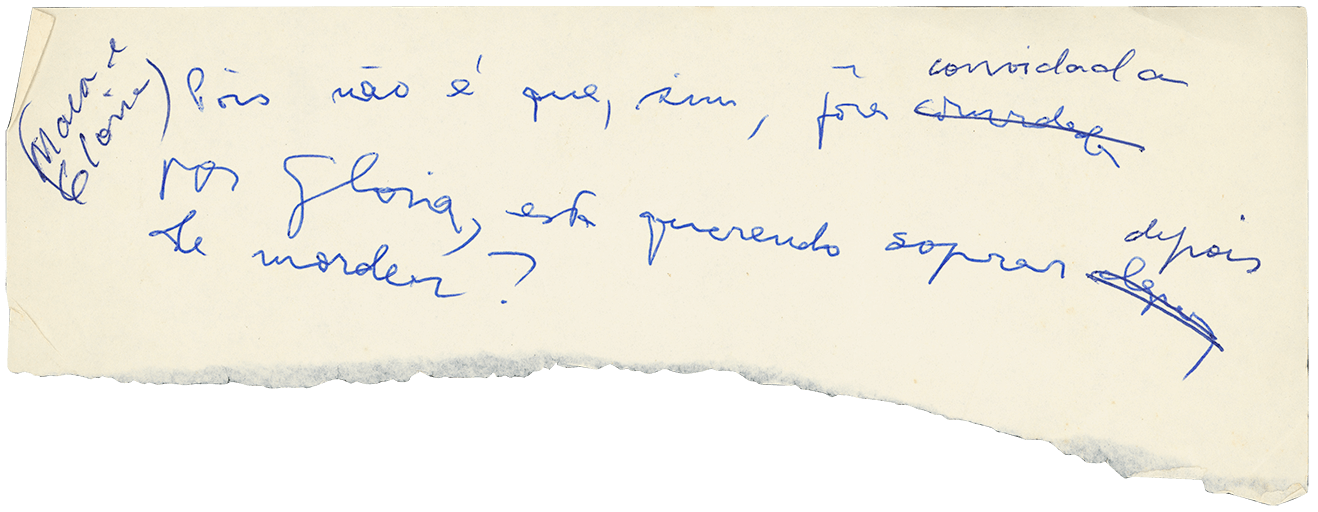
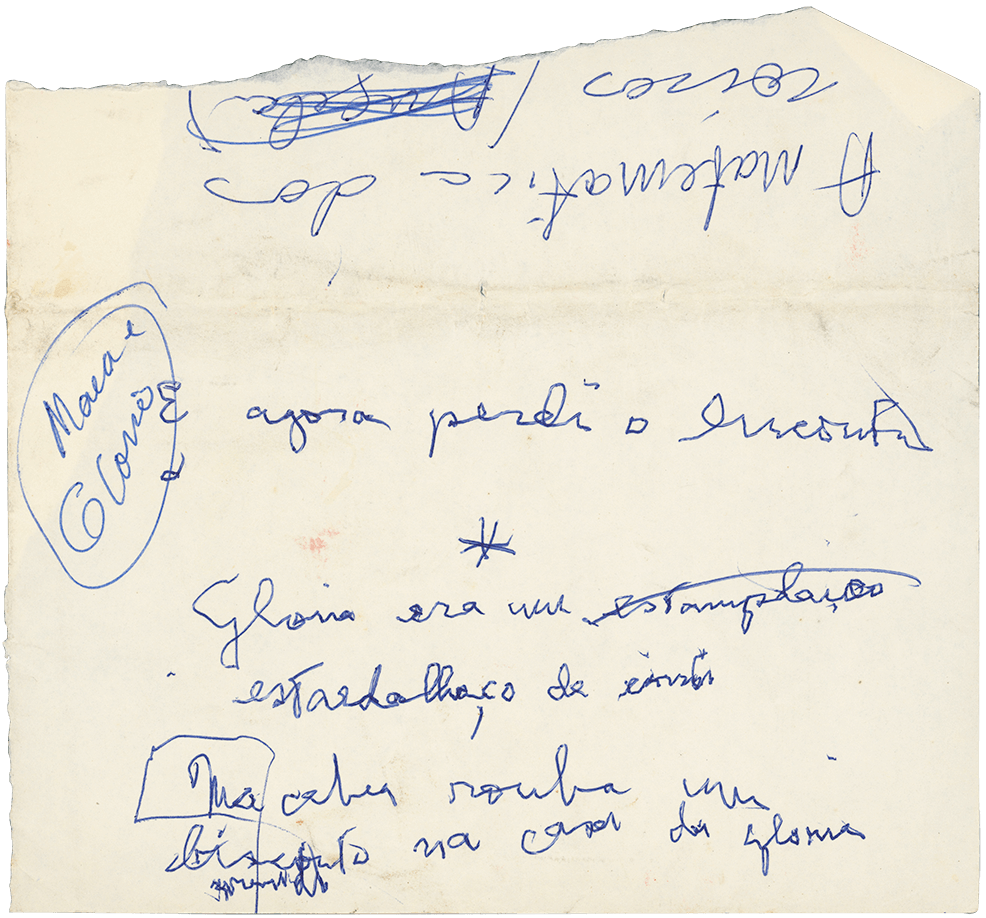
“Glória, wanting to make up for stealing the other girl’s boyfriend, invited her for a snack one afternoon, Sunday, at her house. To treat the wound she herself had inflicted? (Ah what a boring story, I can hardly stand writing it.)”
Note used in the 348th paragraph of The Hour of the Star. The handwriting is by Clarice and by Olga Borelli (observation between parentheses, on the left).
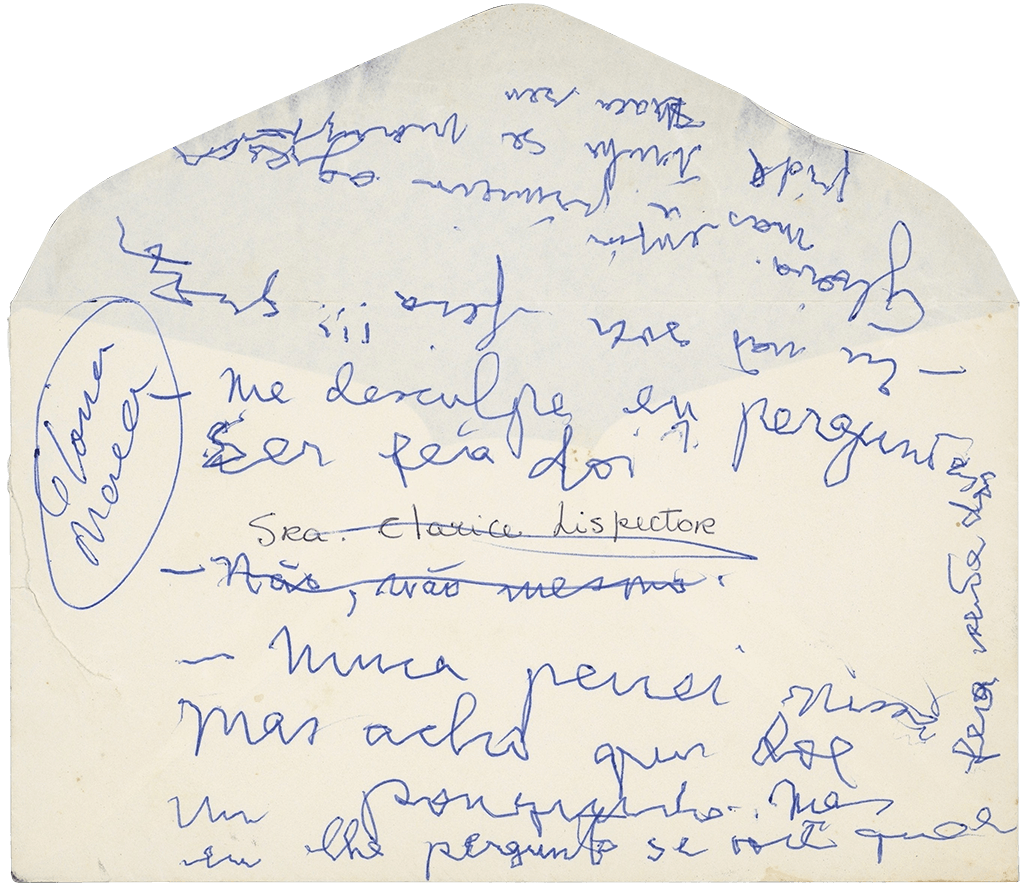
“— Sorry for asking: does being ugly hurt?
— I never thought about it, I think it hurts a little. But I should ask you if you hurt because you’re ugly.
— I’m not ugly!!! — Glória howled.”
Note used in the 320th, 321st, and 322nd paragraphs of The Hour of the Star. The handwriting is by Clarice and by Olga Borelli (observation circled, on the left).
“Macabéa understood one thing: Glória was a fanfare of existence. And it must have been all because Glória was fat. Fat had always been Macabea’s secret ideal, since in Maceio she’d heard a guy say to a fat girl walking down the street: ‘your flesh is fresh!” From then on she’d aspired to fleshiness and that was when she made the only request of her life. She asked her aunt to buy her cod liver oil. (Even then she had a thing for ads.) Her aunt asked her: you think you’re some rich man’s daughter wanting luxuries?”
Note used in the 315th paragraph of The Hour of the Star. The handwriting is by Clarice and by Olga Borelli (observation circled, on the left).
“Since she didn’t want to rest her back for a day? She knew that if she said this to her boss he wouldn’t believe her ribs hurt. So she used a lie that was more convincing than truth: she said to her boss that she couldn’t work the next day because having a tooth pulled was very dangerous. And the lie worked. Sometimes only a lie can save you. So, the next day, when the four tired Marias went to work, she had for the first time in her life the most precious thing of all: solitude. She had a room all to herself. She could hardly believe that all this space was hers. And not a word was heard. So she danced in an act of absolute courage, since her aunt couldn’t hear her. She danced and twirled because being alone made her: f-r-e-e! She enjoyed everything, of this arduously obtained solitude, the radio as loud as it would go, the vastness of the room without the Marias. She got, as a favor, a little instant coffee from the landlady, and, as another favor, she asked her for some boiling water, drank it all licking herself and in front of the mirror so as not to miss any of herself. The encounter with herself was a good she had not yet known. I don’t think I’ve ever been so happy in my entire life, she thought. She owed nothing to anyone and no one owed her a thing. She even allowed herself the luxury of boredom — a quite unusual boredom.”
Note used in the 117th paragraph of The Hour of the Star. The handwriting is by Clarice.