, Without Formulas. IMS Clarice Lispector, 2014. Disponível em: https://site.claricelispector.ims.com.br/en/2014/04/28/sem-formulas/. Acesso em: 01 March 2026.
In 1970, Clarice Lispector started to write a work that would come to be called Água viva [translated into English as both Água Viva and Stream of Life].
According to Nádia Gotlib in “Memória seletiva” (Selective Memory), published in a special edition of Cadernos de Literatura Brasileira (Brazilian Literature Notebooks) on Clarice Lispector:Incorporating old notes, she begins to work on a new novel entitled Atrás do pensamento: monólogo com a vida (Behind Thought: A Monologue with Life). The book, which in a later phase would be called Objeto gritante (Screaming Object), would finally be called Água viva and would come out under the broad genre of “fiction,” given the author’s understanding that she had surpassed conventional classifications of literary narrative.
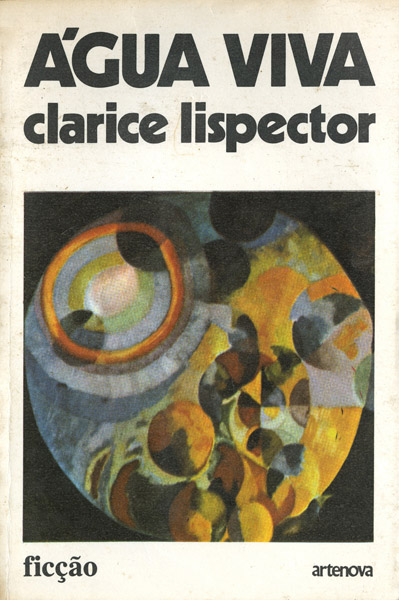
Cover of the 1st edition of Água viva, published in 1973 by Artenova. Ana Cristina César Library/ IMS collection
Professor Clarisse Fukelman analyzes Água viva and says that, in this work, the author “radicalizes innovative writing processes with which she had already experimented in previous publications” and develops a book in which “there is no linear story or central theme.”
Água viva was published at the end of August 1973 by the publisher Artenova. Below is a handwritten excerpt from the work’s manuscript under the care of the Moreira Salles Institute, followed by its transcription.
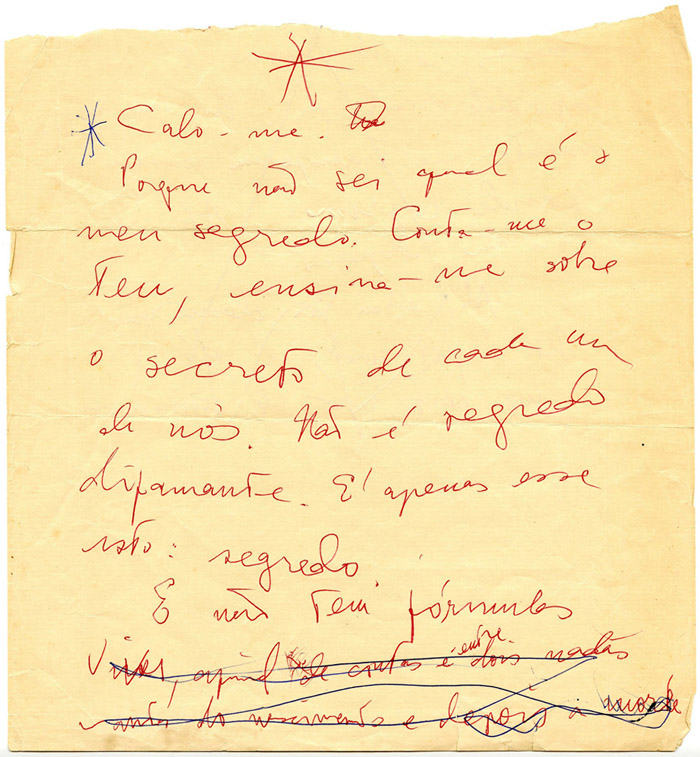
Excerpt from the manuscript for Água viva, by Clarice Lispector. Clarice Lispector Collection / IMS collection
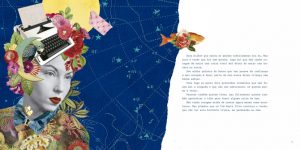
Calo-me.
Porque não sei qual é o meu segredo. Conta-me o teu, ensina-me sobre o secreto de cada um de nós. Não é segredo difamante. É apenas esse isto: segredo.
E não tem fórmulas.
[I go quiet.
Because I don’t know what my secret is. Tell me yours, teach me about the secrets of every one of us. It’s not a slanderous secret. It’s only this: a secret.
I believe that Clarice and I shared a common feeling: objects are not inanimate, on the contrary, they have a secret life. I do not know if the reader has already tried turning off the lights at night in your room and, little by little, noticed that your eyes adapt to the dark and finally you can perceive the living presence of things.
[...] throughout all of Clarice’s work there is a dazzling – almost primordial, inaugural, Edenic – vision of gender, of the man-woman division. One notes a frightened fascination that there is a male-animal-man in the world, as we read, for example, in the short story “The Buffalo,” and also in another story about phantasmic and monstrous masculinity titled “The Dinner”.
Acclaimed by critics and a popular phenomenon on the internet, Clarice Lispector is considered, internationally, one of the great names in 20th century literature. Mysterious, obscure, revealing, experimental, strangely mystical, or philosophical – how to define the writing of the author of The Hour of the Star? This podcast, conceived and presented by Bruno Cosentino and Eucanaã Ferraz, covers Clarice’s life and work in five episodes, in which they talk to great specialists, professors, and researchers.
The film portrays the famous Ulisses, Clarice Lispector’s dog and a prominent character in her life and fiction. He is present in the posthumous novel A Breath of Life, he is the narrator of the children’s book Quase de verdade (Almost True), he was mentioned in countless chronicles, and today he is immortalized, alongside his owner, in a bronze statue at Leme Beach, in Rio de Janeiro.
This August, Todas as crônicas will be released, a volume that brings together for the first time all the chronicles written by Clarice Lispector for newspapers and magazines.
More or less fantastic in their plots, these children’s stories reveal narrators who, stripped almost completely of their fictional character, are very similar to the author: they are mothers, writers, they go by the initials “C.L.,” or even say their name is Clarice. Thus, if there is a horizontal posture in these narrators in which respect for the particularities of childhood is presupposed, this same movement also shows the desire to become a little more like a child.