Benedito Nunes described Clarice’s language as a circular movement that “goes from silence to words and from words to silence.”1 To read Clarice is to accompany this back and forth: the sentence that advances and suddenly retreats; the thought that seems to insist on the same point until that point opens into an abyss. This circle is never sterile: with each turn, words gain density, as if the text were furrowing the very ground on which it treads.
The center of gravity in Clarice Lispector’s work is not in the plot, but in the verbal surface itself: in the words that return, hesitate, advance, and retreat as if measuring the outline of something still formless. Her writing, creating the initial impression of a “zero-degree writing,”2 relies on a minimal and insistent lexicon, always in a tension between what is said and what is suspended — a writing, as Walnice Nogueira Galvão recalls, “rounded by the limit of the power of words, by silence.”3 Between words and silence, repetition functions like a drill: it returns to the same point to descend a little further.
This attention to detail — to the insistent return of the same words, to the way that silence breathes within the sentence — explains why translation becomes such a revealing instrument for thinking about Clarice. To translate her prose is to directly confront the inner workings of language, the precision of verbal gesture, and the structural force of repetition. By forcing the reader to measure each inflection, each recurrence, the translation ends up illuminating that which, in the original, might go unnoticed: the way that Clarice thinks through her own choice of words.
Among the most evident — and most misunderstood — features of Clarice Lispector’s writing is repetition, considered by Luciana Stegagno-Picchio to be “the correlate, at an expressive level, of the opacity of the world, of its repeating itself in a mechanical monotony.”4 At first glance, this seems like a vicious circle: a false return, a lack of invention, of synonymy. But this is not the case with Clarice, who confessed in one of her chronicles: “repetition pleases me, and repetition happening in the same place ends up digging down bit by bit, the same old song ad nauseam says something.”5 To repeat is to dig: what returns never returns empty, but denser.
In other words: Clarice thinks by repeating. A minimal word, apparently neutral, comes back and returns until it loses its triviality and gains conceptual depth. With each return, it emerges slightly displaced, more loaded, more ambiguous. This movement is the “circle” that Benedito Nunes mentions: language that seems to spin on itself and, at the same time, opens fissures through which doubt, astonishment, and silence irrupt. In “The Smallest Woman in the World,” this dynamic becomes particularly visible because the short story operates with a reduced lexicon — and it is in this minimal that Clarice establishes her metaphysics.
Criticism, at a general level, confirms this intuition. For J. Hillis Miller, an American critic, the signifier gains weight through insistence: it is not the isolated content but the fact of returning that creates structural weight of meaning. The repeated word is converted into a loaded sign, almost a sound object that thinks for itself. Jan Mukařovský, a Czech theorist, described repetition as a “snowball:” each return adds to the previous ones, accumulating layers, growing in volume and intensity.
Clarice performs this movement in an exemplary way. She repeats everyday words until they are transformed into concepts. With each return, the term deepens and gains weight. What seemed to be a circle reveals itself to be a spiral: repetition ceases to be a simple stylistic device to become a method of literary thought.
1. Marcel Prêtre: Between Hat and Helmet
“The Smallest Woman in the World,”6 written before the second half of 1956 and published in 1960 in Family Ties, is based on a real episode: the publication, in an American magazine, of the supposed discovery announced by Marcel-Georges Prêtre (1922–1995), a Swiss traveler who reported the existence of a pygmy woman measuring 45 centimeters, whom he called “the smallest woman in the world.” This information is probably misleading: known documentation indicates that the smallest person on record was 54.6 centimeters tall. Prêtre’s “discovery,” therefore, was a staged event from the start.
Prêtre claimed to have lived with Pygmy communities, working as a hunting guide in Africa and cultivating the image of a chasseur de fauves — hunter of wild beasts — thus associating himself with the exoticism and violence of colonial hunting. He became known as the “discoverer” of the smallest woman, but his trajectory is not limited to this feat. He was possibly also a prolific author of popular literature: he published or wrote around 150 crime and spy novels, many promoted by the Parisian magazine Fleuve Noir, under the pseudonym Frank Evans (Chris Holden, Agent Z 003 series). A significant part of this production, however, was written by the Fribourg journalist Marc Waeber and attributed to the collective pseudonym François Chabrey, revealing that his literary persona — like that of explorer — was built through masks and collaborations.
In 1954, the novel Calibre .475 Express was published in Neuchâtel under the name Prêtre, a title that refers to the big game hunting rifle. The book, actually written by Frédéric Dard —creator of the celebrated San Antonio series and one of the most read popular authors of post-war France — was based on information provided by Prêtre.7 The result is a narrative in which travelogue, informative pretension, self-promotion, and romantic exoticism are confused — a perfect example of popular literature, in which documentary rigor gives way to sensationalism.8
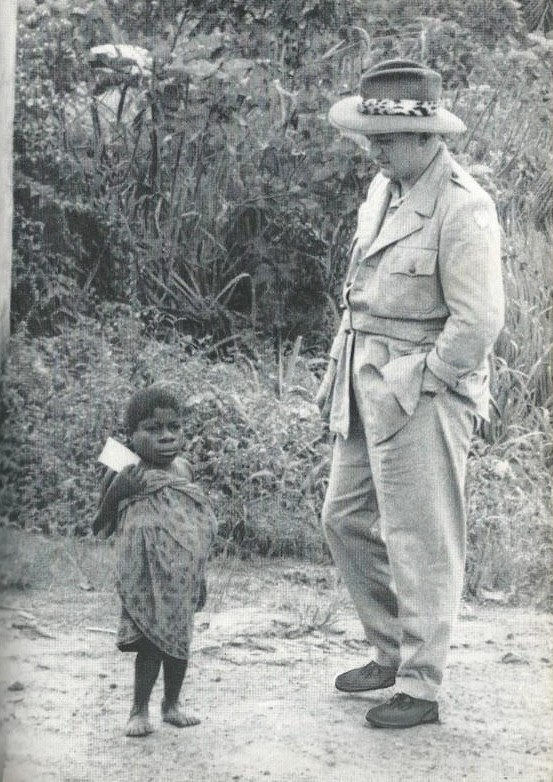
It is in Calibre .475 Express that one finds the photograph of the pygmy woman, “eighteen inches tall, full-grown, black, silent,” posing next to Prêtre. The caption accompanying the image reinforces the visual device that Clarice’s story problematizes: “This tiny woman, around twelve years old, is approximately five months pregnant and measures around 48 cm in height. She is holding in her hand a photograph that I gave her.”9
The gesture is visible: the girl is holding a piece of paper in her hand, and the explorer is beside her. But what the image shows is only the back of the photograph, not Prêtre’s portrait. The precise content of the photo remains invisible to the viewer and needs to be provided by the caption to produce the desired effect — that the woman would value the explorer, as one who keeps the image of an admired figure. The meaning of the gesture, therefore, does not originate from the photograph, but from the discourse that accompanies it.
This arrangement produces a subtle mise en abyme of colonial relations. The explorer would be symbolically present for the second time — miniaturized in the photo that she holds—, but this duplication remains hidden from whoever observes the scene. The woman is entirely exposed, while the explorer reappears only through verbal mediation, controlling what becomes visible and what remains opaque. The circulation of images — “like a box within a box” — reveals the asymmetry of this relation: each is transformed into proof of the existence of the other, but according to a logic in which the visibility of the colonized is total, and that of the colonizer, filtered and directed.
In the photograph published in the book, Prêtre is wearing a traveler’s hat in the tropics, exactly as Clarice writes in the story. This detail allows us to perceive a decisive aspect of her literary production: exactness of expression. The text introduces a small apparent contradiction: it speaks both of a hat and of a “symbolic helmet.” Clarice’s precision lies precisely there: by transforming the hat into a helmet, she displaces a banal accessory into the realm of metaphor. The traveler’s gesture, upon adjusting his hat after blushing like “a lime at dawn,” marks the attempt to recompose himself, to disguise the embarrassment caused by a confused desire, and to regain inner discipline. The banal hat is thus converted into a symbolic helmet: a barrier against the disturbance of perverse desire and an emblem of a supposedly civilizing power that needs to be continually reaffirmed.
This backdrop illuminates the story. When she parodies the tone of the “science of the tropics” — “In the tepid, wild mists, which swell the fruits early and make them taste almost intolerably sweet, she was pregnant” —, Clarice echoes the emphatic and crafty register of popular literature with a scientific veneer, of which Prêtre became an example. It is unlikely that she knew the editorial behind-the-scenes of Calibre .475 Express or the details of the explorer-writer’s trajectory; but it is plausible that she already intuited this universe in the magazine article about “the smallest woman in the world” — still not located —, in which exoticism, adventurous impetus, and a certain theatricality that her fiction took to the extreme were probably combined.
In the story, all this machinery is condensed into a single word: “explorer.” Prêtre’s name disappears, leaving only the role, repeated as title and mask. From then on, Clarice no longer needs to directly discuss the veracity of what was “discovered:” it is enough to let the word “explorer” resonate alongside a prose that imitates — and twists — the tone of the science that shares the colonialist perspective. She assumes this diction to, from within, make the opposite gesture: to show how this discourse relies on staging, desire, and spectacle. The “serious” language of Prêtre’s report thus reveals its novelistic basis.
2. Anchor Words and Layers of Repetition
The Deep and the False Initial Circle
The story opens with the location of the explorer’s adventure: “In the depths of Equatorial Africa …”, and ends the same paragraph with “So deeper still he plunged.” At first glance, the duplication of the lexical root suggests redundancy, making the first paragraph a circle that spins on itself.
But soon one realizes — and the repetition is the first indication of this process — that “deeper” does not function here as a simple adverb, but rather becomes one of the central concepts of the story. Highlighted from the beginning by the syntactic inversion (“deeper still he plunged”), the term gains emphatic rhythm and sonic force, thus guiding the vertical movement of the narrative. Each recurrence that converts a common word into an anchor word “deepens” this trajectory, and the repetition confers to the text its voracious form: a merely apparent circularity that, as it accumulates, is transformed into a descent.
The motif of depth, which emerges as a spatial displacement — penetrating the jungle, venturing into the Congo — takes up a commonplace of colonial literature that Joseph Conrad’s Heart of Darkness elevated to one of the highest points of anti-colonial criticism. Clarice Lispector takes up this motif and subverts it: each step “inward” is, in fact, a step “downward.” “Deeper” does not open perspectives: it closes them; it does not expand: it condenses. The expansionist expectation of the colonizer is converted into a contraction. The narrative stages a reductive movement, which shifts the horizontal advance through space to a vertical path towards depth. Going deeper is not about covering a distance, but about passing from the jungle to the body and from the body to the elemental condition of being alive. Under the cliché of exploration, the journey to the core of existence takes place. The Congo is at the same time landscape and metaphor: a place where the explorer, without realizing it, touches the depths of the human.
In Prêtre’s own account, the motif of “going deeper” is organized as a fantastical gradation. After speaking of the pygmies with whom he lived — presented as his “friends” — the explorer narrates a scientific expedition that takes him even deeper, in search of “une race inconnue de Pygmées réducteurs de têtes” (p. 177). The encounter culminates in groups described as “êtres si primitivetifs qu’ils ne semblent pas connaître le feu,” feeding on roots, caterpillars, and fruits (p. 188).
It is precisely at this point that the discourse falls into open contradiction: these same groups, presented as lacking even the mastery of fire, are described as capable of performing births through an operation “wholly similar to the caesareans performed in European hospitals,” preceded by an anesthesia obtained with “flowers and seeds” (p. 188). The extravagance does not indicate an indigenous technical knowledge, but the narrative need to produce spectacular equivalents of the European body — even at the cost of the internal coherence of the account.
This excessive discourse is revealing. The deeper the explorer claims to go, the more the text needs to inflate the exceptional, multiply the strange, and force improbable parallels. In the story, none of this subsists: there is no technique, no prodigy, no symbolic equivalence. Only the exposed body remains, pregnant, warm, subjected to the elemental risk of being devoured. This world of explorers against which Clarice writes is not abstract: it refers to a historical economy of violence and stigmatization, which operates through moving targets — black people, indigenous people, women — whenever difference needs to be reduced, classified, or neutralized.
This shift in meaning is consistent with one of Clarice’s obsessions: the lexicon of “depth” [fundo] as a metaphor for the essential. To cite only a few examples, in The Passion According to G.H., the narrator looks at the “backs [fundo] of all the apartments” before “the deepest” [fundo] event; in Água Viva, we read: “At the bottom [fundo] of everything there is the hallelujah.”10 The centrality of “depth” [fundo] in Clarice’s writing condenses the intuition that, beneath the layers of the everyday, there exists an unnamable, possibly mystical, depth.
In contrast, the story shows the flattening of the surface. The “smallest woman in the world” circulates in the Sunday supplement as a photograph in “life size.” What is a physical and geographical descent for the explorer — and an existential immersion for Clarice — reaches the reader as a flat image, ready for consumption, filtered, and neutralized. The report reduces the vortex to exoticism and transforms depth into an illustrated curiosity without demanding human understanding.
A Swiss Explorer, Actually
The term “explorer,” repeated twenty times throughout the more than 2,000-word story, organizes not the narrative, but the vocabulary of the text. The lexical insistence is not neutral: the story speaks less of the smallest woman than of the position from which she is initially presented. In the story’s opening, the narrator allows the explorer’s gaze to become apparent — his way of seeing, measuring, and framing — as the first filter of the scene. It concerns a partial, unstable focalization, which the text soon tensions and destabilizes.
Marcel-Georges Prêtre, the model for the character, was not a scientist: as we have seen, he was a traveler-adventurer, hunter of wild animals, and author of popular literature. The term “explorer,” used by the press and taken up by Clarice Lispector, carries ambivalence. On the one hand, it designates the discoverer, the one who ventures into unknown territories and describes them. On the other, in Portuguese the word [explorador] contains another meaning: one who exploits, appropriates lives, and exhibits bodies as rarities. In Prêtre’s case, the two meanings merge.
The repetition exposes this merger. By returning so many times, the word makes visible the artifice of that initial gaze: the role of the explorer needs to be constantly reaffirmed, and it is this reaffirmation that weakens him. The term, saturated, ceases to designate an individual and comes to function as an index of a device: it is no longer a character, but an operation.
In the end, the explorer is converted into a sign. He embodies the colonial logic of reducing the other, but the very excess of his repetition makes this logic falter. Clarice neither comments nor argues: it is enough to insist. The circle of naming becomes a critical spiral. The word, saturated, thinks for itself.
Irony of Thingification
The word “thing” appears more than a dozen times in the story — and never with the same weight. First, it is almost neutral: “The Likoualas use few names, referring to things with gestures and animal sounds.” Here “thing” designates inanimate objects — and it is the only time that the term contains this elementary meaning. Soon the term becomes loaded: “the smallest human thing in existence.” The adjective “human” does not annul the reduction, it only makes it more acute. What was neutral comes to be violent: a life named as an object.
In the civilized homes of newspaper readers, the word returns in an even more violent way. Before the photograph, someone says: “something that ought to be ‘dark like a monkey.'” Thingification is allied with animalization, and it is no longer the explorer who speaks, but ordinary readers — which brings the Bantu closer to citizens of the 20th century. The bourgeois gaze reactivates the same logic of dehumanization, and the repetition is duplicated: “that tiny and indomitable thing for himself, that thing spared from being eaten.” The thing-thing refrain hammers the reduction, as if language had lost any way of escape: the generic word is constrained to naming what resists names, insisting until it touches the grotesque.
The culmination of this process is the formula “rare thing.” It is not the explorer who utters it, but a mother reacting to the photograph: “But you must admit […] that we’re talking about a rare thing.” From then on, the expression is repeated eight times (!), becoming naturalized in the narrator’s discourse, as if it were an objective description. The repetition reinforces the irony: the noun that reduces (thing) and the adjective that exalts (rare) collide, exposing the mechanism that transforms a life into an object that is precious simply because it is dehumanized.
Furthermore, this repetition functions as a double of the very circulation of the photograph. The fame of the “smallest woman in the world” spreads because she is presented as a rare thing; the phrase, by echoing in the story, reproduces the way that this fame is built and stabilized. The refrain accompanies the logic of dissemination: that which is declared rare tends to be repeated until it is converted into evidence.
The diffusion of the expression rare thing proves the success of this device: by circulating in the supplement and echoing in homes, Little Flower does not appear as a subject, but as a curiosity that legitimizes the prestige of the discoverer. Repetition becomes corrosion: triumph is converted into fetishization. It is said that “no emerald is as rare” as the smallest woman: a living body equated with a precious stone. It is the logic of human zoos and freak shows, in which difference is treated as monstrosity. Clarice insists on the formula until it is exhausted, exposing the violence under the veneer of praise.
The anaphora, whose repetition confers rhythmic emphasis and semantic insistence on the idea of possession — “It is good to possess, good to possess, good to possess” —, resonates as an axis that sets the narrative in motion. It does not concern merely a childish phrase, but a kind of formula that reveals the voracity of desire: the word “possess,” repeated with the cadence of an incantation, vibrates the ambiguity between plenitude and lack, between immediate satisfaction and the threat of loss. What the explorer and the readers call a “rare thing” is, therefore, only the other side of the same mechanism: to possess/to be possessed, to be conserved/to be devoured. The obsessive repetition of the words “thing” and “rare” creates a circularity that ceaselessly points to the same blind spot: the impossibility of separating the desired object from the desire that devours it. Rarity, at the same time that it elevates the pygmy to the condition of exception, reduces her to a collectible object; and the “thing,” in its banality, converts the human into a commodity.
In this deforming mirror, the sense of possessing the smallest woman — vital, instinctive, geared towards survival — reflects and unmasks the desire for possession on the part of the civilized, which shows itself to be polished only on the surface. The question that arises, almost whispered but inescapable, is disturbing: who, after all, has never desired to possess a human being for oneself alone? Clarice does not leave this question unanswered: she documents it within the story, in the embedded narrative of the girl who died and, at the boarding school, served as a doll for her affection-deprived classmates. This episode shifts the paradox from the conceptual plane to the dead body, which is transformed into an object for playing and consolation. The girls’ gesture — cruel and innocent at the same time — makes palpable the tenuous boundary between tenderness and violence, desire and appropriation, thus showing that the same mechanism permeates “the forest and the school,”11 the “smallest woman in the world,” and civilized domesticity, the principle of devouring being the “world’s single law.”12
Profound Love
The climax of the story is in the “profound love” of the smallest woman. The verb to love pervades the text and, with each return, exhausts the word’s usual brilliance to reconfigure it as a minimal law. If the explorer heard her, he would “puff up with vanity” at being loved; then he “deflated in disappointment” upon learning that Little Flower also loved his ring and his boot. This love is diffuse, without hierarchy between people and objects. What sounds like debasement to the explorer is, for her, vital economy: everything can be loved, because everything can conserve life.
Hence the decisive formula: “one might even say her ‘profound love,’ because, having no other resources, she was reduced to profundity.” Profound takes up the descent dug ever since the beginning — “[i]n the depths of Equatorial Africa,” “deeper still he plunged” — and unites it with the field of love. The profundity here does not exalt; it reduces: a minimal, essential love. The following paragraph makes this explicit through anaphora: “love is not being eaten, love is thinking a boot is pretty, love is liking that rare color of a man who isn’t black, love is laughing with the love of a ring that sparkles.” Each repetition of love corrodes the sublime of the Western tradition and converts it into a vital core: to survive, to conserve, to laugh.
Maria Homem’s reading helps to specify this shift. For her, love in Clarice is structurally fractured and heterogeneous, marked by the impossible — impossible encounter, impossible dialogue, impossible to fully express affection.13 This condition permeates Family Ties, in which love irrupts as an indecipherable sensation in “Daydream and Drunkenness of a Young Lady,” and ends in an oscillation between love and hate, in the visceral confrontation of “The Buffalo.” Coming from this scenario of failed affections, it is surprising that “The Smallest Woman in the World” — placed almost in the middle of the book, preceding the story titled “The Dinner” — concentrates precisely the greatest insistence on the word love in the book. The story suspends the regime of the impossible: in the forest, without family, without ties, and without promise, love ceases to depend on frustrated reciprocity, truncated speech, and projection. It coincides with the vital impulse — not to be devoured, to rejoice in color, in beauty, to conserve the warmth of the body. Repetition shifts the term between these two poles: a culturalized love that fails and a minimal love for simple things that escapes fracture.
While the story descends into the “deep love” of the smallest woman — love without metaphors, almost zoological, reduced to the vital minimum — the families who leaf through the Sunday supplement seem to distance themselves further and further from this source. They “protect” their own, measure, comment, make jokes, cover the children, but they do not approach the vital dimension that Clarice exposes: in a world where living is always risking being devoured, to love is to protect — and to be loved is to run less risk.
The domestic love that becomes apparent in living rooms is often a sanitized love, tempered by good manners, moral excuses, and ready-made phrases. The most intimate layer of this affection, when it threatens to emerge — in the cruelty of the girls at the boarding school, in the mother’s bewilderment at her daughter’s fear — is soon covered by formulas of consolation. Familial “civilizations” function as a curtain: they maintain a stable surface so that the abyss of desire, fear, and violence which sustains these relations is not seen.
It is at this point that the false initial circle — the word that returns, the phrase that hesitates, the meaning that seems to spin upon itself — reveals its true nature. The accumulated repetition ceases to go around and begins to pull: it transforms the circle into a vortex. What seemed to be merely a return is, in fact, a fall.
In “The Smallest Woman in the World,” the minimal lexicon dug by its very insistence — deep, small, thing, rare, love — creates a sucking motion: each recurrence narrows the space, deepens the axis, forces the narrative downwards. The vortex is not a metaphor for the jungle, but for language: it is the point where repetition ceases to spin and begins to swallow meaning into its depths. Thus, love reduced to the vital does not close the circle; it precipitates it.
In this motion, “rare” returns inverted: if before the woman was a “rare thing,” now it is the explorer’s color that appears as unusual. The adjective changes target and exposes the arbitrariness of the classification. The closing is corporeal: “Little Flower blinked with love, and laughed warm, tiny, pregnant, warm.” The double occurrence of “warm,” reinforced by epiphora, involves “tiny” and “pregnant” as a physical refrain — and mirrors, by contrast, the language employed in the opening. There, pregnancy was inscribed in the “tepid, wild mists” that swell the fruits early and make them “almost intolerably sweet:” a “civilized” vocabulary, inherited from medico-racial theories that read warmth as a sign of precocity and degeneration. Here, the same phenomenon — warmth, growth, maturation — appears named in another register, direct and corporeal. The climate is no longer an explanatory metaphor: it becomes the warm laughter and pregnant body of Little Flower.
In the end, this rhetoric returns reduced to the basics: warmth, body, pregnancy. The theory comes undone; the experience remains. That is how the repetition becomes fixed: the deep touches the small, the rare approaches the grotesque, and love is shown as a minimal gesture of life.
“Profound love” is thus the conceptual culmination of the story. It gathers and condenses the repetition of the anchor words — depth, smallness, thing, rarity, love — and shows how Clarice thinks through insistence. The repetition digs until it exposes the foundation: the minimal and absolute condition of life. At bottom, love is neither exclusivity nor transcendence, but a truce against being devoured. The vital core of existence is not uttered in abstracts, but in refrains: “it is good to possess,” “love is not being eaten,” “warm, warm.” The circle is transformed into a vortex — and what remains is the grammar of the essential.
Minimal Poetics
In “The Smallest Woman in the World,” Clarice transforms repetition into a method: minimal words return until they are converted into concepts. What seemed to be redundancy opens layers of meaning and makes language an instrument of thought. This verbal economy dismantles the colonial logic of “discovery:” Marcel Prêtre’s photograph stages the exotic, but the repetition reveals that the scandal is not in the diminutive body, but in the gaze that transforms it into a rarity — into a thing. By alternating between jungle and living room, the story shows that the abyss is not geographical, but ethical: civilized banality also devours, as domestic clichés suggest — “what a rarity,” “poor thing,” “God knows what He’s doing.” For Clarice, to repeat is to insist on the minimal until the essential is unveiled: to go deeper, where to survive is not to be devoured, and where language, opening and closing upon itself again, finds in repetition its way of thinking.
- Benedito Nunes: O drama da linguagem. São Paulo: Ática, 1989, p. 135.[↩]
- Luciana Stegagno-Picchio: História da Literatura Brasileira. Rio de Janeiro: Nova Aguilar, 1997, p. 610.[↩]
- Walnice Nogueira Galvão: “Clarice Lispector: Uma Leitura”. Revista de Crítica Literaria Latinoamericana, 1998, Ano 24, No. 47, p. 72.[↩]
- Stegagno-Picchio, p. 611.[↩]
- Clarice Lispector: “Appendix: The Useless Explanation.” Complete Stories. Translated by Katrina Dodson. New York: Random House, 2022, p. 628.[↩]
- Clarice Lispector, “The Smallest Woman in the World,” in Complete Stories. Translated by Katrina Dodson. New York: Random House, 2022. Available at: https://www.tabletmag.com/sections/arts-letters/articles/the-smallest-woman-in-the-world.[↩]
- For information on the first editions and their context cf. https://toutdard.fr/book/calibre-475-express/. Acesso 10/08/2025.[↩]
- Extensive literature on Prêtre and his “hunt for success” can be found in Dasen, Véronique. et al. “Curieux petits hommes”. Corps, 2013/1 No. 11, 2013, p. 299-303. Online shs.cairn.info/revue-corps-2013-1-page-299?lang=fr. Accessed August 10,2025.[↩]
- Marcel–G. Prêtre: Calibre 475 Express. Grandes chasses africaines. Récits dʼaventures. Préface de Jean Gérin, guide de chase à Fort-Archambault. Paris: Éditions de la Pensée Moderne, 1955, p. 32.[↩]
- Clarice Lispector: Água Viva. Translated from the Portuguese by Stefan Tobler. New York: New Directions, 2012. p. 29.[↩]
- Oswald de Andrade: “Manifesto of Pau-Brasil Poetry.” Latin American Literary Review, Vol. 14, No. 27, Brazilian Literature [Jan. – Jun., 1986], p. 187.[↩]
- Oswald de Andrade: “Cannibalist Manifesto.” Latin American Literary Review, Vol. 19, No. 38 [Jul. – Dec., 1991], p. 38.[↩]
- Maria Homem: “Notas sobre o impossível: dizer e amor em Clarice Lispector.” Revista Insight, 2001. Available at: https://mariahomem.com/uncategorized/notas-sobre-o-impossivel-dizer-e-amor-em-clarice-lispector-dizer-o-amor-em-clarice-lispector/. Accessed Sept. 20, 2025.[↩]