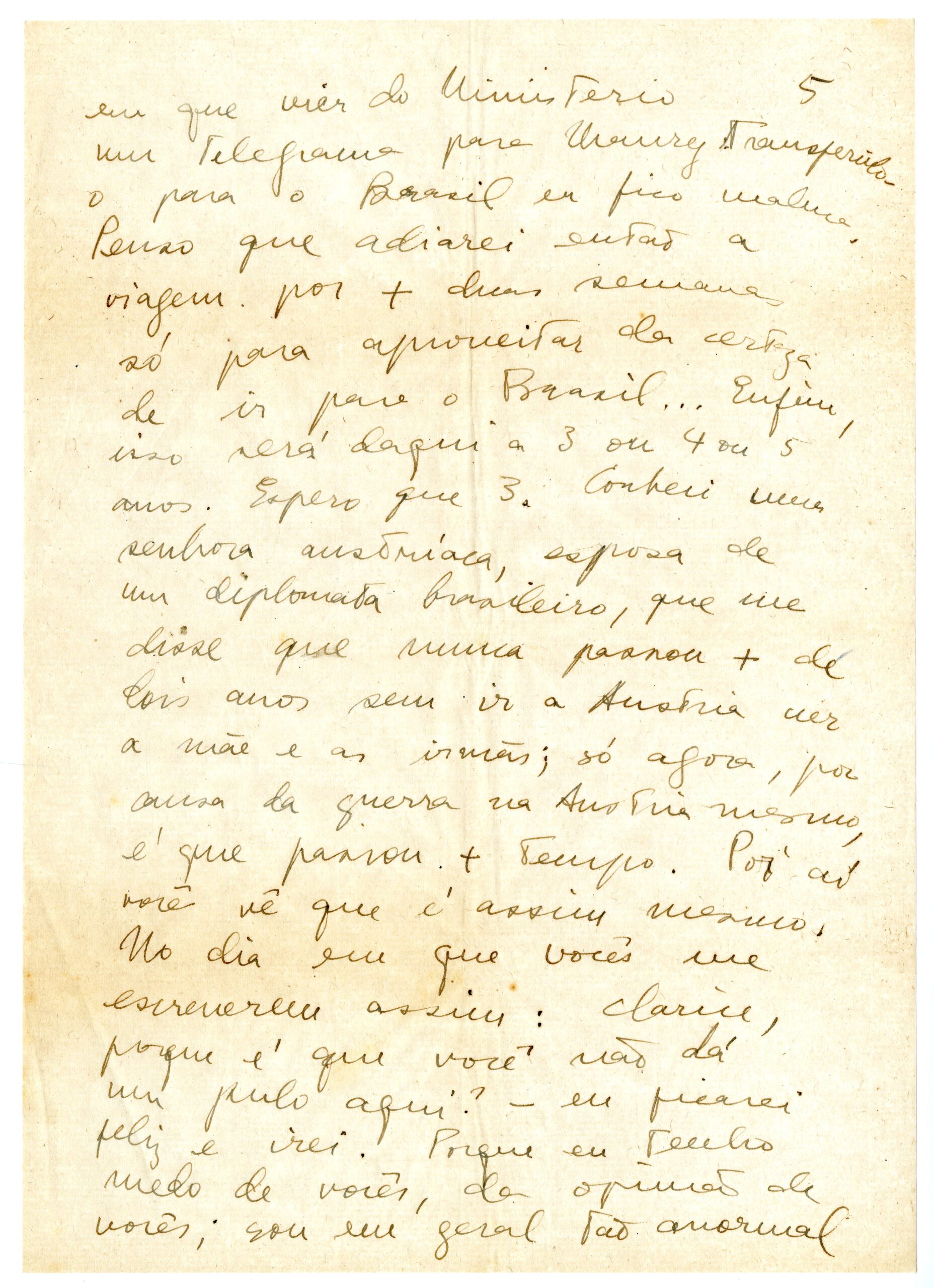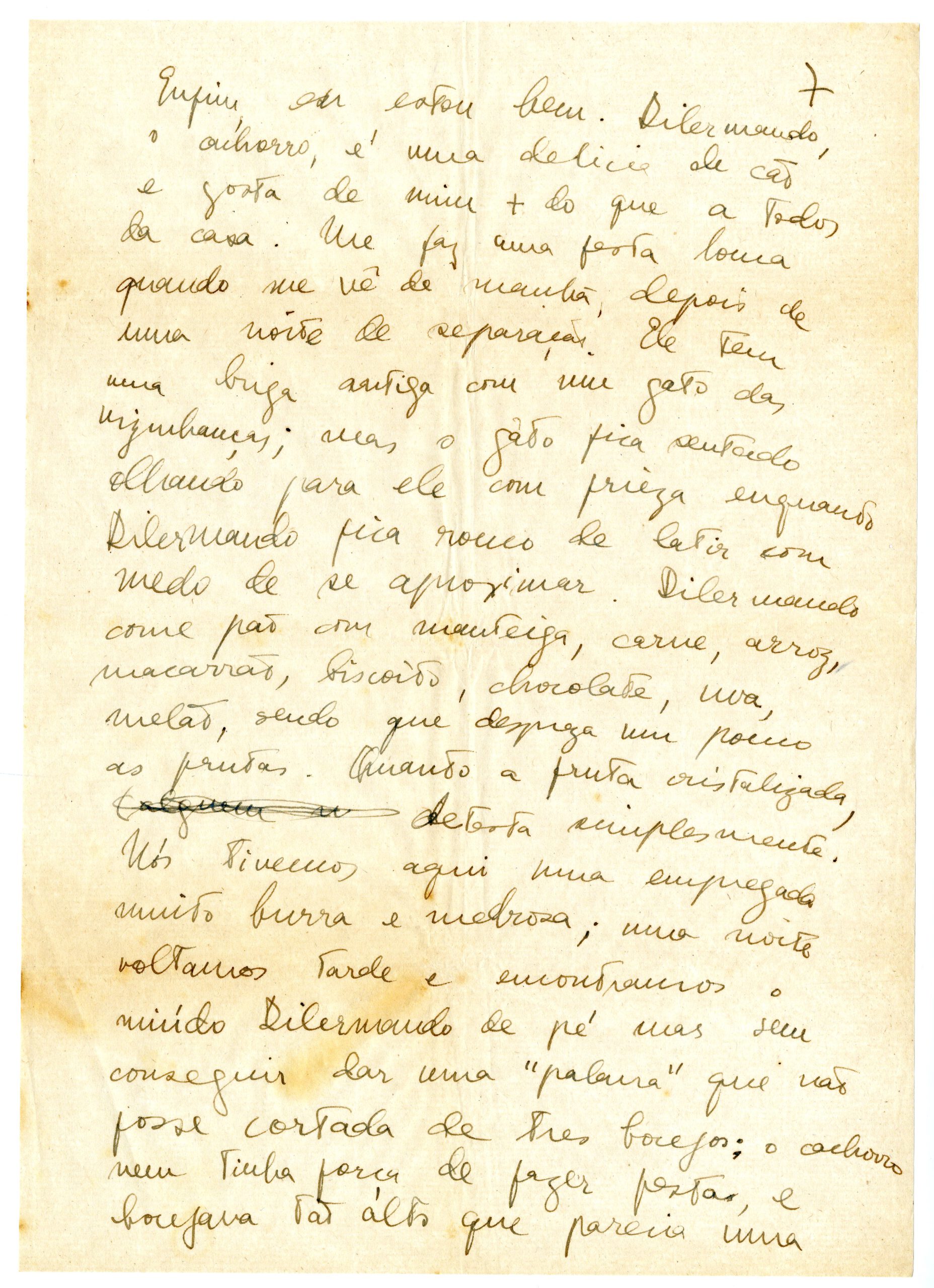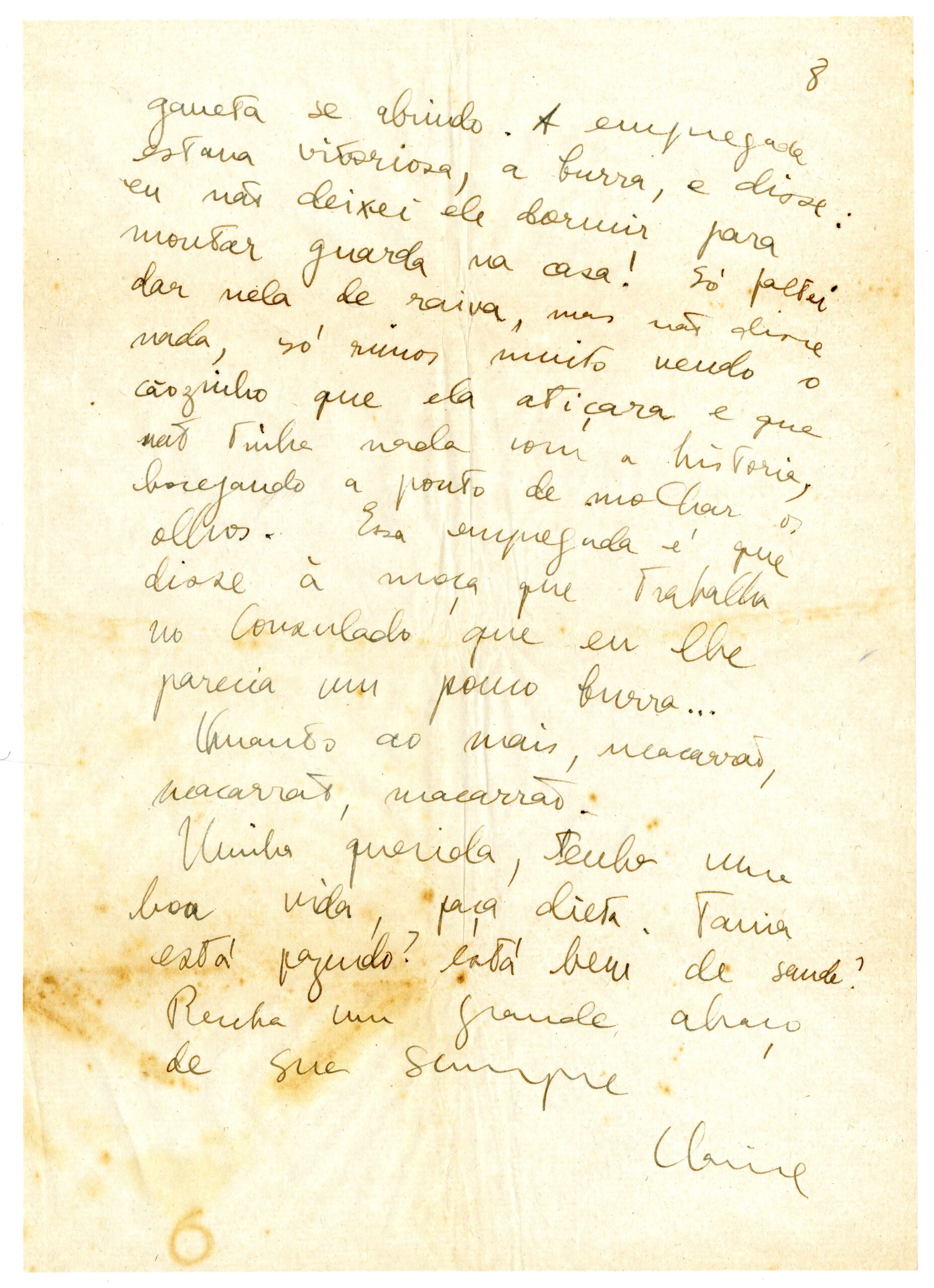
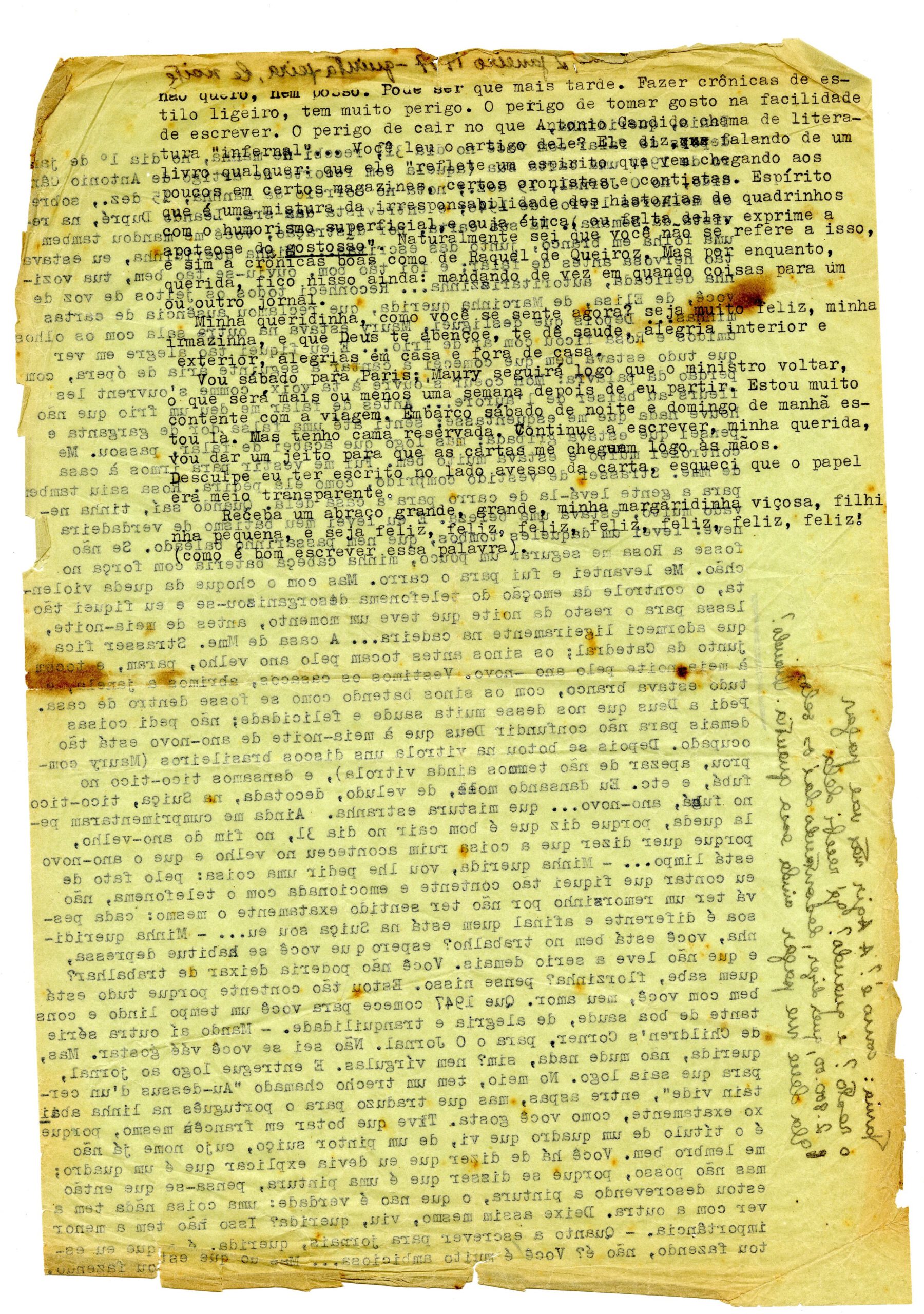
From: Clarice Lispector
To: Tania Kaufmann

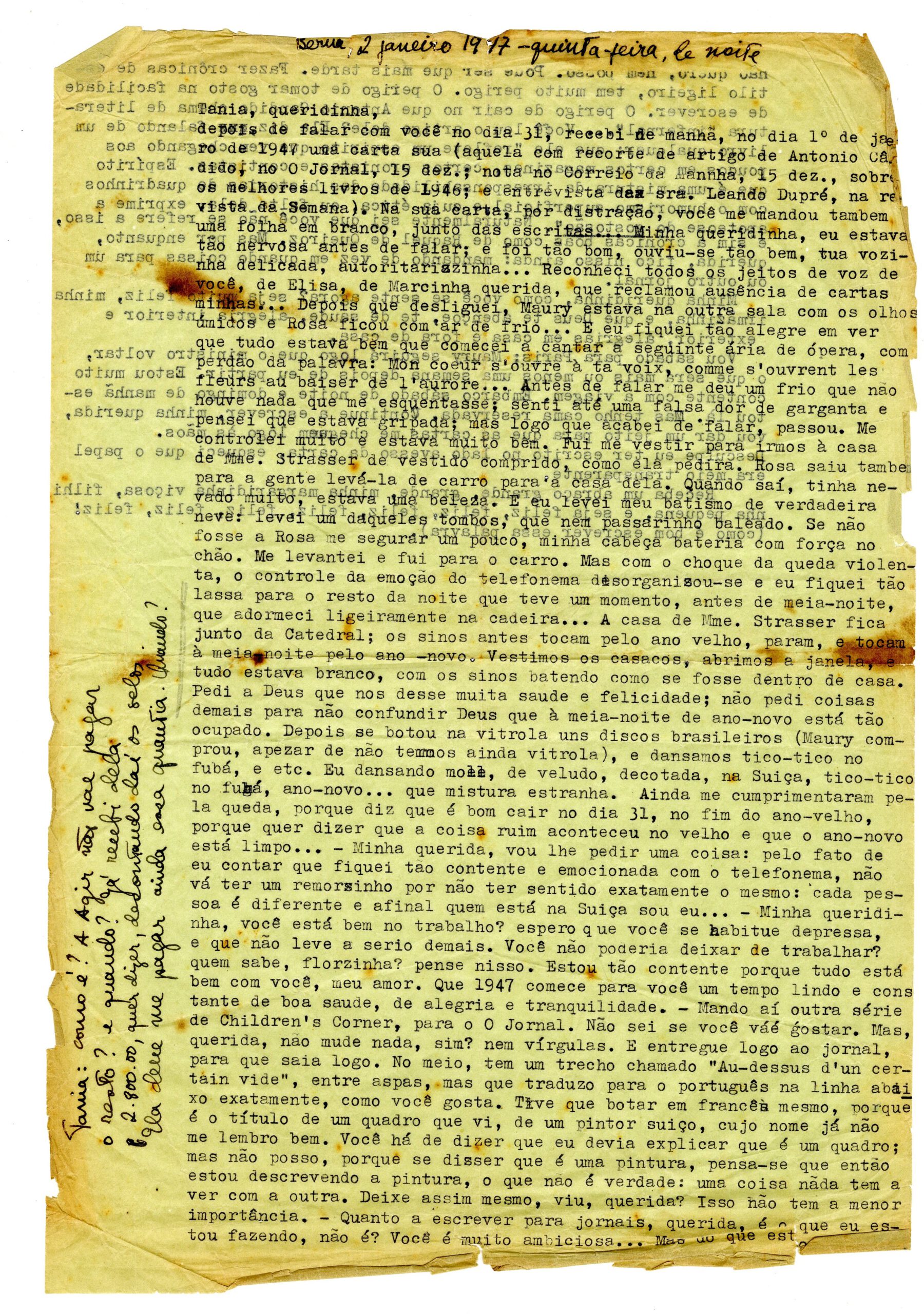
Bern, January 2, 1947
Thursday night

Tania, darling,

After speaking with you on the 31st, I received a letter of yours in the morning, on the 1st of January, 1947 (the one with the clipping of Antonio Cândido’s article in O Jornal, December 15; a note in the Correio da Manhã, Dec. 15., about the best books of 1946; the interview with Mrs. Leandro Dupré in the magazine Semana). In your letter, distractedly, you also sent me a blank sheet, next to the writings… My darling, I was so nervous before I spoke; and it was so good, one could hear so well your delicate little voice, a bit authoritarian… I recognized all the voice mannerisms of you, of Elisa, of dear Marcinha, who complained about the absence of letters from me… After I hung up, Maury was in the other room with teary eyes and Rosa took on a cold air… And I was so glad to see that everything was fine that I began to sing the following opera aria, excuse my French: Mon coeur s’ouvre à ta voix, comme s’ouvrent les fleurs au baiser de l’aurore… (“my heart opens to your voice, like the flowers open to the kiss of dawn.”) Before I spoke, I felt chills and nothing could warm me up; I even falsely felt I had a sore throat and thought I had the flu; but as soon as I finished speaking, it passed. I controlled myself a lot and was fine. I went to get dressed to go to Mme. Strasser’s house in a long dress, as she had requested. Rosa also left so we could drive her to her house. When I left it had snowed a lot, it was beautiful. And I received my true snow baptism: I had one of those true falls, like a bird shot in the air. If it weren’t for Rosa holding me a little, my head would have hit the ground hard. I got up and went to the car. But with the shock of the violent fall, the emotional control of the phone call became disorganized and I became so fatigued for the rest of the night that there was a moment before midnight that I fell asleep slightly in the chair… Mme. Strasser’s house is next to the Cathedral, the bells ring first for the old year, stop, and ring at midnight for the new year. We put on our coats, opened the window, and everything was white, with the bells ringing as if they were inside the house. I asked God to give us much health and happiness, I didn’t ask for too many things in order not to confuse God, who at midnight on New Year’s Eve is so busy. Then some Brazilian records were put on the player (Maury bought them, although we don’t yet have a player), and we danced tico-tico no fubá etc. Me, dancing softly, in velvet, low-cut, in Switzerland, tico-tico no fubá (“Tico-tico no fubá” (1917), by Zequinha de Abreu, was recorded by Carmen Miranda.), New Year’s… what a strange mix. They even complimented me for the fall, because they say it is good to fall on the 31st, at the end of the old year, because it means that the bad thing happened in the old year and the new year is clean… – My dear, I’m going to ask something of you: the fact that I told you I was so happy and emotional with the phone call, don’t have any regrets for not feeling exactly the same: Each person is different and after all I’m the one in Switzerland… – My darling, are you OK at work? I hope you get used to it soon, and don’t take it too seriously. Couldn’t you stop working? Who knows, little flower? Think about it. I’m so happy because everything is fine with you, my love. May the year 1947 begin for you a beautiful and constant time of good health, joy and tranquility. – I’ll send another series of “Children’s Corner” for O Jornal. I don’t know if you’ll like it. But dear, don’t change anything, okay? Not even commas. And give it to the paper right away so that it comes out soon. In the middle, there’s a passage called “Au-dessus d’un certain vide,” in quotes, but I translate it in the line below into Portuguese exactly, as you like it. I had to put it in French because it is the title of a painting I saw, by a Swiss painter, whose name I can’t remember very well. You’re going to say that I should explain that it is a painting; but I can’t, because if I say that it’s a painting, then one will think that I’m describing the painting, which is not true: one thing has nothing to do with the other. Leave it like that, okay, dear? It’s not important. – As for writing for the papers, darling, that’s what I’m doing, isn’t it? You are very ambitious… I don’t want to do more than what I’m doing, nor can I. Maybe later. There’s a lot of danger in writing chronicles in a hasty style. The danger of taking pleasure in the ease of writing. The danger of falling into what Antonio Cândido calls “infernal” literature… Did you read his article? He says, speaking of some book: that it “reflects a spirit that has been arriving gradually in certain magazines, certain chroniclers and short story authors. A spirit that is a mix of comic book irresponsibility with superficial humor, and whose ethics, or lack thereof, expresses the apotheosis of the hottie.” Naturally, I know that you don’t refer to this, but to the good chronicles such as those of Raquel de Queiroz. But for now, darling, this is how it’ll be: sending things now and again to one newspaper or another.

My darling, how do you feel now? Be very happy, my dear sister, and God bless you, give you health, inner and outer joy, joys at home and away from home.

I’m going to Paris on Saturday: Maury will follow as soon as the minister returns, which will be about a week after I leave. I’m very happy about the trip. I board Saturday night and Sunday morning I’m there. But I have a bed reserved. Keep writing, my dear, I’ll arrange for the letters to reach me soon. Sorry I wrote on the wrong side of the letter, I forgot the paper is sort of transparent.

A big, big hug for my sweet little daisy, little girl, and be happy, happy, happy, happy, happy, happy, happy! (how good it is to write this word).

Tania: what’s going on? Isn’t Agir going to pay the rest? And when? I’ve already received 2,800.00 from them, that is, discounting the stamps. They still have to pay me that amount. When? 
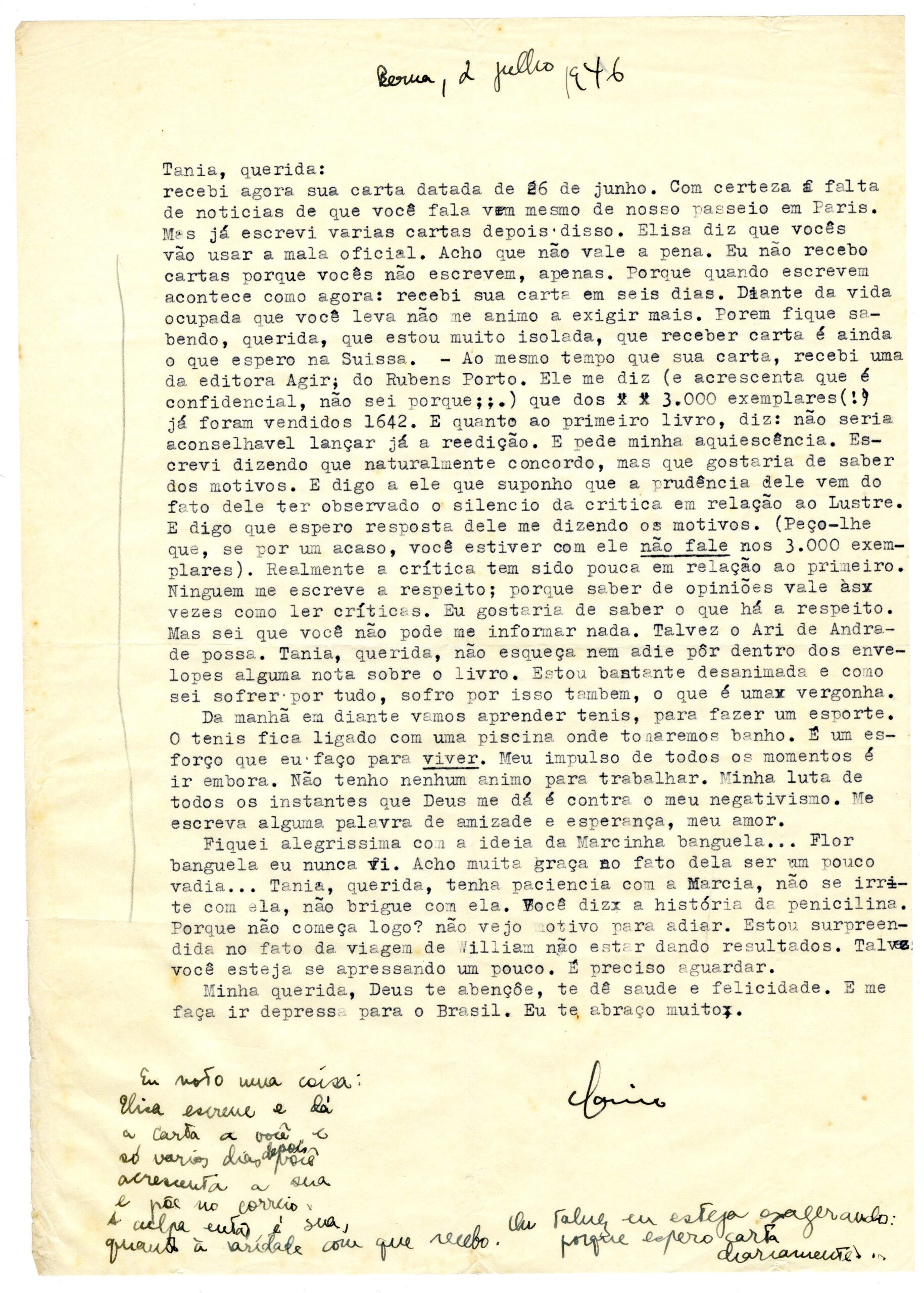
From: Clarice Lispector
To: Tania Kaufmann

Bern, July 2, 1946

Tania, darling:

I just received your letter dated 26 June. Certainly, the lack of news that you speak of comes from our tour in Paris. But I’ve already written several letters after that. Elisa says you are going to use the diplomatic mail. I don’t think it’s worth it. I simply don’t get letters because you don’t write. Because when you do it happens like it does now: I received your letter in six days. In view of the busy life you lead, I don’t encourage myself to demand more. But know, dear, that I am very isolated, that receiving a letter is still what I hope for in Switzerland. – At the same time as your letter, I received one from the publishing house Agir; from Rubens Porto. He tells me (and adds that it is confidential, I don’t know why) that of the 3,000 copies (!) 1,642 have already been sold. As for the first book, he says: it would not be advisable to launch the reissue now. And he asks for my acquiescence. I wrote saying that naturally I agree, but that I would like to know the reasons. And I tell him that I suppose that his prudence comes from the fact that he observed the silence of criticism in relation to O Lustre. And I say I expect an answer telling me the reasons. (I ask that, if you happen to be with him, do not mention the 3,000 copies). Truly, the reviews have been few compared to the first book. Nobody writes to me about it; because knowing opinions is sometimes worth as much as reading reviews. I would like to know what there is, in this respect. But I know you can’t tell me anything. Perhaps Ari de Andrade can (the poet and journalist Ari de Andrade was a contributor to the magazine Vamos Lêr!). Tania, dear, don’t forget or postpone putting some notes on the book inside the envelopes. I am very discouraged and as I know how to suffer with everything, I suffer with this, too, which is a shame.

From tomorrow on we are going to learn how to play tennis, to have a sport. The tennis court is connected to a swimming pool where we will bathe. It is an effort that I make to live. My impulse at all times is to leave. I have no spirit to work. My struggle in all the moments that God gives me is against my negativism. Write me a word of friendship and hope, my love.

I was very happy with the idea of a toothless Marcinha … a toothless flower I’ve never seen. I find it very funny that she is a bit sassy.

… Tania, darling, be patient with Marcia, don’t get angry at her, don’t fight with her. You mention the story about penicillin. Why don’t you begin soon? I see no reason to postpone. I’m surprised that William’s trip is not paying off. Maybe you are hurrying a little. You have to wait.

My dear, God bless you, and give you health and happiness. And make me go to Brazil quickly. I give you many hugs.

Clarice

From: Clarice Lispector
To: Tania Kaufmann

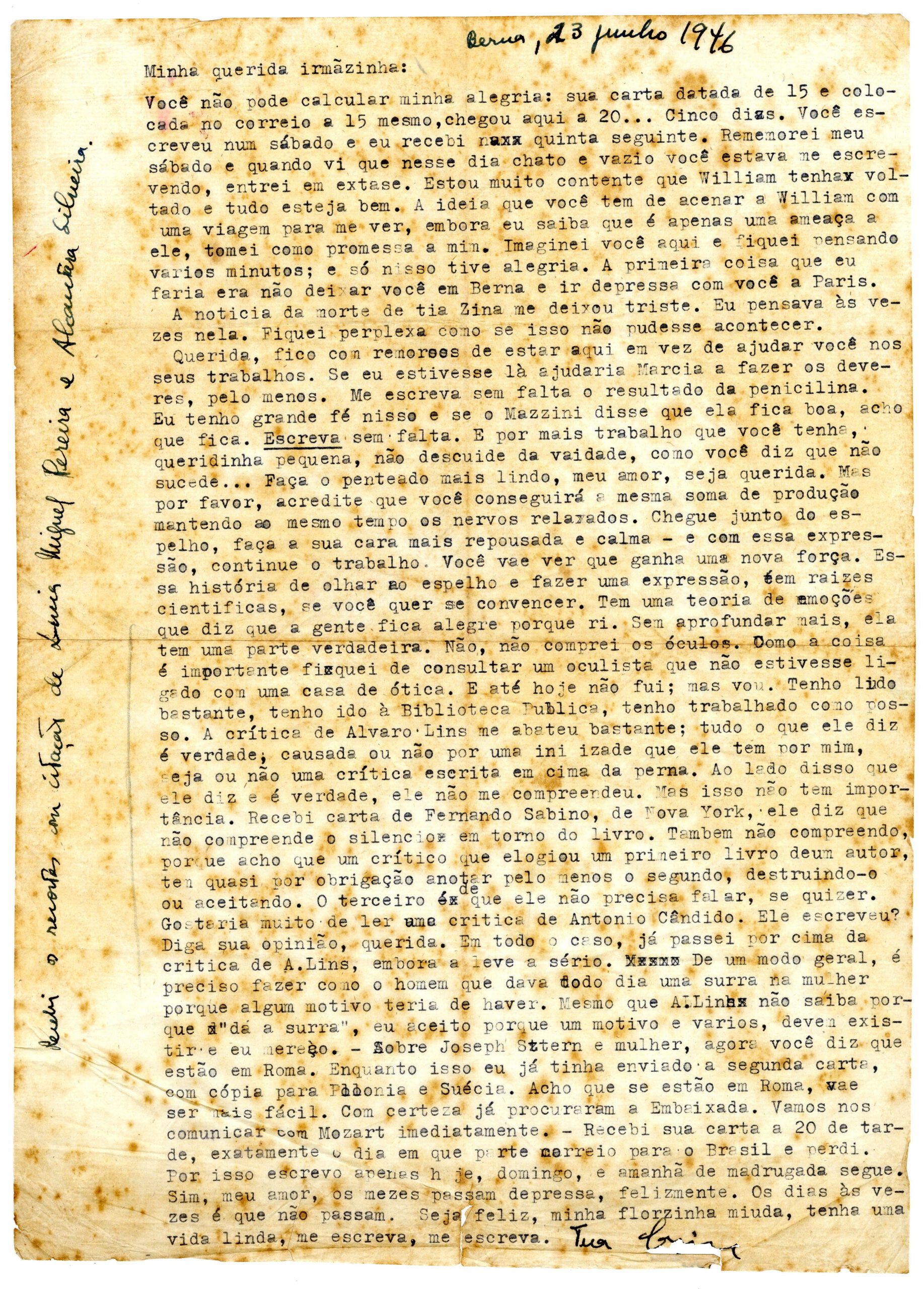
Bern, June 23, 1946

My dear sister,

You can’t imagine my joy: your letter dated the 15th and posted in the mail immediately on the 15th, arrived here on the 20th … Five days. You wrote on a Saturday and I received it the following Thursday. I recalled my Saturday and when I saw that on that boring and empty day you were writing to me, I went into ecstasy. I’m very happy that William is back and everything is fine. Your idea of suggesting to William a trip to see me, although I know it is only a threat to him, I took as a promise to me. I imagined you here and I was thinking for several minutes, and this alone gave me joy. The first thing I would do was not to leave you in Bern and go with you quickly to Paris.

The news of the death of Aunt Zina (The sister of Mania Lispector, Clarice’s mother, lived in Recife.) made me sad. I thought about her sometimes. I was perplexed as if that couldn’t happen.

Honey, I have regrets about being here instead of helping you with your work. If I were there I would help Marcia to do her homework, at least. Write me without fail with the result of the penicillin. I have great faith in it and if Mazzini said she will get better, I think she will. Write without fail. And now matter how much work you have, little darling, don’t neglect vanity, although you say this doesn’t happen … Make your hair more beautiful, my love, be well-liked. But please, believe that you will be able to produce the same amount keeping your nerves relaxed at the same time. Go to the mirror, assume your more rested and calm expression – and with that face, continue the work. You will see that you gain a new strength. This practice of looking in the mirror and making an expression, it has scientific roots. If you want to convince yourself. There is a theory of emotions which says that we are happy because we laugh. Without going any further, it is partially true. No, I didn’t buy the glasses. Since it is important, I was supposed to consult an optician who was not connected to an eyeglass store. And to this day I haven’t been; but I’ll go. I have been reading a lot, I have been going to the Public Library, I’ve been working as I can. The review by Álvaro Lins (“And his note saying that my two novels are mutilated and incomplete, that Virginia is like Joana, that the characters have no reality, that many people take Claricinha’s nebulosity as being the very essential reality of romance, that I always shine, shine too much, excessive exuberance … ” (Letter from Clarice Lispector to Fernando Sabino. Bern, 6/19/46. Cartas Perto do Coração. Record, 2001.)) depressed me, everything he says is true, whether or not caused by an enmity he has for me, whether or not a review written haphazardly. Besides what he says and it is true, he did not understand me.

But it doesn’t matter. I received a letter from Fernando Sabino, from New York, he says he doesn’t understand the silence around the book. I don’t understand either, because I think that a critic who praised a first book of an author, has almost an obligation to at least note the second one, destroying it or accepting it. Then he doesn’t need to talk about the third one, if he doesn’t want to. I would love to read a review by Antonio Cândido. Did he write one? Give your opinion, dear. In any case, I have already gotten past A. Lins’ criticism, although I take it seriously. In general, it is necessary to do like the man who beats his wife every day because there’s got to be some reason. Even though A. Lins doesn’t know why he is  “giving a beating,” I accept it because one and several reasons must exist and I deserve it. – About Joseph Sztern and his wife, now you say they are in Rome. In the meantime, I had already sent the second letter, with a copy to Poland and Sweden. I think if they are in Rome, it will be easier. Surely they already looked for the Embassy. We will communicate with Mozart immediately. – I received your letter on the afternoon of the 20th, exactly the day that the mail leaves for Brazil and I missed it.

That’s why I’m writing only today, Sunday, and tomorrow morning it will be sent. Yes, my love, the months pass quickly, fortunately. The days sometimes don’t, though. Be happy, my little tiny flower, have a beautiful life, write me, write me.

Your Clarice

I received the clippings with quotes from Lucia Miguel Pereira and Alcântara Silveira.

From: Clarice Lispector
To: Tania Kaufmann

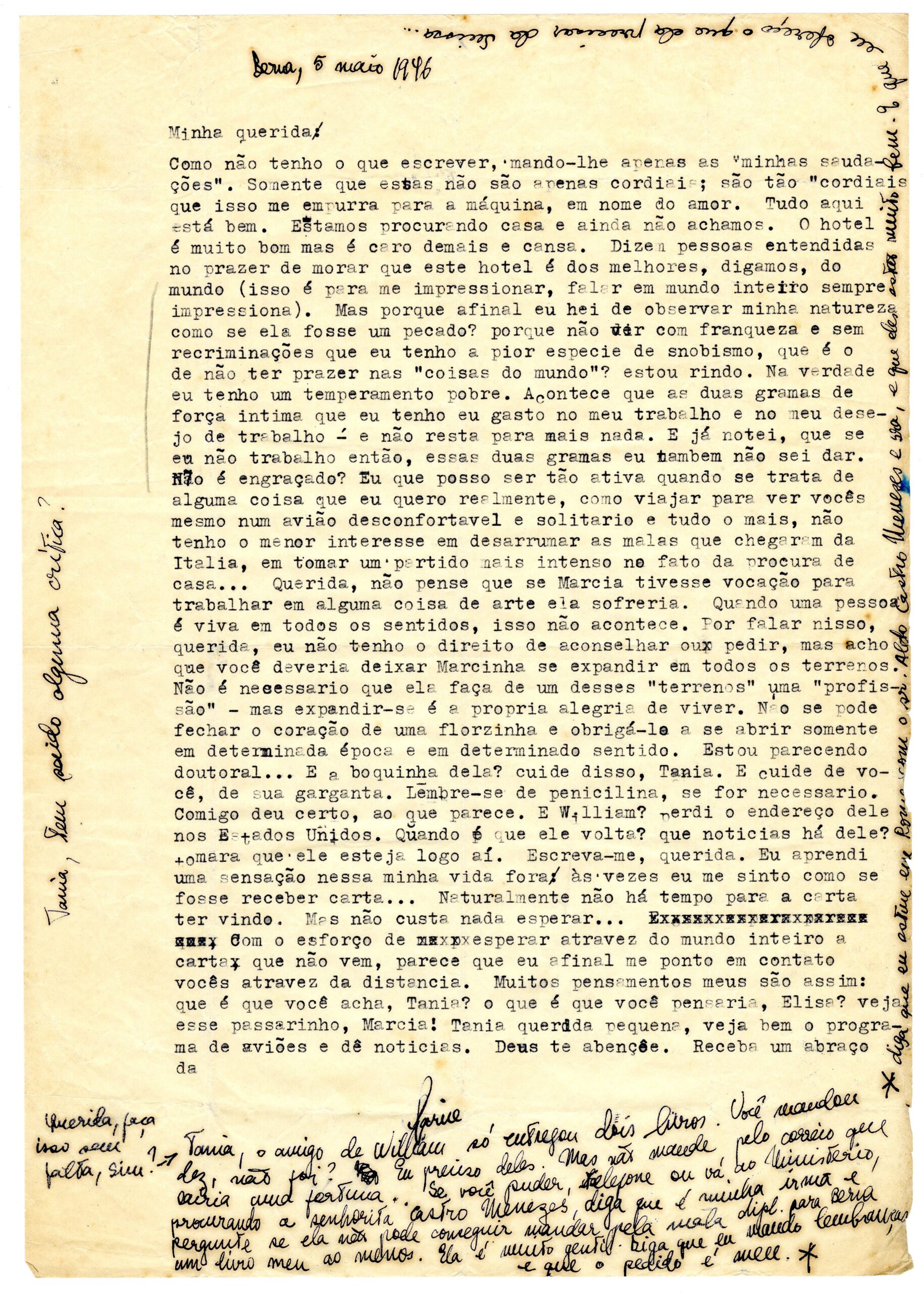
Bern, May 5, 1946

My dear:

Since I have nothing to write, I just send you “my greetings.” However these are not just cordial; they are so cordial that it pushes me to the typewriter in the name of love. Everything here is fine. We’re looking for a house and we still haven’t found one. The hotel is very good but it is too expensive and tiresome. People who are knowledgeable about the pleasure of living say that this hotel is one of the best in the world (this is to impress me, speaking of the whole world always impresses). But why am I supposed to observe my nature as if it were a sin? Why not see frankly and without recrimination that I have the worst kind of snobbery, which is not taking pleasure in the “things in the world?” I’m laughing. Actually, I have a poor temperament. It turns out that the two grams of private strength that I have I spend on my job and my desire to work – and there’s nothing left for anything else. And I already noticed that if I don’t work, then I don’t know how to give those two grams either. Funny, isn’t it? Me, who can be so active when it comes to something I really want, like traveling to see you all, even on an uncomfortable and lonely plane and all, won’t have an interest in unpacking the bags that arrived from Italy, or take a more intense interest in the search for a house … Darling, don’t think that if Marcia had a vocation to work on something in the arts, she would suffer. When a person is alive in every sense, this doesn’t happen. By the way, dear, I have no right to advise or ask, but I think you should let Marcinha expand into all terrains. It is not necessary for her to make one of these “terrains” into a “profession” – but expanding oneself is the very joy of living. One cannot close the heart of a little flower and force it to open only at certain times and in a certain sense. I sound scholarly… And William? I lost his address in the United States. When will he be back? What news is there of him? I hope he returns soon. Write to me, dear. In this life of mine abroad I’ve learned to feel sometimes as if I were going to receive a letter  … Of course, there hasn’t been enough time for a letter to come. But it’s worth the wait … With the effort of waiting across the entire world for the letter that does not come, it seems that after all I get in touch with you across the distance. Many of my thoughts are like this: what do you think, Tania? What would you think, Elisa? You, this little bird, Marcia! Tania dear little one, take a good look at the airplane schedule and give us news. God bless you. A hug from

Clarice

Tania, William’s friend only delivered two books. You sent ten, didn’t you? I need them. But don’t send them in the mail because it would cost a fortune. If you can, call or go to the Ministry, look for Miss Castro Menezes, say that you are my sister and ask if she can send them through the diplomatic mail to Bern, at least one book of mine. She is very kind. Say that I send my regards and that the request is mine. Say that I’ve been in Bern with Mr. and Mrs. Aldo Castro Menezes, and that they are doing very well. And that I offer whatever she needs from Switzerland.

Darling, make sure you do it, ok?

Tania, have any reviews come out?

From: Clarice Lispector
To: Tania Kaufmann

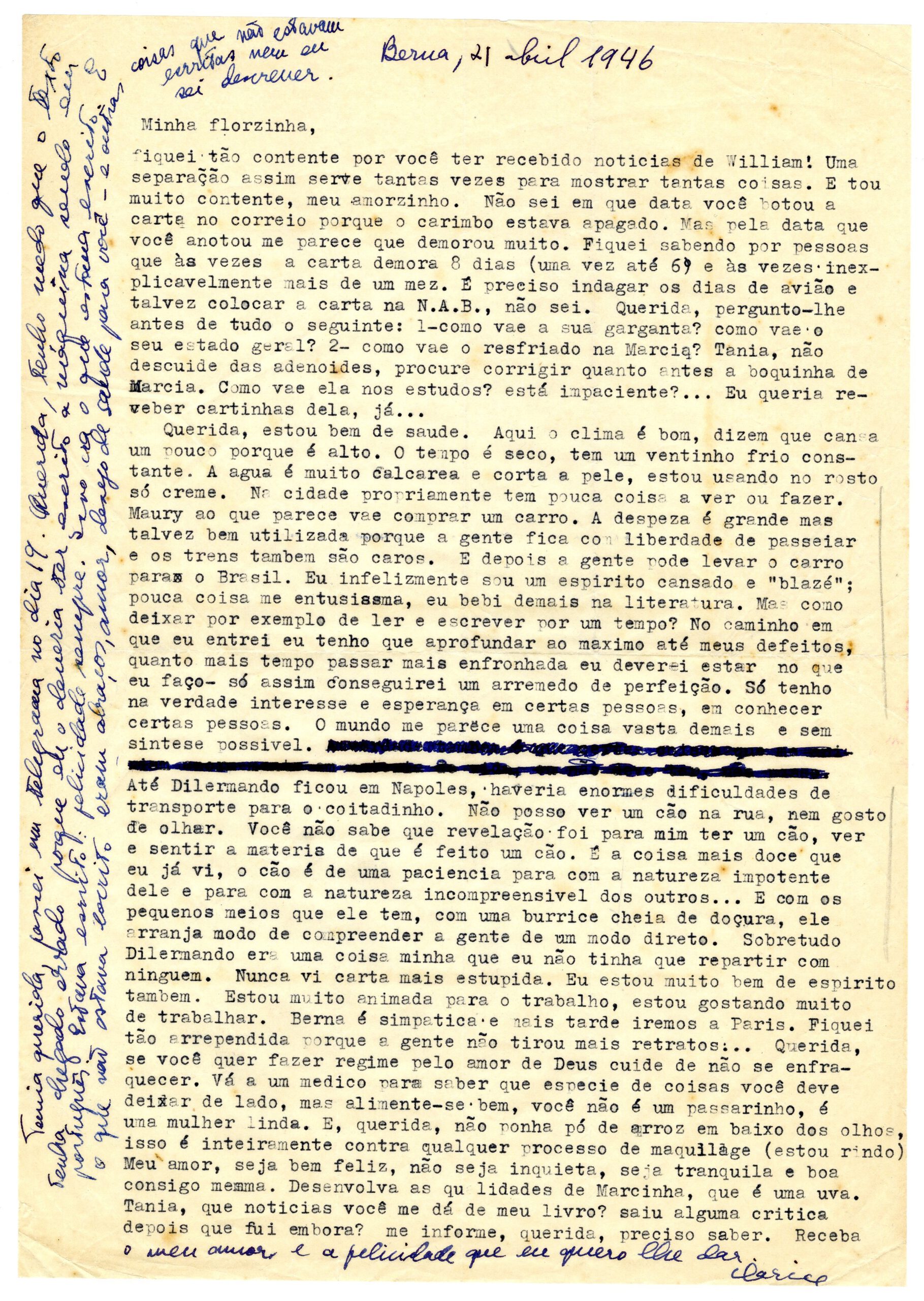
Bern, April 21, 1946

My little flower,

I was so glad you received news from William! A separation like that often serves to show so many things. I’m very glad, my sweetheart. I don’t know what day you put the letter in the mail because the stamp was rubbed out. But from the date you noted, it seems to me that it took a long time. I heard from people that sometimes the letters take 8 days (once up to 6) and sometimes inexplicably more than a month. You need to inquire about the days of the airplane and maybe put the letter on the NAB [Brazilian Navigation Airline], I don’t know. Darling, I ask first of all the following: 1 – How’s your throat? How’s your general condition? 2 – How’s Marcia’s cold? How’s she doing with her studies? Is she impatient?… I’d like to be receiving letters from her…

Darling, I’m in good health. Here the weather is good, they say it’s a bit tiring because it is high. It’s dry, there’s a constant chilly breeze. The water is very calcareous and abrasive to the skin, I’m using only lotion on my face. In the city proper there is little to see or do. Maury is apparently going to buy a car. The expense is great but perhaps well used because we’ll be free to travel around and the trains are also expensive. And afterwards we can take the car to Brazil. I am unfortunately a tired and “blasé” spirit; little excites me, I drank too much from literature. But how to stop, for example, reading and writing for a while? On the path I’ve entered I have to delve as much as possible even into my faults, the more time I spend the braver I should be in what I do- only then will I achieve a mock perfection. I really only have interest and hope in certain people, in getting to know certain people. The world seems to me to be too vast and without a possible synthesis. Even Dilermando stayed in Naples, there would be enormous difficulties in transporting the poor fellow. I can’t see a dog on the street, nor do I like to look. You don’t know what a revelation it was for me to have a dog, to see and feel the stuff that a dog is made of. It’s the sweetest thing I’ve ever seen, the dog is so patient with his helpless nature and with the incomprehensible nature of others… And with the little means he has, with a stupidity full of sweetness, he finds a way to understand us in a direct way. Above all Dilermando was something of mine that I didn’t have to share with anyone. I’ve never seen a more stupid letter. I’m in very good spirits, too. I’m very excited about work, I’m really enjoying working. Bern is nice and later we will go to Paris. I was so sorry because we didn’t take any more pictures. Darling, if you want to go on a diet for the love of God take care not to weaken yourself. Go to a doctor to find out what sorts of things you should leave out, but eat well, you’re not a bird, you’re a beautiful woman. And, darling, don’t put rice powder under the eyes, this is entirely against the rules of makeup (I’m laughing). My love, be very happy, don’t be restless, be calm and good with yourself. Develop Marcinha’s qualities, she’s a delight. Tania, what news do you give me of my book? Have any reviews come out since I left? Inform me, dear, I need to know. Receive my love and the happiness I want to give you.

Clarice

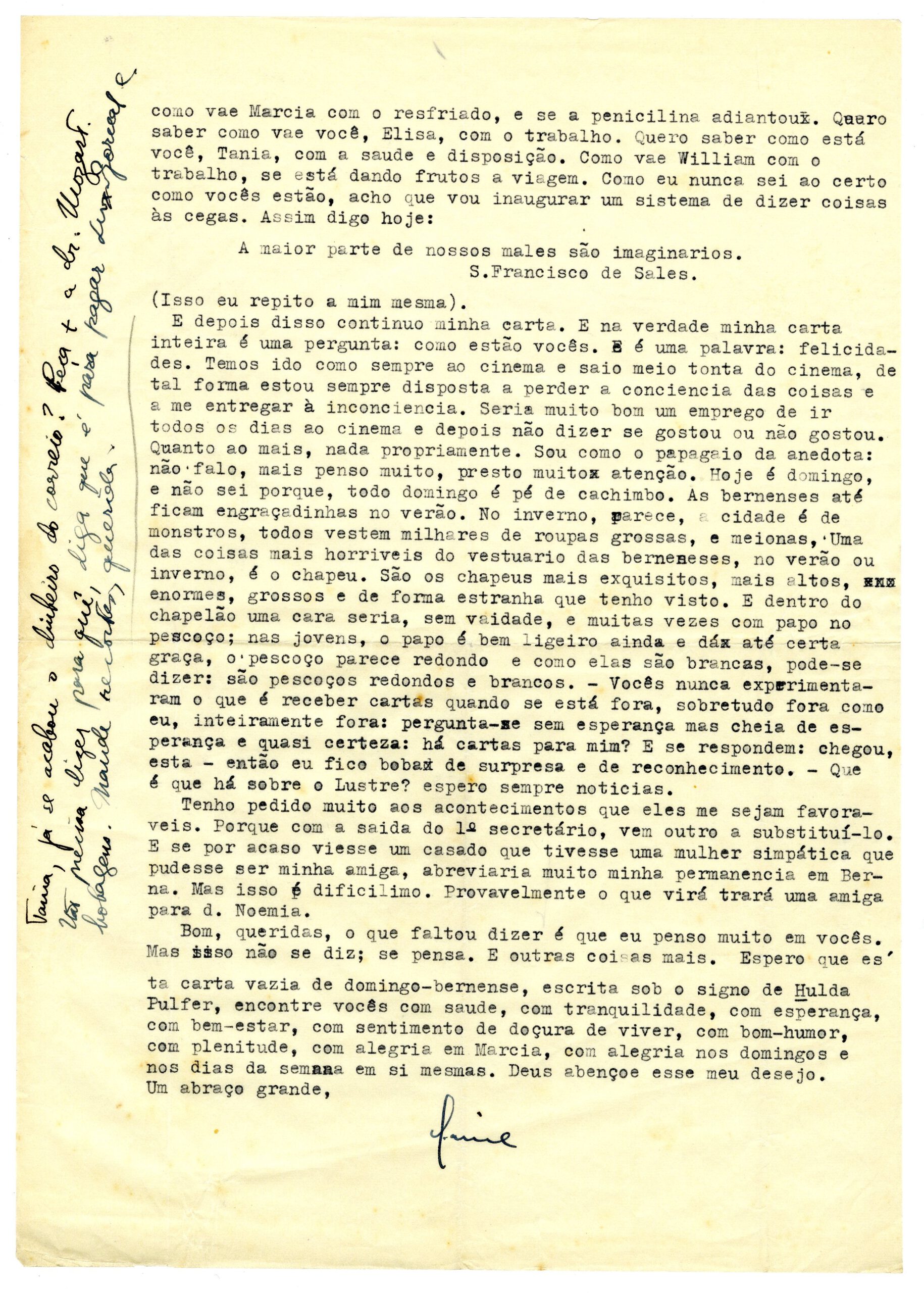
How Marcia’s doing with the cold, and whether the penicillin worked. I want to know how you’re doing, Elisa, with work. I want to know how you are, Tania, with your health and disposition. How’s William with work, whether the trip is paying off. Since I never know for sure how you guys are, I think I’m going to start a system of saying things out of the blue. So I say today:

Most of our ills are imaginary. St. Francis de Sales.
(This I repeat to myself.)

And after that I will continue my letter. And actually, my whole letter is a question: how you all are. And it’s a word: happiness. We’ve been going to the movies as usual and I leave the cinema a bit dizzy, in such a way that I’m always willing to lose consciousness of things and give myself up to unconsciousness. It would be a great job to go to the movies every day and then not say whether you liked it or not. As for the rest, nothing exactly. I’m like the parrot of the anecdote: I don’t speak, but I think a lot, I pay a lot of attention. Today is Sunday, and I don’t know why, every Sunday is for pipe smoking. The people of Bern even become cute in the summer. In the winter, the city is for monsters, it seems, everyone wears thousands of thick clothes, and stockings. One of the most horrible things about Bernese clothing, in summer or winter, is the hats. They are the weirdest, tallest, biggest, thickest and strangely formed hats I’ve ever seen. And inside the big hats are serious faces, without vanity, and many times with a double-chin; on young women, they are still small and give a certain grace, their necks seem round and since they are white, one can say: they are round and white necks- You don’t know how it is to receive letters when you’re away, above all away like me, entirely away: you ask yourself without hope, but full of hope and almost certainty: are there any letters for me?” And if they respond: this arrived – then I become silly with surprise and recognition. – What’s up with The Chandelier? I expect news always.
I’ve been asking a lot for events to be favorable to me. Because with the departure of the first secretary, another one replaces him. And if by chance one comes who is married and has a nice wife who could be my friend, it would greatly abbreviate my stay in Bern. But this is very difficult. Probably whoever comes will bring a friend for Mrs. Noemia.

Well, my dears, the only thing left to say is that I think a lot about you. But this one does not say; one thinks. And one more thing. I hope that this empty letter from a Bernese Sunday, written under the sign of Hulda Pulfer, finds you in health, tranquility, with hope, well-being, with a feeling of the sweetness of living, with good humor, with  fullness, with joy in Marcia, with joy on Sundays and the days of the week in themselves. God bless my wish. A big hug.

Clarice

Tania darling, I sent a telegram on the 19th. Darling, I’m afraid the text may have arrived wrong because I should have typed it and in Portuguese. It was written: happiness always. This is what was written. And what was not written was hugs, love, good health for you – and other things that were not written nor can I describe.

Tania, has the money for the mail already run out? Ask Dr. Mozart for more. You don’t need to say what for, say it is to pay for Lux-Jornal and unimportant things. Send clippings dear. 

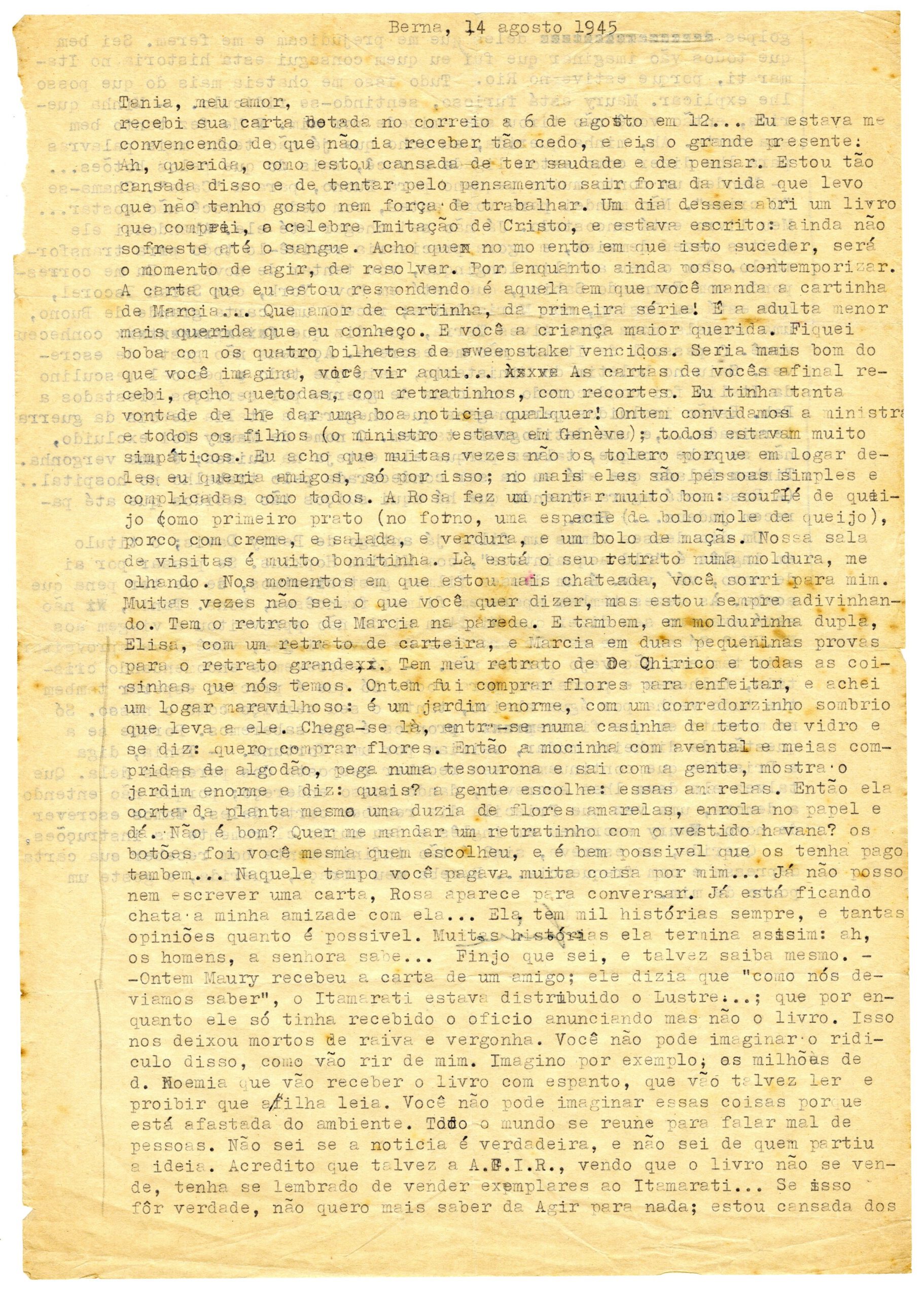
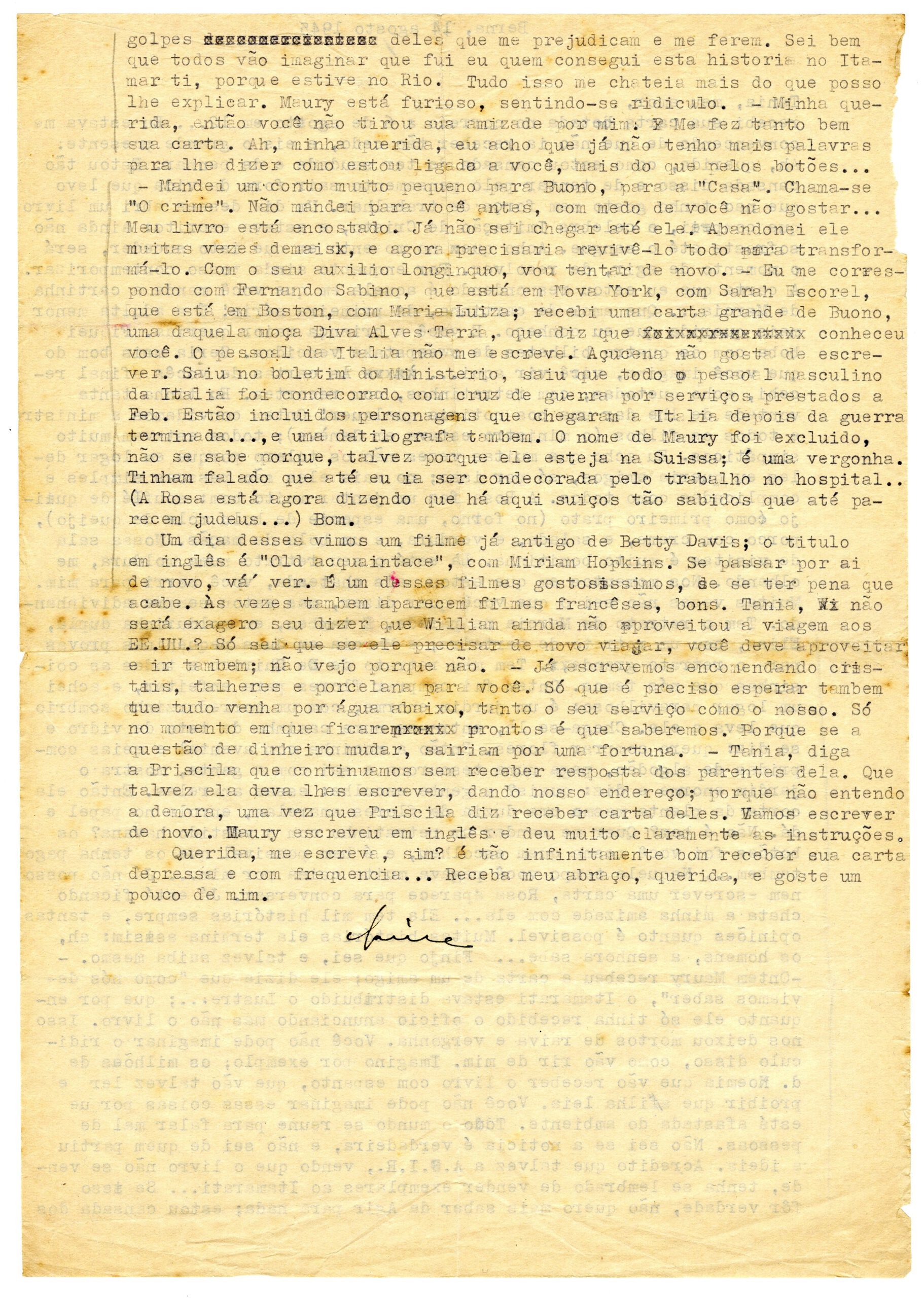
From: Clarice Lispector
To: Tania Kaufmann

Bern, August 14, 1946

Tania, my love,

I received your letter postmarked August 6th on the 12th… I was convincing myself that I wouldn’t receive it so soon, and then comes the big present:  Oh, darling, how I’m tired of missing everyone and of thinking. I’m so tired of it and trying through thought to escape the life I live that I have no desire or strength to work. The other day I opened a book I bought, the celebrated The Imitation of Christ (Published in the 15th century, by an unknown author. There are those who attribute its authorship to the German priest Thomas à Kempis. Considered the most read work in the Christian world after the Bible. Clarice made a few comments about reading this work with Fernando Sabino (Cartas perto do coração [Letters Near to the Heart]). “I’ve been reading a lot the Imitation of Christ which has been purifying me at times.” (p. 21)) “As for the Imitation of Christ, it tells us to suffer until we bleed, and completely surrender. To suffer until we bleed, I’ll get there and actually sometimes I’ve already gotten there. But to abandon myself, I don’t know how, I lack grace. As Álvaro Lins says, I’m often called and never chosen…” (p. 45)), and it was written: you have not suffered yet until you bleed. I think that when this happens, it’ll be time to act, to decide. Meanwhile I can still contemporize. The letter I’m answering is the one in which you send Marcia’s note… What a sweet note, first rate! She’s the most adorable smaller adult that I know. And you’re the most adorable bigger child. I was shocked by the four expired sweepstake tickets. It would be better than you imagine, you coming here… I finally received your letters, I think all of them, with pictures, clippings. I really wanted to give you some good news. Our living room is very nice. Your portrait is there, looking at me. Whenever I’m most upset, you smile at me. I often don’t know what you want to say, but I’m always guessing. Marcia’s portrait is on the wall. And also, in a double frame, Elisa, with a wallet-sized picture, and Marcia in two small proofs for the large portrait. There’s my portrait by De Chirico (Giorgio de Chirico, [1888-1978]. He is part of the Metaphysical Painting movement, which anticipated elements that later appeared in Surrealist painting.  In the beginning of the 1920s, his work obtained considerable success in vanguard circles, and in 1925, he participated in the first Surrealist exhibition. Among his most well-known works are Portrait of Guillaume Apollinaire, Hector and Andromache, and the Disquieting Muses.) and all the little things we have. Yesterday I went to buy flowers for decoration, and I found a wonderful place: it’s a huge garden, with a little dark hallway that leads to it. You get there, enter a little house with a glass roof and say: I want to buy flowers. Then the girl with an apron and long cotton socks grabs some shears and takes us outside to the huge garden and says: which ones? We choose: those yellow ones. So she cuts a dozen yellow flowers right from the plant, wraps them in paper, and gives them to us. Isn’t that nice? Do you want to send me a picture with the Havana dress? You chose the buttons yourself, and it’s very likely that you paid for them also… In those days you used to pay for a lot of things for me… Now I can’t write a single letter without Rosa showing up to talk. My friendship with her is already becoming a bore… She’s always got a story to tell, and as many opinions as possible. She ends many stories like this: oh, men, you know… I pretend I know, and maybe I really do. – Yesterday Maury received a letter from a friend; he said that “as we must know,” the Ministry of Foreign Affairs was distributing the Chandelier…; that meanwhile he had only received the notice announcing it but not the book. This left us morbidly angry and ashamed. You can’t imagine how ridiculous this is, how they’ll laugh at me. You can’t imagine these things because you’re far from the environment. Everybody gathers to talk bad about people. I don’t know if the news is true, and I don’t know whose idea it was. I believe that the publisher Agir, seeing that the book is not selling, remembered to sell copies to the Ministry of Foreign Affairs… If that’s true, I don’t want anything to do with Agir, I’m tired of their coups that harm and hurt me. I know well that everyone will imagine that I was the one who arranged this with the Ministry of Foreign Affairs, because I was in Rio. This all upsets me more than I can explain. Maury is furious, feeling ridiculous. – My dear, so you’re still friends with me. Your letter made me feel so good. Oh, my dear, I think I no longer have the words to tell you how I’m connected to you, not just because of the buttons…                       

– I sent a very short story to Buono, to the “House.” It’s called “The Crime” (Later published under the title “The Crime of the Math Teacher” in Family Ties [Francisco Alves, 1960].). I didn’t send it to you earlier, fearing you wouldn’t like it… My book is on hold. I no longer know how to approach it. I abandoned it too many times, and now I need to relive all of it to transform it. With your remote assistance, I’ll try again. – I’m corresponding with Fernando Sabino, who’s in New York, with Sarah Escorel (Wife of the diplomat Lauro Escorel. The couple were often with Clarice and Maury in Washington.), who’s in Boston, with Maria Luiza; I received a long letter from Buono, one from that girl Diva Alves Terra, who says she met you. The people from Italy don’t write me. Açucena doesn’t like to write. It was published in the Ministry’s newsletter, it was published that all men in Italy were awarded a war cross for services offered to the Brazilian Expeditionary Force (FEB), including people who arrived in Italy after the war was over…, and a female typist, also. Maury’s name was excluded who knows why, maybe because he’s in Switzerland; it’s a shame. They had said that even I’d be awarded one for the work at the hospital… (Rosa is now saying that there are Swiss people here so wise that they even seem Jewish…) Alright.         

The other day we saw an already old film with Bette Davis; the English title is “Old Acquaintance,” with Miriam Hopkins (Old Acquaintance (1943), starring Miriam Hopkins and Vincent Sherman.). If it returns to theaters, go see it. It’s one of those really nice films, that you wish never ended. Sometimes good French films also appear. Tania, wouldn’t it be an exaggeration for you to say that William did not enjoy the trip to the U.S.? I only know that if he needs to travel again, you should make the most of it and go also; I don’t see why not. – We’ve already written to order glassware, silverware, and chinaware for you. But it’s also necessary to expect for everything not to work out, both your service and ours. Only when they’re ready we’ll know. Because if the issue of money changes, they’d cost a fortune – Tania, tell Priscila that we still haven’t received an answer from her relatives. That maybe she should write to them, giving our address, because I don’t understand the delay, since Priscila says she receives their letters. Let’s write again. Maury wrote in English and gave very clear instructions.     

Darling, write me, OK? It’s so infinitely good to receive your letter quickly and frequently. Hugs, darling, and be a little fond of me.

Clarice 

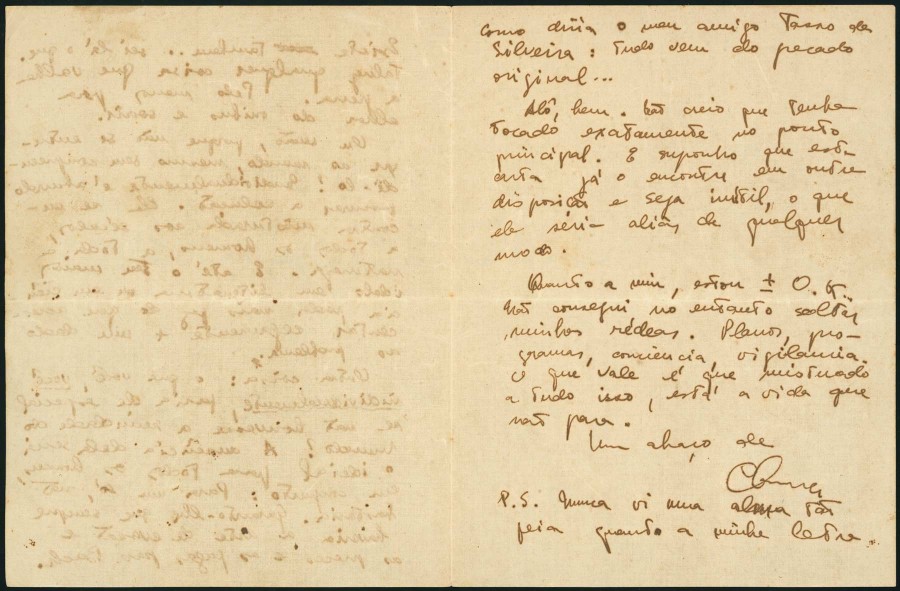
From: Clarice Lispector
To: Maury Gurgel Valente

[Maricá, January 1941]

[…]

There is also… whatever. Maybe something worthwhile. At least to look out the bus window and smile.  

Otherwise, why not surrender to the world, even without understanding it? It’s absurd to look for the solution individually. It’s found mixed up with the centuries, with all mankind, with all of nature. And even your greatest idol in literature or science has done nothing more than blindly add one more bit of information to the problem.  

What’s more: what would you do, you individually, if there weren’t wickedness in the world? Its absence would be ideal for all mankind as a whole. Just for one person wouldn’t be enough. I guarantee you there’d always be the art of escape and the prayers and the fugues for Bach. As my friend Tasso de Silveira would say: “It all comes from original sin…”    

Oh well. I don’t believe there’s sin right from the beginning. And I suppose that this letter will already find you in another mood and be useless, which actually it would be anyway.  

As for me, I’m more or less O.K. Nonetheless, I haven’t been able to loosen up. Plans, programs, consciousness, vigilance. What matters is that, mixed up with all of this, life goes on. 

Hugs,

Clarice

P.S. I’ve never seen anything uglier than my handwriting.

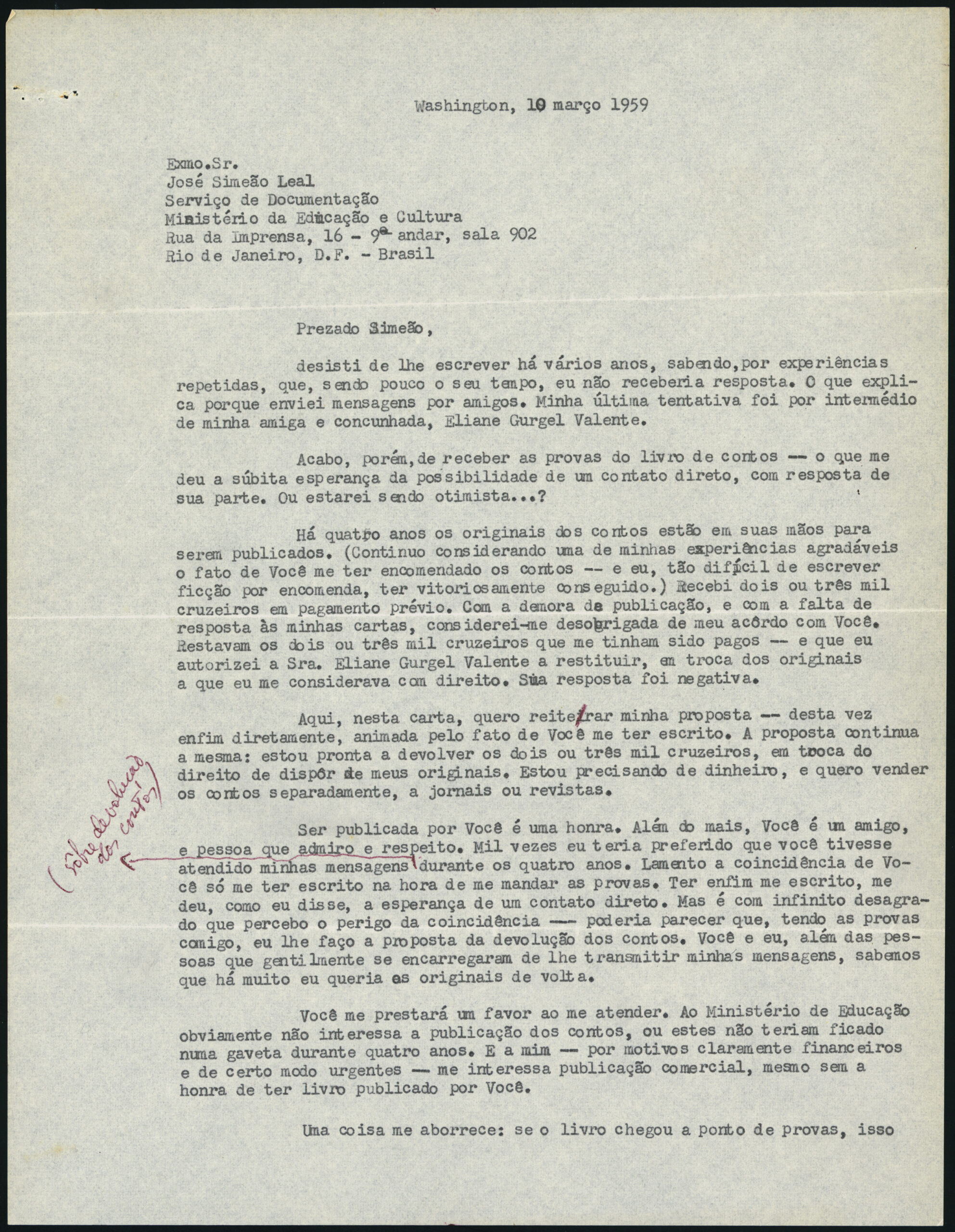
From: Clarice Lispector
To: José Simeão Loeal

Washington, March 10, 1959 

Mr. José Simeão Leal 
Document Services 
Ministry of Education and Culture 
Rua da Imprensa, 16 
9th floor, room 902 
Rio de Janeiro, D.F. – Brazil 

Dear Simeão,

I stopped writing to you several years ago, knowing, due to repeated experiences, that, your time being short, I would not receive a reply. That is why I sent messages via friends. My last attempt was through my friend and husband’s sister, Eliane Gurgel Valente. 

I have nonetheless just received the proofs of the book of short stories – which made me suddenly hope for the possibility of a direct contact, with an answer on your part. Or am I being optimistic…?  

For four years, the original versions of the short stories have been in your hands, waiting to be published. (I am still so pleased that you commissioned the short stories – and that I, who find it so difficult to write fiction by commission, victoriously succeeded.) I received Cr$2000 or Cr$3000 in advance payment. With the delay in publication, and with the lack of a reply to my letters, I considered myself free of any obligations to you. There remained only the Cr$2000 or Cr$3000 that were paid to me – and that I authorized Mrs. Eliane Gurgel Valente to repay, in exchange for the originals to which I felt I had a right. You said no.

Here, in this letter, I wish to reiterate my proposal – this time directly, excited by the fact that you have written me. The proposal remains the same: I am ready to return the Cr$2000 or Cr$3000, in exchange for the right to use my originals. I need money, and wish to sell the short stories separately, to newspapers or magazines.

To be published by you is an honor. In addition, you are a friend, and a person whom I admire and respect. I must emphasize that I would have preferred for you to have answered my messages (about returning the stories) over the past four years. It is too bad that, coincidentally, you have only written me at the time of sending me the proofs. Your finally writing me has made me, as I have said, hope for a direct contact. However, I am infinitely sorry to see the danger of the coincidence – it may seem that, now that the proofs are in my possession, I am proposing for you to return the short stories. You and I, in addition to those who have kindly offered to transmit my messages, know that I have wanted the originals back for a long time.      

You will grant me a favor by accepting my request. The Ministry of Education is obviously not interested in publishing the short stories, otherwise they would not have been kept for four years in a drawer. And in my case – clearly for financial reasons, which are somewhat urgent – I am interested in commercial publication, even without the honor of having a book published by you.

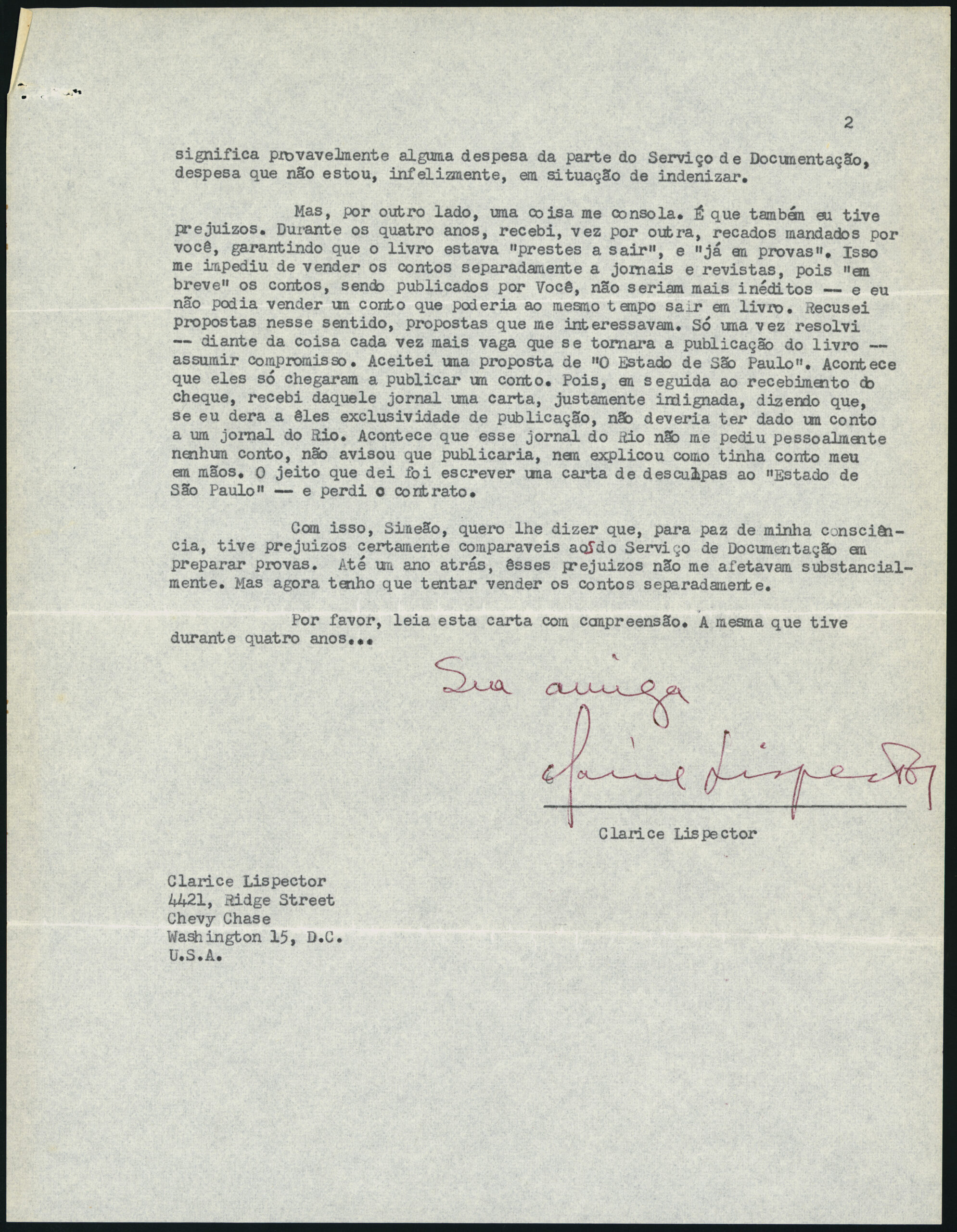
One thing makes me upset: if the book arrived at the proof stage, it means that there was probably some expense incurred on the part of Document Services, an expense that I am unfortunately not able to reimburse. 

However, on the other hand, one thing gives me consolation. It is that I have also had losses. Over the past four years, I have received, every now and then, messages sent by you, guaranteeing that the book was “ready for publication,” and “already at the proof stage.” This kept me from selling the short stories separately to newspapers and magazines, for “soon” the short stories, once edited by you, would no longer be unpublished – and I could not sell a short story that at the same time would be published in a book. I turned down proposals of this sort, proposals that were of interest to me. Only once did I decide – faced with the more and more remote possibility of the book’s publication – to assume a commitment. I accepted a proposal from O Estado de S. Paulo. It so happens that they only published one short story. For, after receiving the check, I received an angry letter from the newspaper saying that, if I had given them exclusive publication rights, I would not have given a short story to a Rio newspaper. It so happens that this Rio newspaper did not personally ask me for any short story, did not tell me that they would publish it, and did not explain how they had my short story in hand. My solution was to write a letter of apology to O Estado de S. Paulo – and I lost the contract.

Thus, Simeão, I wish to tell you that, for my peace of mind, I have had losses that are certainly comparable to those of Document Services in preparing proofs. Up to one year ago, these losses did not affect me substantially. But now I have to try to sell the short stories separately.

Please read this letter with consideration. The same that I have had for four years…

Your friend

Clarice Lispector 

Clarice Lispector
4421, Ridge Street
Chevy Chase
Washington 15, D.C.
U.S.A.

From: Clarice Lispector
To: Elisa Lispector

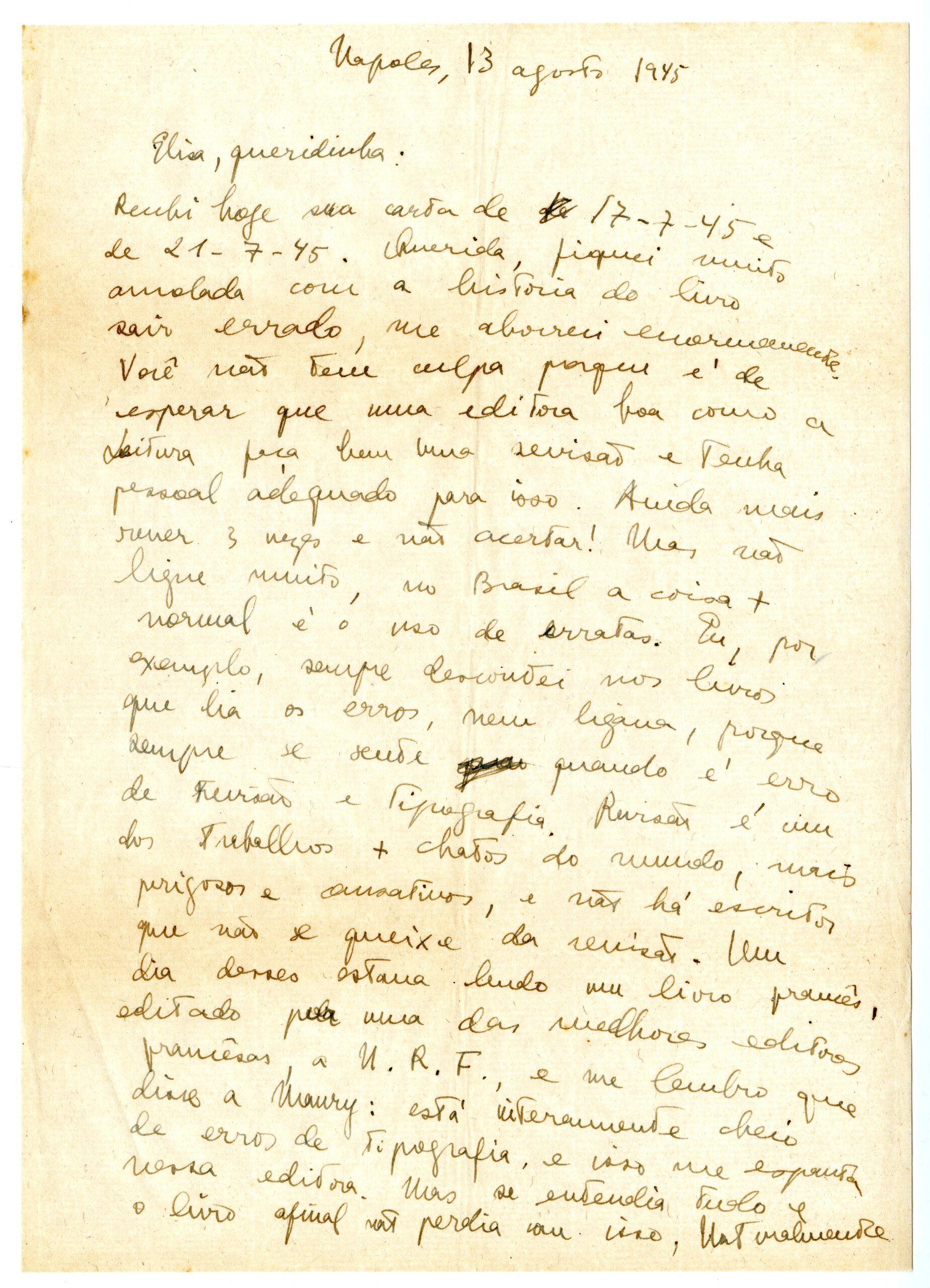
Naples, January 12, 1945

Elisa, darling:

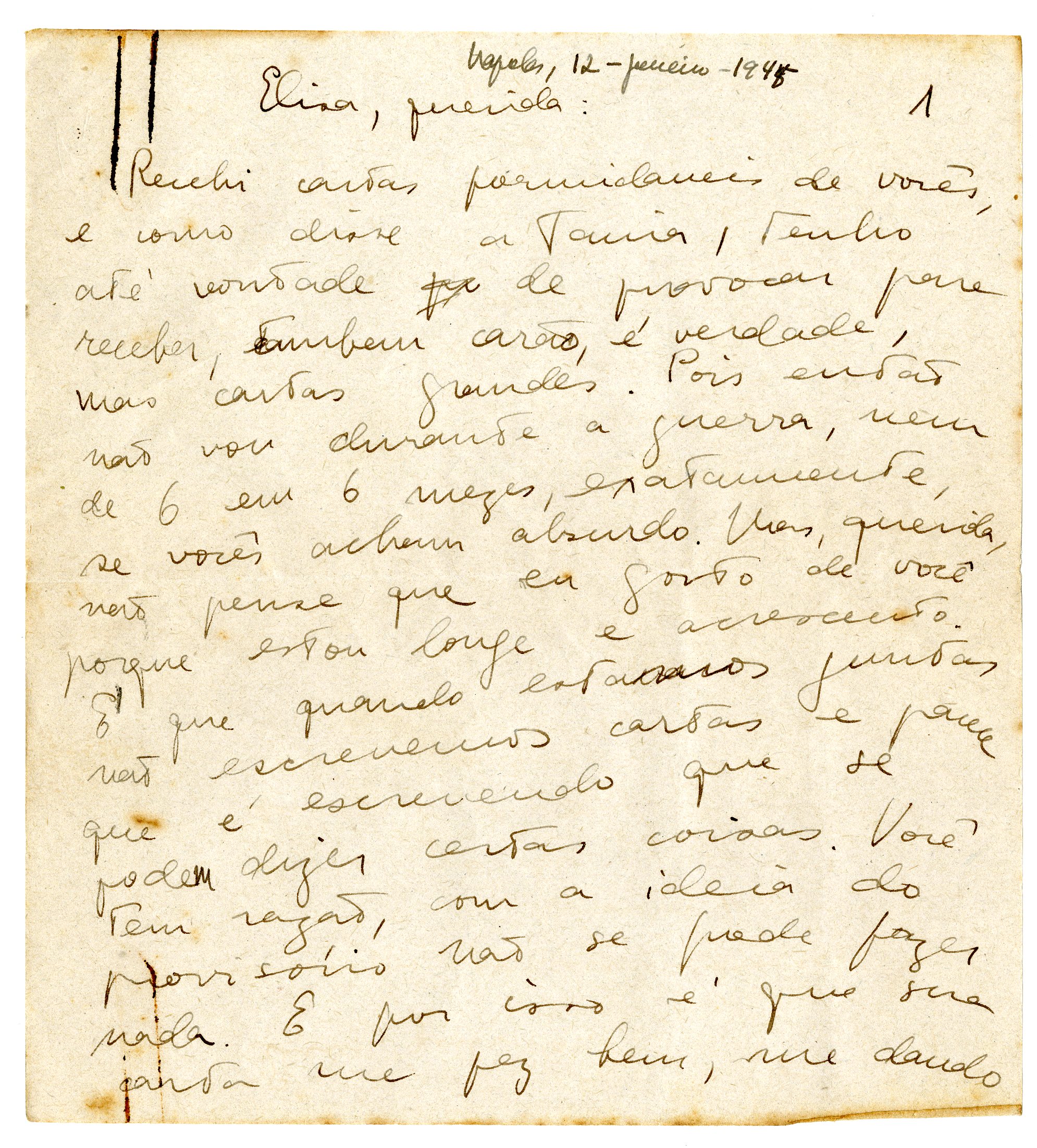
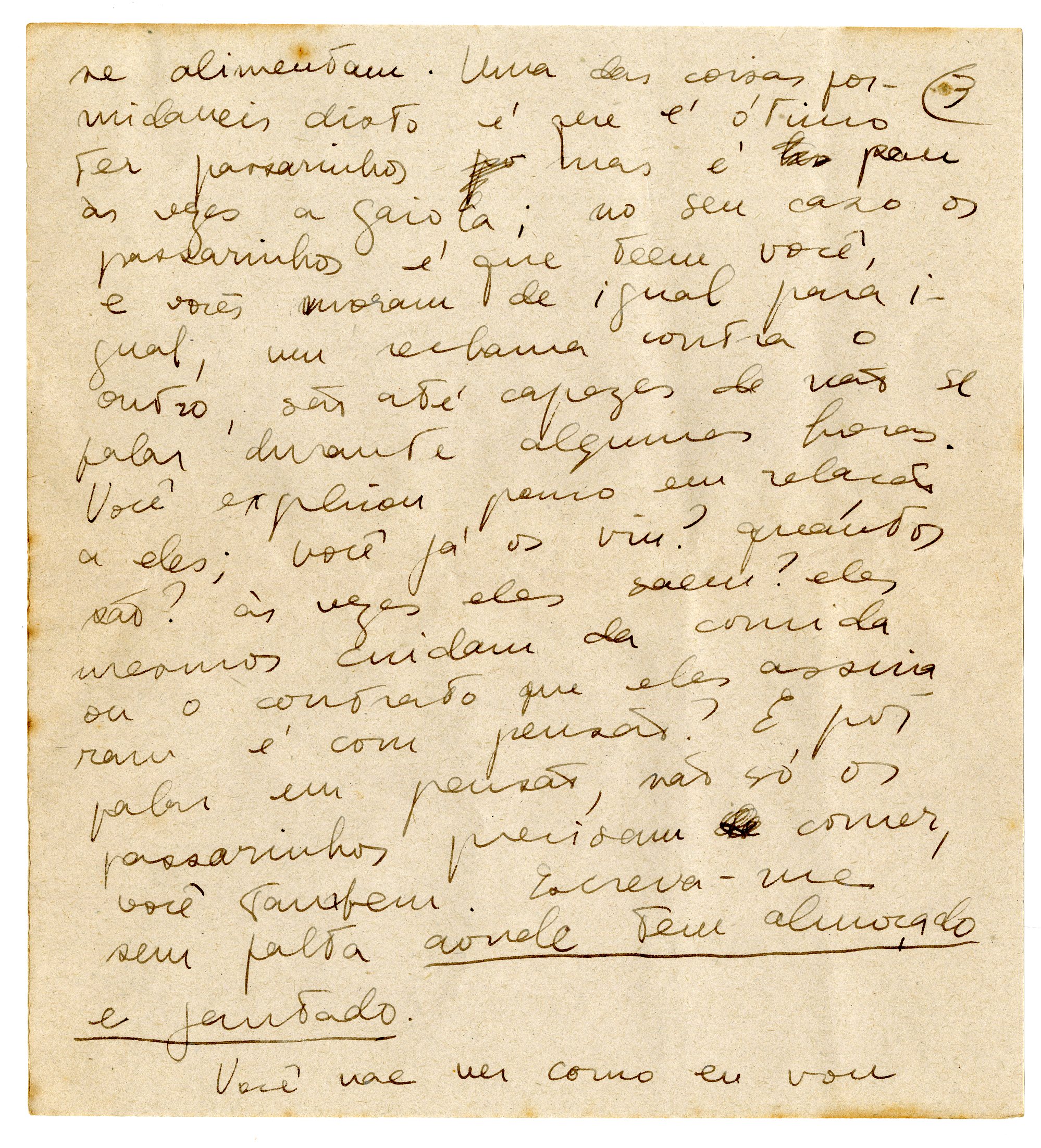
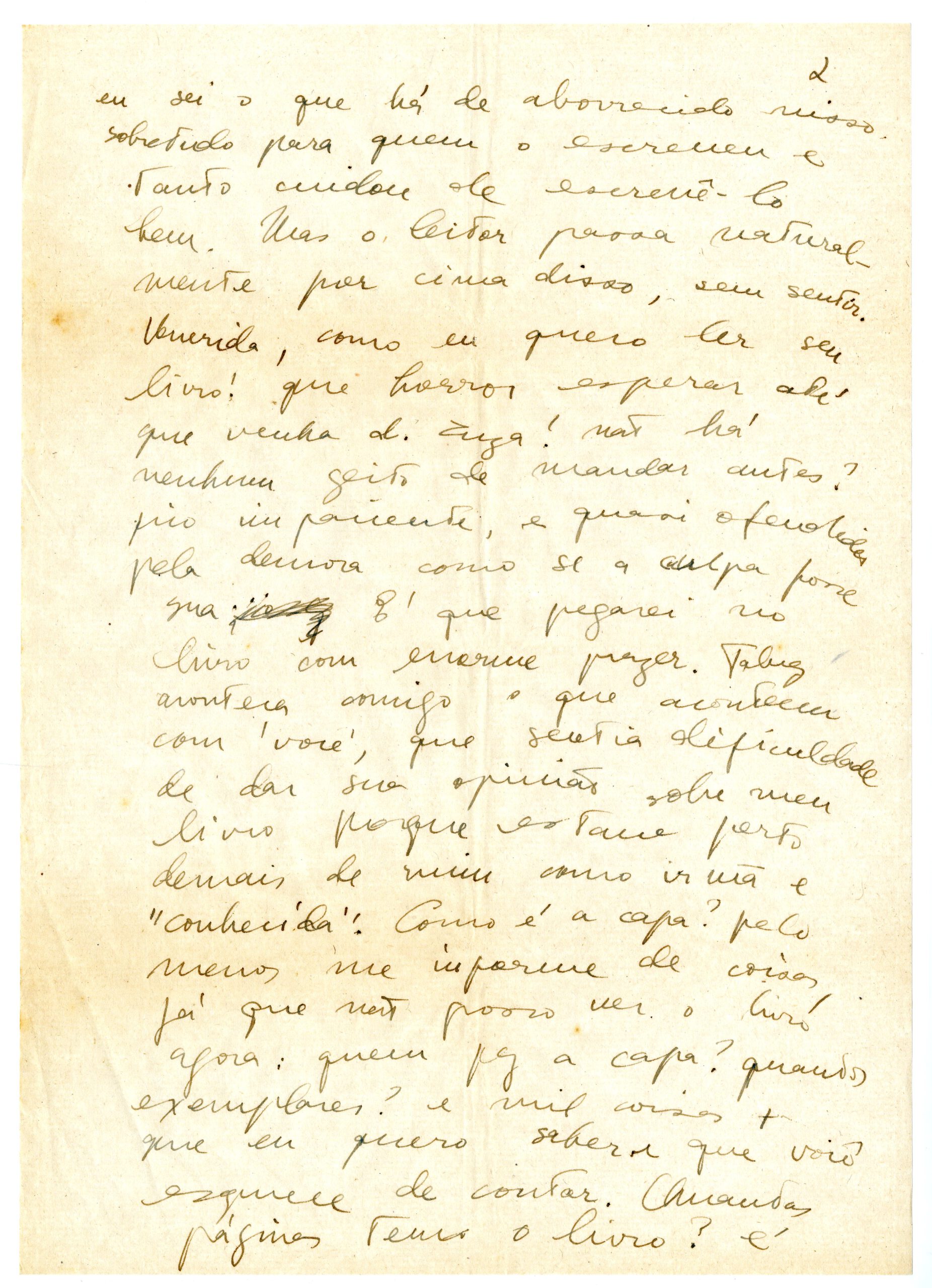
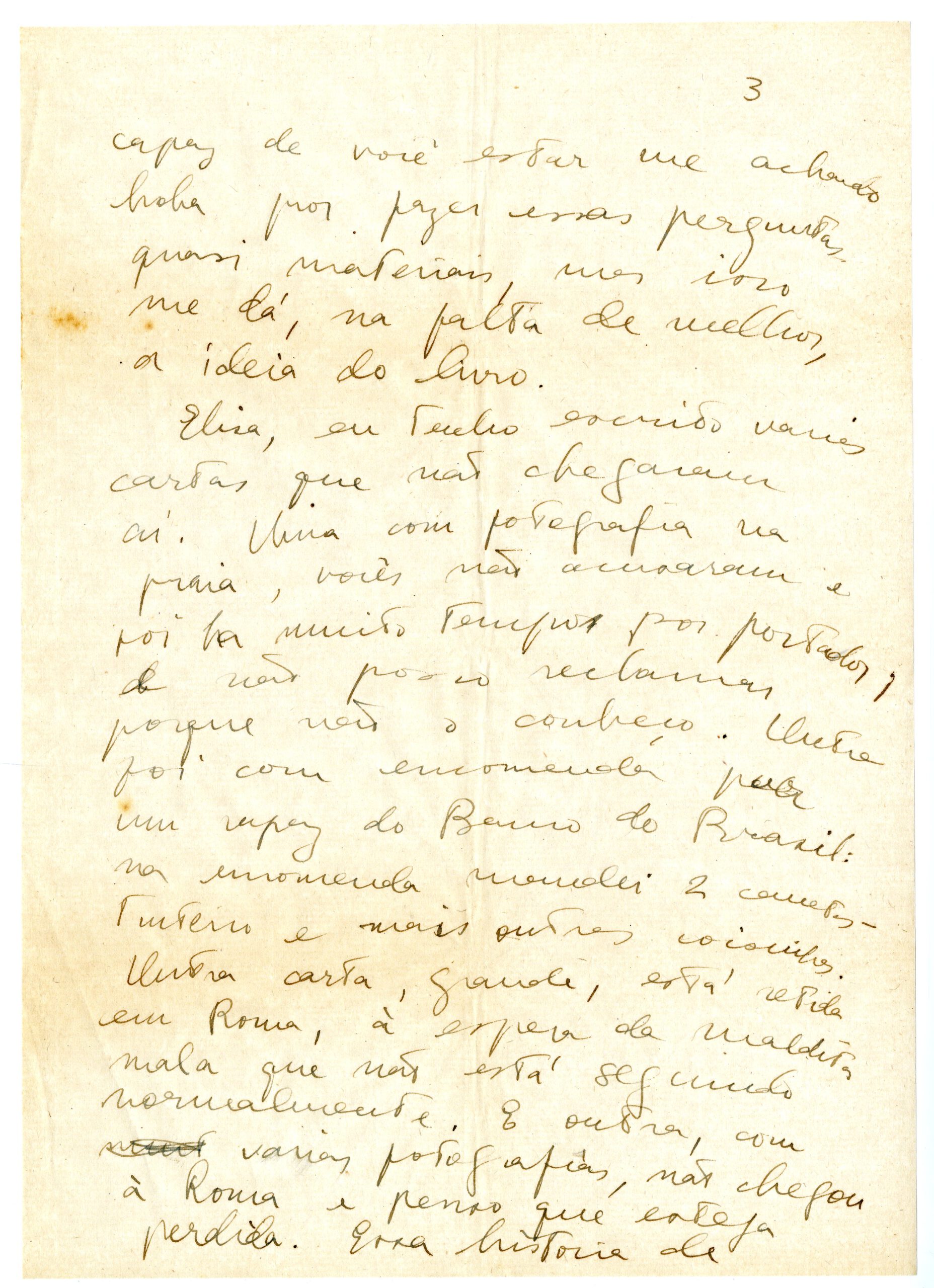
I have received magnificent letters from you all, and as I said to Tania, in the long letters it’s true that I’m inclined to provoke to also receive a reprimand. So then I won’t go during the war, not even every six months, precisely, if you all think it’s absurd. But, darling, don’t think I like you because I’m far away and add stuff. It’s just that when we’re together we don’t write letters and it seems that certain things can only be said in writing. You’re right, with the idea of the provisional nothing can be done. And that’s why letters are good for me, by giving me a lesson. Don’t tell me you don’t wish to have ascendancy over me, which is silly, my dear. And speaking of silly, here’s another one coming from the same source, which is you: you say that although it seems incredible, you’ve also chased mirages. How stupid you are! If there is somebody who demonstrates this, it’s you! And you not only have chased, but chase – which counts as not having changed and being true. This girl even raises little birds in the bathroom, a place where in general only towels hang! I’d like to know how they’re fed. One of the magnificent things about this is that it’s great to have birds but sometimes the cage is an issue: in your case the birds own you and you all live as equals, one complains about the other, and you may even stop talking to each other for a few hours. You have explained little about them; have you seen them yet? How many are there? Do they go out sometimes? Do they provide for their own food or does the contract they signed include room and board? And speaking of room and board, you also need to eat, not only the birds. Don’t forget to tell me where you eat lunch and dinner.                  

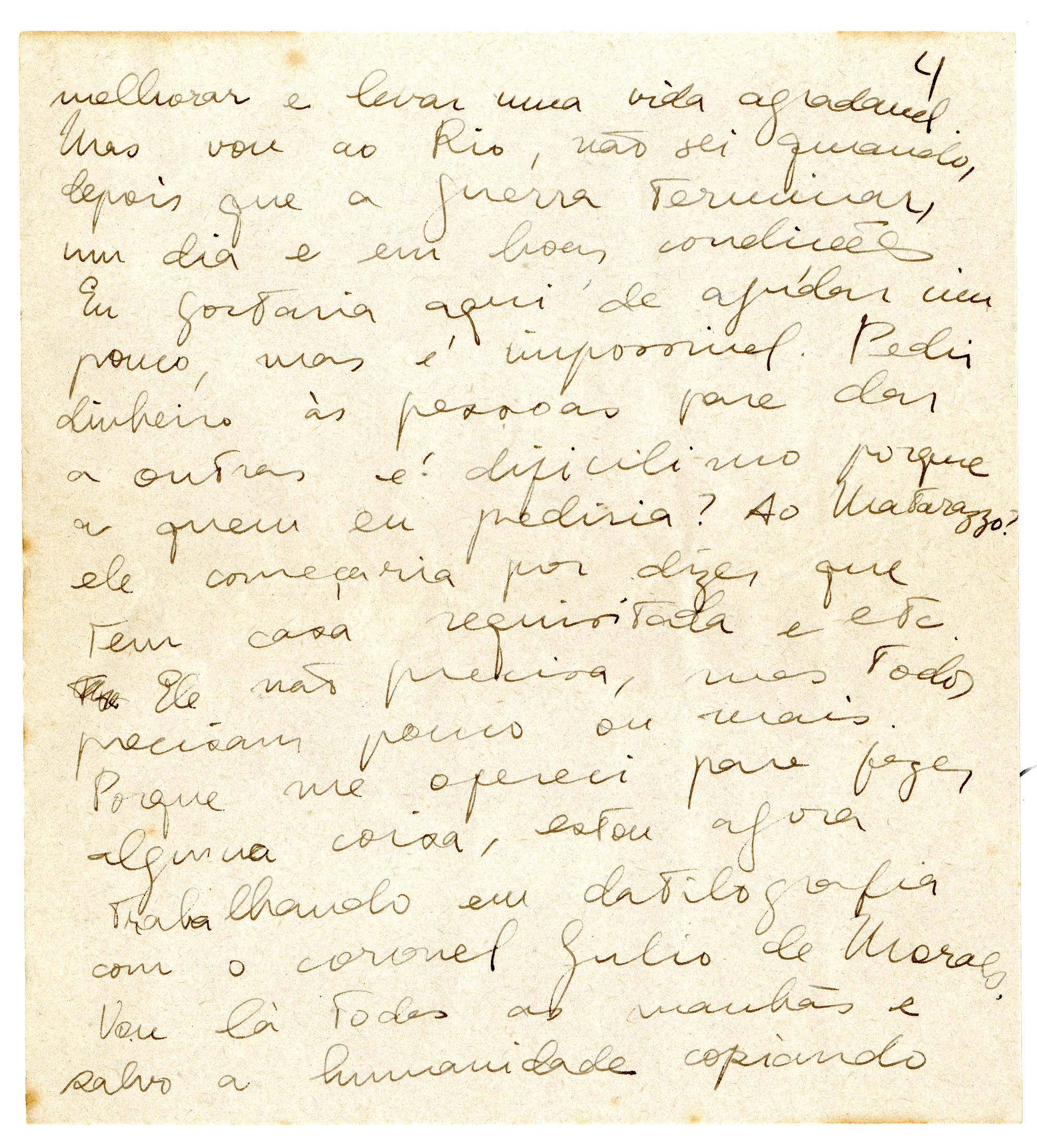
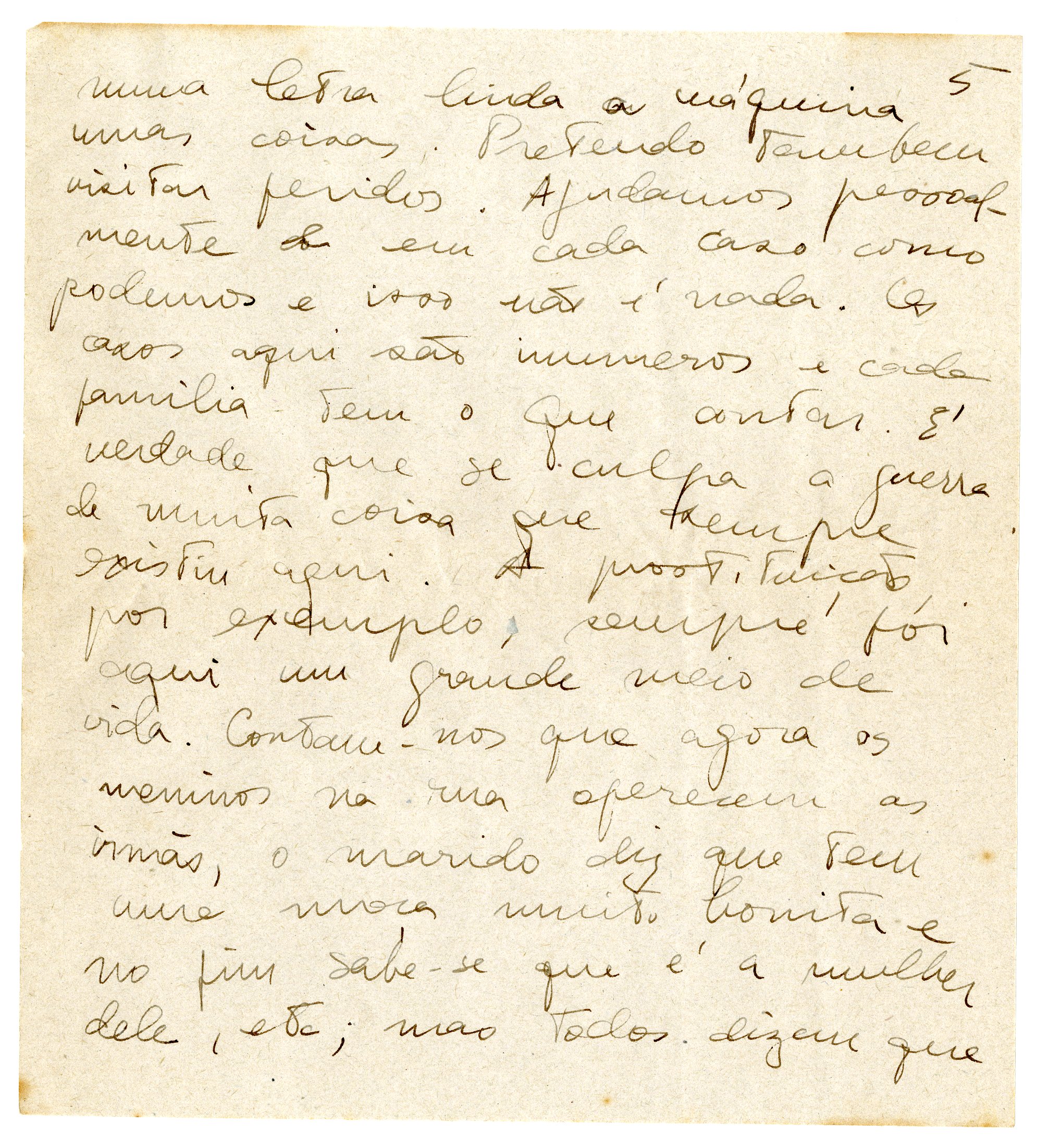
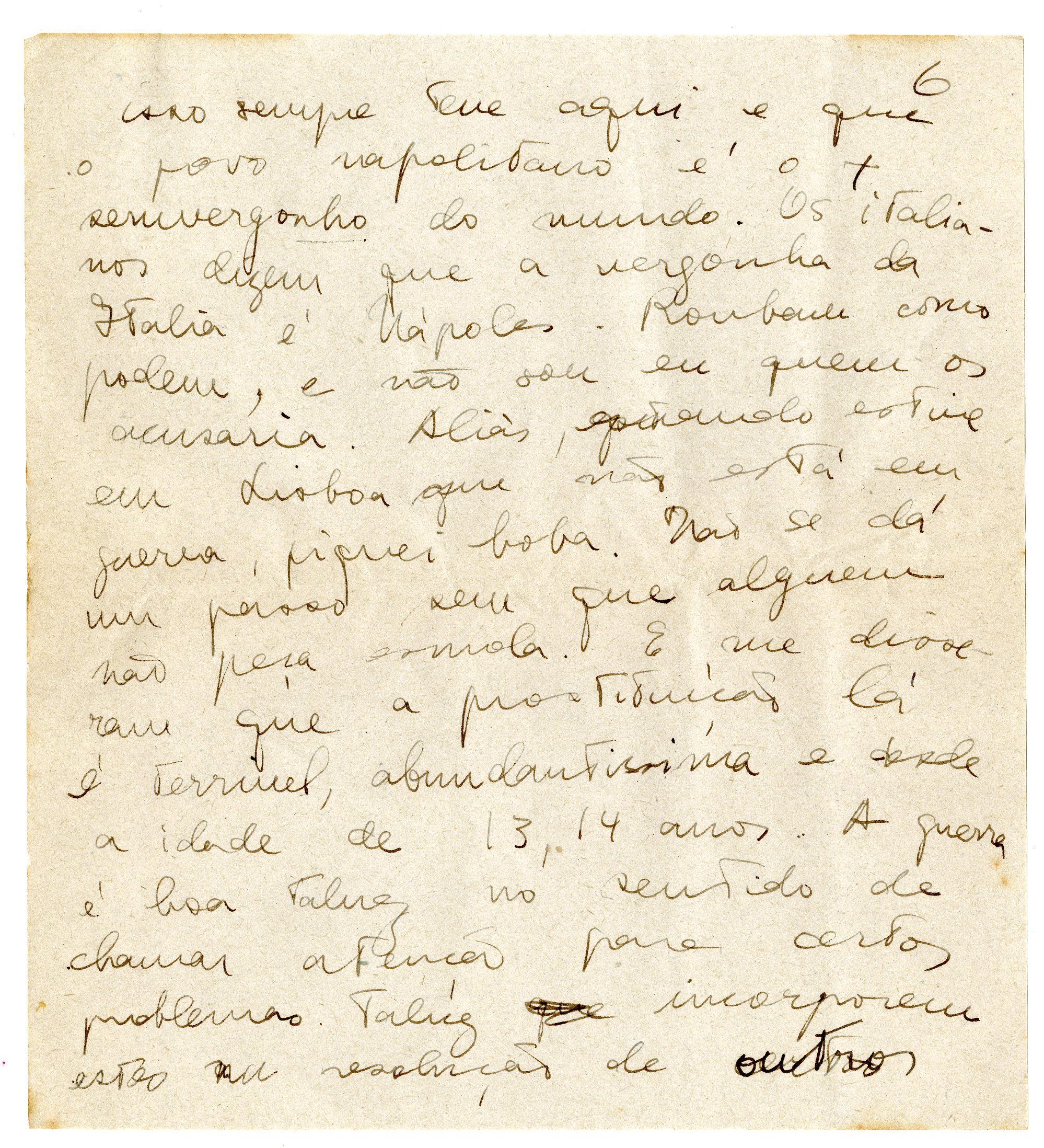
You’ll see how I’m going to get better and live a nice life. But I’m going to Rio, I’m not sure when, after the war is over, one day and in good conditions. I’d like to help here a little, but it’s impossible. To ask people for money for other people is really difficult because whom would I ask? Matarazzo? He would begin by saying that he has household demands, etc. He’s not in need, but everyone needs a little or more. Because I’ve already offered to do something, I’m now working on typescripts with Colonel Julio de Moraes. I go there every morning and save humanity by copying some things in beautiful typewriting. I also intend to visit the wounded. We help in person and in each case as well as we can and that’s nothing. The cases here are countless and every family has a story to tell. It’s true that the war is blamed for many things that have always existed here. Prostitution, for example, has always been a big livelihood here. They tell us that now the boys on the street offer their sisters, the husband who says there’s a very beautiful girl and in the end one finds out it’s his wife, etc.; but everyone says it’s always been like this. What happens here is that the Neapolitan people are the most shameless in the world. Italians say that Naples is the shame of Italy. They steal as much as they can, and I’m not the one pointing the finger. Actually, when I was in Lisbon which is not at war, I was shocked. You can’t take one step without someone asking for spare change. And they told me prostitution there is terribly abundant, and begins at the age of 13-14 years old. The war is maybe good in the sense of calling attention to certain problems. Maybe they’ll include them in the resolution of other specifically war-related problems.          

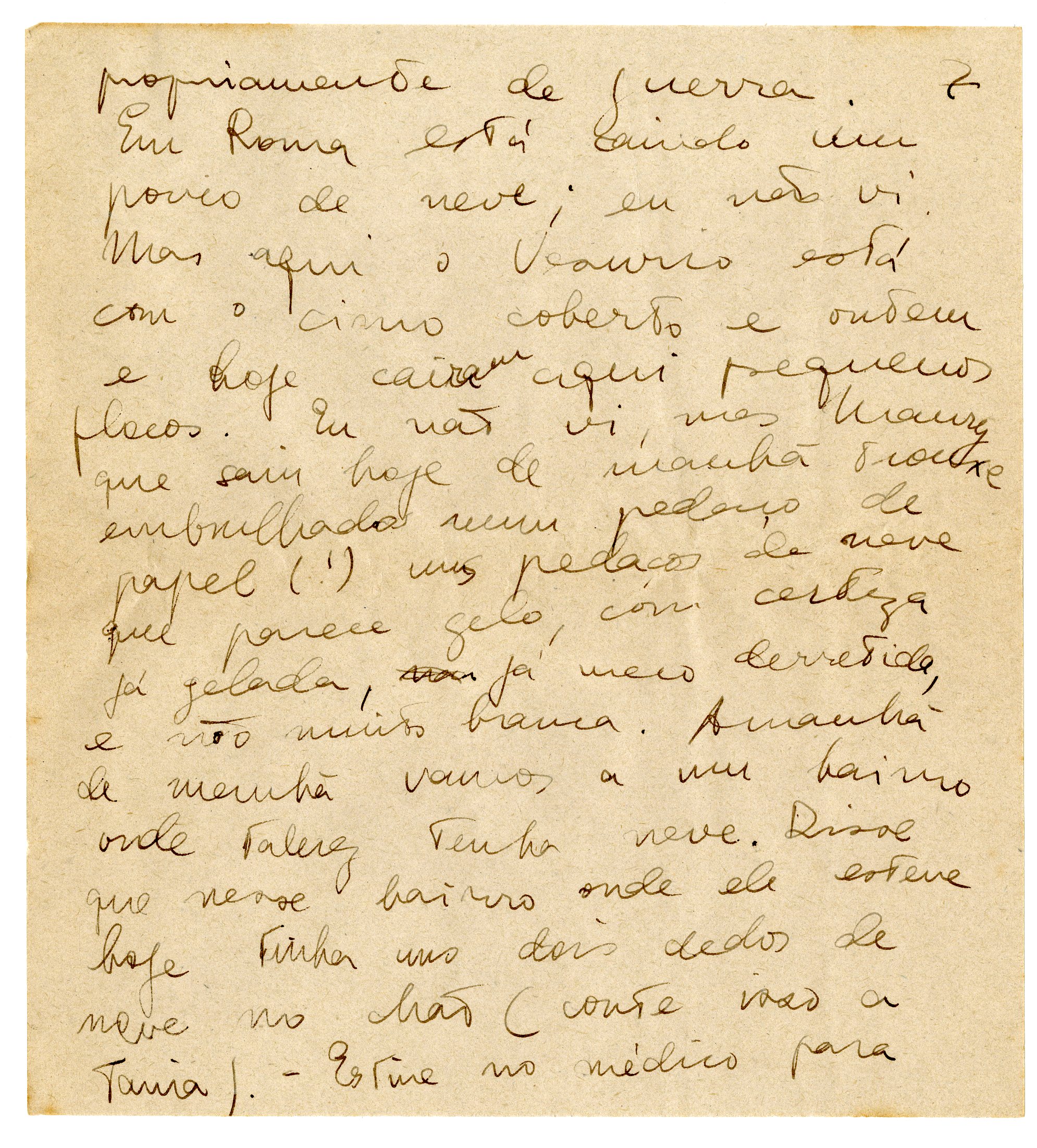
In Rome it’s snowing a little; I haven’t seen it. But here Vesuvius (Vesuvius – the only active volcano on the European continent, situated above the Gulf of Naples, on the west coast of Italy. Its summit, although variable, rises to a height of 1,277 meters) is covered and yesterday and today there were a few flurries here. I didn’t see it, but Maury left this morning and brought back, wrapped in a piece of paper (!) a few pieces of snow that seemed like ice, certainly once icy, already melting, and not very white. Tomorrow morning we’re going to a neighborhood where there may be snow. He said that in the neighborhood where he was today there was an inch or two of snow on the ground (tell Tania that). 

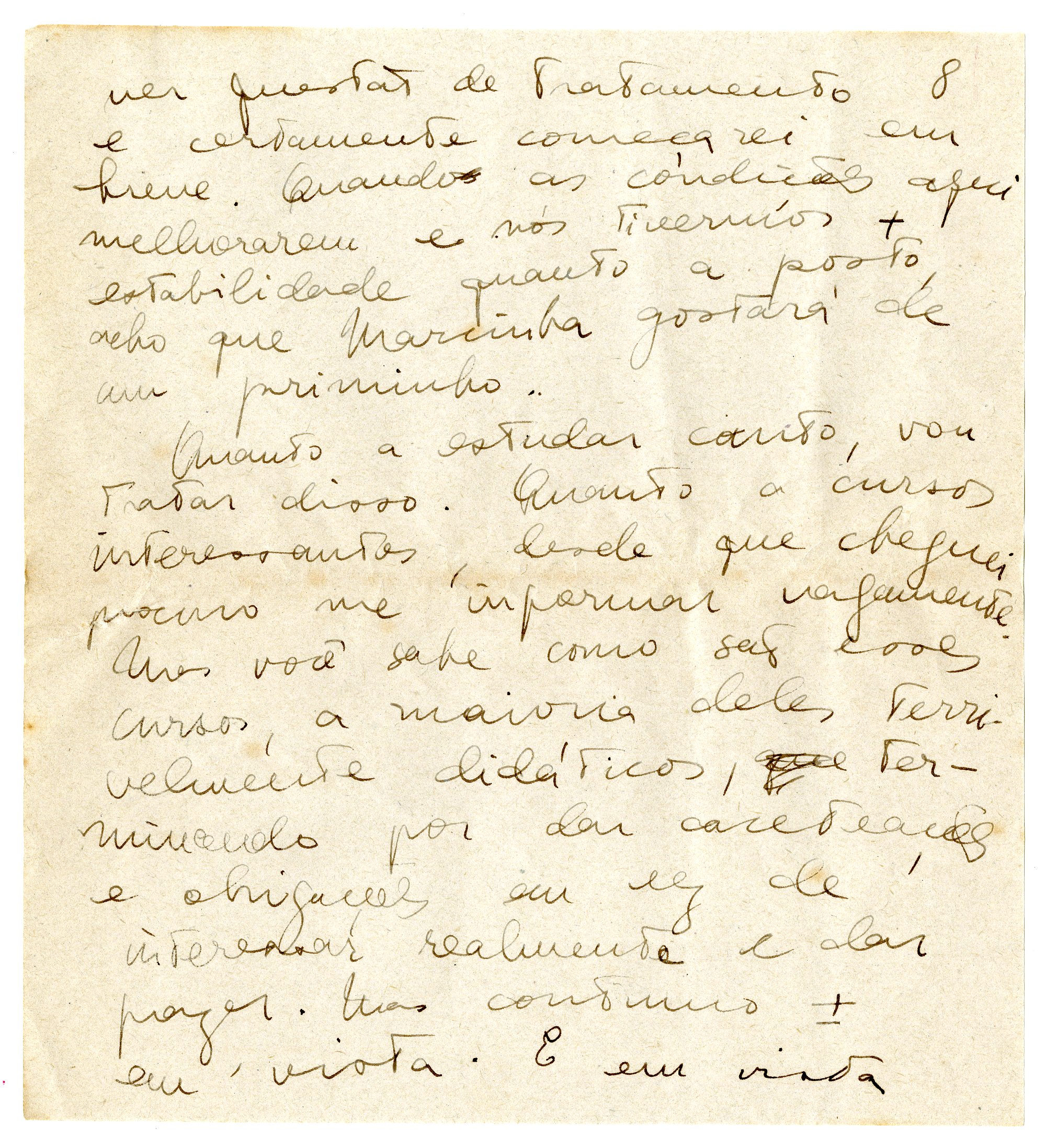
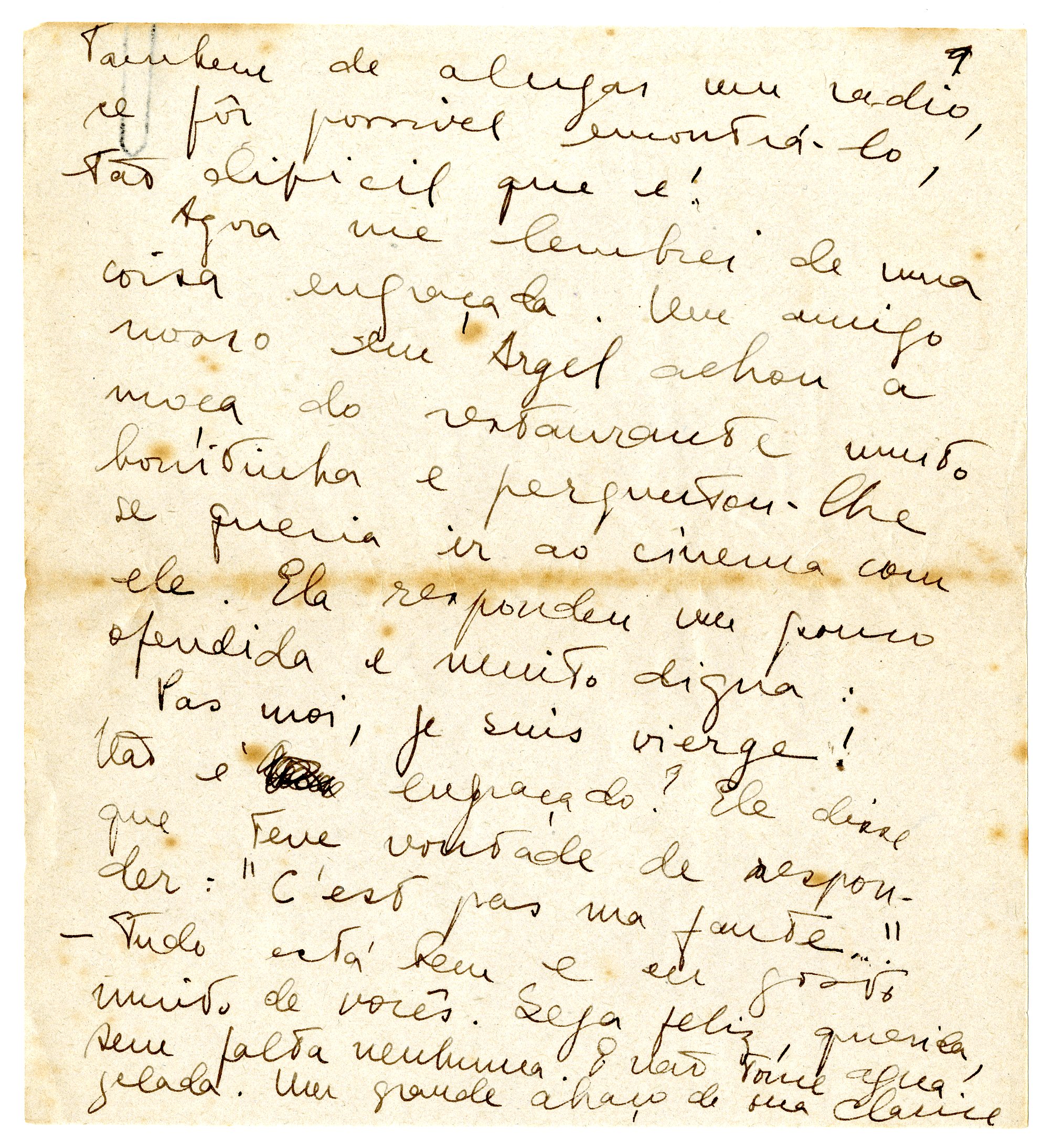
As for singing lessons, I’ll look into it. As for interesting courses, ever since I arrived I’ve tried to get some information but you know how these courses are, most of them terribly didactic, causing suffering and creating obligations instead of being really interesting and giving pleasure. But I’m still more or less looking. And also looking for a radio to rent, if possible, since it’s so hard to find one.

I just now remembered something funny. A friend of ours in Algeria thought the girl from the restaurant was very cute and asked her if she wanted to go to the movies with him. She answered somewhat offended and very dignified: Pas moi, je suis vierge!  

Isn’t that so funny? He said he felt like answering: C’est pas ma faute…

– All is well and I like you all very much. Be happy, darling, without fail. And don’t drink cold water. Hugs from your 

Clarice

From: Clarice Lispector
To: Elisa Lispector

Naples, January 12, 1945

Elisa, darling:

I have received magnificent letters from you all, and as I said to Tania, in the long letters it’s true that I’m inclined to provoke to also receive a reprimand. So then I won’t go during the war, not even every six months, precisely, if you all think it’s absurd. But, darling, don’t think I like you because I’m far away and add stuff. It’s just that when we’re together we don’t write letters and it seems that certain things can only be said in writing. You’re right, with the idea of the provisional nothing can be done. And that’s why letters are good for me, by giving me a lesson. Don’t tell me you don’t wish to have ascendancy over me, which is silly, my dear. And speaking of silly, here’s another one coming from the same source, which is you: you say that although it seems incredible, you’ve also chased mirages. How stupid you are! If there is somebody who demonstrates this, it’s you! And you not only have chased, but chase – which counts as not having changed and being true. This girl even raises little birds in the bathroom, a place where in general only towels hang! I’d like to know how they’re fed. One of the magnificent things about this is that it’s great to have birds but sometimes the cage is an issue: in your case the birds own you and you all live as equals, one complains about the other, and you may even stop talking to each other for a few hours. You have explained little about them; have you seen them yet? How many are there? Do they go out sometimes? Do they provide for their own food or does the contract they signed include room and board? And speaking of room and board, you also need to eat, not only the birds. Don’t forget to tell me where you eat lunch and dinner.                  

You’ll see how I’m going to get better and live a nice life. But I’m going to Rio, I’m not sure when, after the war is over, one day and in good conditions. I’d like to help here a little, but it’s impossible. To ask people for money for other people is really difficult because whom would I ask? Matarazzo? He would begin by saying that he has household demands, etc. He’s not in need, but everyone needs a little or more. Because I’ve already offered to do something, I’m now working on typescripts with Colonel Julio de Moraes. I go there every morning and save humanity by copying some things in beautiful typewriting. I also intend to visit the wounded. We help in person and in each case as well as we can and that’s nothing. The cases here are countless and every family has a story to tell. It’s true that the war is blamed for many things that have always existed here. Prostitution, for example, has always been a big livelihood here. They tell us that now the boys on the street offer their sisters, the husband who says there’s a very beautiful girl and in the end one finds out it’s his wife, etc.; but everyone says it’s always been like this. What happens here is that the Neapolitan people are the most shameless in the world. Italians say that Naples is the shame of Italy. They steal as much as they can, and I’m not the one pointing the finger. Actually, when I was in Lisbon which is not at war, I was shocked. You can’t take one step without someone asking for spare change. And they told me prostitution there is terribly abundant, and begins at the age of 13-14 years old. The war is maybe good in the sense of calling attention to certain problems. Maybe they’ll include them in the resolution of other specifically war-related problems.          

In Rome it’s snowing a little; I haven’t seen it. But here Vesuvius (Vesuvius – the only active volcano on the European continent, situated above the Gulf of Naples, on the west coast of Italy. Its summit, although variable, rises to a height of 1,277 meters) is covered and yesterday and today there were a few flurries here. I didn’t see it, but Maury left this morning and brought back, wrapped in a piece of paper (!) a few pieces of snow that seemed like ice, certainly once icy, already melting, and not very white. Tomorrow morning we’re going to a neighborhood where there may be snow. He said that in the neighborhood where he was today there was an inch or two of snow on the ground (tell Tania that). 

As for singing lessons, I’ll look into it. As for interesting courses, ever since I arrived I’ve tried to get some information but you know how these courses are, most of them terribly didactic, causing suffering and creating obligations instead of being really interesting and giving pleasure. But I’m still more or less looking. And also looking for a radio to rent, if possible, since it’s so hard to find one.

I just now remembered something funny. A friend of ours in Algeria thought the girl from the restaurant was very cute and asked her if she wanted to go to the movies with him. She answered somewhat offended and very dignified: Pas moi, je suis vierge!  

Isn’t that so funny? He said he felt like answering: C’est pas ma faute…

– All is well and I like you all very much. Be happy, darling, without fail. And don’t drink cold water. Hugs from your 

Clarice