

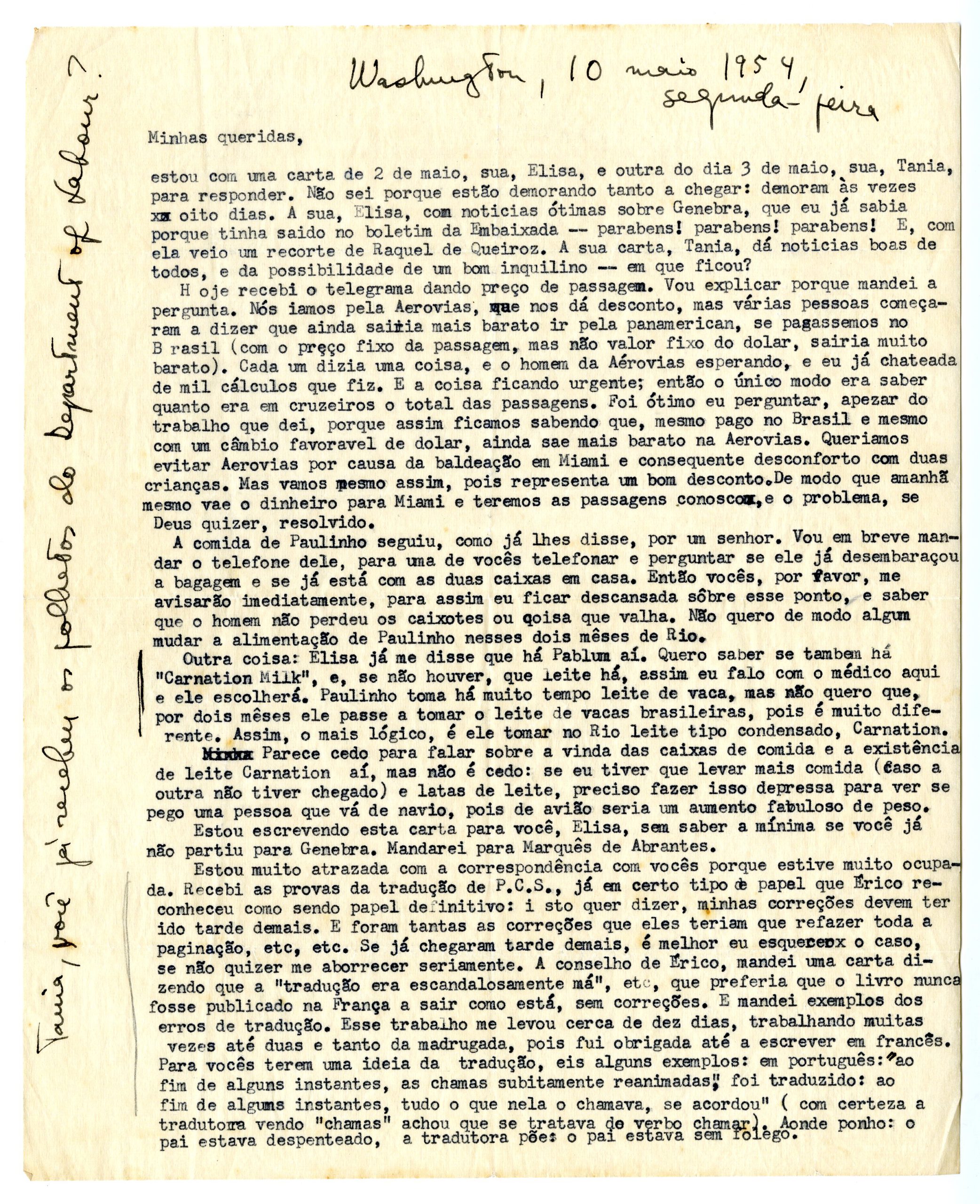
Washington, May 10, 1954, Monday
My darlings,
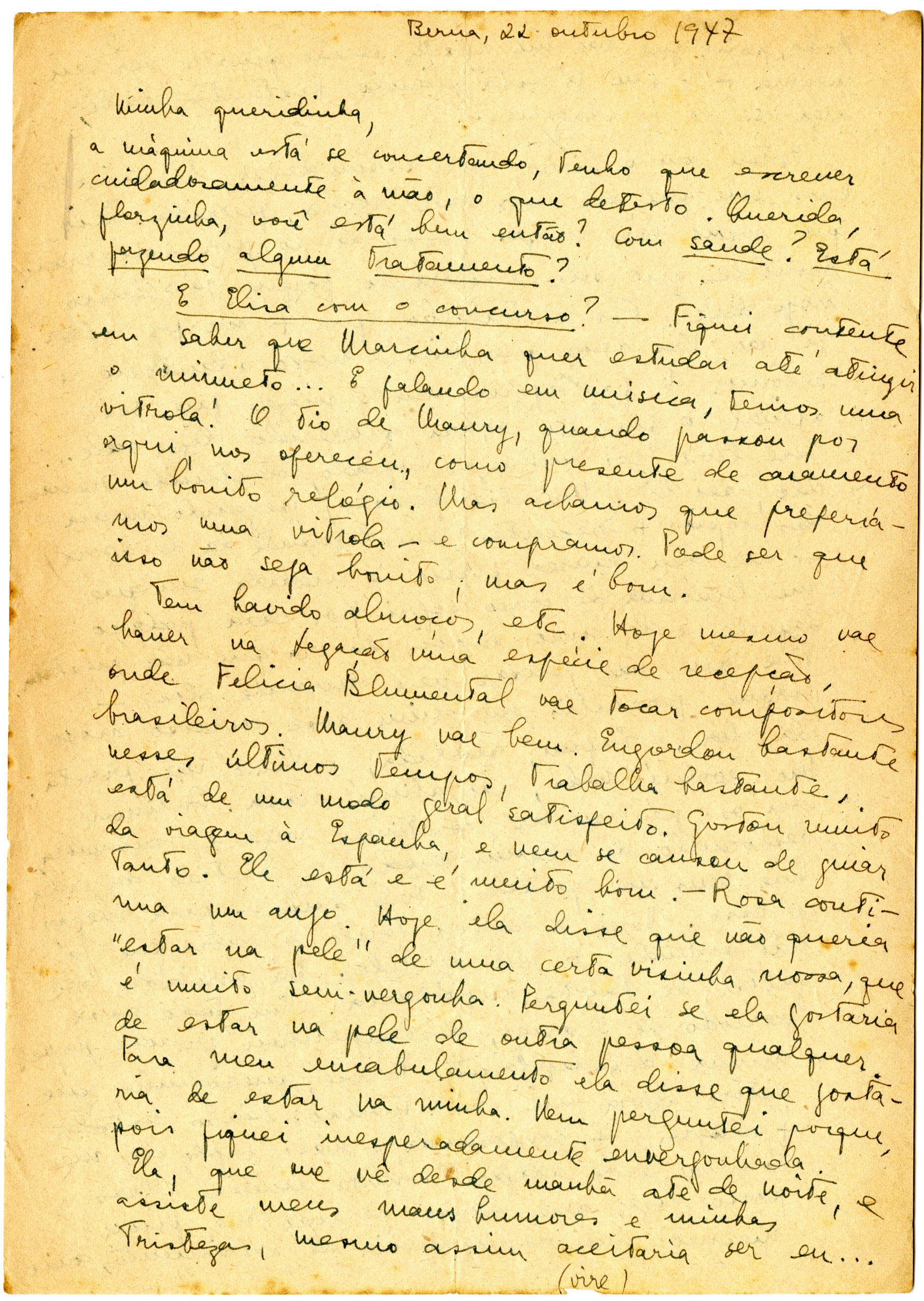
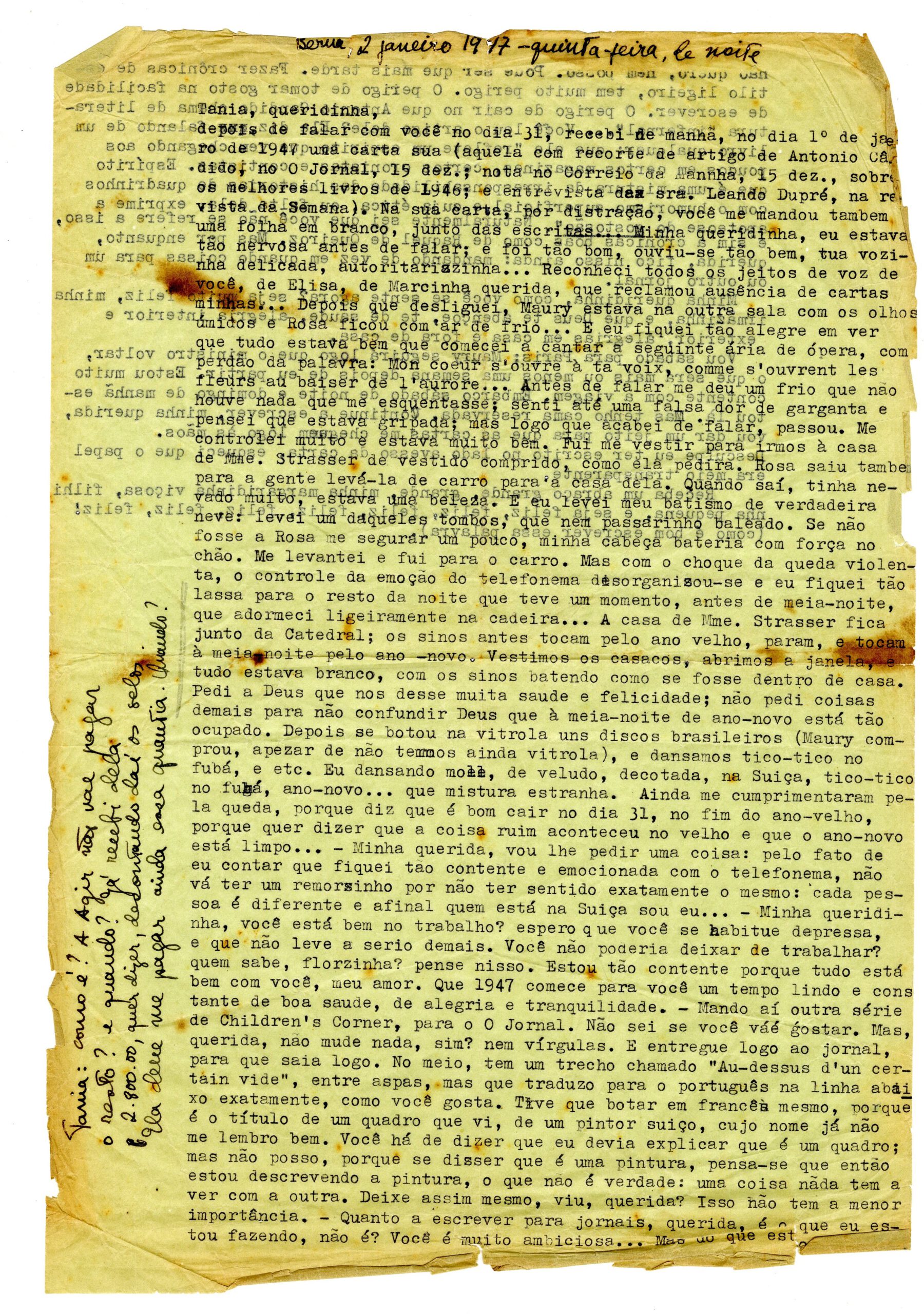
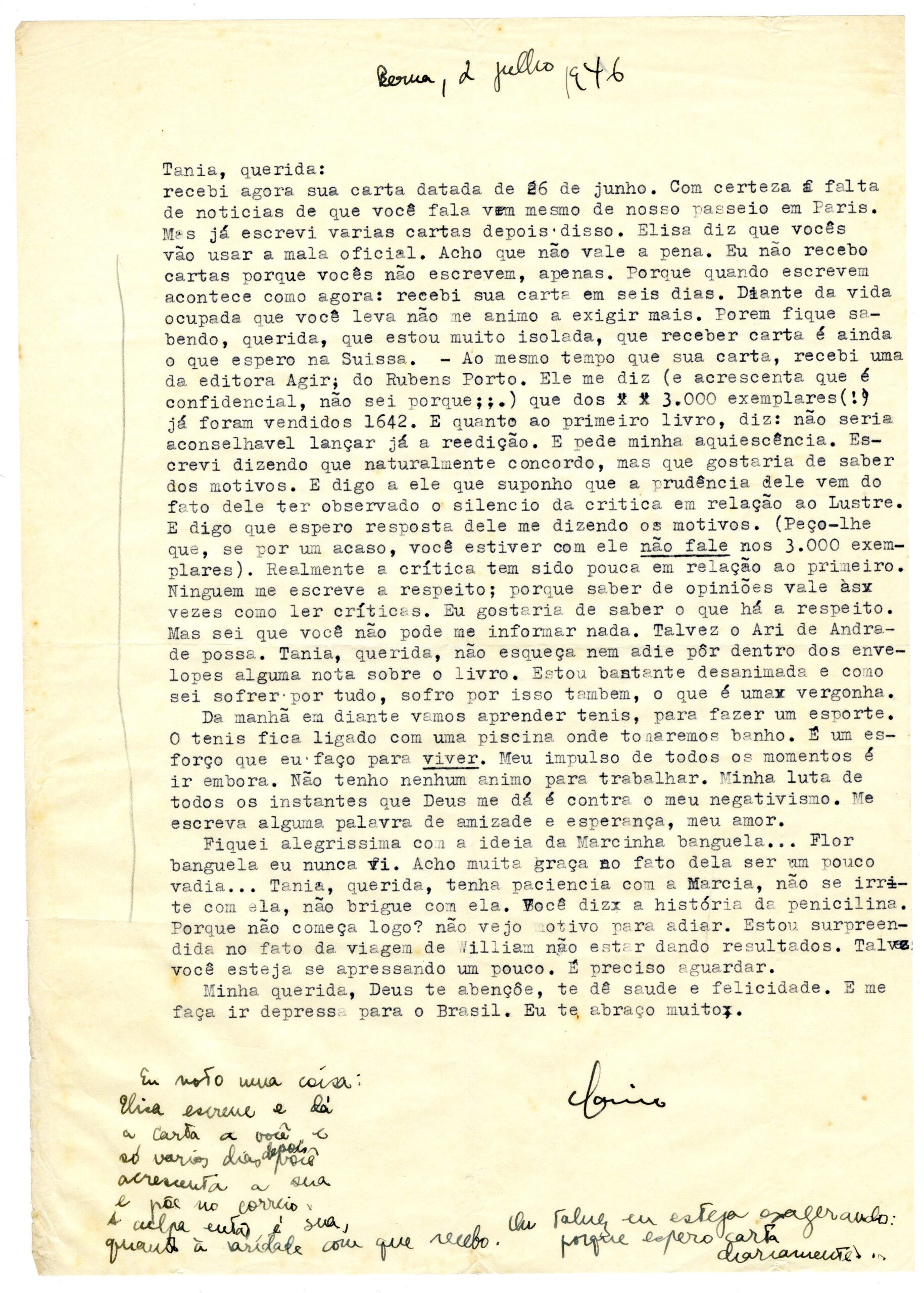
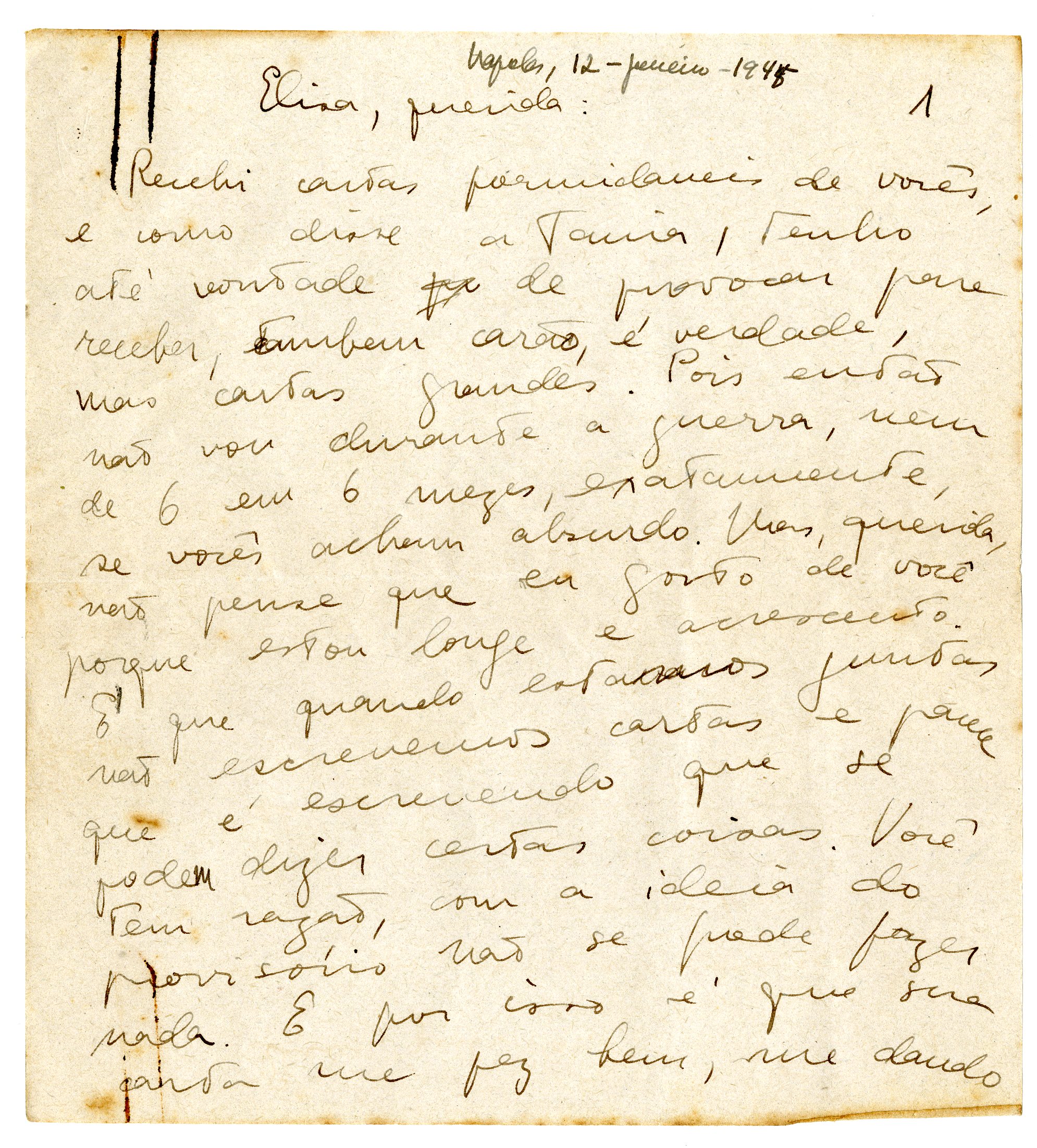
I have a letter from May 2 to answer, yours, Elisa, and another from May 3, yours, Tania. I don’t know why they are taking so long to arrive: sometimes they take 8 days. Yours, Elisa, with great news about Geneva, which I already knew because it had come out in the Embassy newsletter – congratulations! congratulations! congratulations! And with it came a clipping from Raquel de Queiroz. Your letter, Tania, gives good news from everyone, and the possibility of a good tenant – how did it turn out?
Today I received the telegram giving the ticket price. I’ll explain why I sent the question. We travel with Aerovias, which gives us a discount, but several people started saying that it was cheaper with Panamerican, if we pay in Brazil (with the fixed price of the ticket, but not a fixed dollar value, it would be very cheap). Each person said something different, and the man at Aerovias was waiting, and I was already annoyed with a thousand calculations. And the thing was getting urgent; so, the only thing was to know how much the ticket would be in cruzeiros. It was great that I asked because, despite the work it gave me, we found out that, even paid in Brazil and even with the favorable exchange rate, it’s still cheaper with Aerovias. We wanted to avoid Aerovias because of the connection in Miami and consequently the discomfort with two children. But we’ll go that way anyway, because it’s a good discount. So, tomorrow the money goes to Miami and we’ll have the tickets with us, and the problem, God willing, will be resolved.
Paulinho’s food has proceeded, as I already told you, by way of a gentleman. I’ll send his number soon, so one of you can call and ask him if he’s already cleared his luggage and if he’s already got the two boxes at home. So you, please, let me know immediately, so I can rest easy on this point, and know that the man didn’t lose his crates or anything of value. In no way do I want to change Paulinho’s diet in those two months in Rio.
I’m writing this letter to you, Elisa, without knowing at all whether you already departed for Geneva. I will send it to the Marquês de Abrantes address.
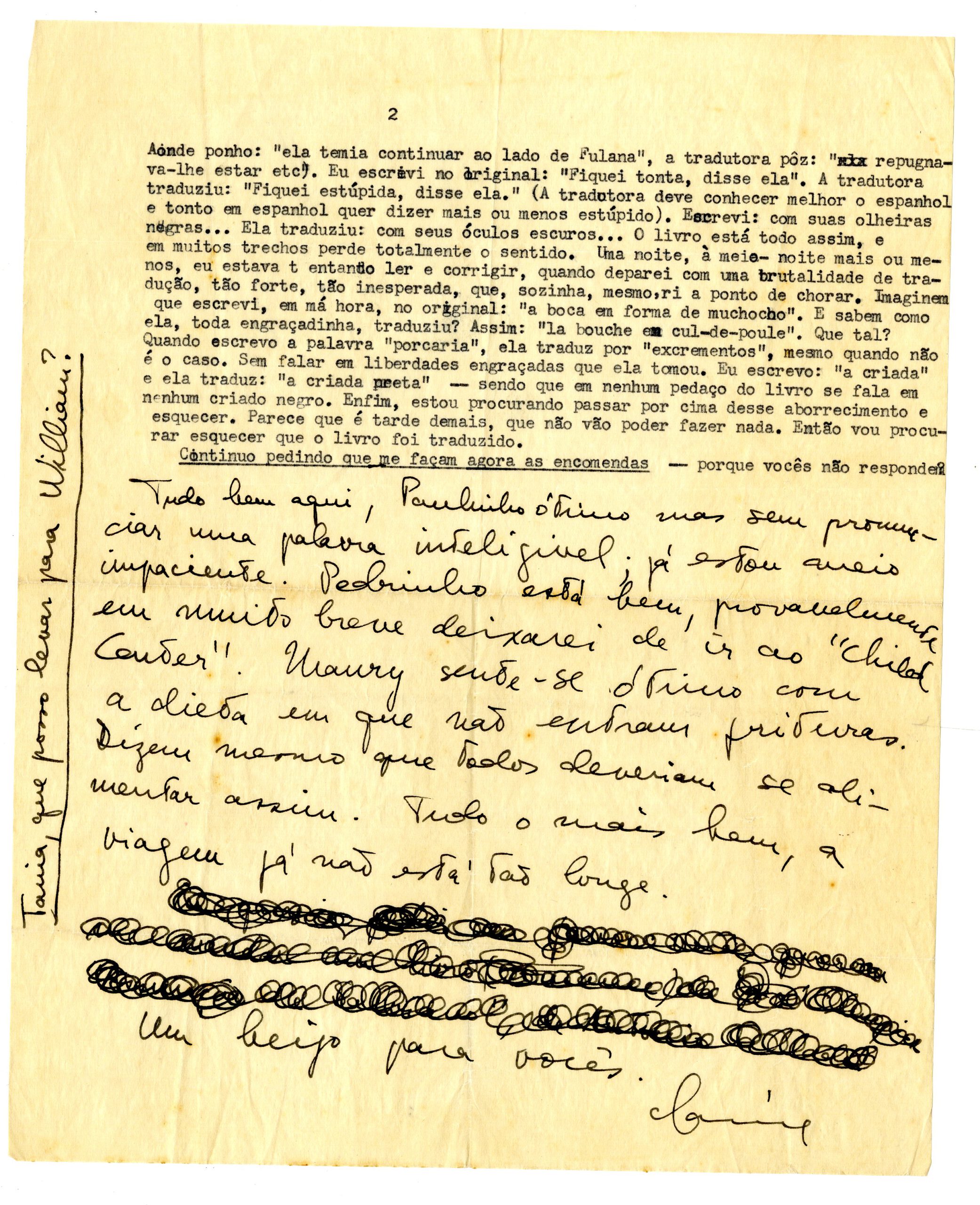
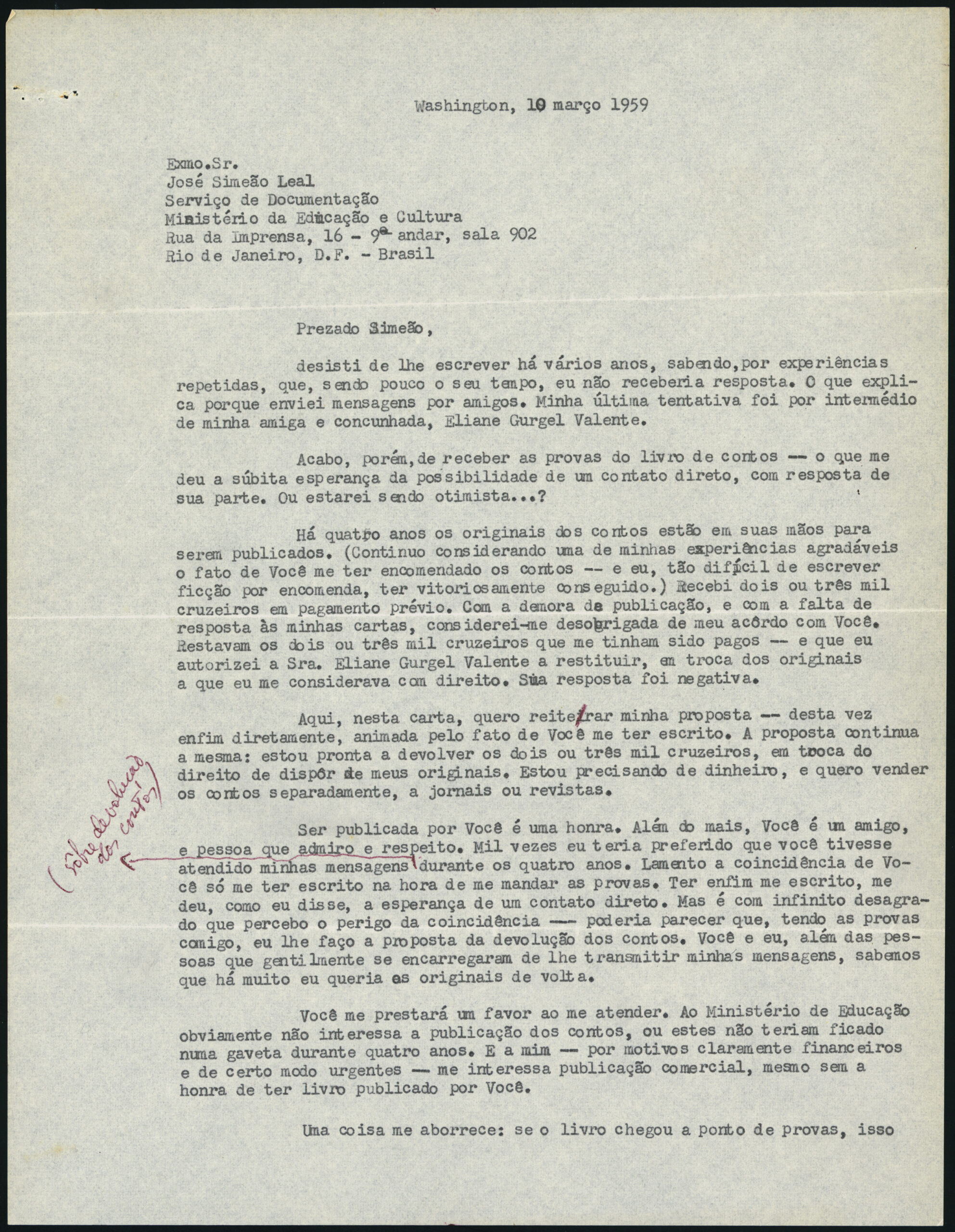
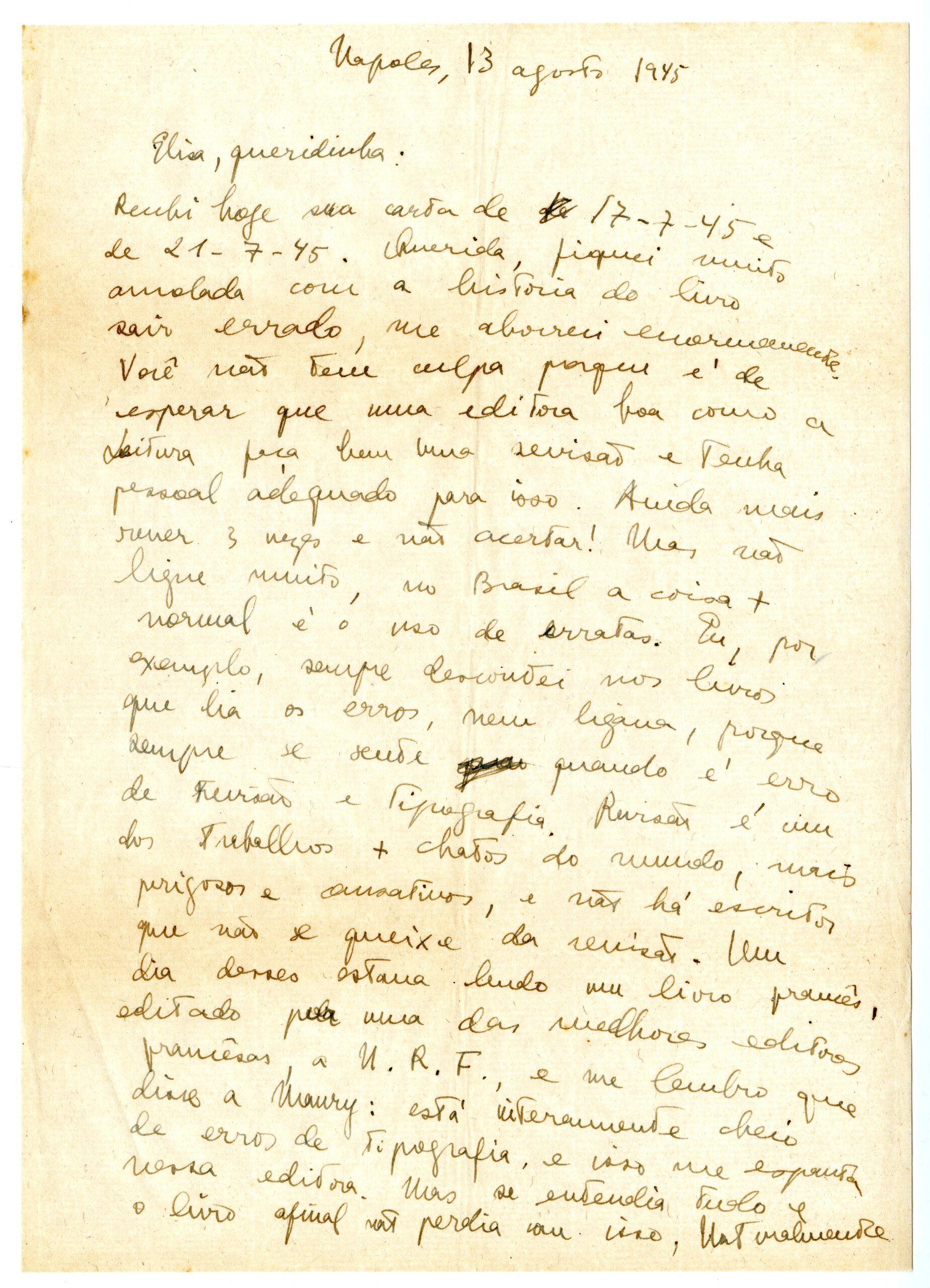
I’m very behind in my correspondence with you both because I’ve been very busy. I received the proofs of P.C.S. (Perto do coração selvagem was translated by E. Plon, in 1954.), already on a certain type of paper that Érico recognized as the definitive paper: that is to say, my corrections must have gone out too late. And there were so many corrections that they would have had to redo the pagination, etc. etc. If they arrived too late, it’s better I forget about it, if I don’t want it to make me seriously upset. Upon Érico’s advice, I sent a letter saying the “translation was scandalously bad” etc., that I would rather the book never be published in France than to come out as it is, without corrections. I sent examples of the translation errors. This work took me about ten days, working often until two-something in the morning, as I was even forced to write in French. To give you an idea of the translation, here are some examples: in Portuguese, “after a few moments, the flames suddenly revived,” was translated as: “after a few moments, everything that called her, awoke” (certainly the translator, seeing “chamas” thought it was from the verb to call). Where I put: “the father was disheveled,” the translator put: “the father was out of breath.” Where I put: “she was afraid to continue beside so-and-so,” the translator put: “she was disgusted to be” etc. I wrote in the original: “I became dizzy, she said.” The translator translated: “I became stupid, she said.” (The translator must know Spanish better and “tonto” in Spanish means more or less stupid). I wrote: with the dark circles around her eyes… She translated: with her sunglasses… The book is all like that, and in many places it totally loses its meaning. One night, at midnight more or less, I was trying to read and correct, when I came across a rather crude translation, so strong, so unexpected that, even alone, I laughed to the point of crying. Imagine that I wrote, at a bad moment, in the original: “the mouth in the shape of a tut-tut.” And you know how she, all funny, translated it: So: “la bouche en cul-de-poule”. How about that? When I write the word “crap,” she translates it as “excrement,” even when that’s not the case. Not to mention the funny liberties she took. I write “the maid” and she translates: “the black maid” – and in no part of the book is there mention of any black servant. Anyway, I’m trying to get over this annoyance and forget it. It looks like it’s too late, that I can’t do anything. So I will try to forget that the book was translated.
I keep asking you to place your orders now – why don’t you respond?
Everything’s fine here, Paulinho is excellent but only utters unintelligible phrases, I’m already very impatient. Pedrinho is fine, probably very soon he will stop going to the “Child Center.” Maury feels great about the no-fried-foods diet. They really say everyone should eat like this. All the better, the trip is not that far away anymore.
A kiss for you both.
Clarice
Tania, did you already receive the Department of Labour brochures?
Tania, what can I bring for William?
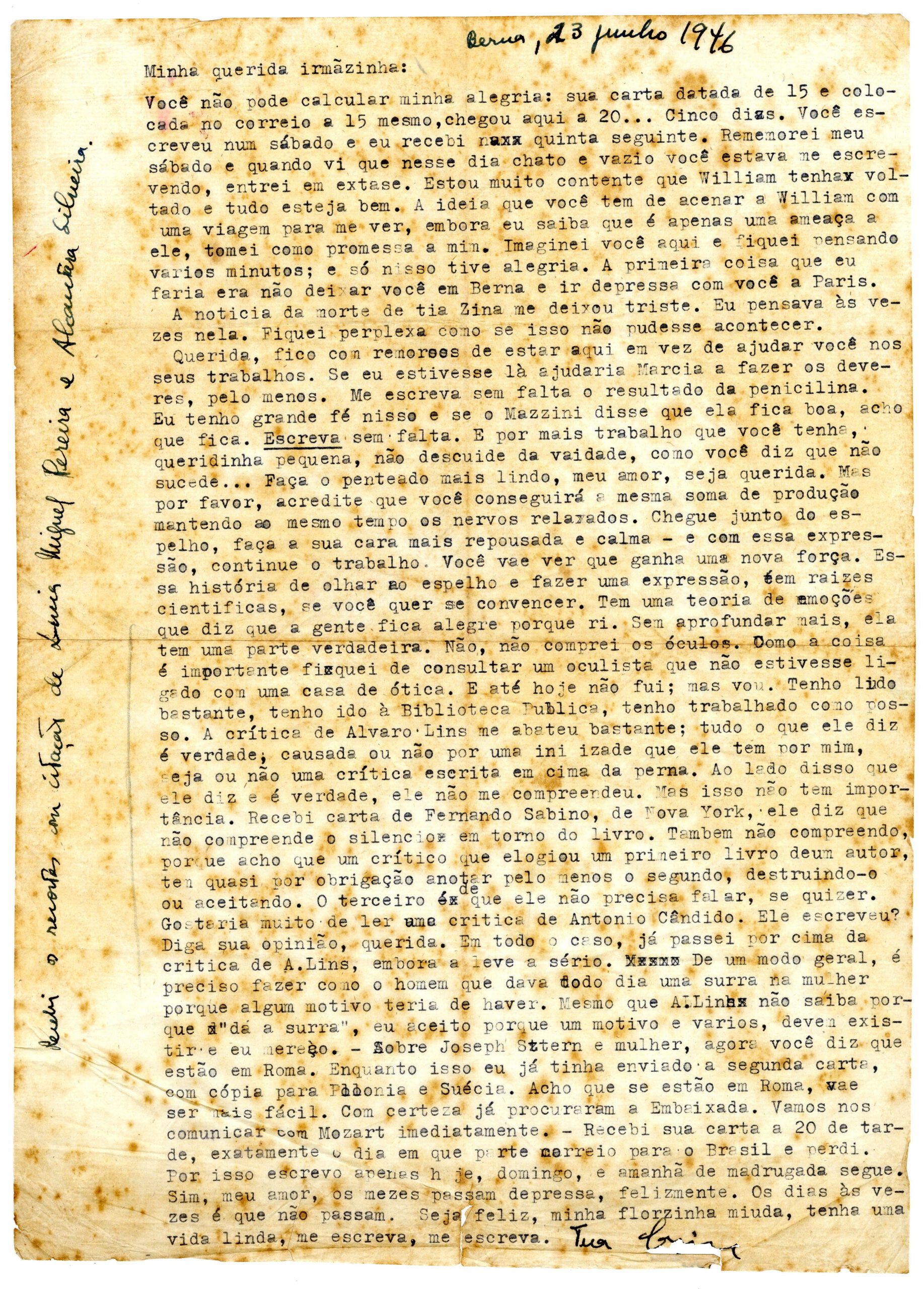
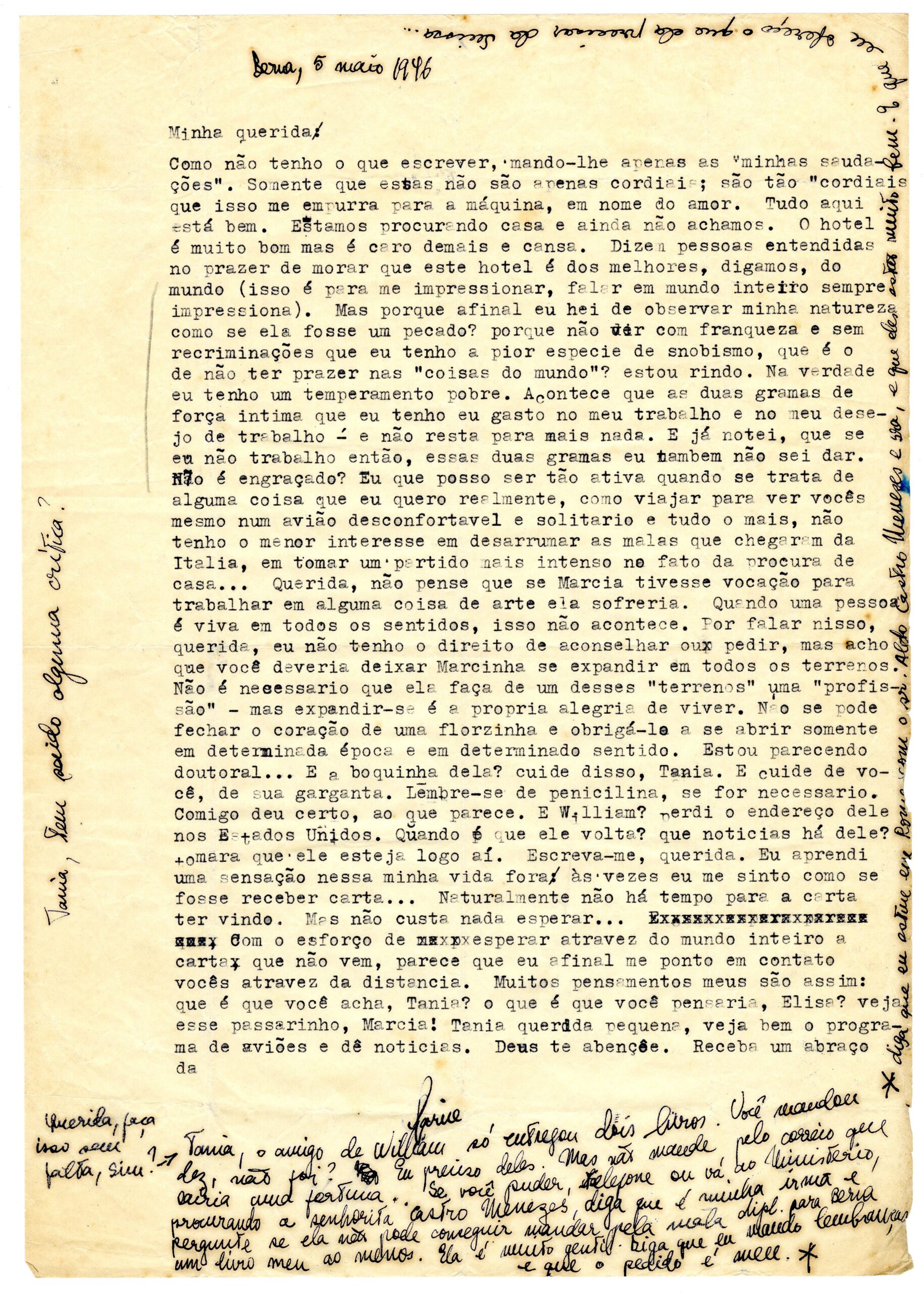
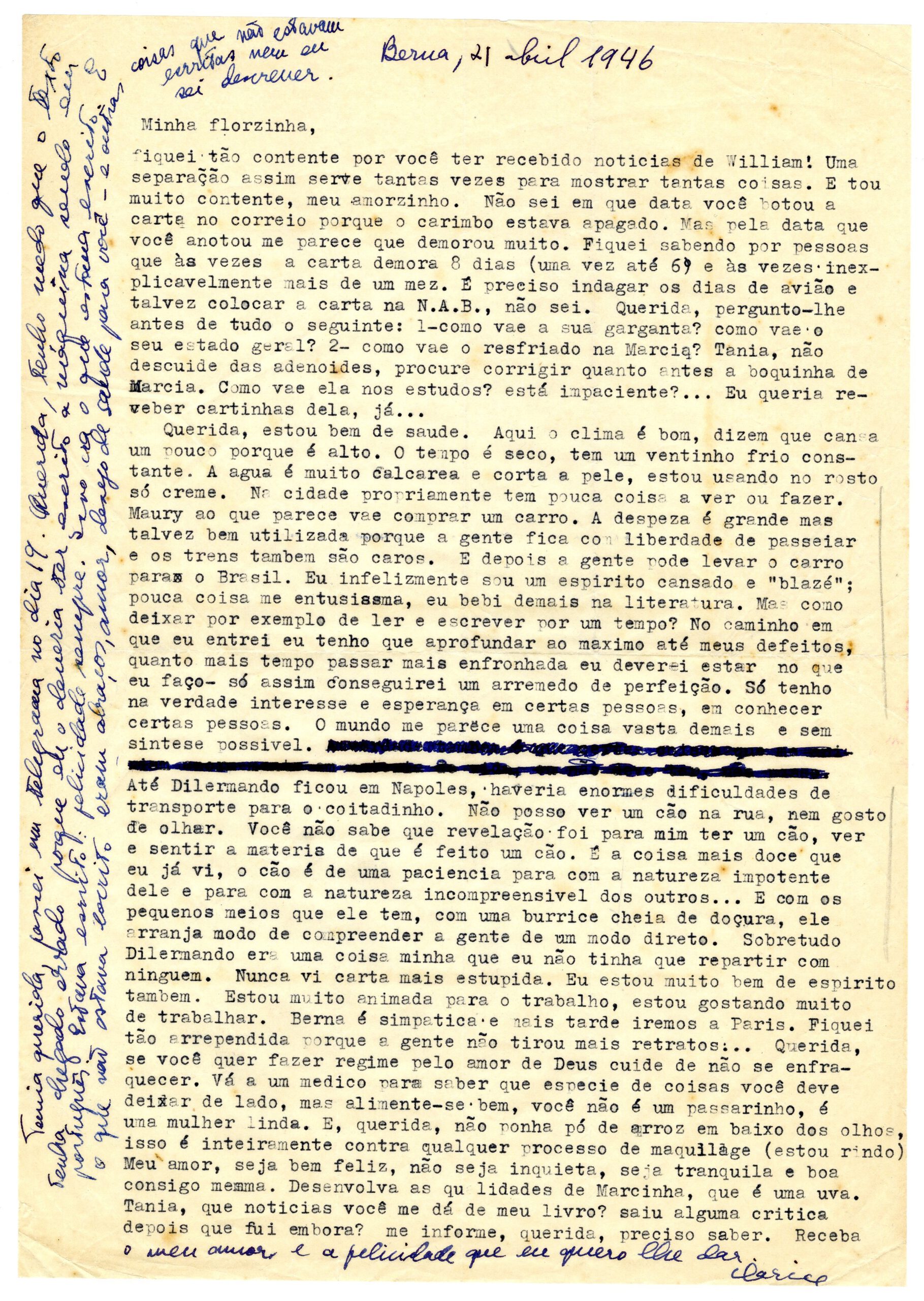
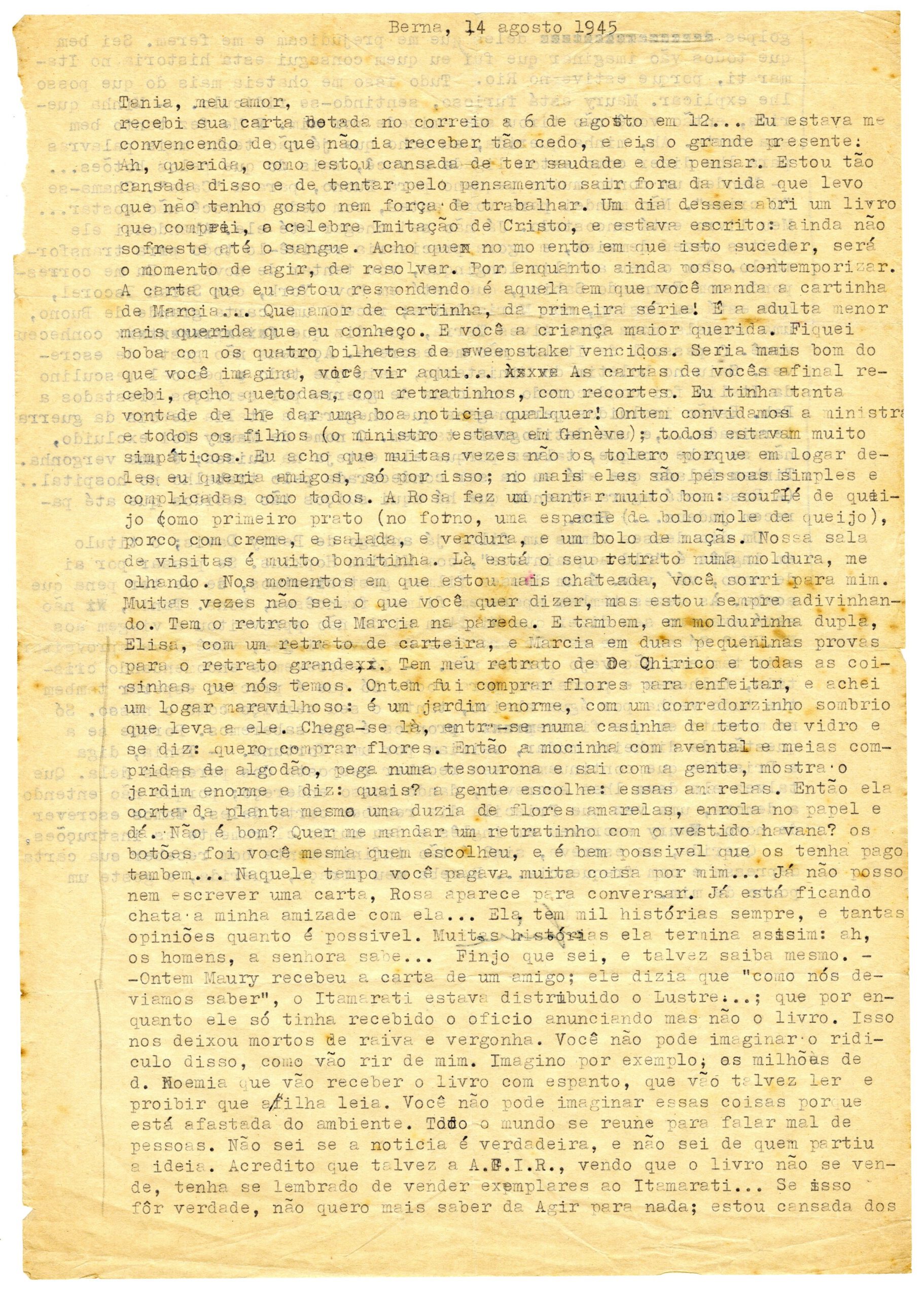
Itens do acervo
Acervo
From: Clarice Lispector
From: Clarice Lispector
To: Elisa Lispector
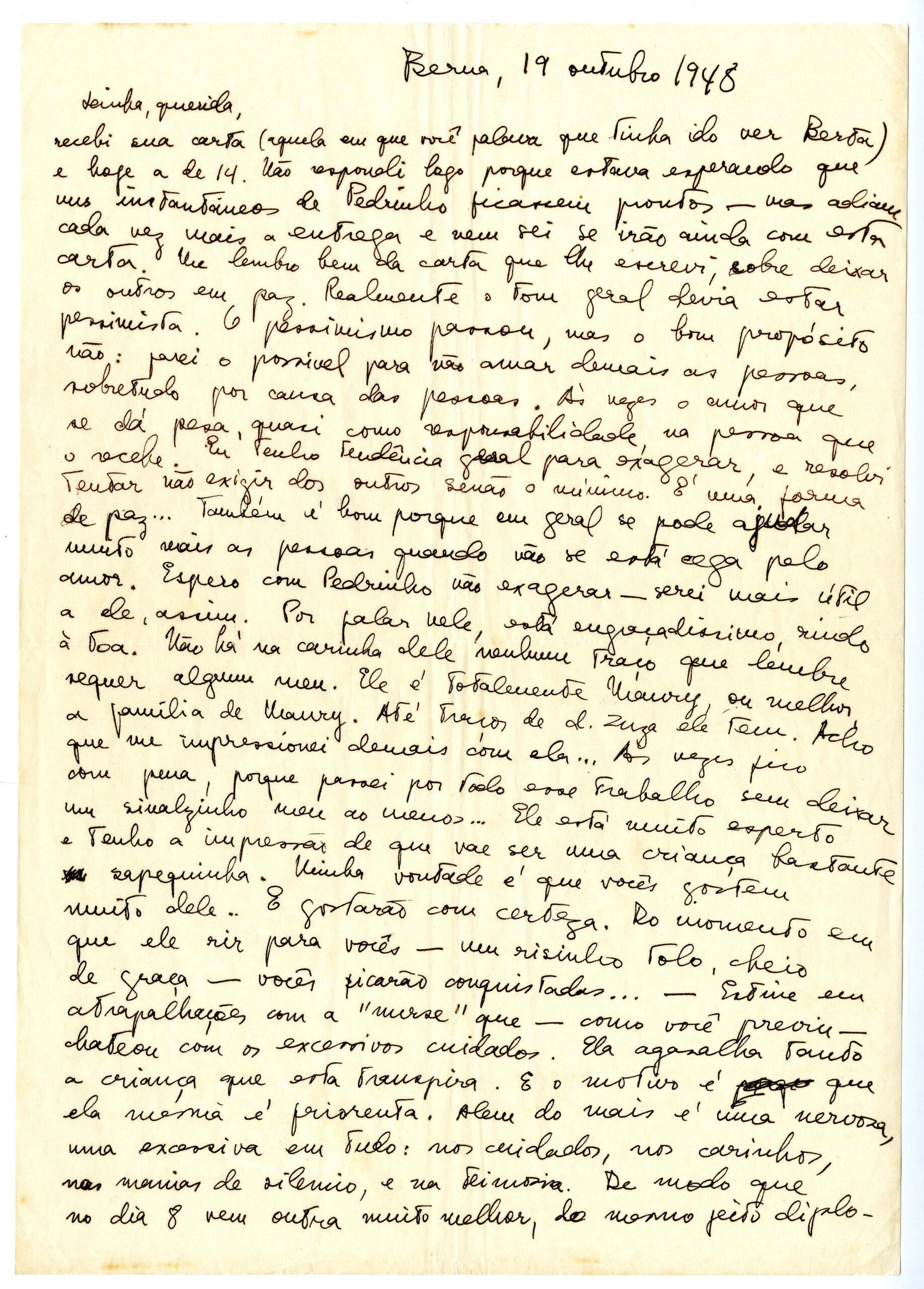

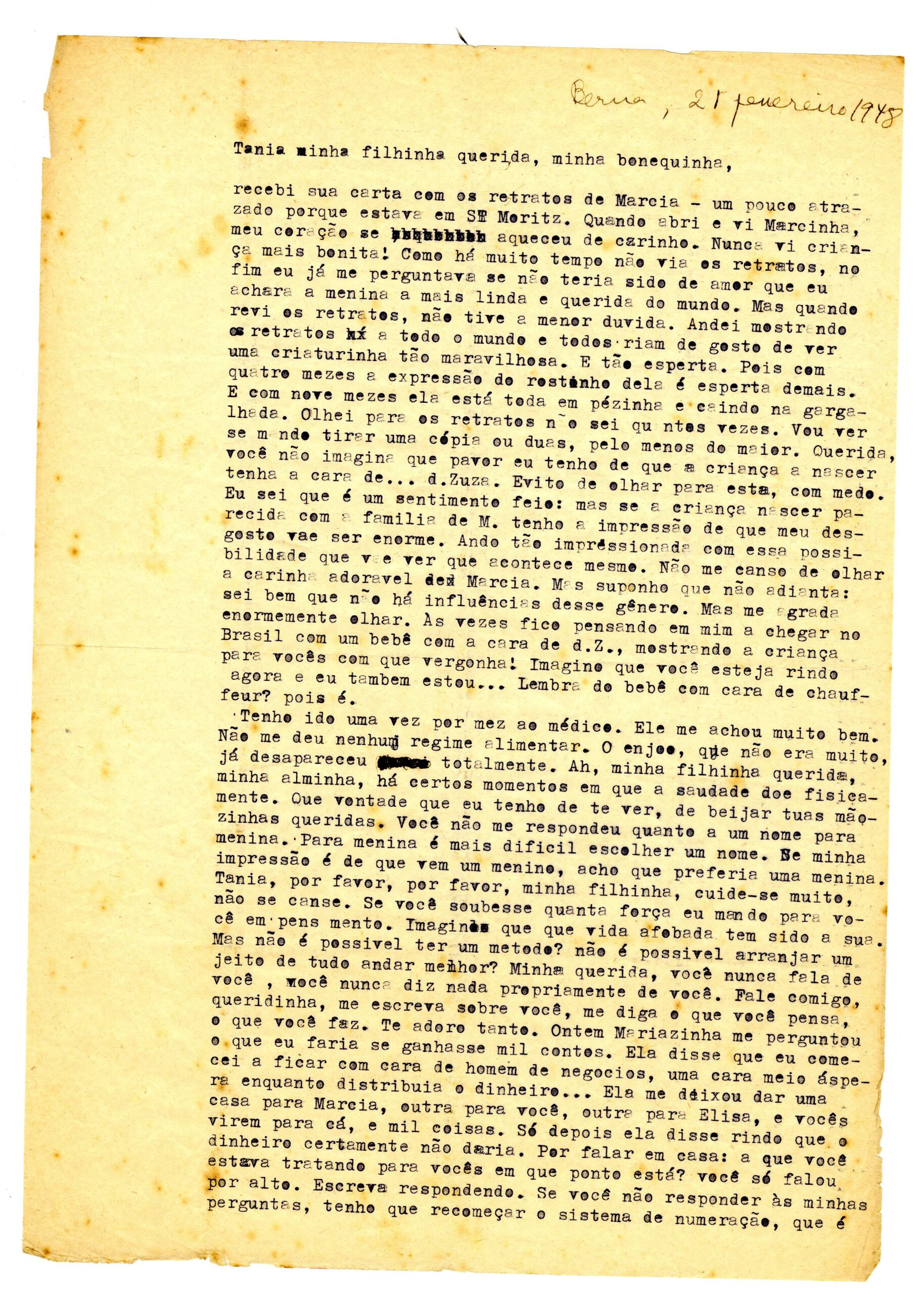
Bern, October 19, 1948
Leinha, darling,
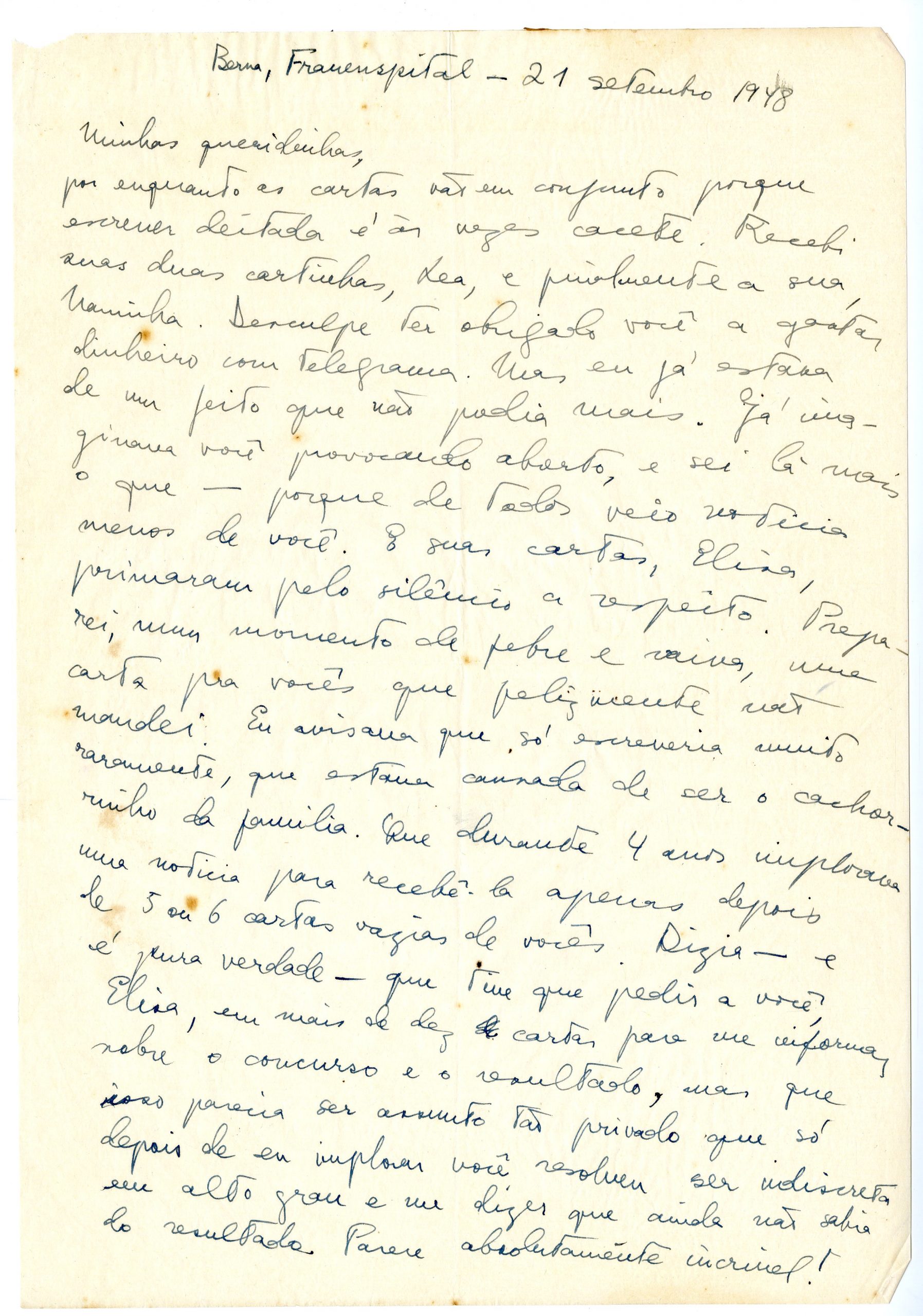
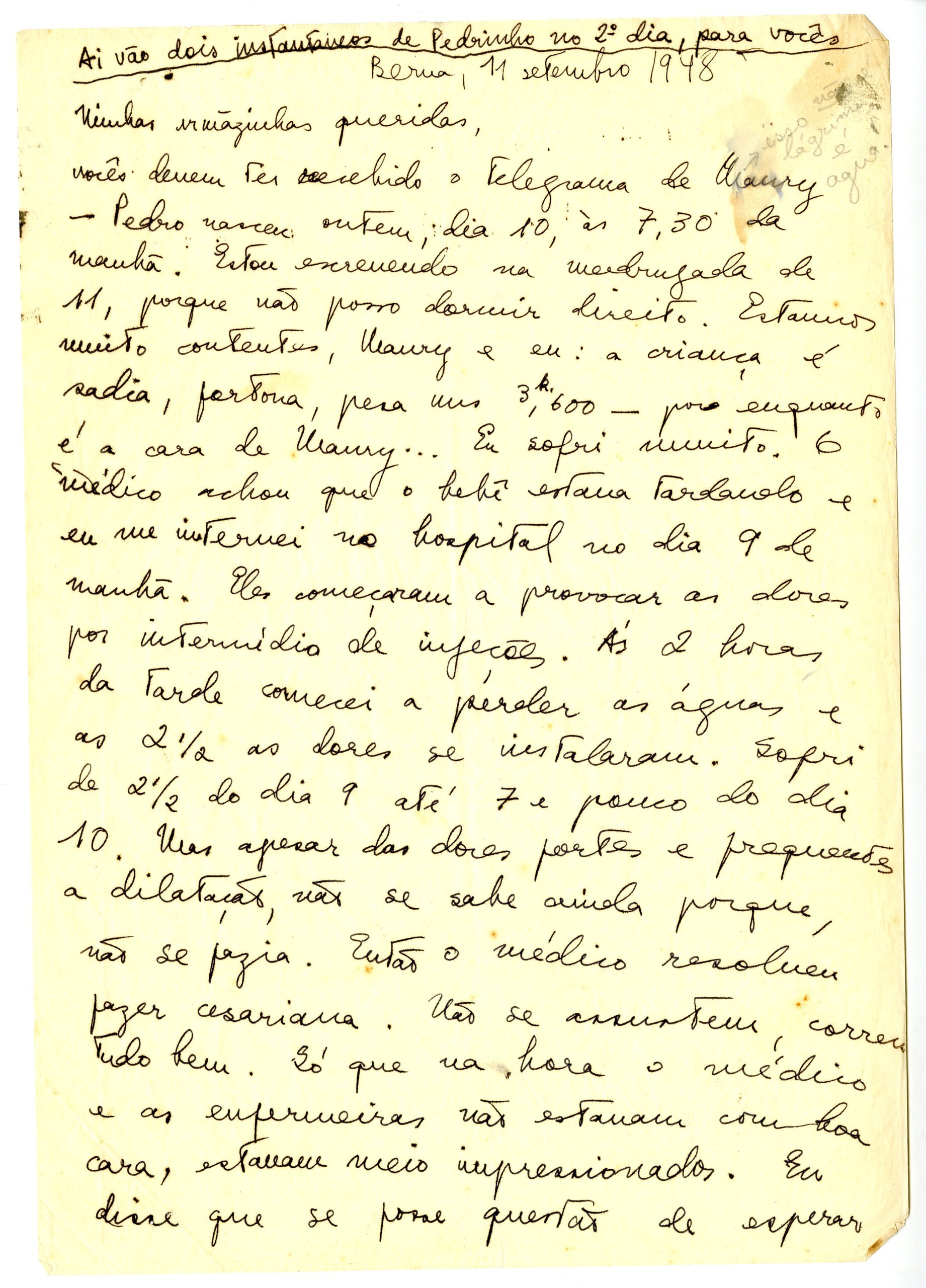
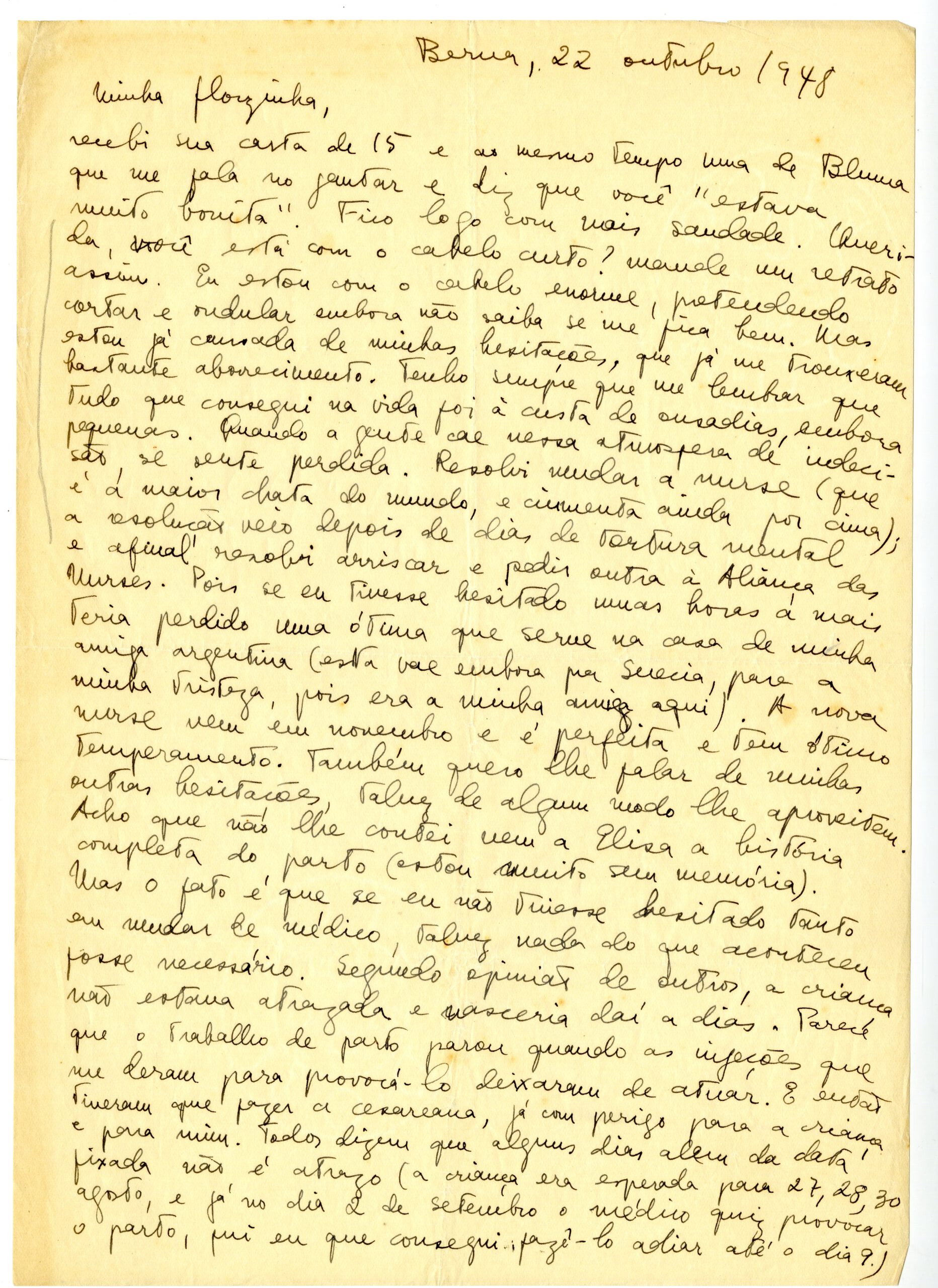
I received your letter (the one in which you said you had gone to see Berta) and today that of the 14th. I didn’t answer right away because I was waiting for some of the snapshots of Pedro to be ready – but putting the delivery off more and more and I don’t even know if they’ll still be sent with this letter. I remember well the letter I wrote to you, about letting others be. The general tone must have been pessimistic, really. The pessimism has passed, but not the good intention: I’ll do my best not to love people too much, especially on their behalf. Sometimes the love you give weighs almost like a responsibility on the person who receives it. I have this general tendency to exaggerate, and I’ve decided to try to ask only the minimum of others. It’s a form of peace… It’s also good because in general you can help people much more when you’re not blinded by love. I hope not to exaggerate with Pedro – I’ll be more useful to him that way. Speaking of him, he’s really funny, laughing at everything. He’s nothing like me at all. He’s much more like Maury, or rather, Maury’s family. He even takes after Zuza. I think I was really impressed by her… Sometimes I feel bad, because I went through all this trouble without leaving not even a slight mark of my own… He’s very clever and I have the impression that he’ll be a very restless child. I hope you all like him. You certainly will. After he smiles at you – a silly smile, full of joy – you’ll be won over… I had a few mix-ups with the nurse who – as you foresaw – upset me with her excessive care. She puts so many layers on the child that he sweats. And the reason is that she herself is sensitive to cold. Besides, she’s agitated, excessive in everything: in her cares, in her caresses, in her obsession with silence, in her stubbornness. Such that on the 8th a much better one is coming, also certified and absolutely trustworthy, who worked in the house of my Argentinian friend. Thus our vacation will be much more relaxing. This annoying woman, with her agitation, rushed us into looking for another house, and it’s not even necessary yet. But now we’re already going to sign a contract for another one (only in December) that isn’t so original and nice as this one; but it’s more sunlit. Darling, as you can see, I’m telling you thousands of small details that give you an idea of life in Bern… Today I have to go to a cocktail party. Tomorrow we’ll have dinner with the president at the minister’s house, with a long dress and material and spiritual costume jewelry. The day after tomorrow I’ll have lunch at the house of the French ambassador, a lady who is very selective of her guests and who honors me with her frequent attention (she’s actually the only intelligent woman in diplomatic circles). And in two days, I’ll have lunch with the Foreign Minister in our legation… Don’t think it’s always like this, it’s a special week. I tell you to give an idea of what can happen around here… – I hope the pictures are ready today and can go. – Darling, kisses for you. How I’d like you to hear Pedro cry (he’s crying now). He looks you right in the eyes and follows you around the room with his gaze. He weighs 4.6 kilos now. Noemia had lunch here today with the minister, and Pedro was smiling at everyone. I hope he doesn’t have the soul of a diplomat, I wouldn’t like it one bit… My dear, hugs for you, from yours always
Clarice
From: Clarice Lispector
To: Tania Kaufmann
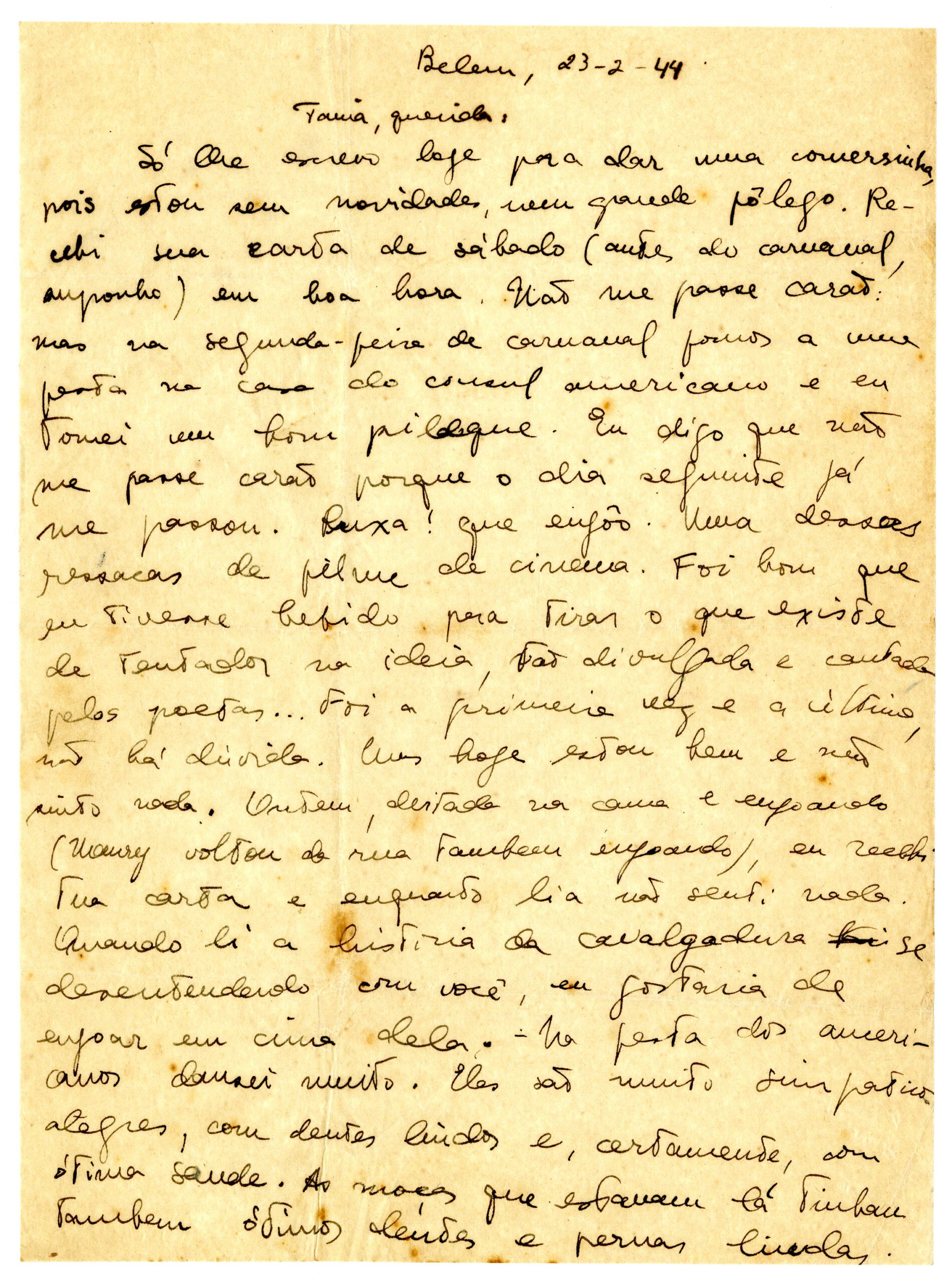
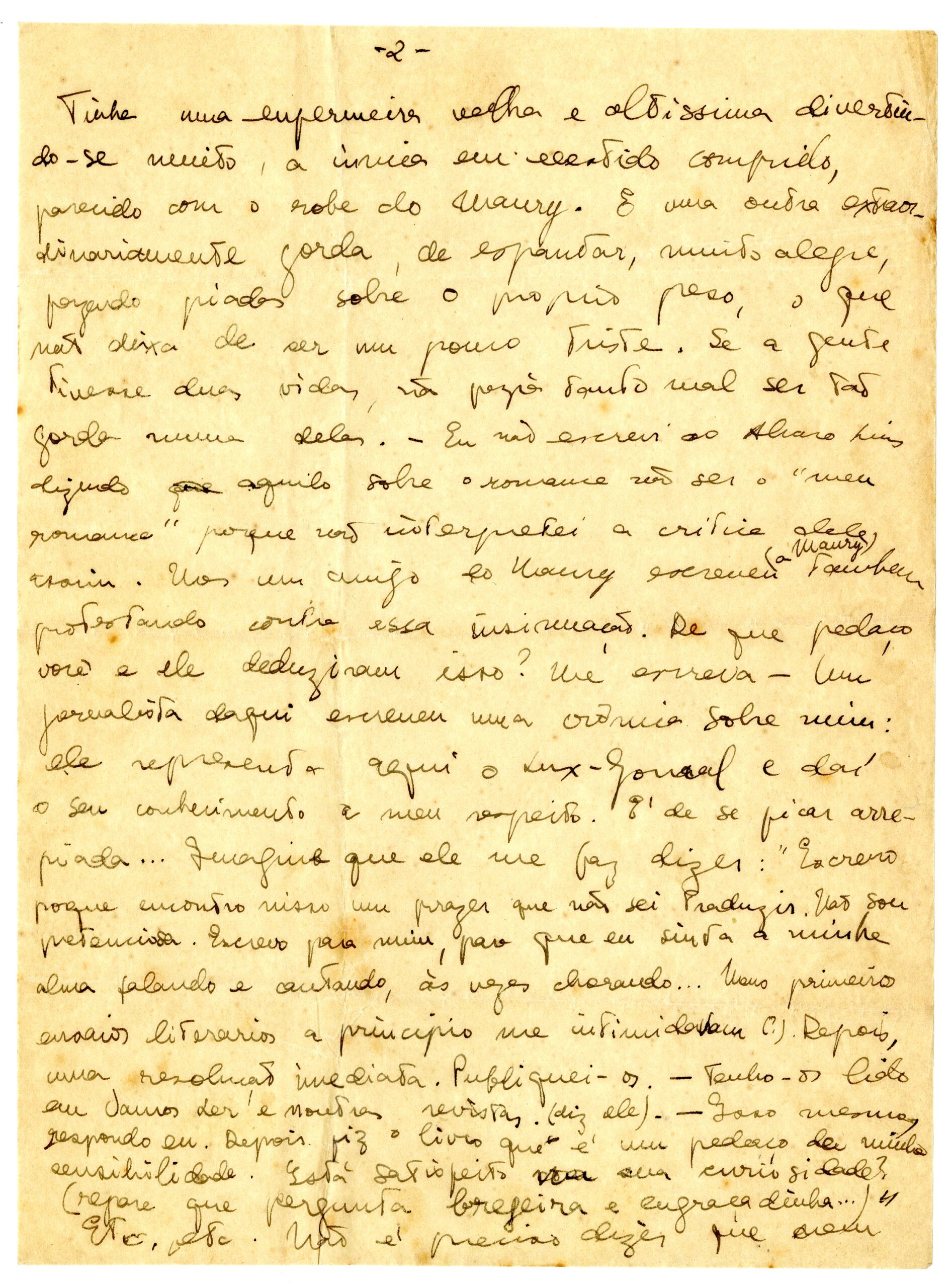

Belém, February 23, 1944
Tania, darling:
I’m only writing to you today for a little conversation, since there is nothing new to report, and I’m still busy. I received your letter from Saturday (before Carnival, I suppose) at a good time. Don’t reprimand me: but on Carnival Monday we went to a party at the house of the American Consul and I got really drunk. I said not to reprimand me because the next day I got it. I felt so sick! One of those hangovers you see in the movies. It was good to get drunk so I could demystify the idea, which poets promote and celebrate so much… It was the first and last time, no doubt. But today I’m fine and don’t feel anything. Yesterday, lying in my bed and feeling sick (Maury also came home feeling sick), I received your letter and while I read it I didn’t feel anything. When I read the story about the dumb lady who got into a misunderstanding with you, I wanted to vomit on top of her. I danced a lot at the Americans’ party. They’re very nice and lively, with beautiful teeth and, certainly, in good health. The girls who were there also had nice teeth and beautiful legs.
There was a tall, old nurse having lots of fun. And a very lively, extraordinarily fat one making jokes about her own weight, which is also somewhat sad. If we had two lives, it wouldn’t be so bad to be fat in one of them. – I didn’t write to Álvaro Lins (The article by Álvaro Lins, “Romance lírico” [Lyrical Novel], was published in Correio da Manhã on February 11, 1944 and republished under the title: “A experiência incompleta: Clarice Lispector” [The Incomplete Experience: Clarice Lispector]. Os mortos de sobrecasaca. Ensaios e estudos (1940-1960) [The Frock Coat Dead: Essays and Studies], Rio de Janeiro, Civilização Brasileira, 1963.) saying that about the novel not being “my novel” because I didn’t interpret his review that way. But one of Maury’s friends wrote (to Maury) also protesting against that insinuation. In what part did you and he deduce that? Write me – A journalist (The journalist Edgar Proença. The interview “Um minuto de palestra” [A Minute Lecture] was published in the Estado do Pará (Belém, February 20, 1944).) from here wrote a piece about me: he represents the Lux-Jornal here and that’s how he knows about me. It gives me goosebumps. Imagine that he made me say: “I write because I find in it a pleasure that I don’t know how to translate. I am not pretentious. I write for myself, for me to feel my soul speaking and singing, sometimes crying… My first literary experiments intimidated me in the beginning. Afterwards, an immediate resolution. I published them.” I’ve read them in Vamos Ler and other magazines (he says). – That’s right, I answered. Then I prepared the book that is a piece of my sensibility. Is your curiosity satisfied? (see what a coarse and funny question that is…) Etc. etc. I need not say that I didn’t even talk to him. I only gave him upon request some reviews of Lux-Jornal, of which he transcribed a section. He even says I have “intellectual tact” … “Thus we read without boredom, without intervals, the short stories and art of C.L.” – I don’t know where to publish my short stories and I don’t actually wish to. It would be good to publish them anywhere just to have them in print and, in case we insist, for me to be able to present them. Knowing that I was a journalist, they asked me to collaborate with a newspaper and a magazine. But it’s impossible… you’ll see.
(…) I’m sending you some clippings. Read the short story, which is very good. Susana will also like it. It’s precisely her genre. When I read it I was thinking of you. – You certainly received a long letter from me after the one that you answered. Write to me. Hugs from yours truly
Clarice
Show Elisa the clippings…
From: Clarice Lispector
To: Tania Kaufmann

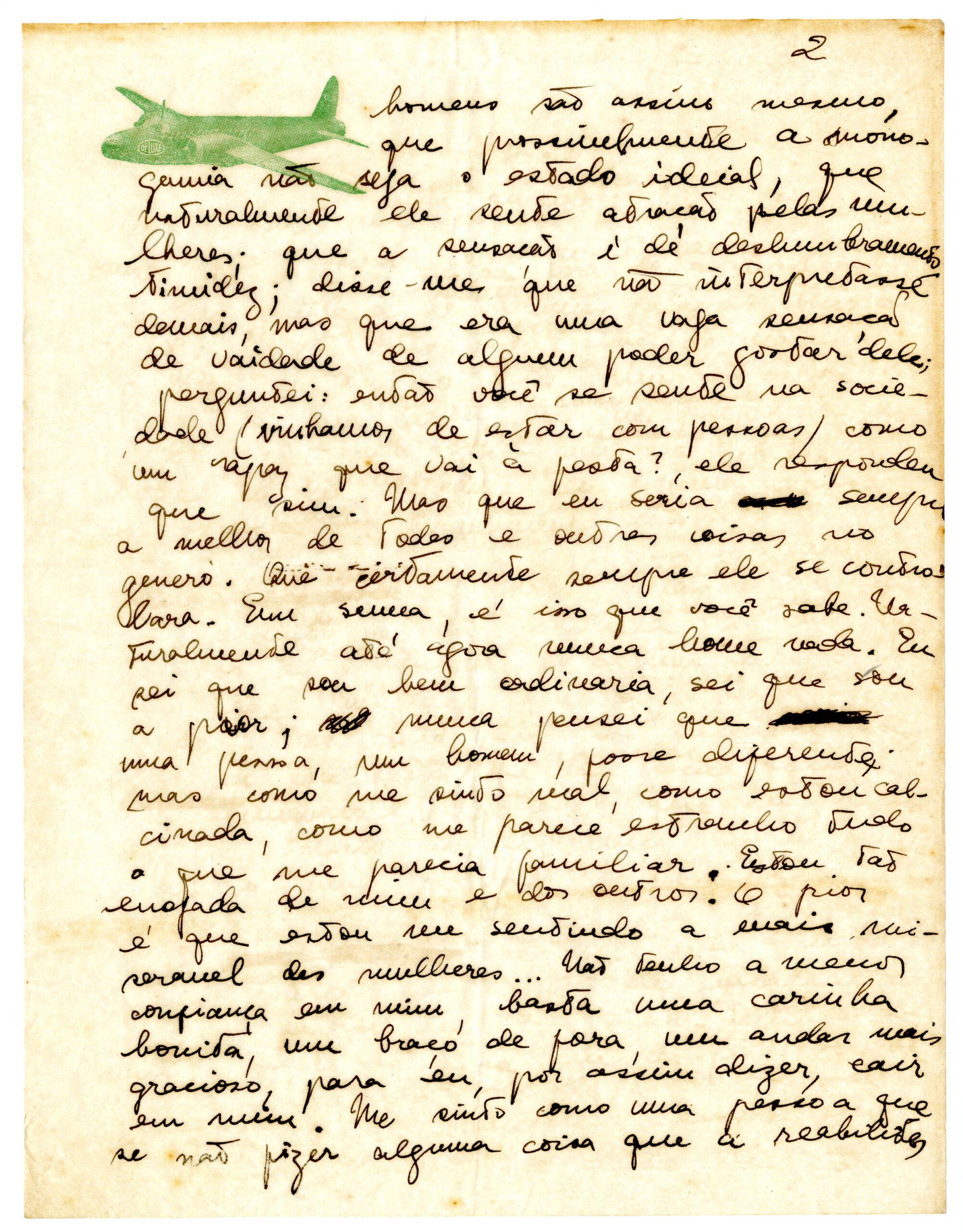
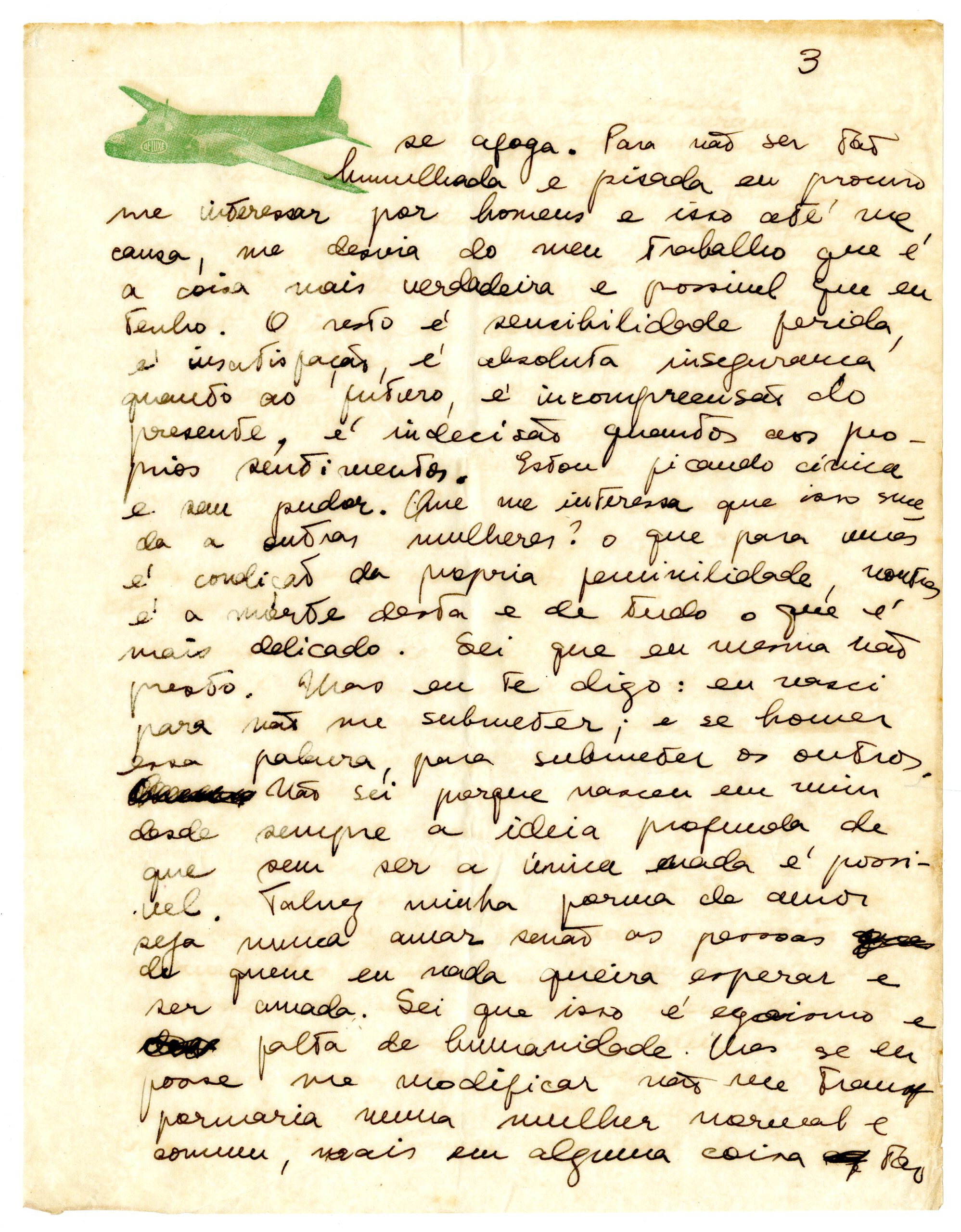

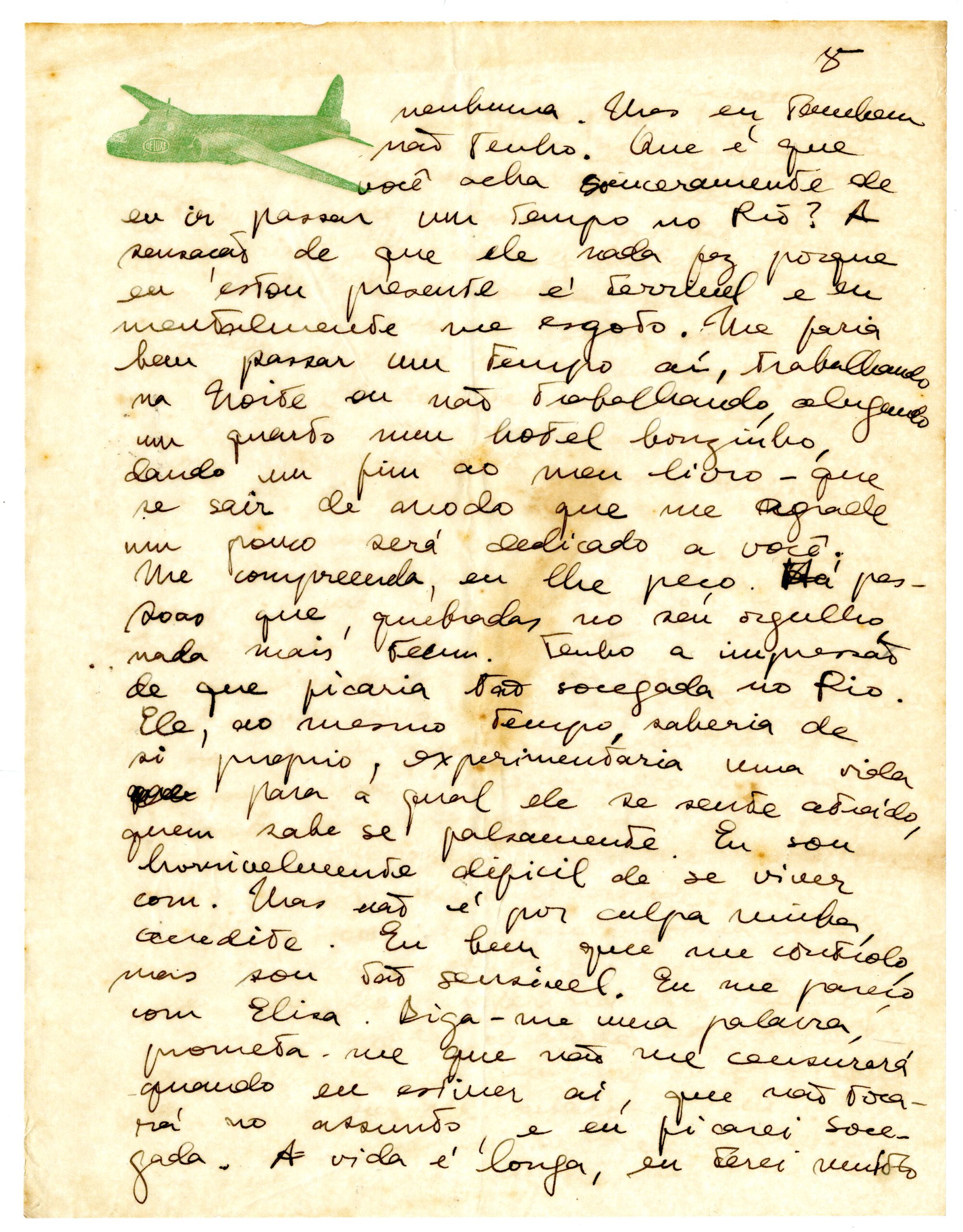
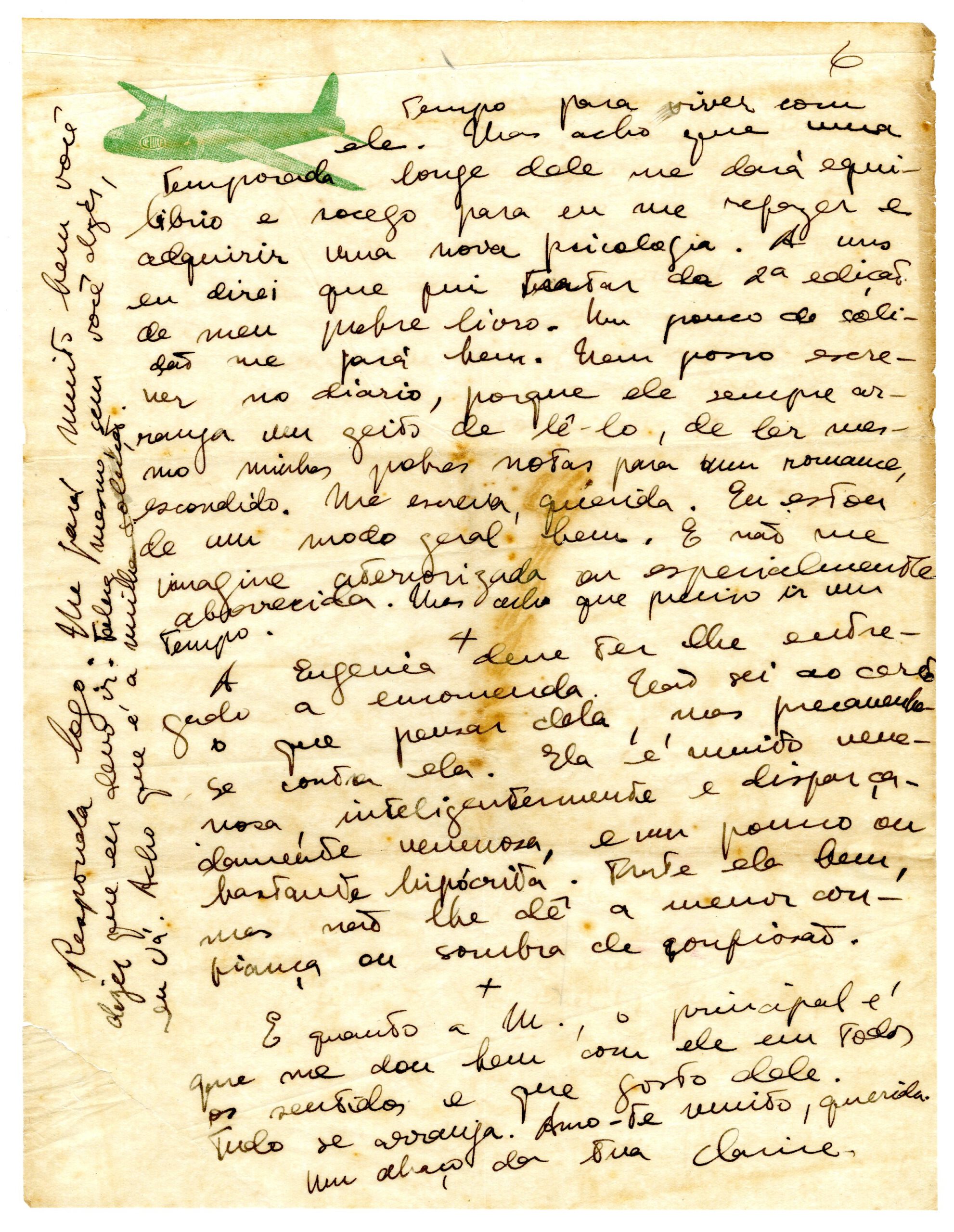
Belém, July 8, 1944
My darling
Your letter arrived with good timing. I really needed to hear your words. Twice already, I almost packed my bags and went to Rio. The day before receiving your letter I was preparing to travel, I had already made arrangements with the Brazilian Navigation Airline (NAB). In the afternoon on the day after I was weary and exhausted and probably wouldn’t go anymore, the letter came. But now I ask myself whether it wouldn’t be better to go to Rio and stay a while. You may well imagine it’s nothing serious. You’ll say this happens to everyone; but I’m made of such little things and my balance is so fragile that I need an excess of security to feel more or less secure. It was nothing except another declaration by M. like the one made a few days before we embarked that almost made me stay. As I began to make a scene, terribly upset, I again heard what I had always known – I’ve always been a little cynical –: that men are the way they are, that monogamy was possibly not the ideal state, that he naturally feels attraction toward women; that the feeling is one of fascination and shyness; he told me not to over-interpret, but it was a vague feeling of vanity that someone could like him; I asked: so you feel in society (we were coming back from being with people) like a young man going to party? He said yes. But that I’d always be the best of all of them and things of that sort. That he would certainly always control himself. In sum, you know that’s how it is. Naturally, until now nothing has happened. I know I’m really no good, I know I’m the worst; I never thought that anyone, a man, would be different; but how I feel bad, how I’m calcified, how everything that seemed familiar seems strange to me. I’m so sick of myself and others. The worst is that I feel like the most miserable woman in the world… I have no confidence in myself, any pretty face, exposed arm, graceful gait, is enough for me, so to speak, to come to my senses. I feel like a person who’ll drown if she doesn’t do something to rehabilitate herself. In order not to be so humiliated and stepped on I try to be interested in men and even that is tiring for me, it takes me away from my work which is the truest and most possible thing I have. The rest is wounded sensibility, dissatisfaction, absolute insecurity with regard to the future, incomprehension of the present, indecision with regard to my own feelings. I’m becoming cynical and shameless. What do I care if this happens to other women? What for some is the female condition, for others is the death of the feminine and of everything that is more delicate. I know that I myself am worthless. But I’ll tell you: I was not born to be submissive; and if this word exists, to submit others. I don’t know why I was born with the profound idea that I must be the only one or else. Maybe my way of loving is never to love anyone except people from whom I expect nothing and be loved. I know this is selfish and inhuman. But if I were to change myself I wouldn’t transform myself into a normal and common woman, but into something as apathetic and miserable as a beggar. You know me well, you’ve always tried to make me into a more balanced and sensible person, but you’ve failed. I like M. and could live well with him if in the end I learned of his liberties with cynicism, shamelessness and irony. I would really like to arrive at this stage of calcification. And then I’d try to take refuge in other ideas and other feelings and the rest would be fine. I don’t know what to do. It only occurs to me to go to Rio, spend a month or two there, give him the liberty not to control himself, to have a life that he didn’t have time to have because he got attached too early, and then go back with the wounds healed over and serene. He doesn’t dislike the idea, of giving some time apart; but he says nothing about having complete freedom while I’m away. And about my also having it, as long as I tell him later. Of course he’d prefer regarding this that I were at peace, working away. But he knows me well and because he does and is afraid of reprisals he controls himself. My God, I know it’s not his fault. But it’s not mine either. What do you really think about me going to spend some time in Rio? The feeling that he hasn’t done anything because I’m around is horrible and naturally I am spent. It would do me well to spend some time there, working on Night or not working, renting a room in a nice hotel, finishing my book – which will be dedicated to you if it’s published in a way that pleases me a little; please understand me. There are people who, broken in their pride, have nothing else. I have the impression that I would be so at peace in Rio. At the same time, he would answer to himself, would experience a life to which he feels attracted, who knows if falsely. I’m terribly difficult to live with. But it’s not my fault, believe it or not. I really control myself, but I’m so sensitive. I’m like Elisa. Talk to me, promise me you won’t censor me when I’m there, that you won’t mention the subject, and I’ll be at peace. Life is long, I’ll have a lot of time to live with him. But I think a long while away from him will give me balance and peace for me to reinvent myself and acquire a new outlook. To some I will say that I went to look after the 2nd edition of my poor book. A little bit of solitude will do me well. I can’t even keep a diary, because he always manages to read it, to even read my poor notes for a novel, hidden. Write to me, darling. I’m well in general. And don’t imagine me terrified or especially upset. But I think I need to go for a while.
And as for M., the main thing is that I get along well with him in every sense and that I like him. Everything will work out. I love you a lot, darling.
Hugs from your Clarice.
Answer me soon. It will do me much good if you say I should go. Maybe even without your saying so, I’ll go. I think it’s my solution.
Logbook
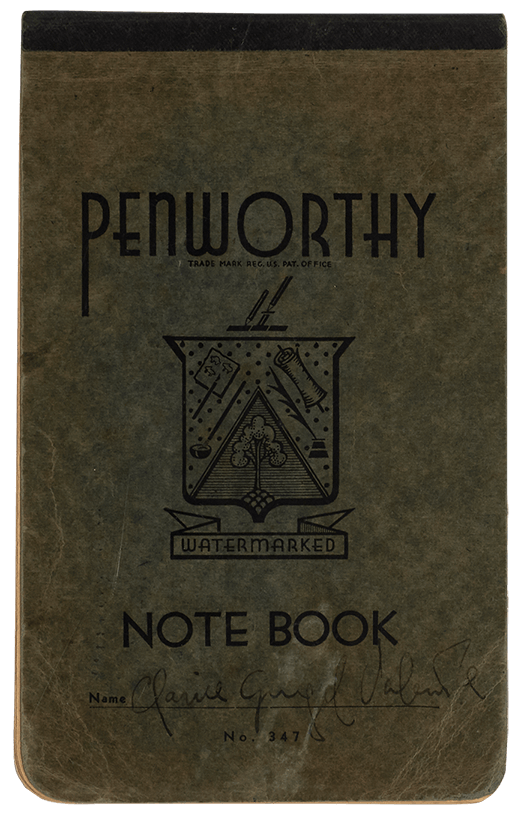
Penworthy // Trade Mark reg. US. Pat. Office // Name Clarice Gurgel Valente Nº 347
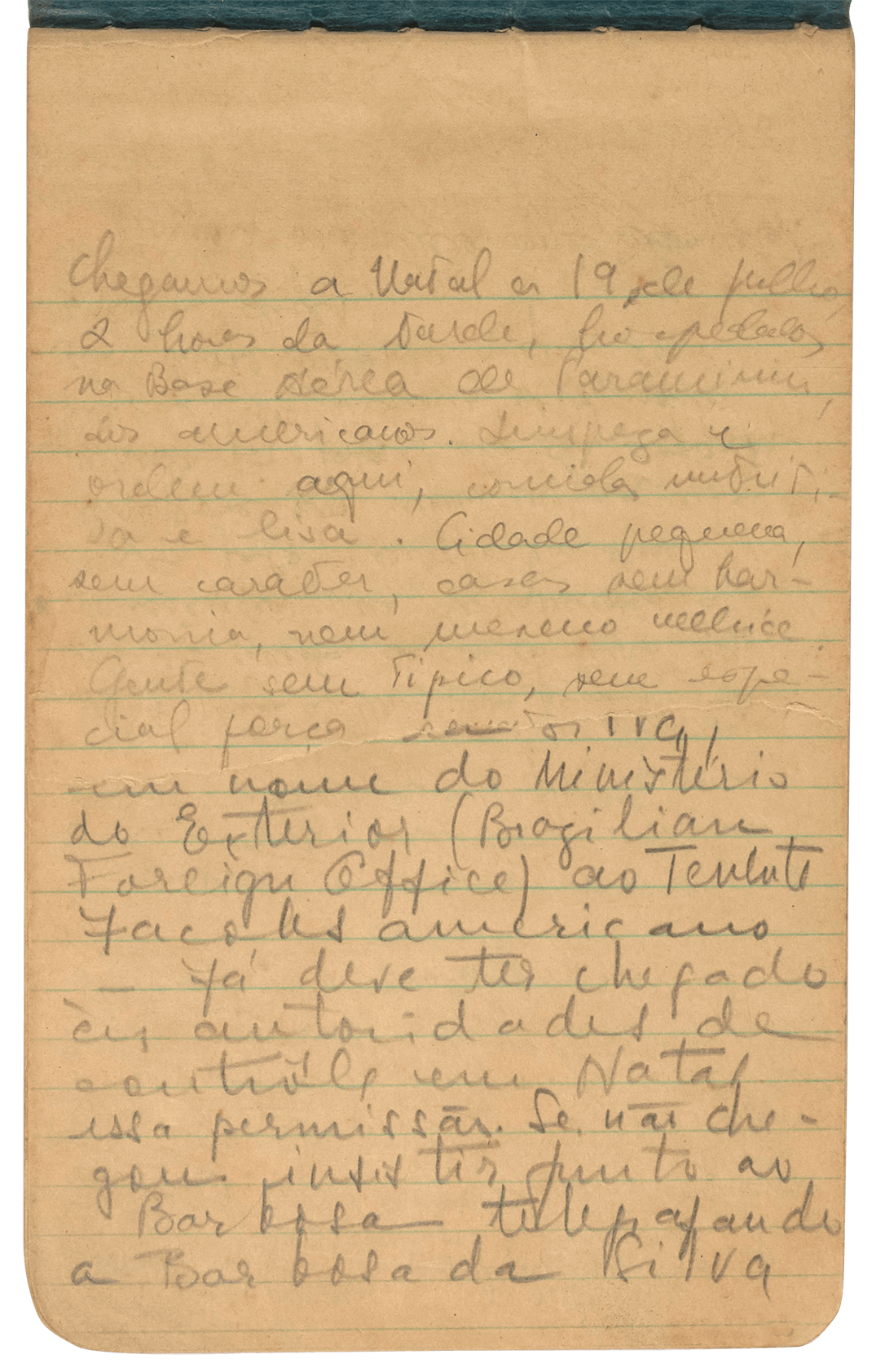
Chegamos a Natal a 19 de julho, 2 horas da tarde, hospedados na base aérea de Parnamirim, dos americanos. Limpeza e ordem aqui, comida nutritiva e lisa. Cidade pequena, sem caráter, casas sem harmonia, nem mesmo velhice. Gente sem típico, sem especial força [lacuna]
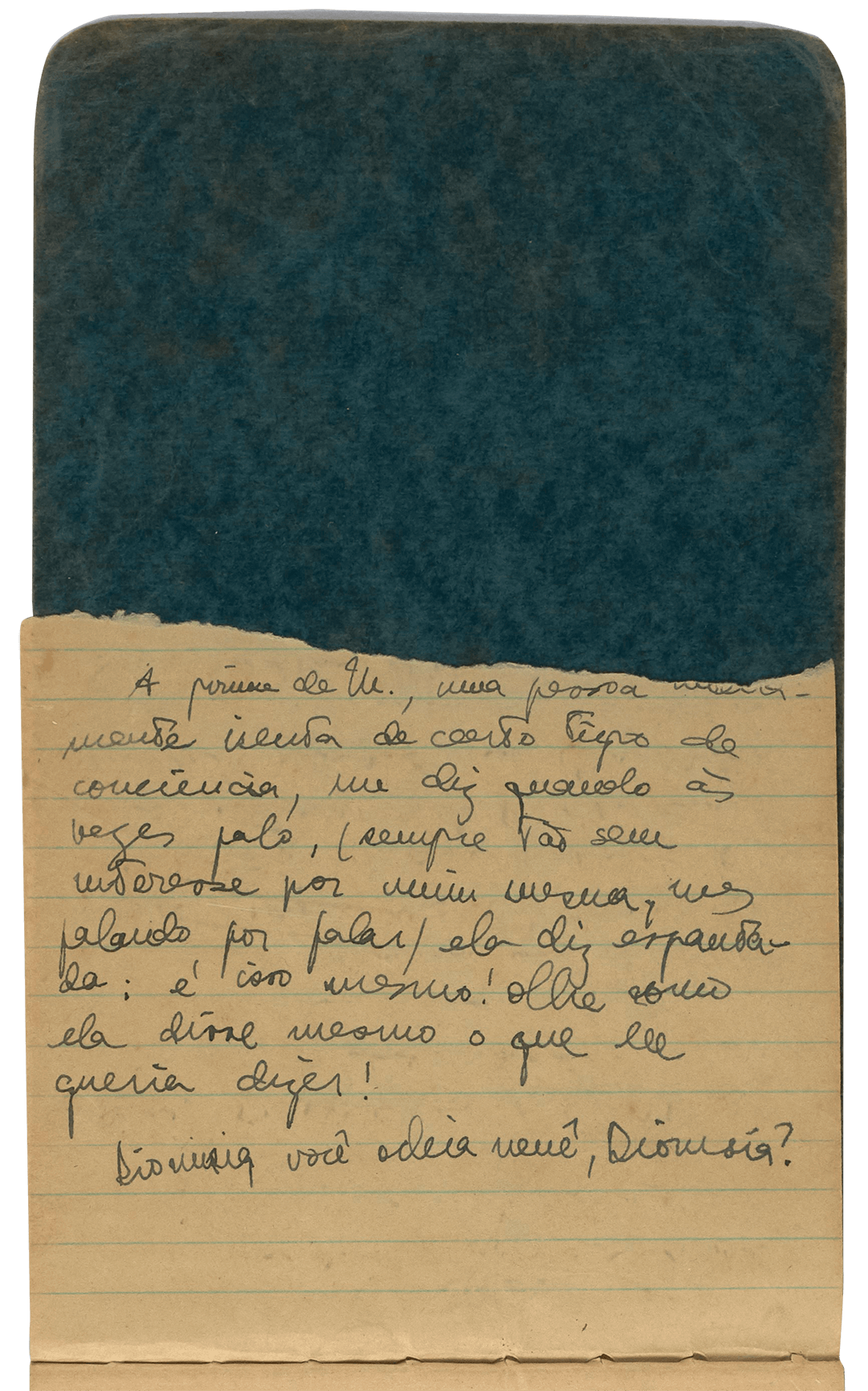
A prima de M.,3 uma pessoa meramente isenta de certo tipo de consciência, me diz quando às vezes falo (sempre tão sem interesse por mim mesma, mas falando por falar), ela diz espantada: é isso mesmo! Olhe como ela disse mesmo o que eu queria dizer! Dionisia você odeia nenê, Dionisia?
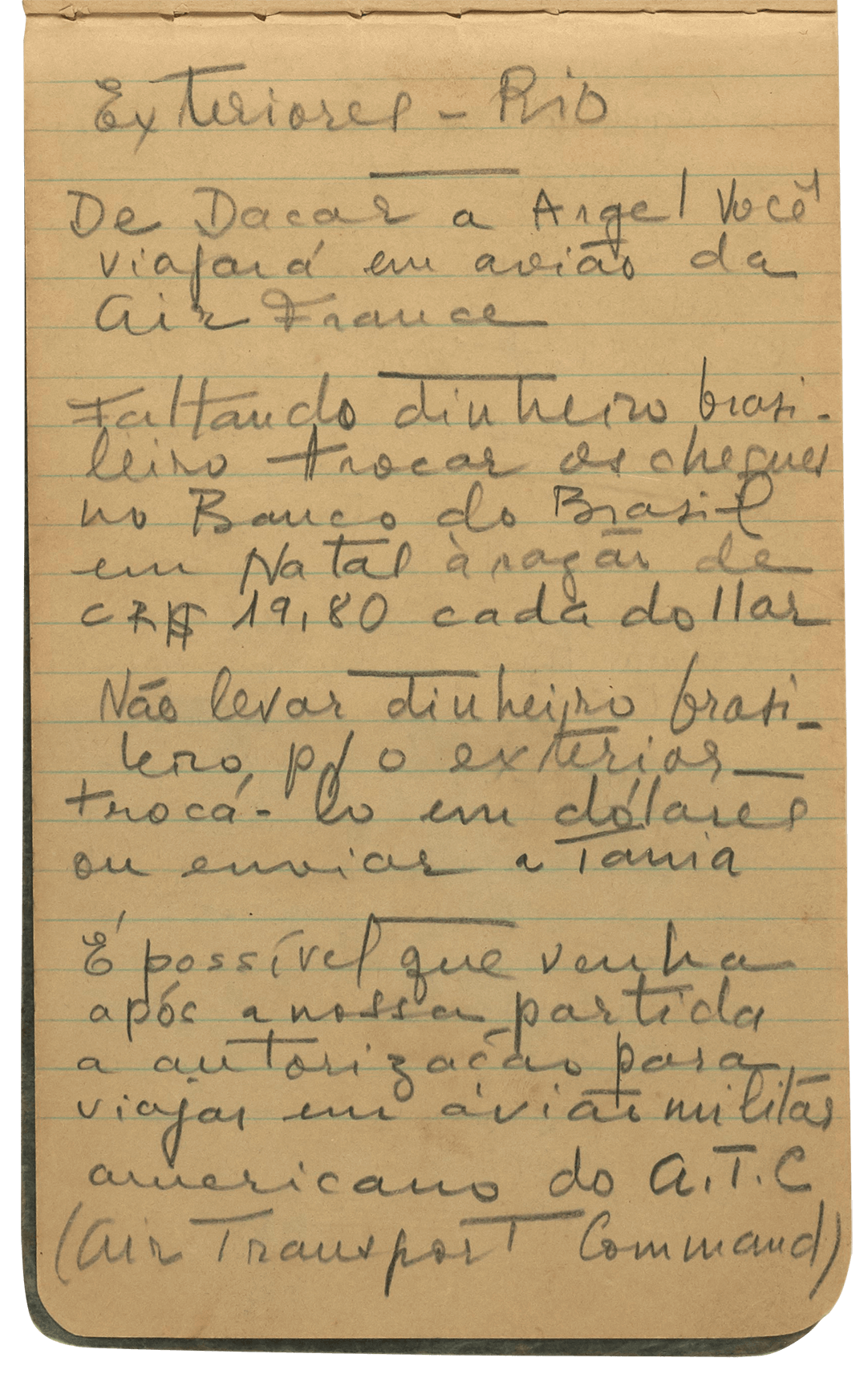
Exteriores – Rio / De Dacar a Argel você viajará em avião da Air France. / Faltando dinheiro brasileiro, trocar os cheques no Banco do Brasil em Natal a razão de Cr$19,80 cada dólar. / Não levar dinheiro brasileiro para o exterior – trocá-lo em dólares ou enviar à Tania. / É possível que venha após a nossa partida a autorização para viajar em avião militar americano do a.t.c. (Air Transport Command).
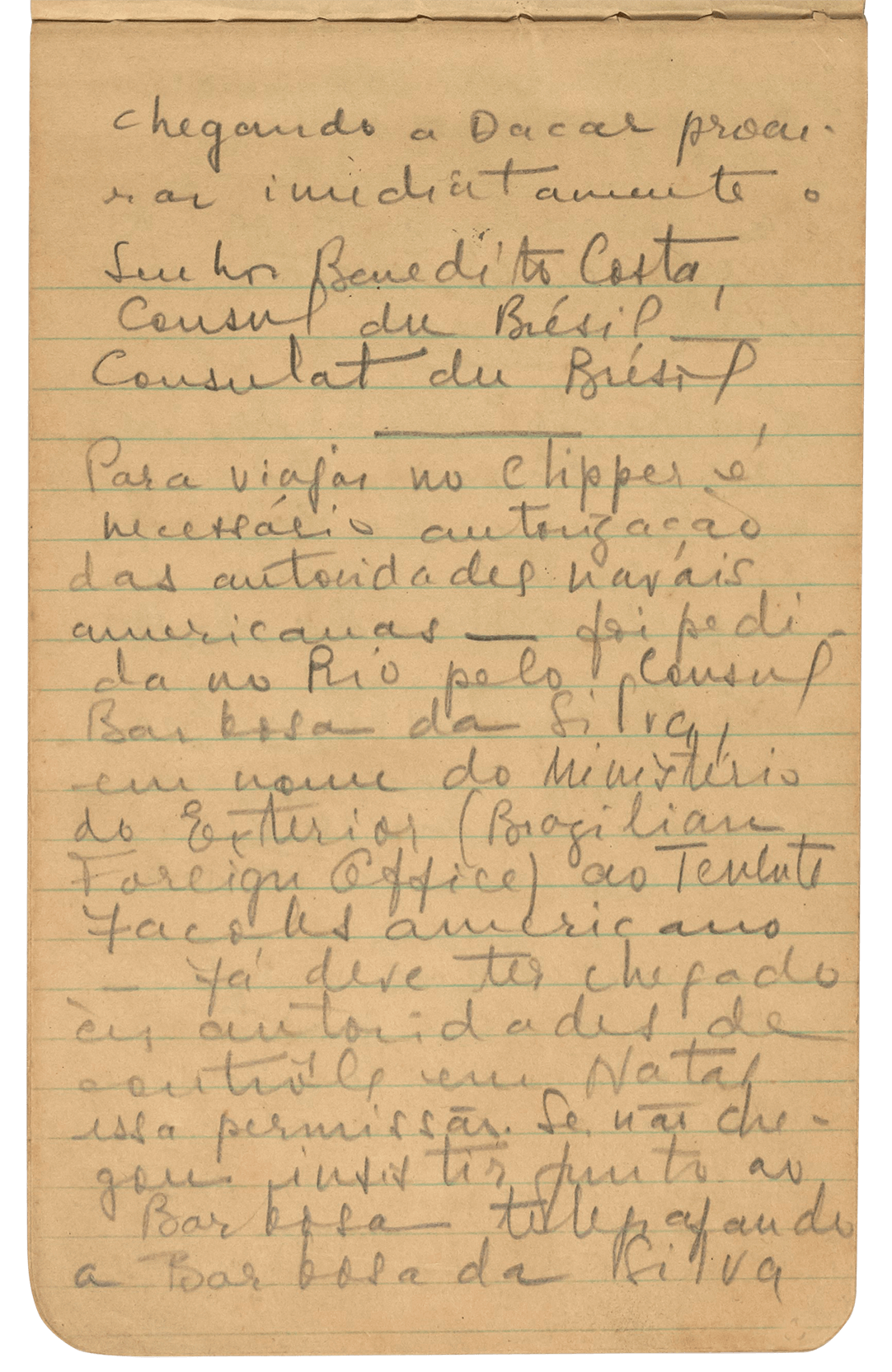
Chegando a Dacar procurar imediatamente o senhor Benedito Costa, consul du Brésil, consulat du Brésil.Para viajar no clipper é necessário autorização das autoridades navais americanas – foi pedida no Rio pelo cônsul Barbosa da Silva, em nome do Ministério do Exterior (Brazilian Foreign Office), ao tenente Jacobs americano – já deve ter chegado às autoridades de controle em Natal essa permissão. Se não chegou, insistir junto ao Barbosa telegrafando a Barbosa da Silva.
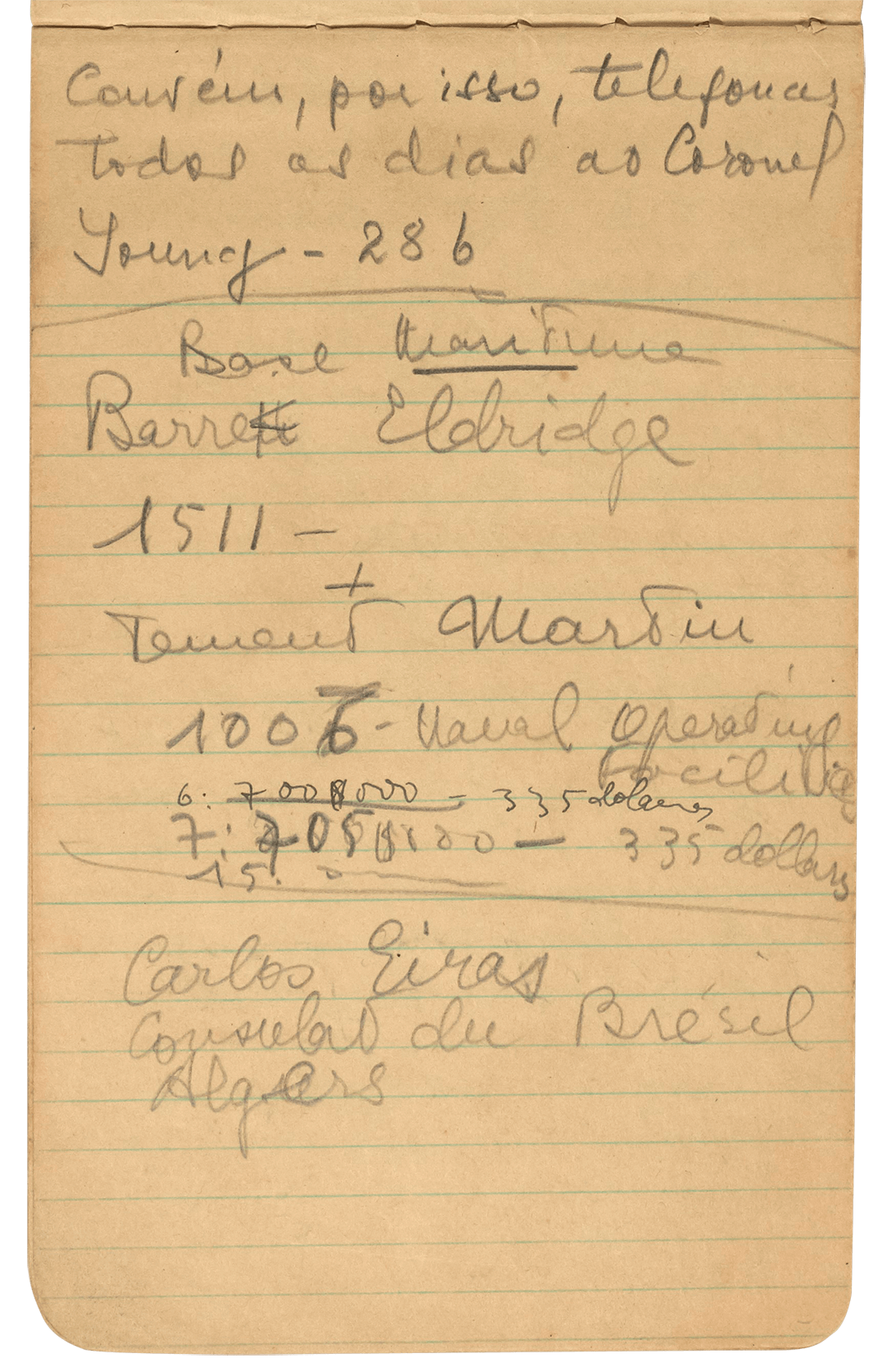
Convém, por isso, telefonar todos os dias ao coronel Young – 286. / Base Maritime / Barrett Eldridge 1511- / Tenente Martin / 1006 – Naval operário [ilegível] / 6:7000$000 – 335 dólares / 7: 705$800 – 335 dólares / Carlos Eiras Consulat du Brésil Argel

De Natal a Recife: terça e sábado / De Recife a Natal: sexta e segunda + Praia de Areia Preta + Anita Gurgel Vieira quarto 58 – Grande Hotel.
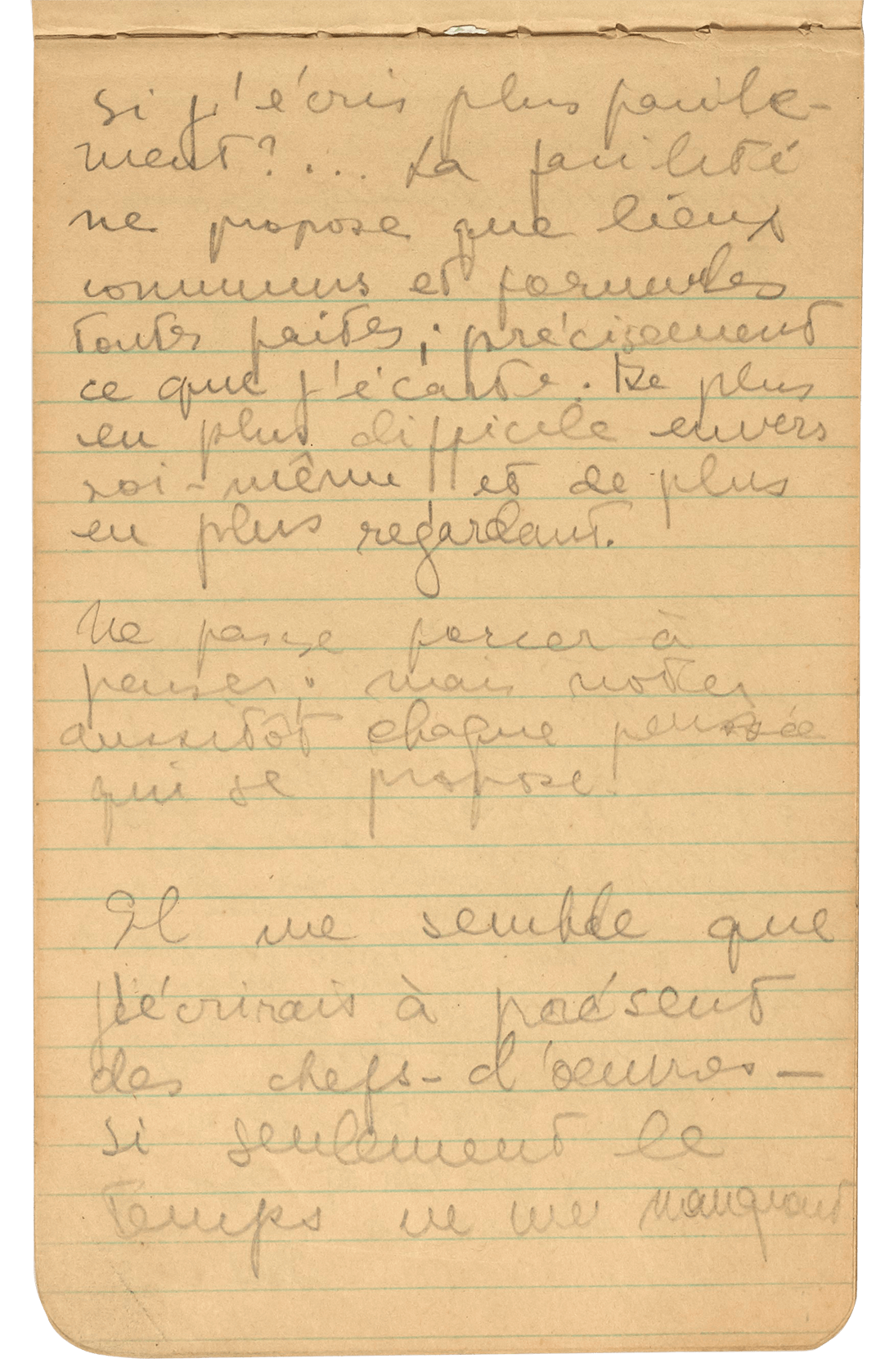
Si j’écris plus facilement?… La facilité ne propose que lieux communs et [formeles] toutes faites; précisement ce que j’écarte. De plus en plus difficile envers moi-même, et de plus en plus regardent. / Ne passe forcer à penser mais noter aussitôt chaque pensée qui se propose. / Il me semble que j’écrivais à présent des chefs-d’oeuvres – si seulement le temps ne me [manque pas].
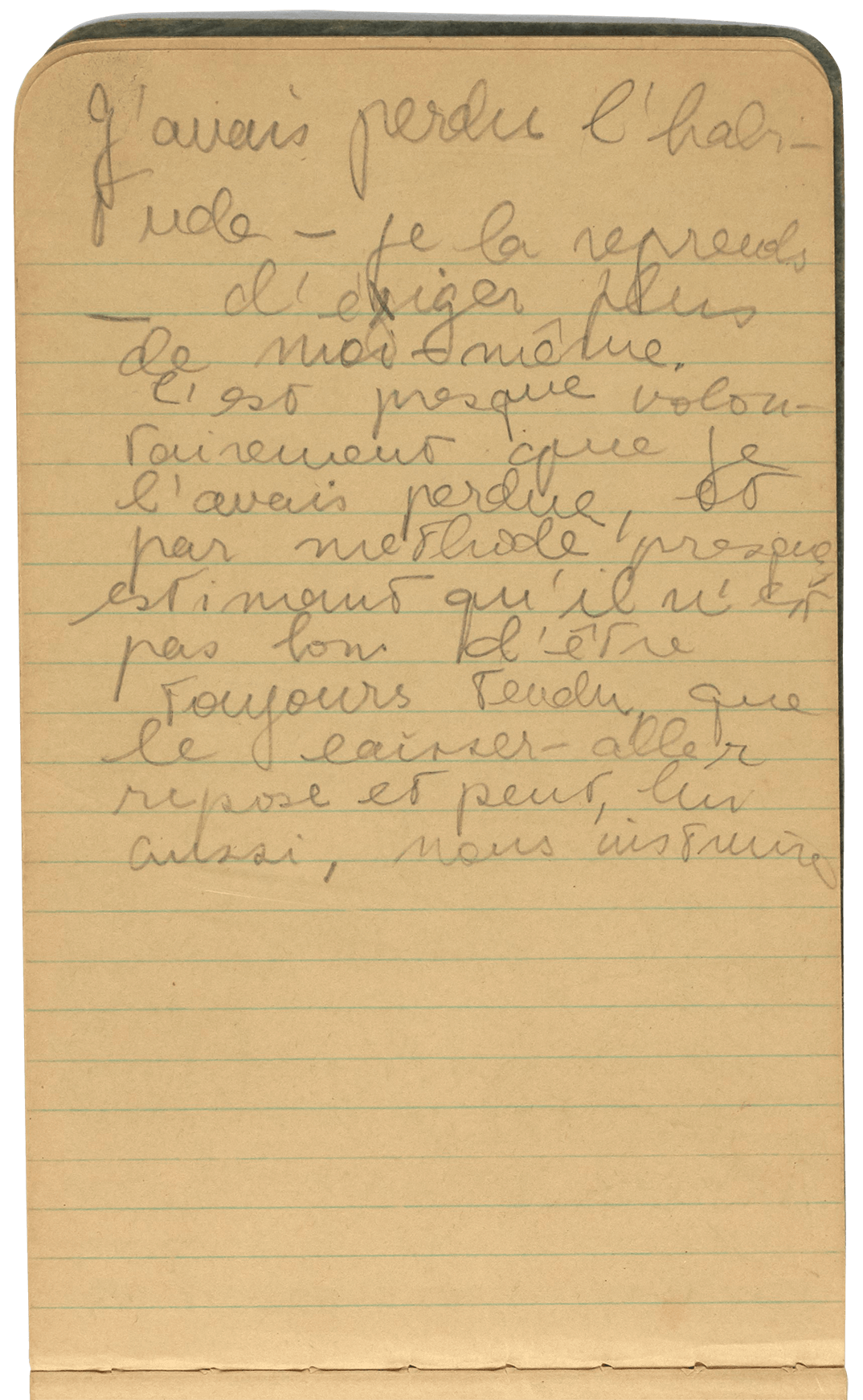
J’avais perdu l’habitude – je la reprends – d’éxiger plus de moi-même. C’est presque volontairement que je l’avais perdue, et par methode presque estimant qu’il n’est pas bon d’être toujours tendre que le laisser-aller repose et peut, [lui] aussi, nous [instruire]
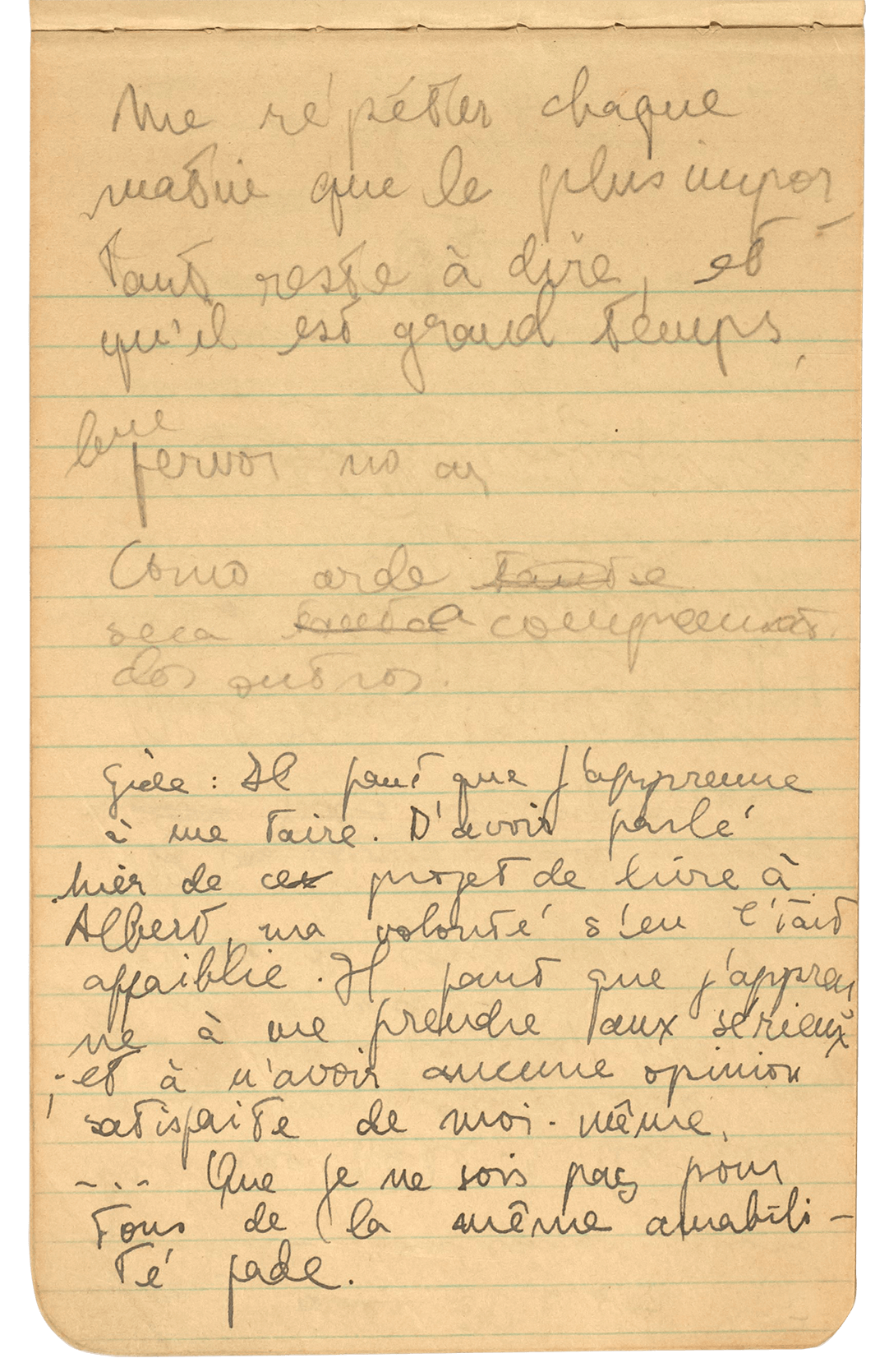
Me répéter chaque matin que le plus important reste à dire, et qu’il est grand temps. / Leve fervor no ar / Como arde seca a compreensão dos outros. / Gide: Il faut que j’apprenne à me taire. D’avoir parlé nier de ce projet de livre à Albert, ma volonté s’en était affaiblie. Il faut que j’apprenne à me prendre aux sérieux et a n’avoir aucune opinion satisfait de moi-même. … Que je ne sois pas pour tous de la même amabilité té fade.
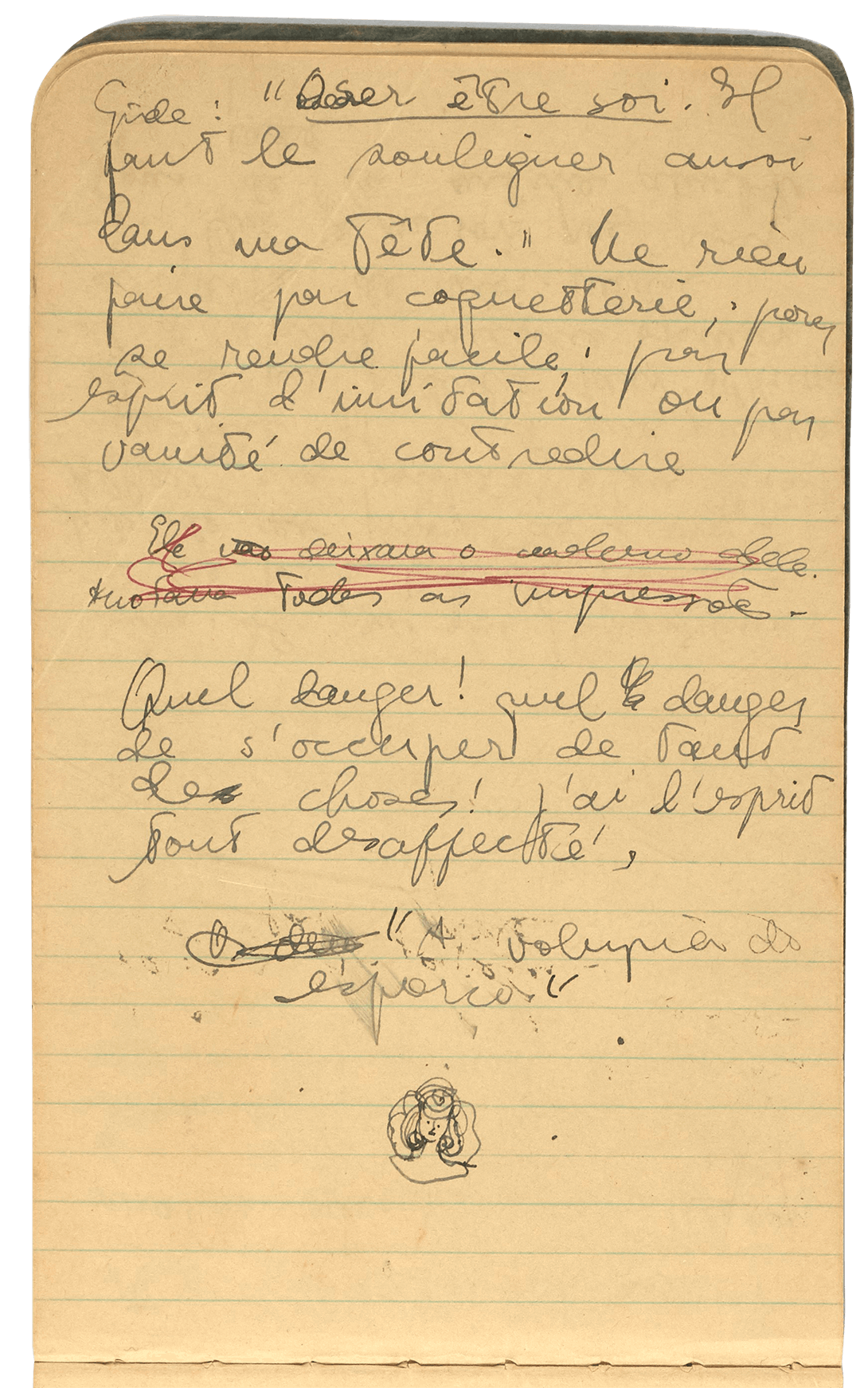
Gide: “Oser être soi. Il faut le souligner aussi dans ma tête.” Ne rien faire par coquetterie; pour se rendre facile par esprit d’imitation ou par vanité de contredire. / Ele não deixava o caderno dele. Anotava todas as impressões. / Quel danger! Quel danger de s’occuper de tant de choses! J’ai l’esprit tout desaffecté. / “A volúpia do esforço”
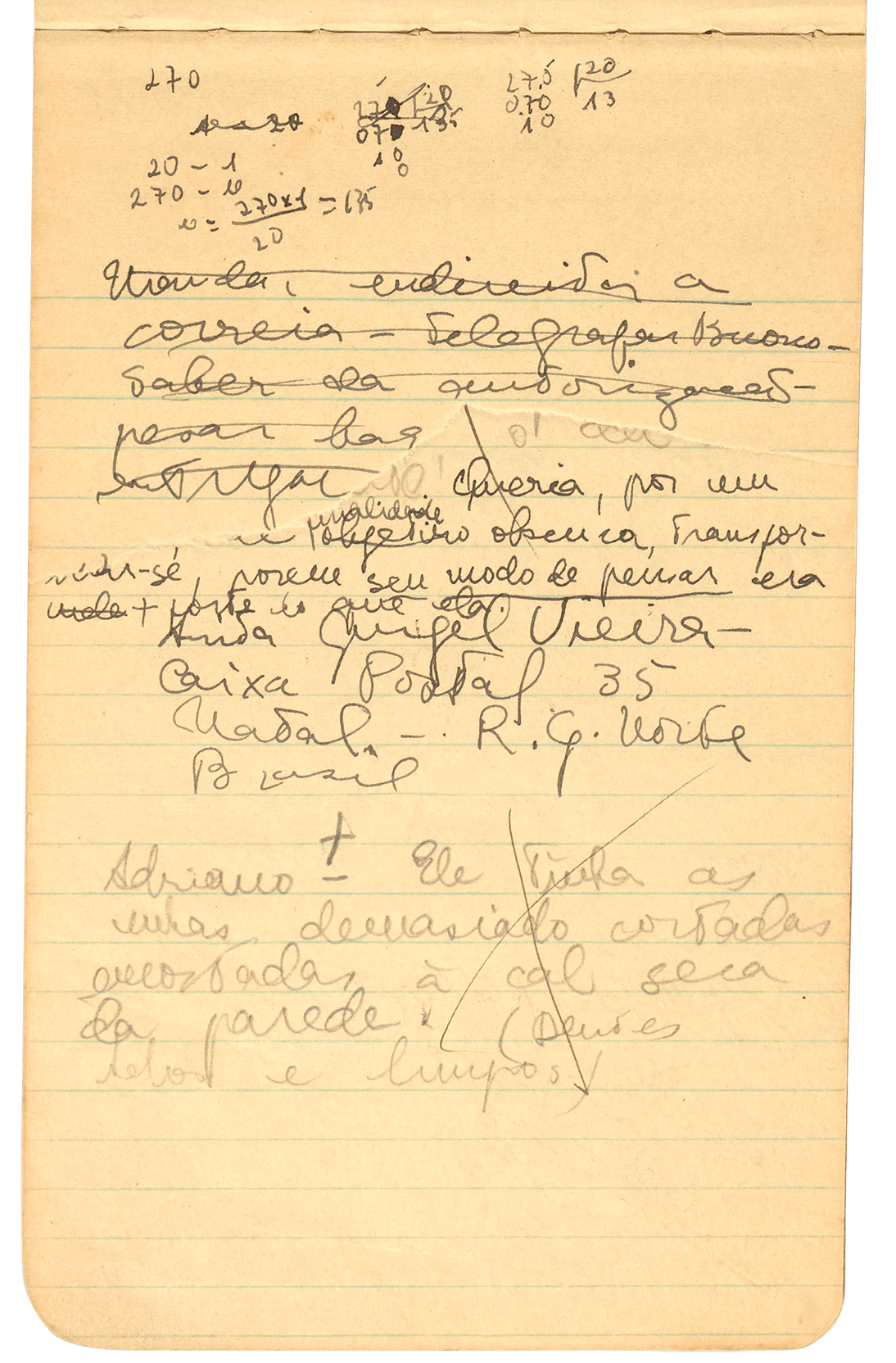
Mandar endireitar a correia – telegrafar [ilegível] – saber da autorização – pesar bagagem – entregar [lacuna]
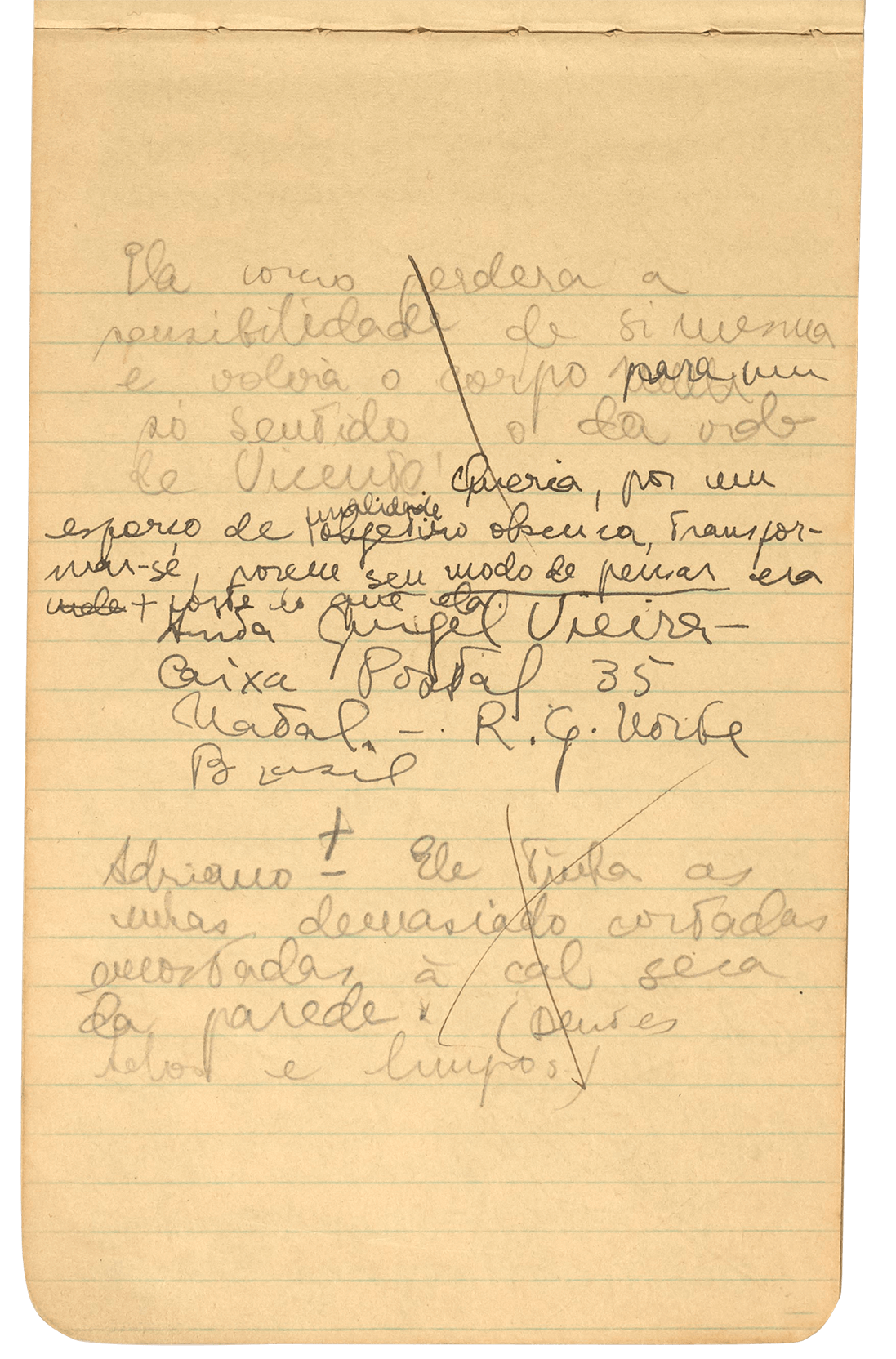
Ela como perdera a sensibilidade de si mesma e volvia o corpo para um só sentido, o da vida de Vicente. Queria, por um esforço de finalidade obscura, transformar-se, porém seu modo de pensar era mais forte do que ela. / Anita Gurgel Vieira – caixa postal 35 Natal – Rio Grande do Norte Brasil / Adriano – Ele tinha as unhas demasiado cortadas encostadas à cal seca da parede. (Dentes belos e limpos)
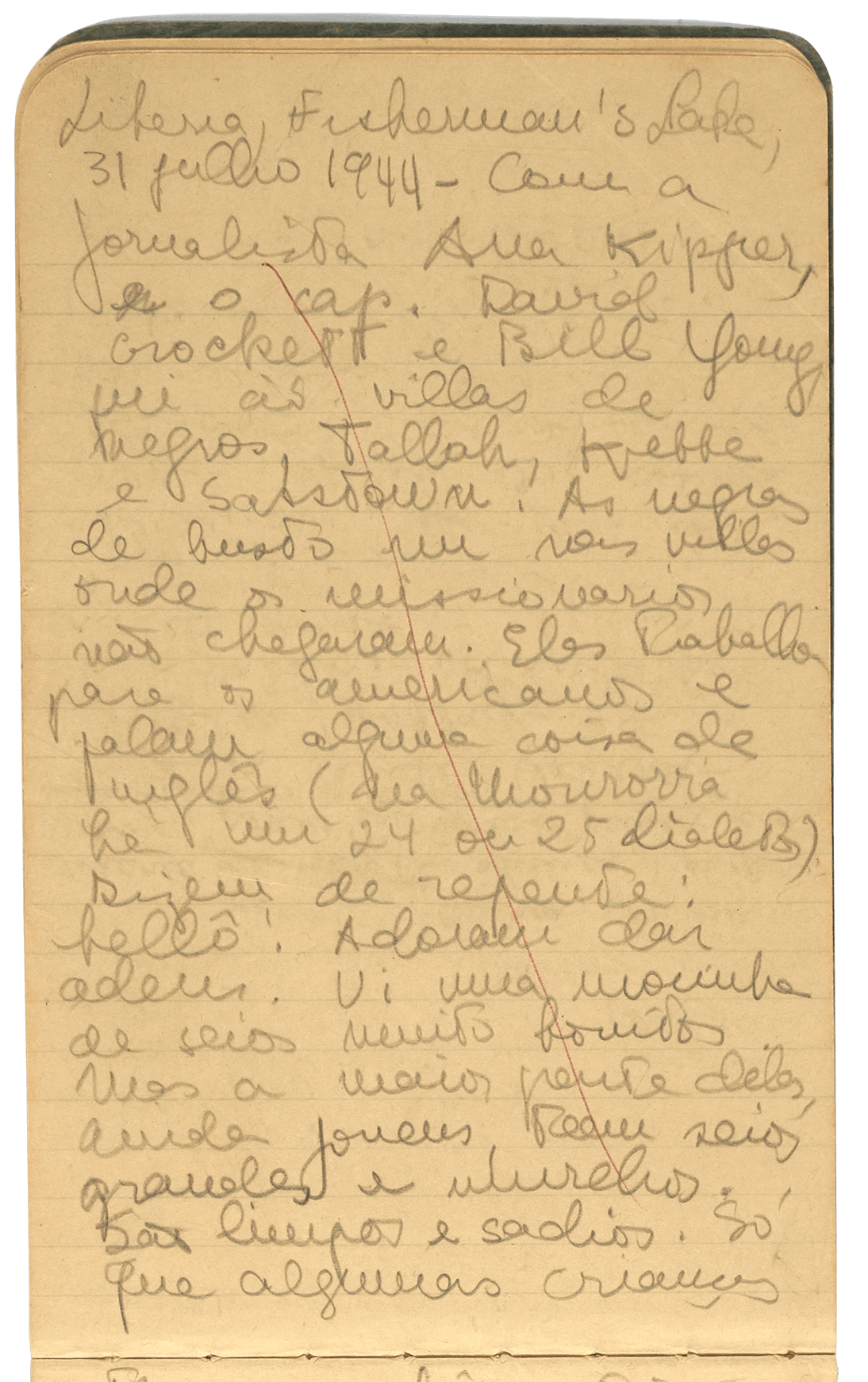
Libéria, Fisherman’s Lake, 31 de julho de 1944 / Com a jornalista Ana Kipper, o capitão David Crockett e Bill Young, fui às vilas de negros, Tallah, Kebbe, Sasstown. As negras de busto nu nas vilas onde os missionários não chegaram. Elas trabalham para os americanos e falam alguma coisa de inglês (na Monróvia há uns 24 ou 25 dialetos). Dizem de repente: hello! Adoram dar adeus. Vi uma mocinha de seios muito bonitos. Mas a maior parte delas, ainda jovens, tem seios grandes e murchos. São limpos e sadios. Só que algumas crianças
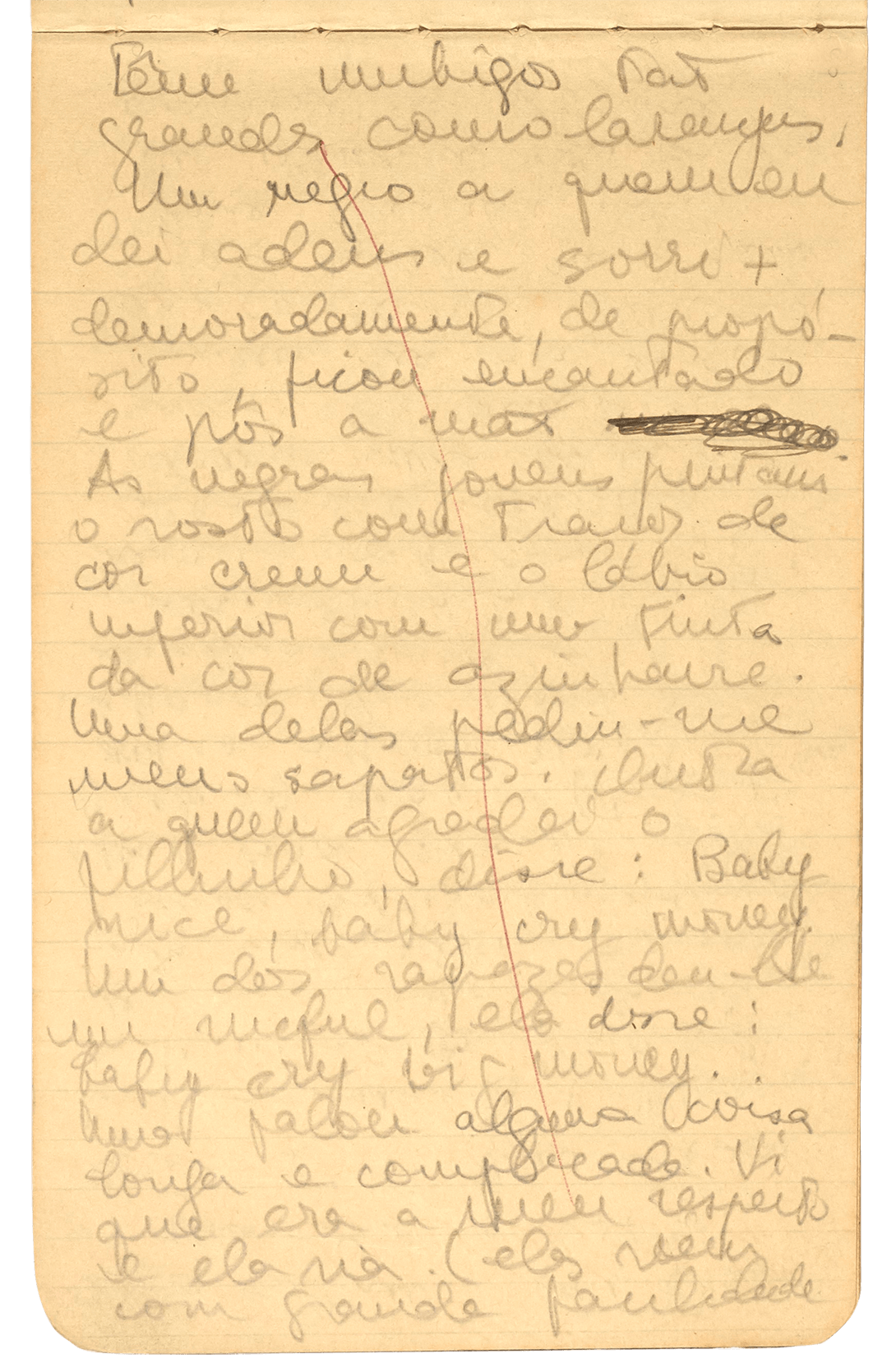
têm umbigos tão grandes como laranjas. Um negro, a quem eu dei adeus e sorri mais demoradamente, de propósito, ficou encantado e pôs a mão no [rasurado]. As negras jovens pintam o rosto com traços de cor creme e o lábio inferior com uma tinta da cor de azinhavre. Uma delas pediu-me meus sapatos. Outra, a quem agradei o filhinho, disse: Baby nice, baby cry money. Um dos rapazes deu-lhe um níquel, ela disse: baby cry big money. Uma falou alguma coisa longa e complicada. Vi que era a meu respeito e ela ria. (eles riem com grande facilidade,
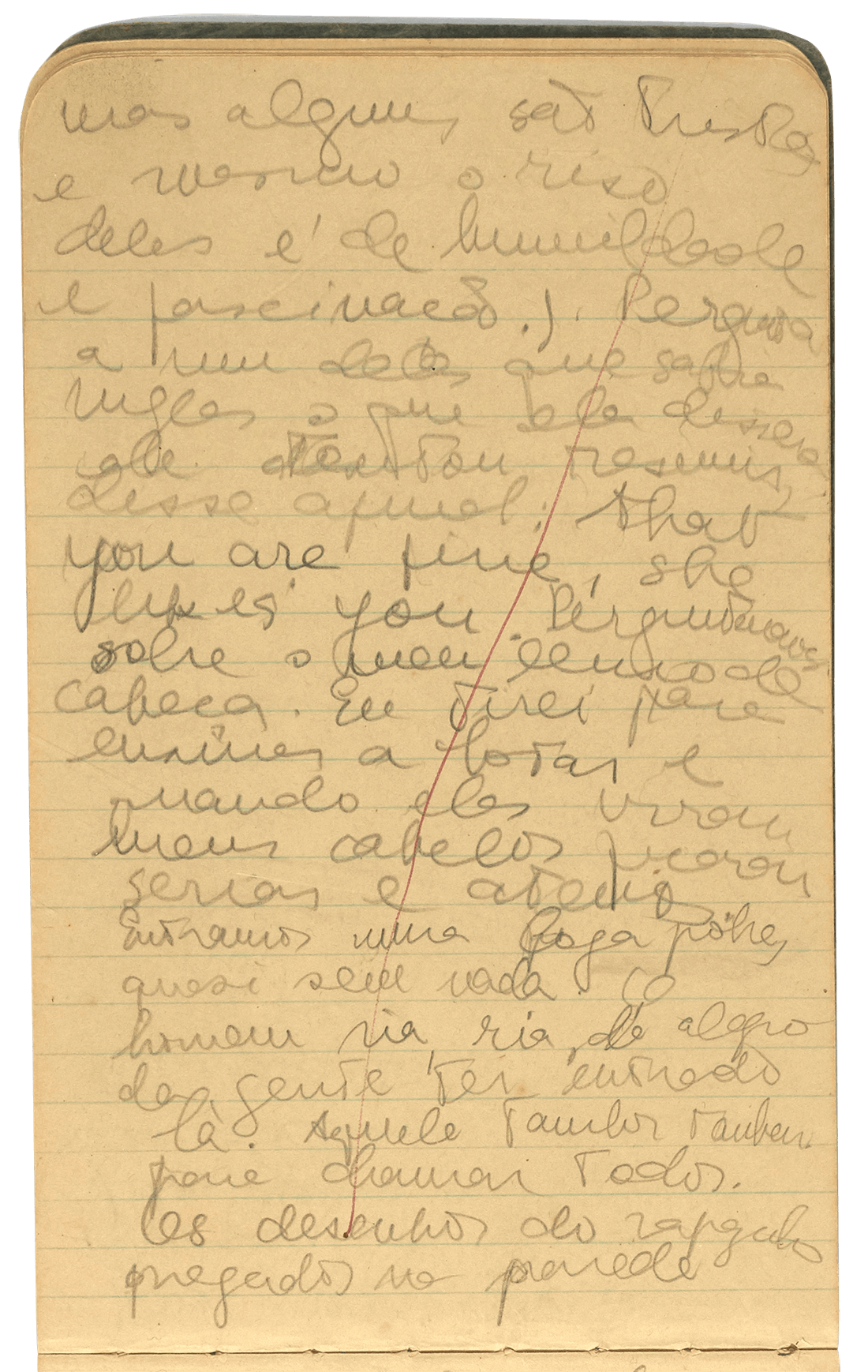
mas alguns são tristes e mesmo o riso deles é de humildade e fascinação.) Pergunto a um deles, que sabia inglês, o que ela dissera: ele tentou resumir, disse afinal: that you are fine, she likes you. Perguntaram sobre o meu lenço de cabeça. Eu tirei para ensinar a botar e quando eles viram meus cabelos ficaram sérios e atentos. Entramos numa loja pobre, quase sem nada. O homem ria, ria de alegria da gente ter entrado lá. Aquele tambor também para chamar todos. Os desenhos do rapazinho pregados na parede

de fora da cabana: em aeroplano, sapatos de mulher civilizada etc. Voltamos, jantamos com os rapazes, fomos ao cinema da base, vimos Jack London. Descobri que quase todos os americanos que viajaram conosco são missionários, homens e mulheres. Aqui dormimos três num quarto: eu, Ana Kipper e uma missionária. Ana Kipper deve ter ficado em intimidade com o capitão. Para mim, tudo um pouco cansativo, menos a visita às vilas. Como gostei daquela gente negra. Cinema aborrecido, jantar qualquer coisa de haricot. A missionária está falando de algo com Ana Kipper.
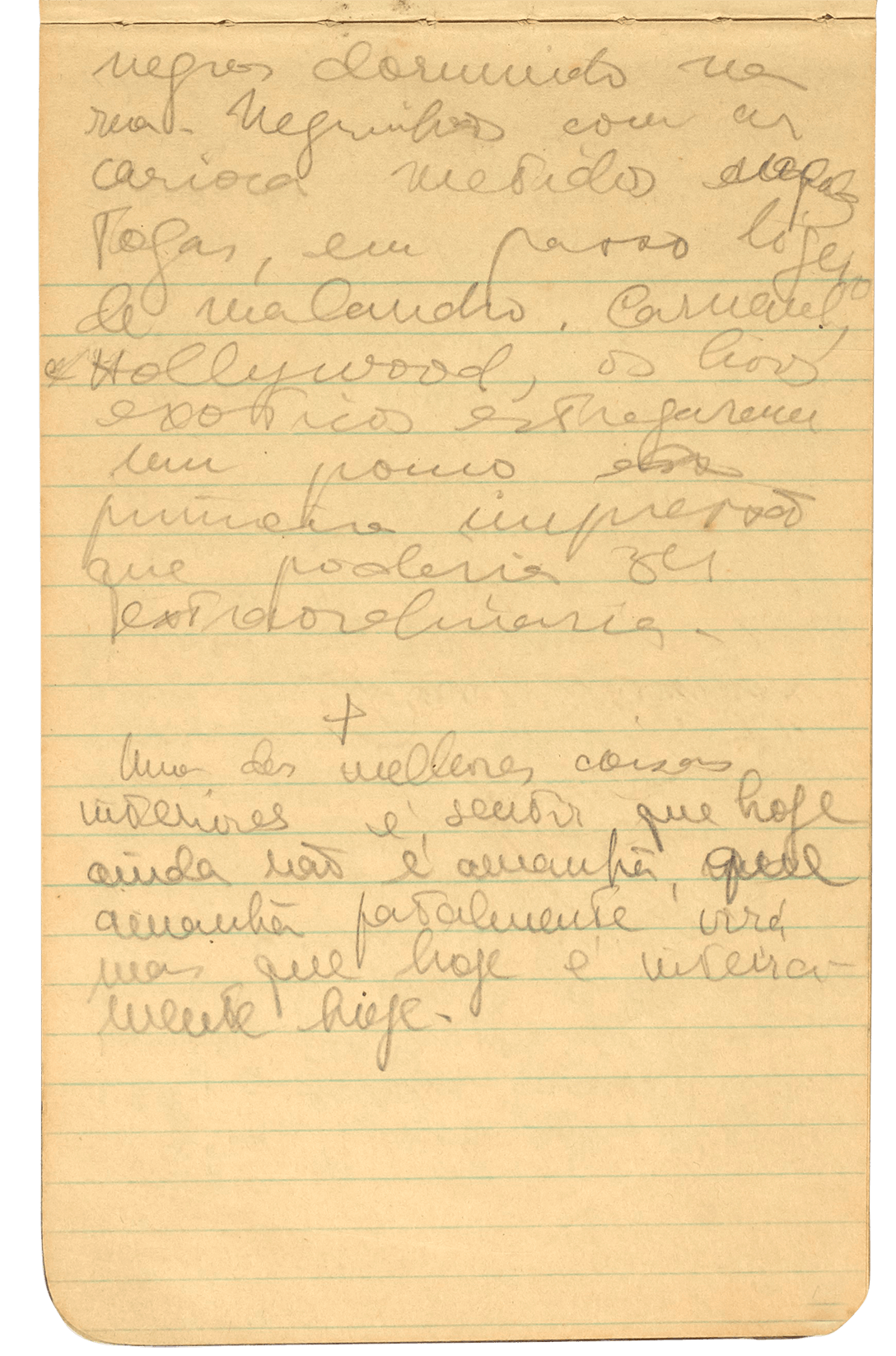
negros dormindo na rua. Negrinhos com ar carioca metidos em togas, em passo ligeiro de malandro. Carnaval, Hollywood, os livros exóticos estragaram um pouco essa primeira impressão que poderia ser extraordinária. / Uma das melhores coisas interiores é sentir que hoje ainda não é amanhã, que amanhã fatalmente virá, mas que hoje é inteiramente hoje
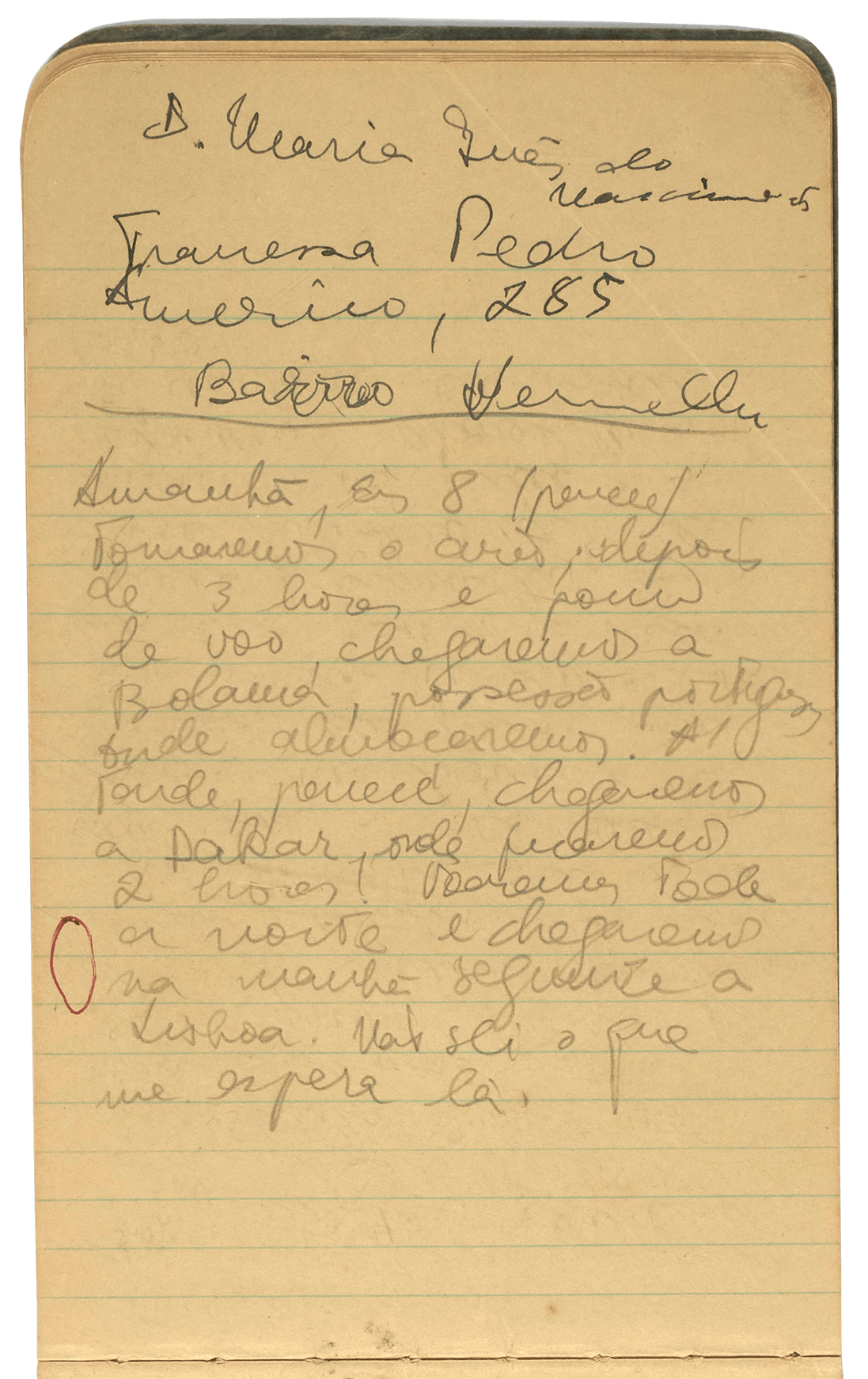
D. Maria Inês do Nascimento / Travessa Pedro Américo, 285 – Bairro Vermelho / Amanhã, às oito horas (parece), tomaremos o avião; depois de três horas e pouco de voo, chegaremos a Bolama, possessão portuguesa, onde almoçaremos. À 1h, parece, chegaremos a Dacar, onde ficaremos duas horas! Voaremos tod a a noite e chegaremos na manhã seguinte a Lisboa. Não sei o que me espera lá.
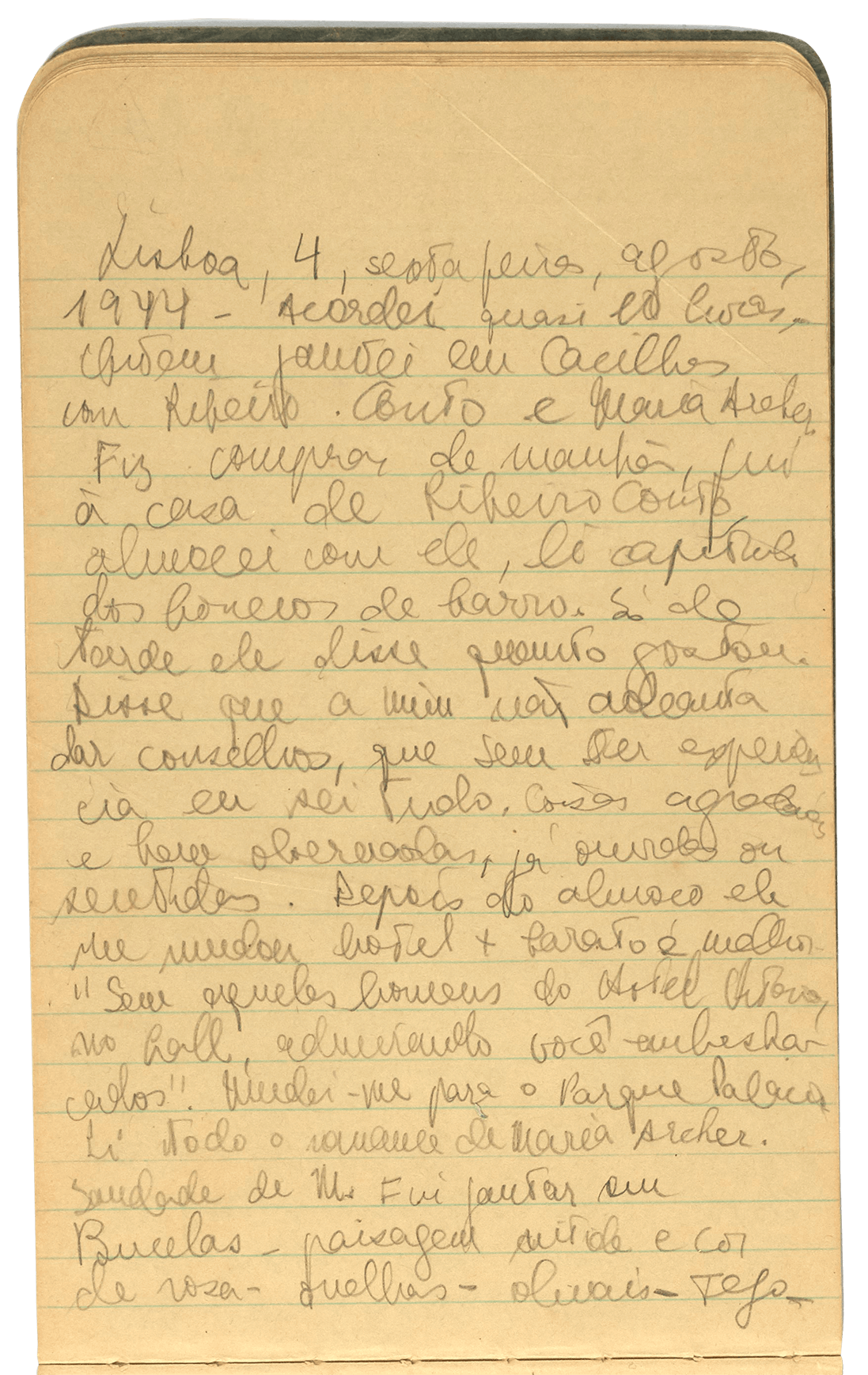
Lisboa, 4 de agosto de 1944, sexta-feira / Acordei quase dez horas. Ontem jantei em Cacilhas com Ribeiro Couto e Maria Archer. Fiz compras de manhã, fui à casa de Ribeiro Couto, almocei com ele, li capítulo dos bonecos de barro.15 Só de tarde ele disse quanto gostou. Disse que a mim não adianta dar conselhos, que sem ter experiência eu sei de tudo. Coisas agradáveis e bem observadas, já ouvidas ou sentidas. Depois do almoço ele me mudou. Hotel mais barato é melhor. “Sem aqueles homens do Hotel Astoria, no hall, admirando você embasbacados”. Mudei-me para o parque Palacio. Li todo o romance de Maria Archer. Saudade de M. Fui jantar em Bucelas – paisagem nítida e cor-de-rosa ovelhas – olivais – Tejo
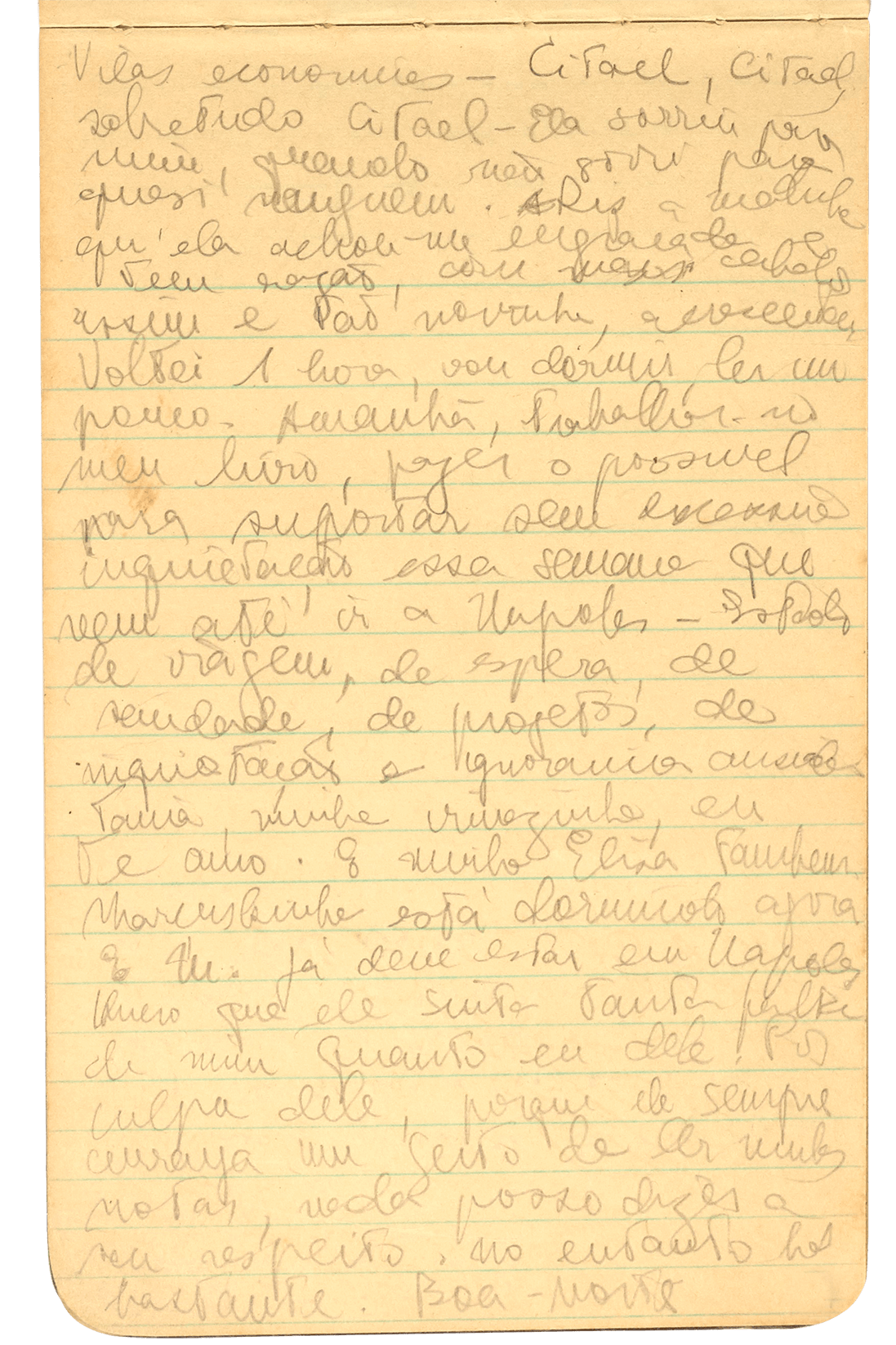
Vilas econômicas – Citael, Citael, sobretudo Citael – Ela sorriu pra mim, quando não sorri para quase ninguém. Diz a madrinha qu’ela achou-me engraçada e sem razão, com meus cabelos assim e tão novinha, acrescentou. Voltei uma hora, vou dormir, ler um pouco. Amanhã, trabalhar no meu livro, fazer o possível para suportar sem excessiva inquietação essa semana que vem até ir a Nápoles – Estado de viagem, de espera, de saudade, de projetos, de inquietação e ignorância e ansiedade. Tania, minha irmãzinha, eu te amo. E minha Elisa também. Marciazinha está dormindo agora. M. já deve estar em Nápoles. Quero que ele sinta tanta falta de mim quanto eu dele. Por culpa dele, porque ele sempre arranja um jeito de ler minhas notas, nada posso dizer a seu respeito. No entanto, há bastante. Boa-noite.
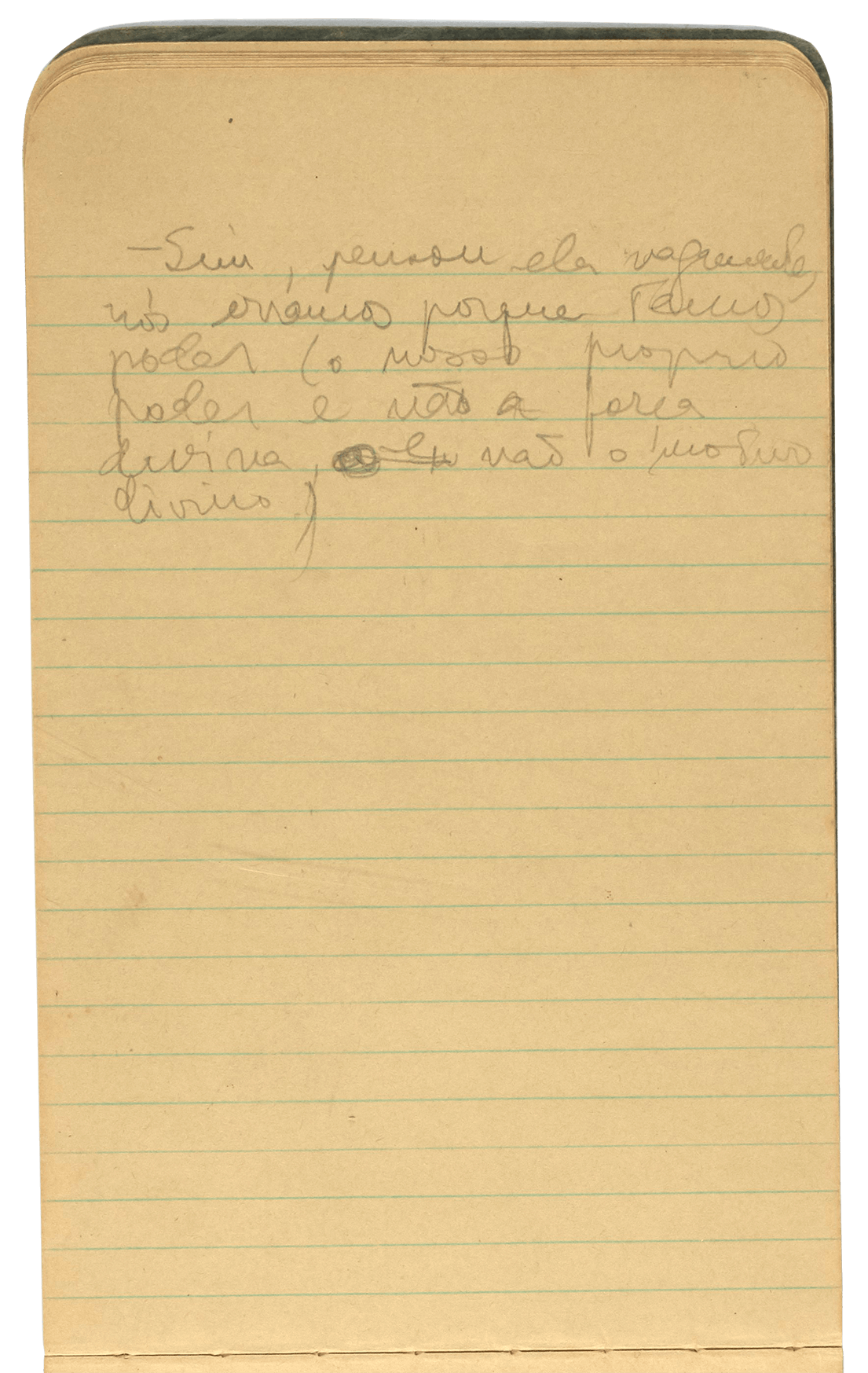
– Sim, pensou ela vagamente, nós erramos porque temos poder (o nosso próprio poder e não a força divina e não o motivo divino).
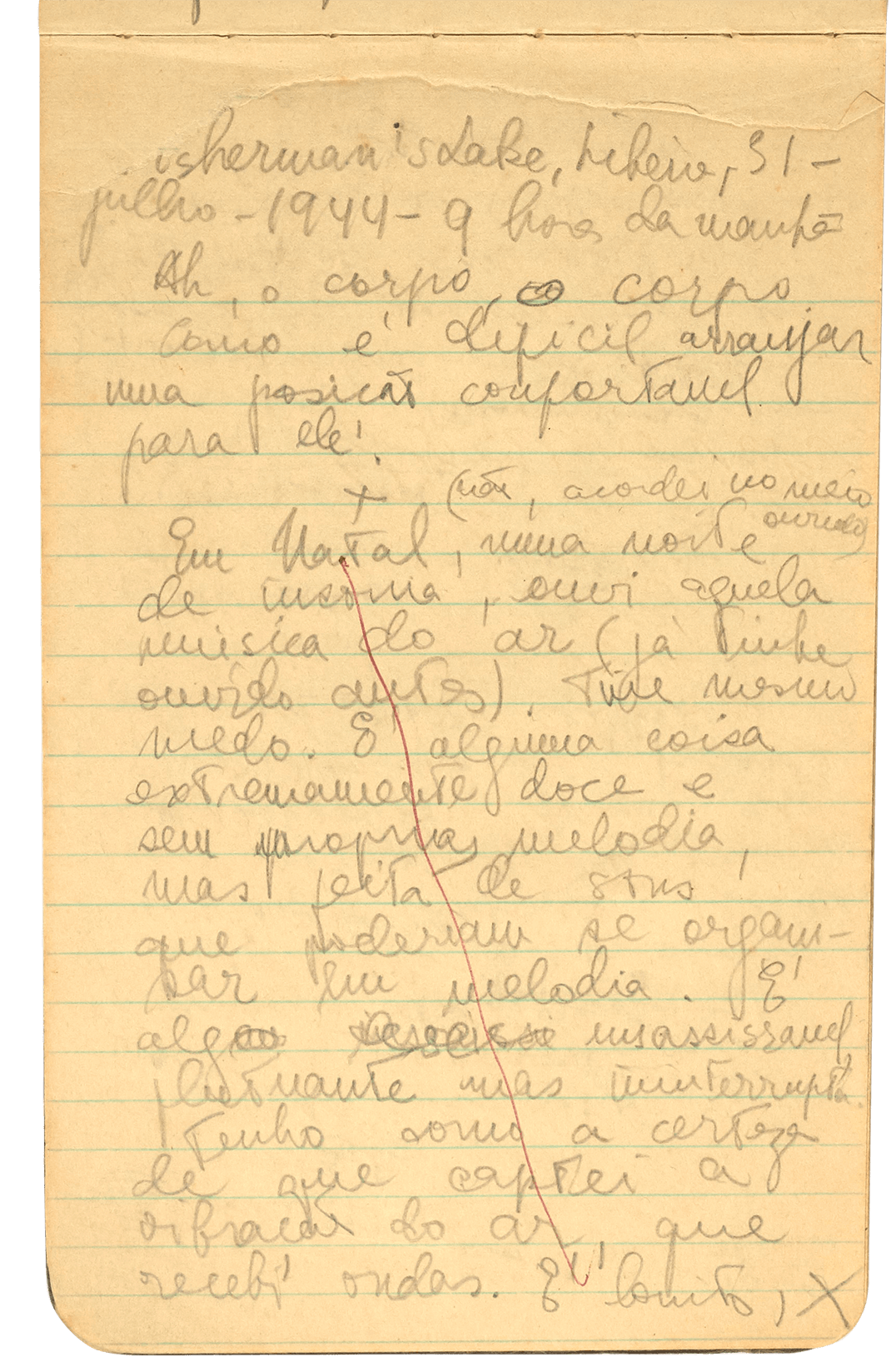
Fisherman’s Lake, Libéria, 31 de julho de 1944 – 09 horas da manhã / Ah, o corpo, o corpo. Como é difícil arranjar uma posição confortável para ele! / Em Natal, uma noite, (não, acordei no meio ouvindo), uma noite de insônia, ouvi aquela música do ar (já tinha ouvido antes). Tive mesmo medo. É alguma coisa extremamente doce e sem própria melodia, mas feita de sons que poderiam se organizar em melodia. É algo insaciável flutuante mas ininterrupto. Tenho como a certeza de que captei a vibração do ar, que recebi ondas. É bonito, x.
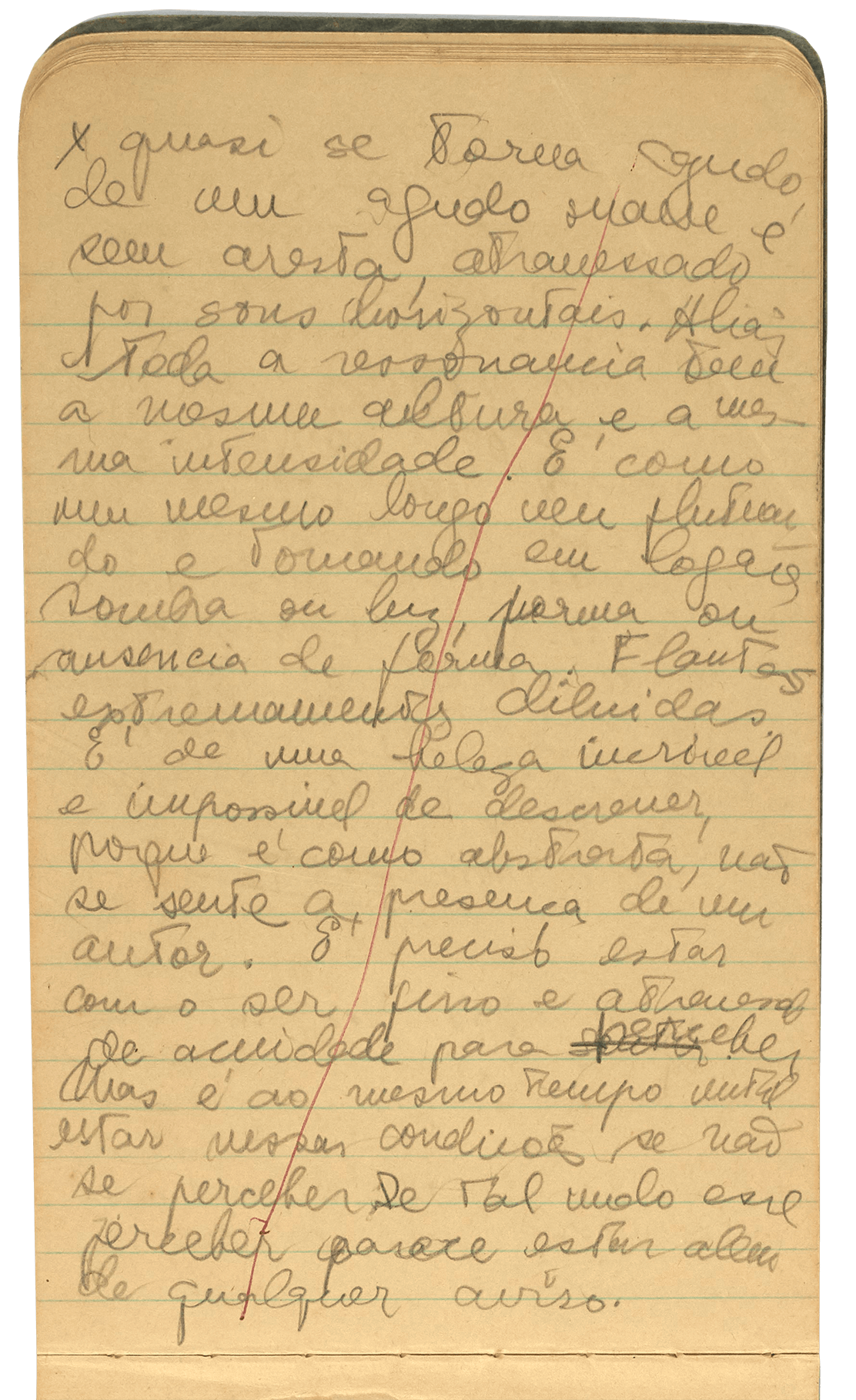
x quase se torna agudo, de um agudo suave e sem aresta, atravessado por sons horizontais. Aliás, toda a ressonância tem a mesma altura e a mesma intensidade. É como um mesmo longo vem flutuando e tornando em longão, sombra ou luz, forma ou ausência de forma. Flautas extremamente diluídas. É de uma beleza incrível e impossível descrever, porque é como abstrata, não se sente a presença de um autor. É preciso estar com o ser fino e atravessado de acuidade para perceber. Mas é ao mesmo tempo inútil estar nessas condições se não se perceber. De tal modo esse perceber parece estar além de qualquer aviso.
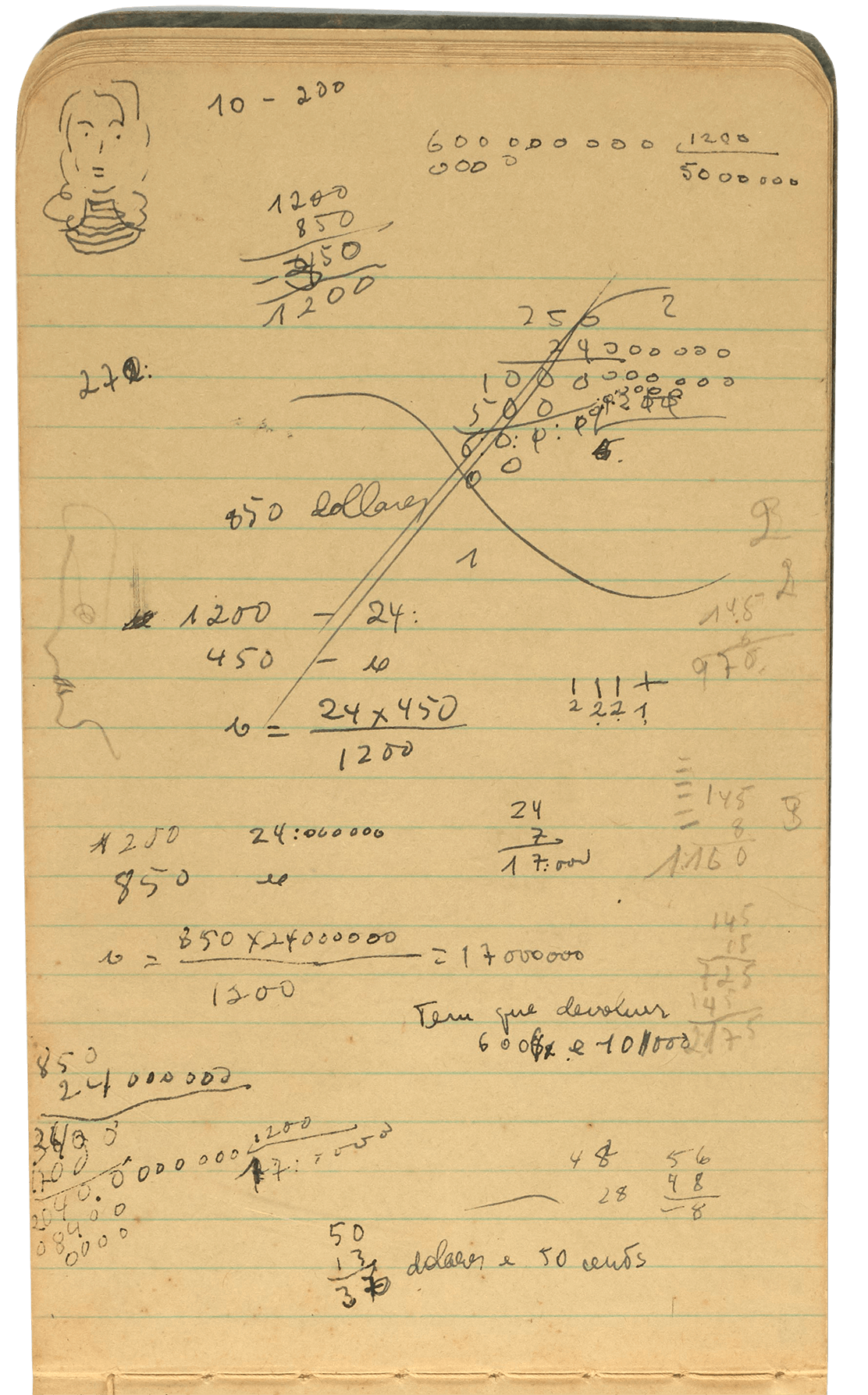
[contas e desenhos]
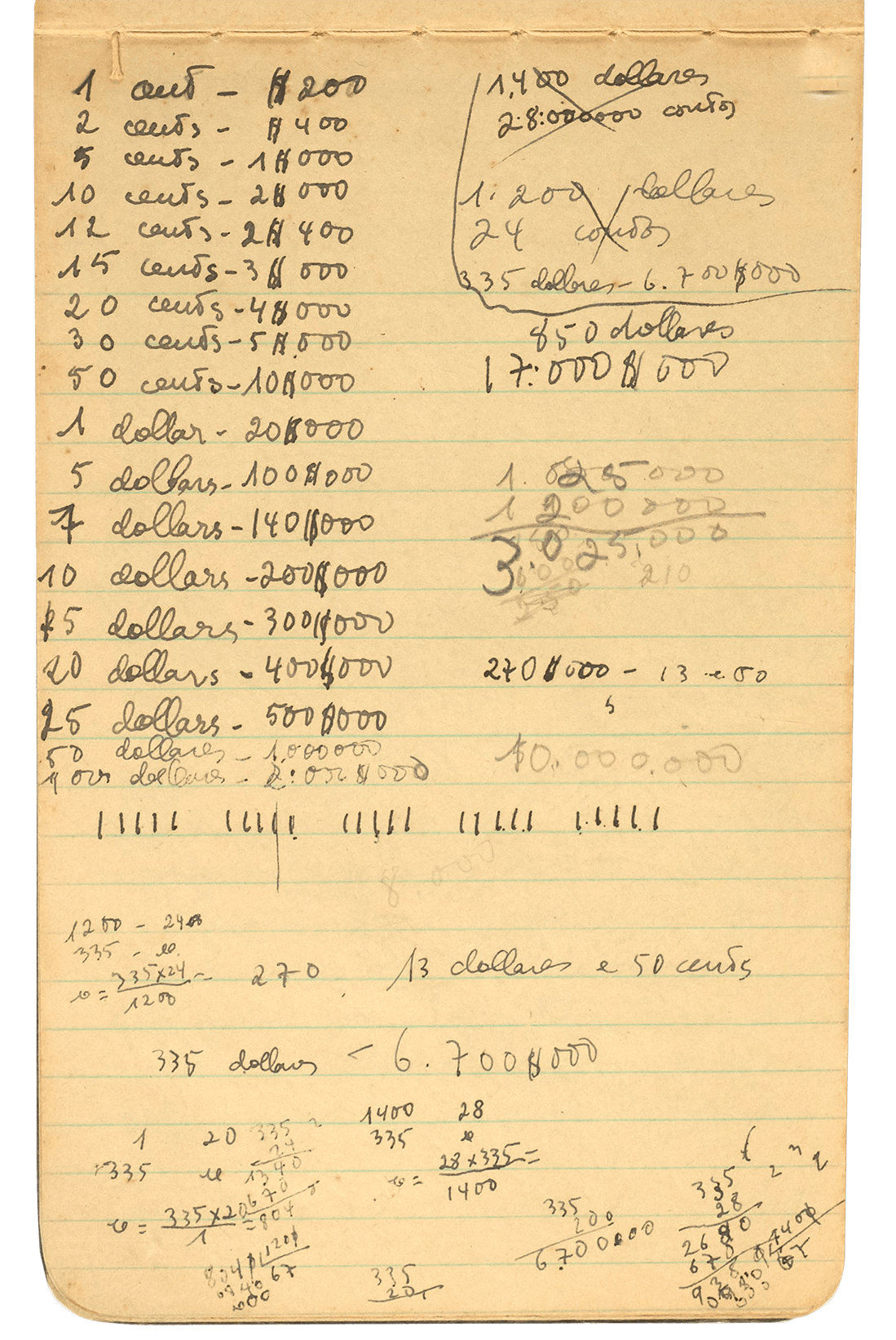
[contas]
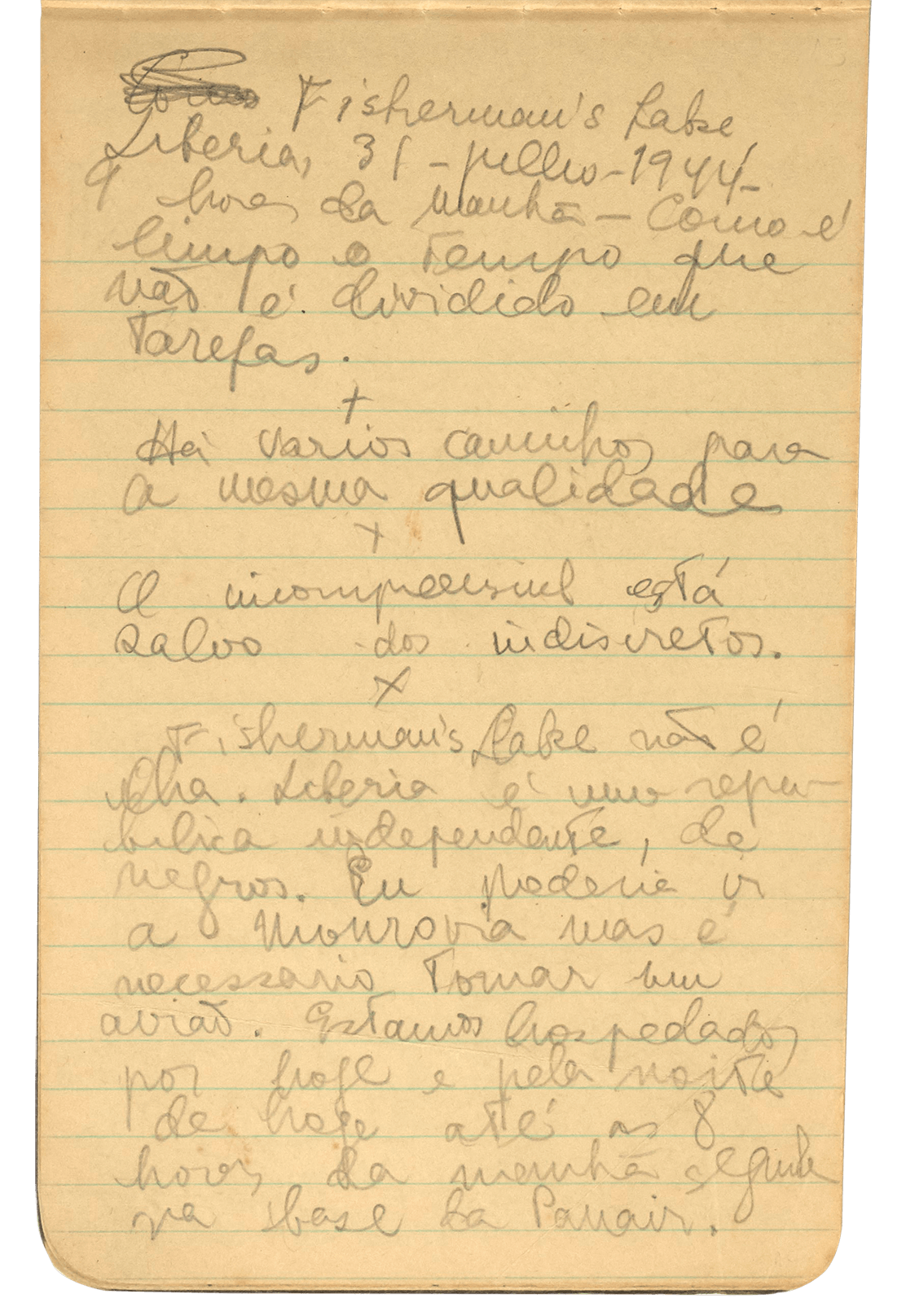
Fisherman’s Lake, Libéria , 31 de julho de 1944 – 9 horas da manhã / Como é limpo o tempo que não é dividido em tarefas. / Há vários caminhos para a mesma qualidade. / O incompreensível está salvo dos indiscretos./ Fisherman’s Lake não é ilha. Libéria é uma república independente, de negros. Eu poderia ir a Monróvia mas é necessário tomar um avião. Estamos hospedados por hoje e pela noite de hoje até às oito horas da manhã seguinte na base da Panair.
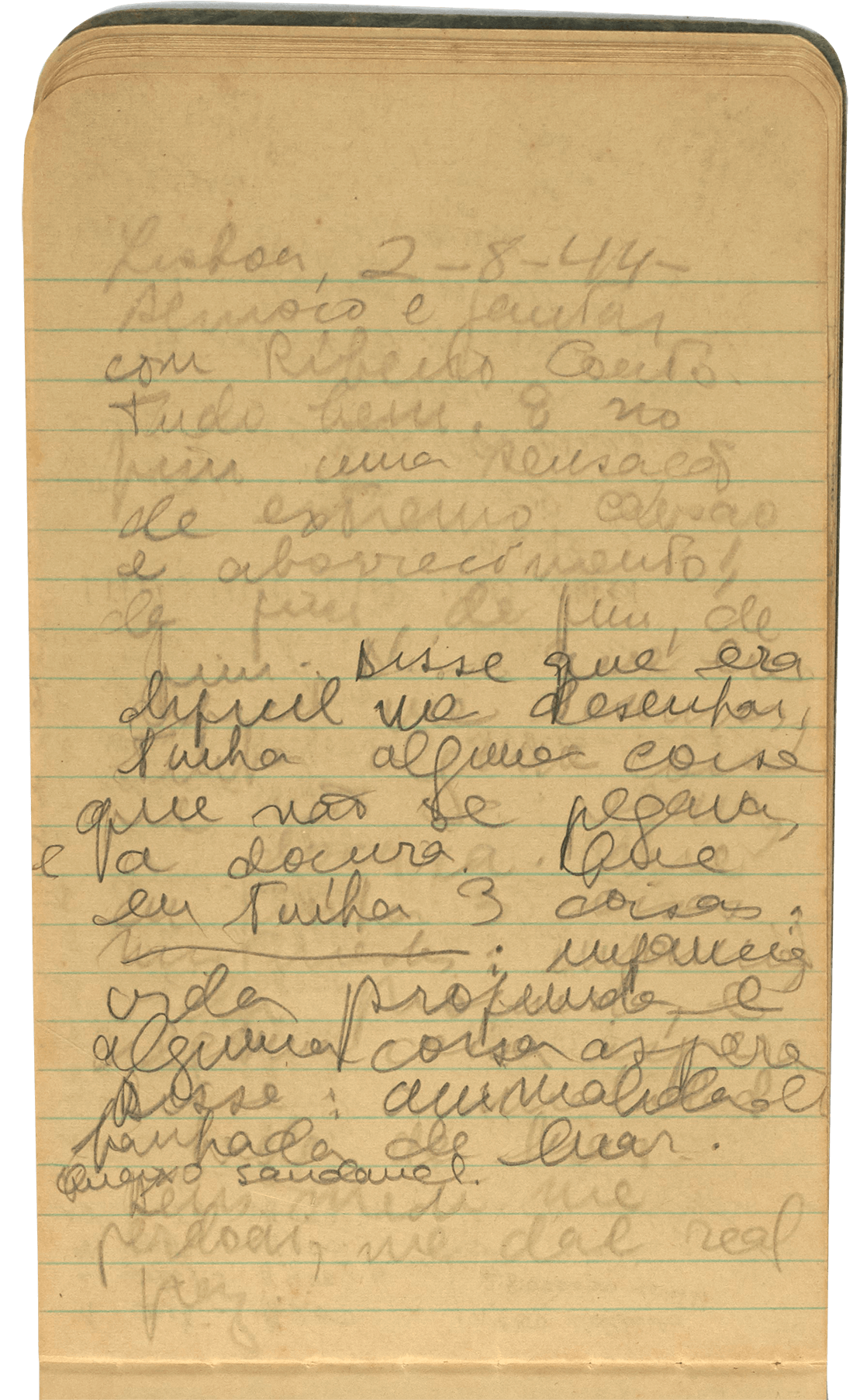
Lisboa, 2 de agosto de 1944 / Almoço e jantar com Ribeiro Couto. Tudo bem. E no fim uma sensação de extremo cansaço e aborrecimento, de fim, de fim, de fim. Disse que era difícil me desenhar, tinha alguma coisa que não se pegava e a doçura. Que eu tinha três coisas: ____________: infância, vida profunda e alguma coisa áspera. Disse: animalidade banhada de luar. Queixo saudável. Deus meu me perdoai, me dai real paz.

Perto não há nenhuma cidade. Vi alguns negros. Bonitos, limpos (por que estou falando deles como de animais? No entanto, gosto mais deles, de certo modo, do que dos *portugueses com os quais viajo. Os negros são bem negros e não marrons como a Marcinha notou no Brasil.12 – Parece-me que tanto faz estar na Libéria como no Brasil. Não sinto mudança de natureza, não sinto “viagem”! Pois agora uma mania de procurar poesia nas coisas, de se enternecer. (É horrível isto e, no entanto, fácil e atraente. Não existirá
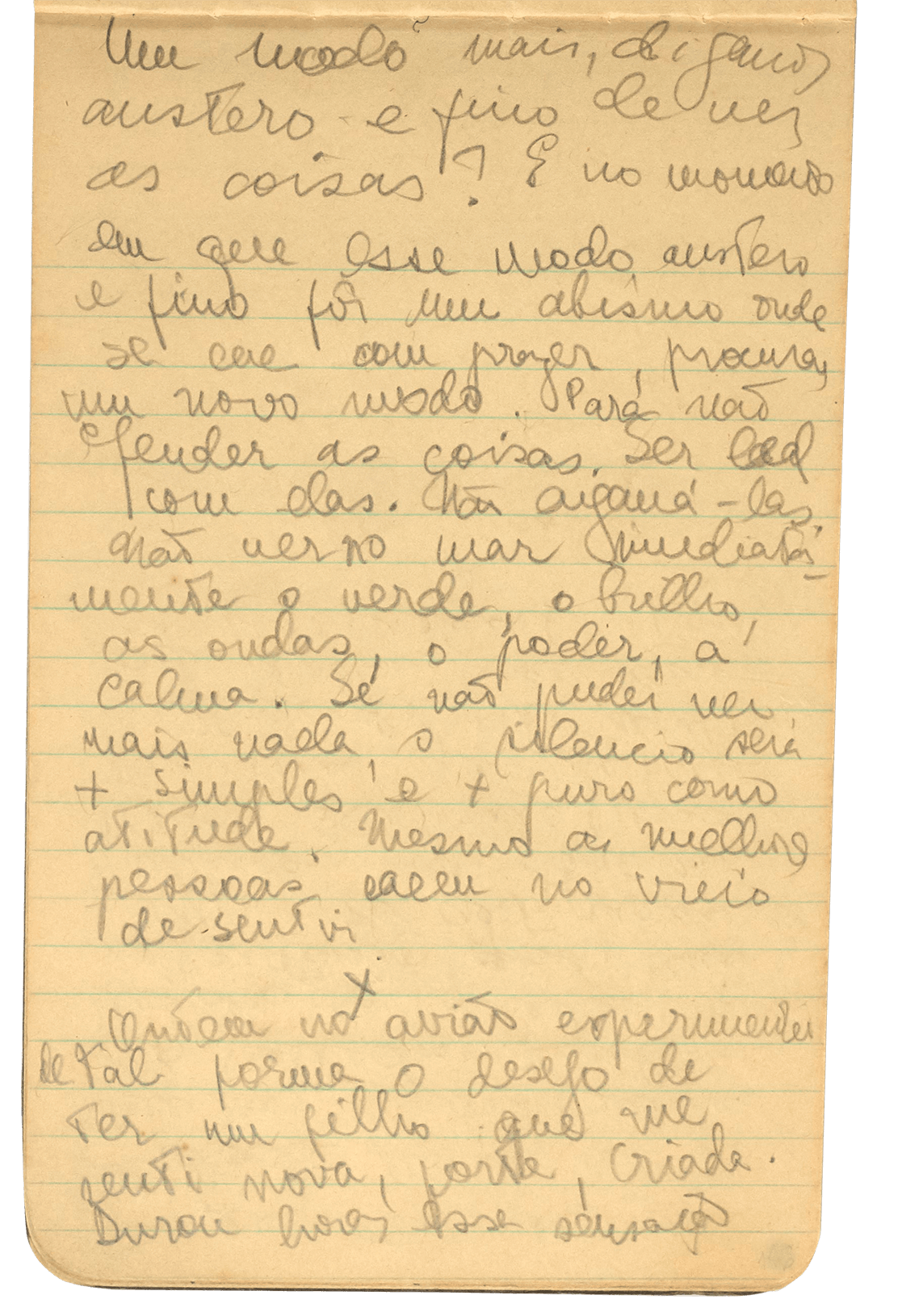
um modo mais, digamos, austero e fino de ver as coisas? E no momento em que esse modo austero e fino for um abismo onde se cai com prazer, procurar um novo modo. Para não ofender as coisas. Ser leal com elas. Não enganá-las. Não ver no mar imediatamente o verde, o brilho, as ondas, o poder, a calma. Se não puder ver mais nada, o silêncio será mais simples e mais puro como atitude. Mesmo as melhores pessoas caem no veio de sentir. Ontem no avião experimentei de tal forma o desejo de ter um filho que me senti nova, forte, criada. Durou horas essa sensaçã
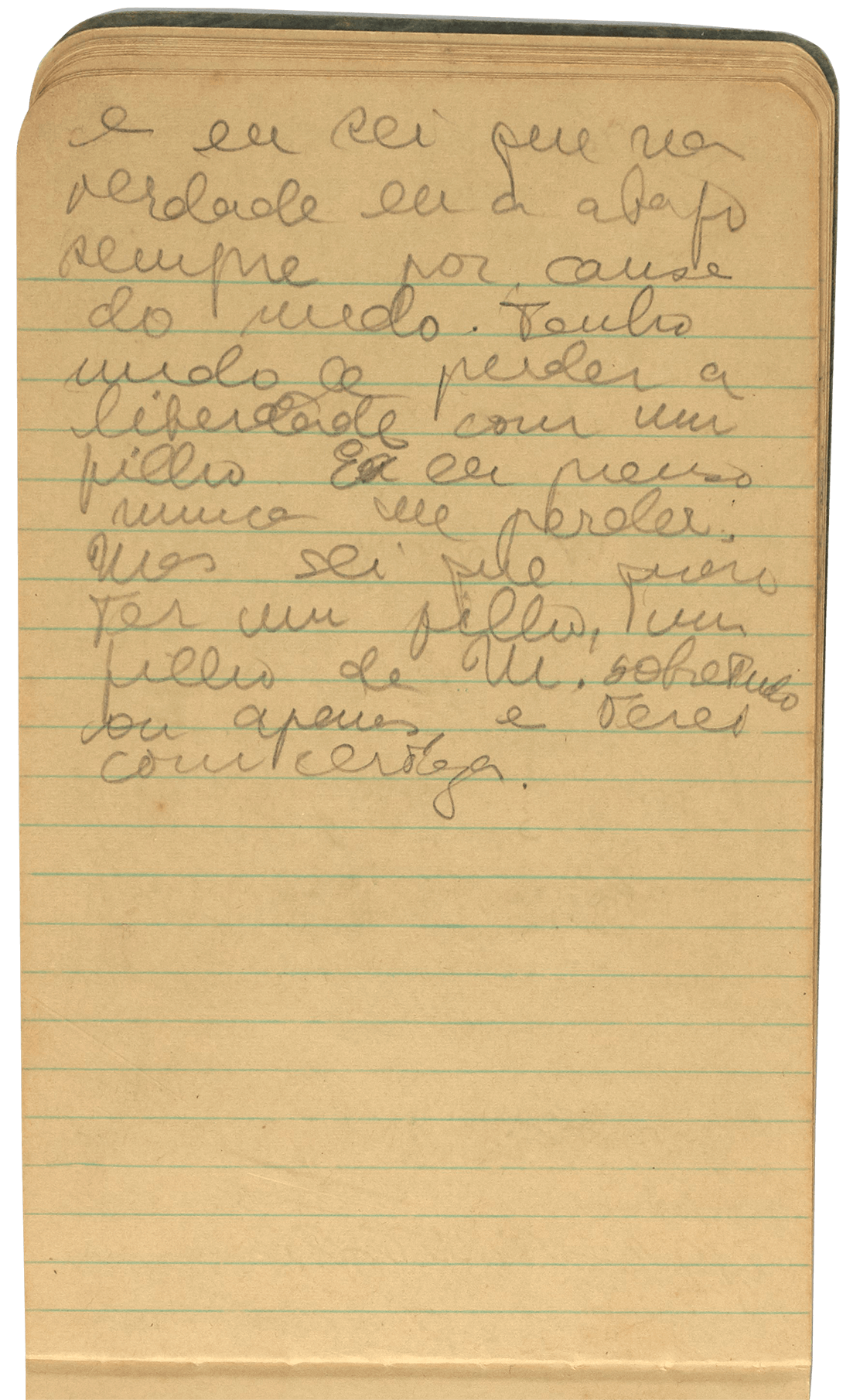
e eu sei que na verdade eu a abafo sempre por causa do medo. Tenho medo de perder a liberdade com um filho. E eu preciso nunca me perder. Mas sei que queria ter um filho, um filho de M. sobretudo ou apenas, e terei com certeza.
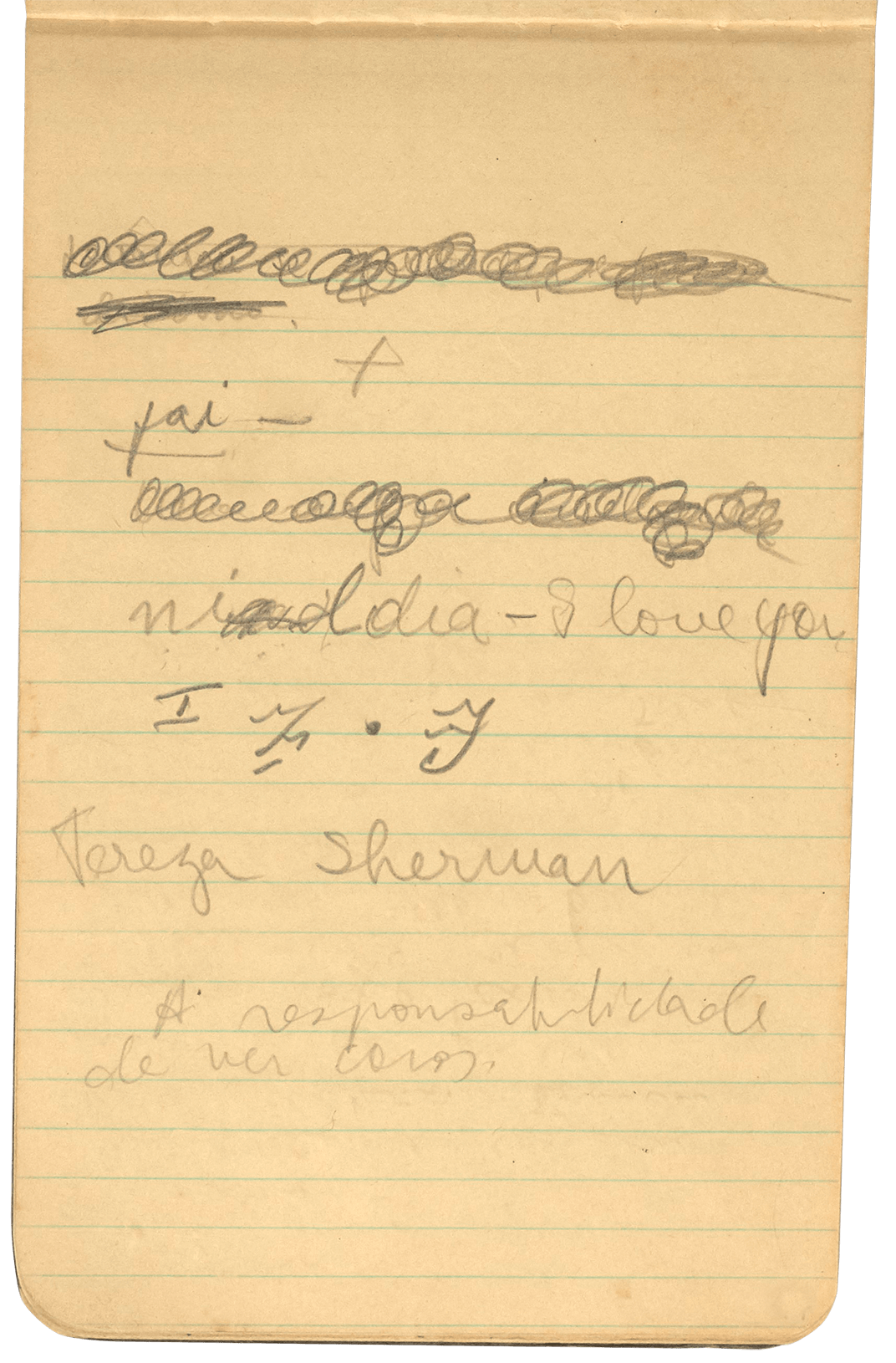
I love you / Tereza Sherman / A responsabilidade de ver coisas.
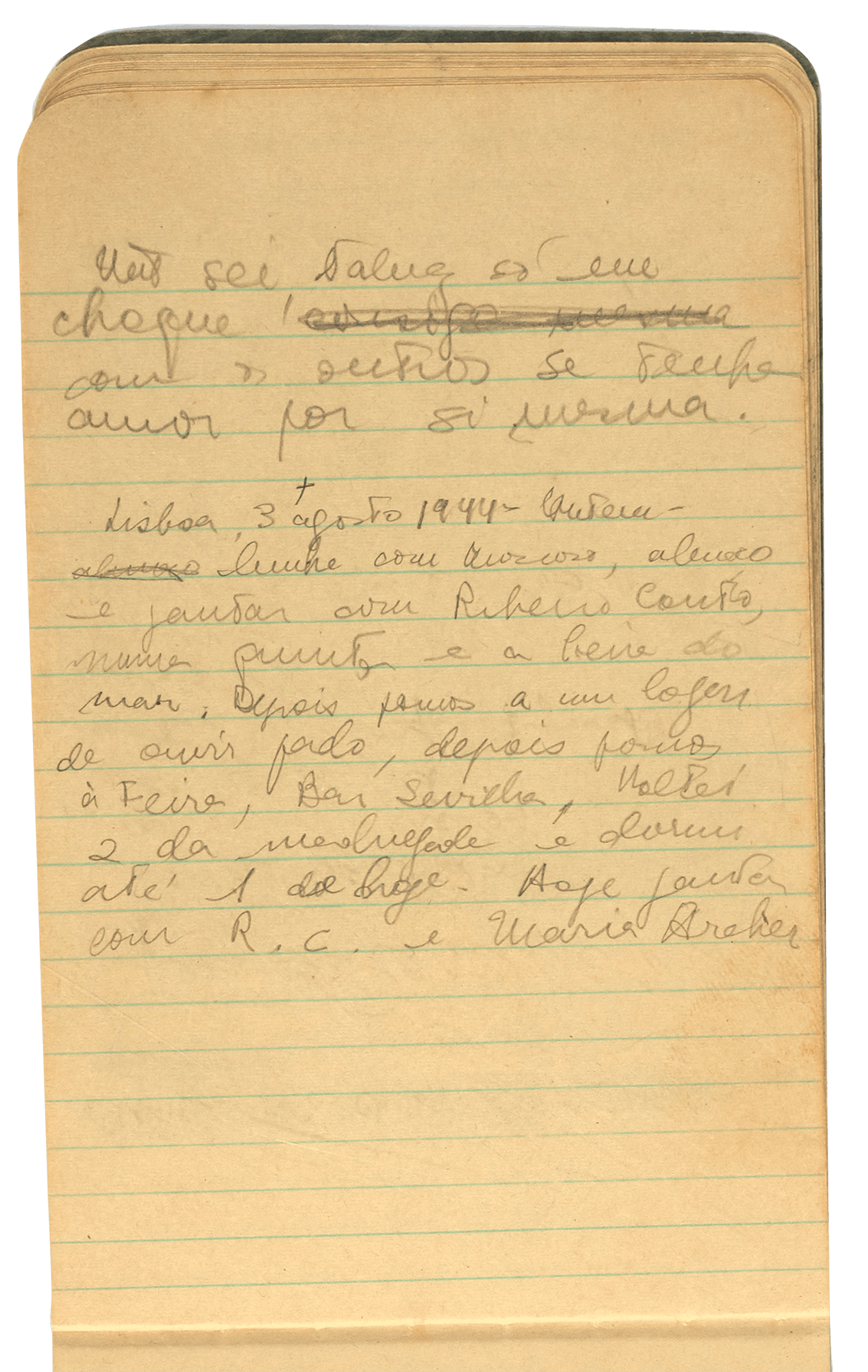
Não sei, talvez só em choque com os outros se tenha amor por si mesma. / Lisboa, 3 de agosto de 1944 / Ontem – lanche com [Moscoso?], almoço e jantar com Ribeiro Couto, numa quinta e à beira do mar. Depois fomos a um lugar de ouvir fado, depois fomos à feira, bar Sevilha. Voltei 2 da madrugada e dormi até 1 de hoje. Hoje jantei com R.C. e Maria Archer.
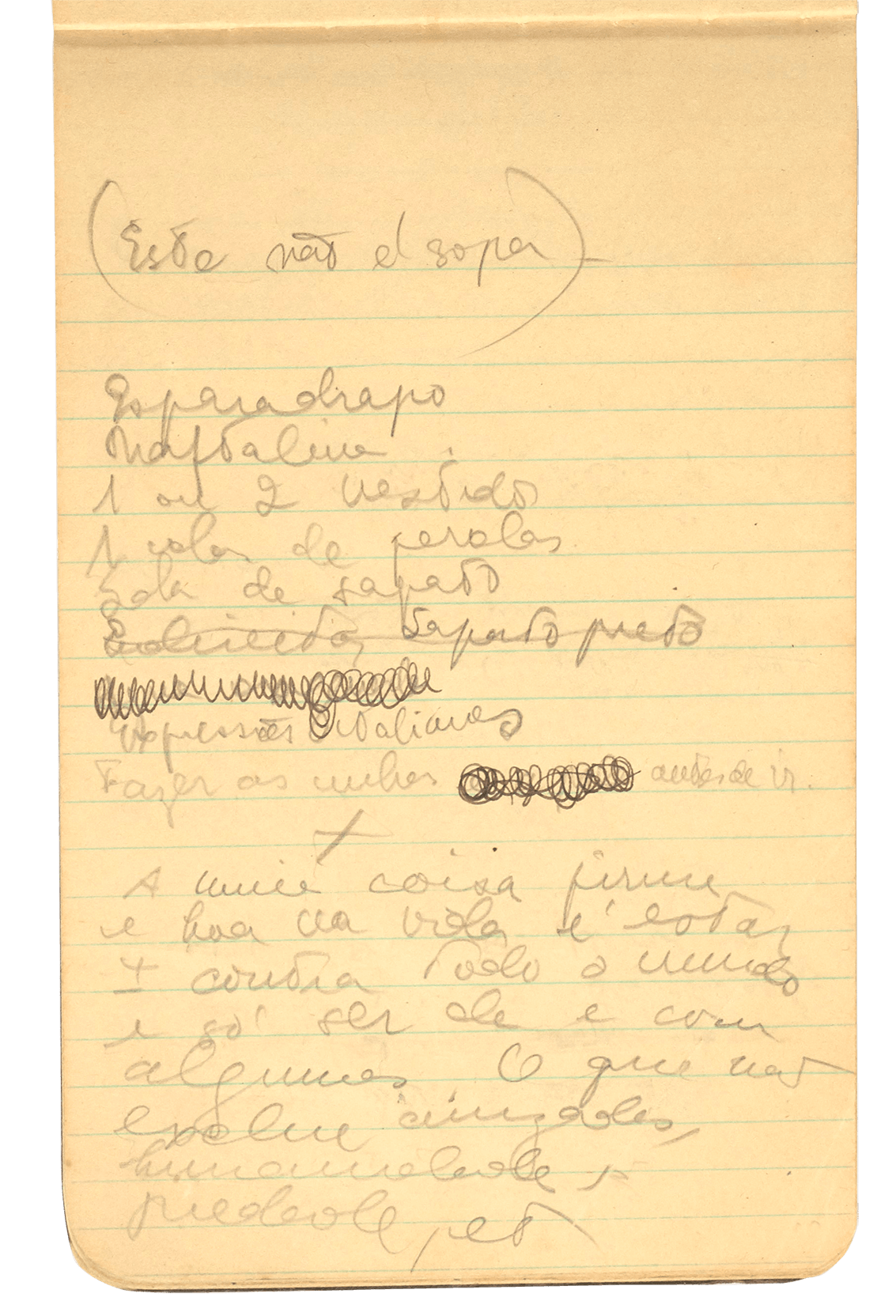
(Este não é sopa). / Esparadrapo / Naftalina / Um ou dois vestidos / Sola de sapato / Sapato preto / Expressões italianas / Fazer as unhas antes de ir / A única coisa firme e boa na vida é estar mais ou menos contra todo o mundo e só ser de e com algumas. O que não exclui amizades, humanidade, piedade etc.
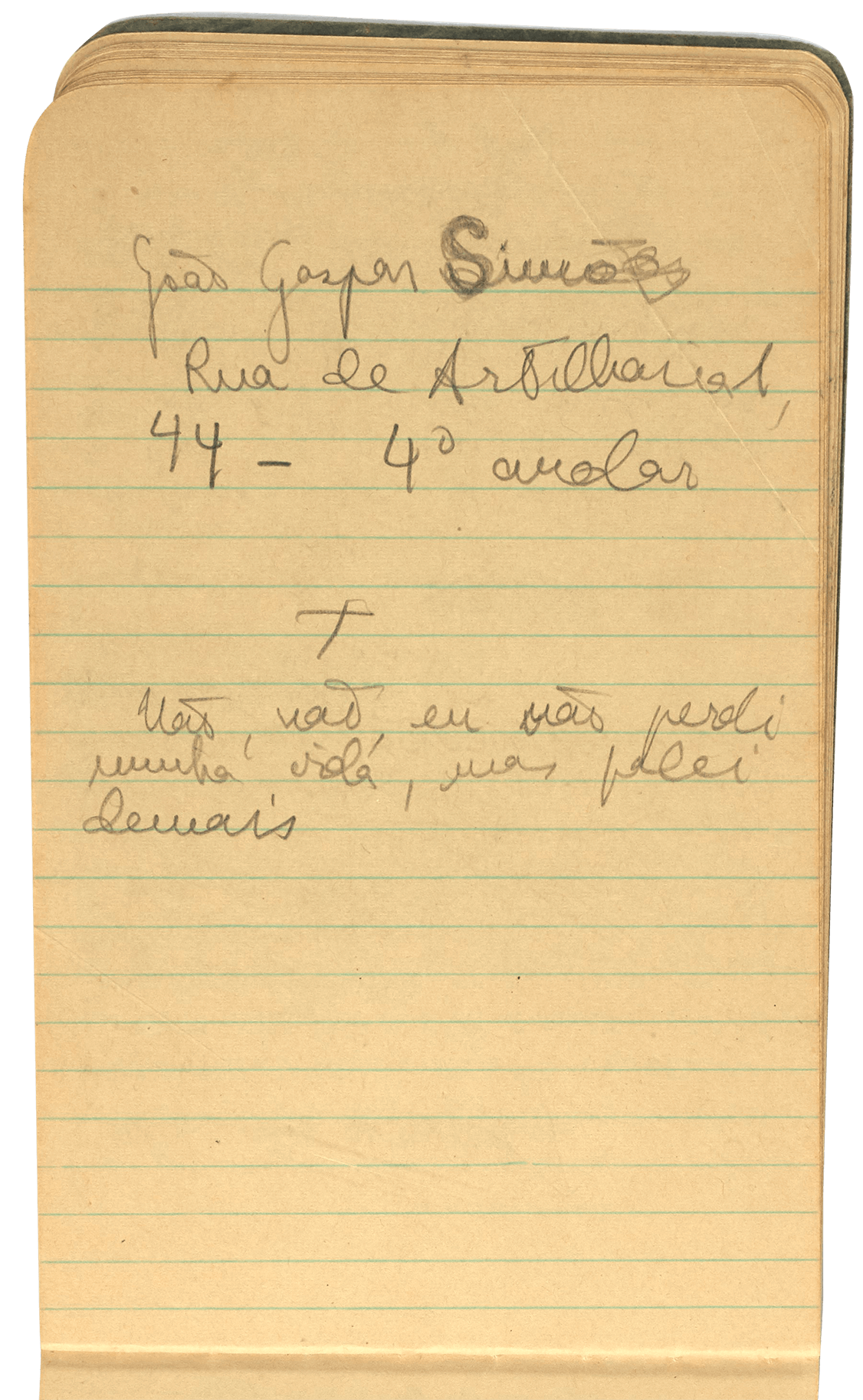
João Gaspar Simões / Rua da Artilharia, 44 – 4º andar / Não, não, eu não perdi minha vida, mas falei demais.
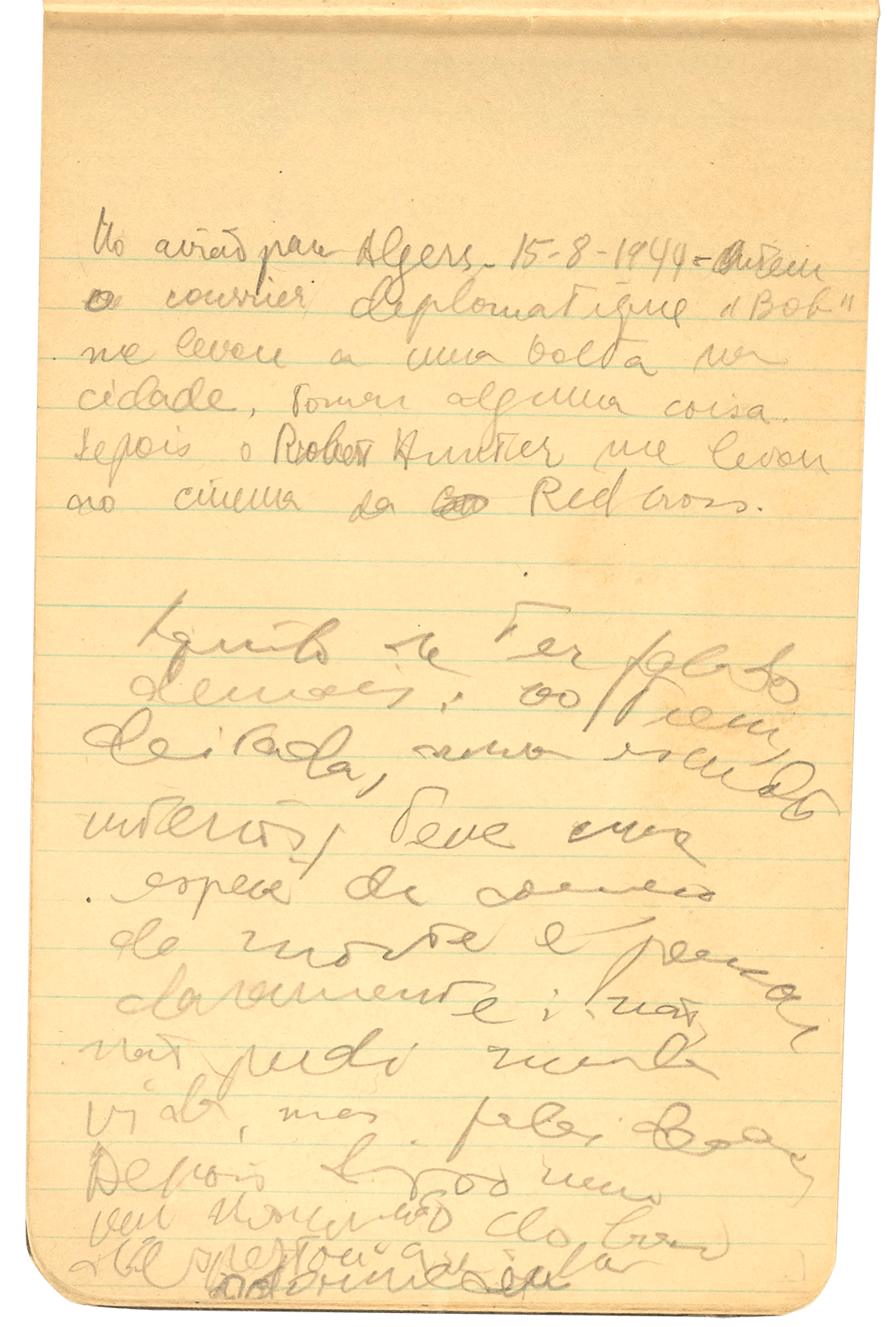
No avião para Argel – 15 de agosto de 1944 Ontem, courrier diplomatique “Bob” me levou a uma volta na cidade, tomar alguma coisa. Depois o Robert Hunter me levou ao cinema da Red Cross. / Aquilo de ter falado demais: do trem, deitada, numa escuridão interior, teve uma espécie de começo de morte e pensou claramente: não, não perdi minha vida, mas falei demais. Depois disso [ilegível] despertou-a e ela adormeceu.

[desenho e números]
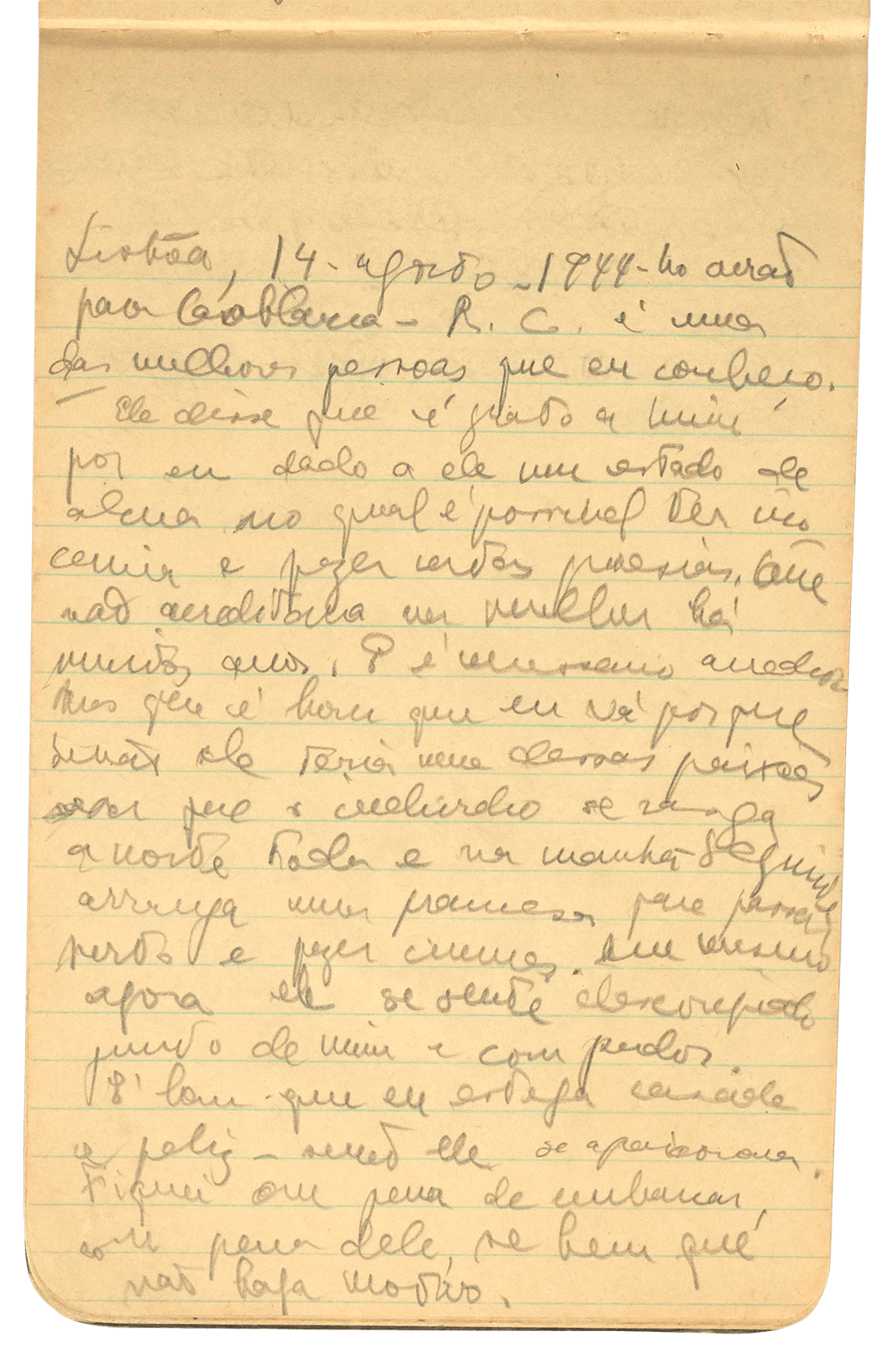
Lisboa, 14 de agosto de 1944 – no avião para Casablanca / R.C. é uma das melhores pessoas que eu conheço. Ele disse que é grato a mim por eu [ter] dado a ele um estado de alma no qual é possível ver discernir e fazer certas poesias. Que não acreditava em mulher há muitos anos. E é necessário acreditar. Mas que é hora que eu vá porque senão ele teria uma dessas paixões que o indivíduo se rasga a noite toda e na manhã seguinte arranja uma francesa para passar perto e fazer ciúmes. Que mesmo agora ele se sente desconfiado junto de mim e com pudor. É bom que eu esteja casada e feliz – senão ele se apaixonava. Fiquei com pena de embarcar com pena dele, se bem que não haja motivo.
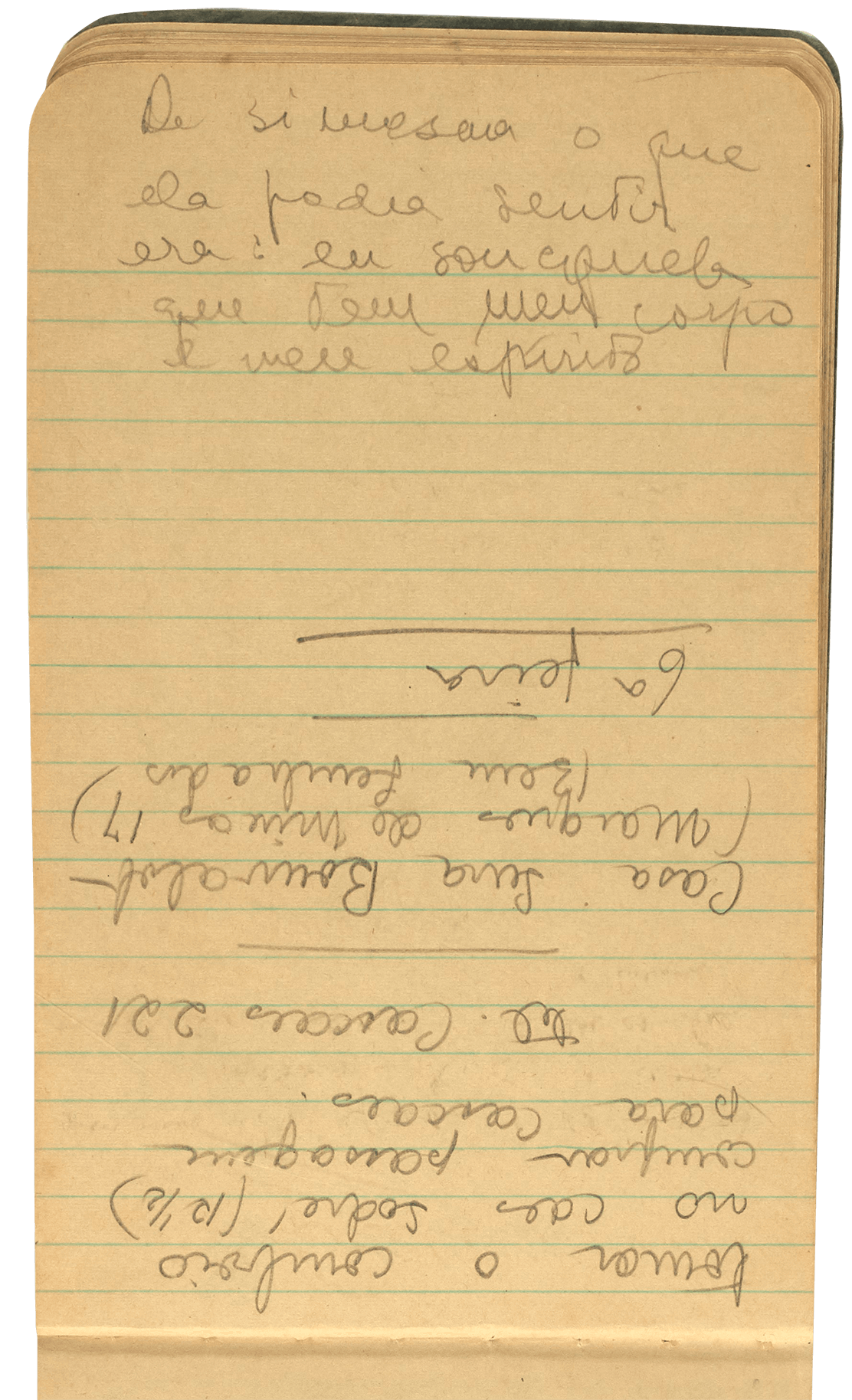
Tomar o comboio no cais Sodré (12:30h), comprar passagem para Cascais. Tel. Cascais 221 / Casa Sura Bonvalot (Marquês de Minas, 17, Bem Lembrados) / Sexta-feira / De si mesma o que ela podia sentir era: eu sou aquela que tem meu corpo e meu espírito.
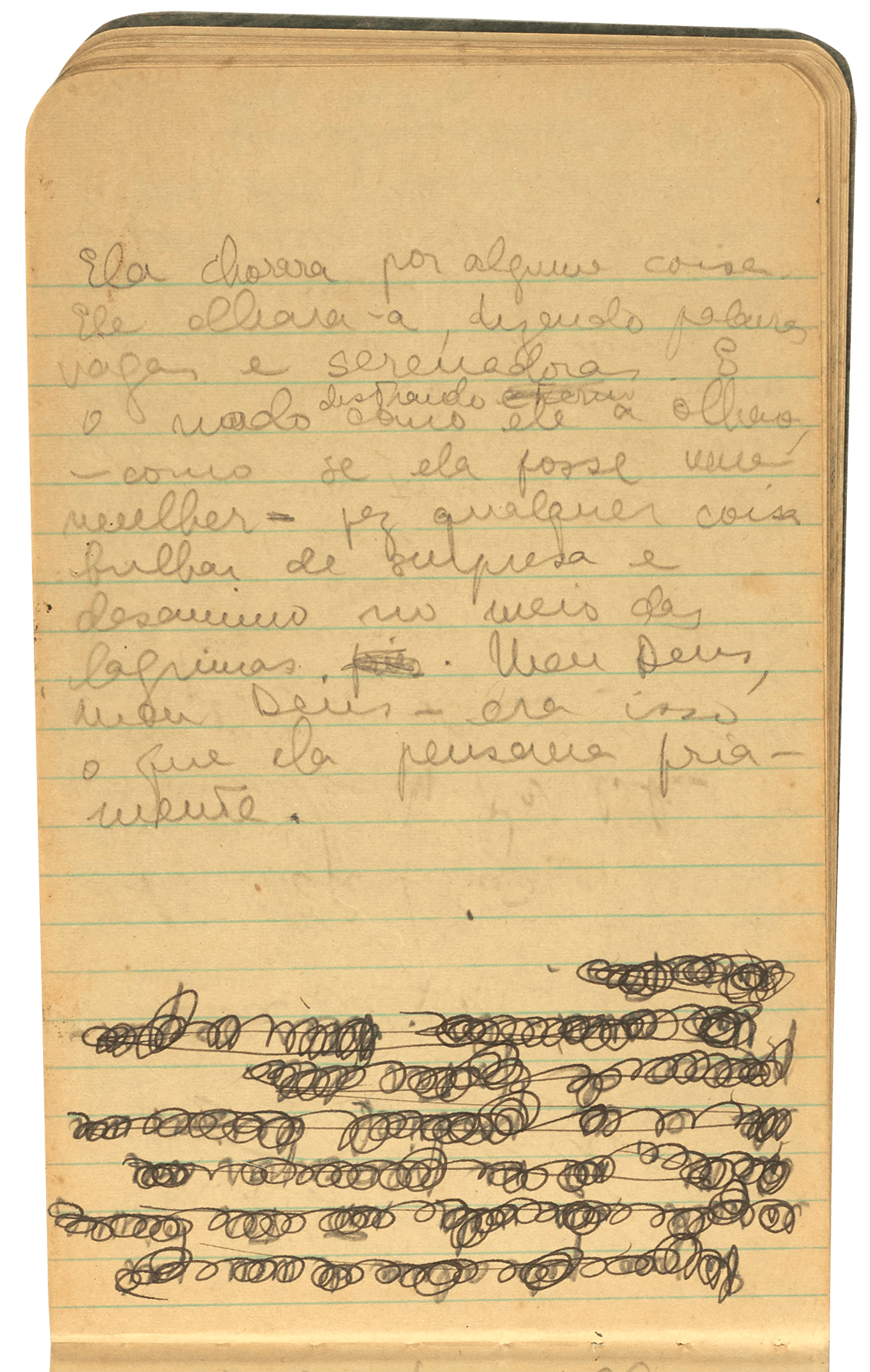
Ela chorava por alguma coisa. Ele olhava-a, dizendo palavras vagas e serenadoras. E o modo distraído como ele a olhava – como se ela fosse uma mulher – fez qualquer coisa brilhar de surpresa e desânimo no meio das lágrimas. Meu Deus, meu Deus – era isso o que ela pensava friamente.

Negro’s Village Tallah Kebbe Sasstown / Bill Young Nicholas M. Mendak Symon Berman David / H. Crockett Nashville, Tenn. U.S.A. / Robert L. Hunter American vice consul Casablanca
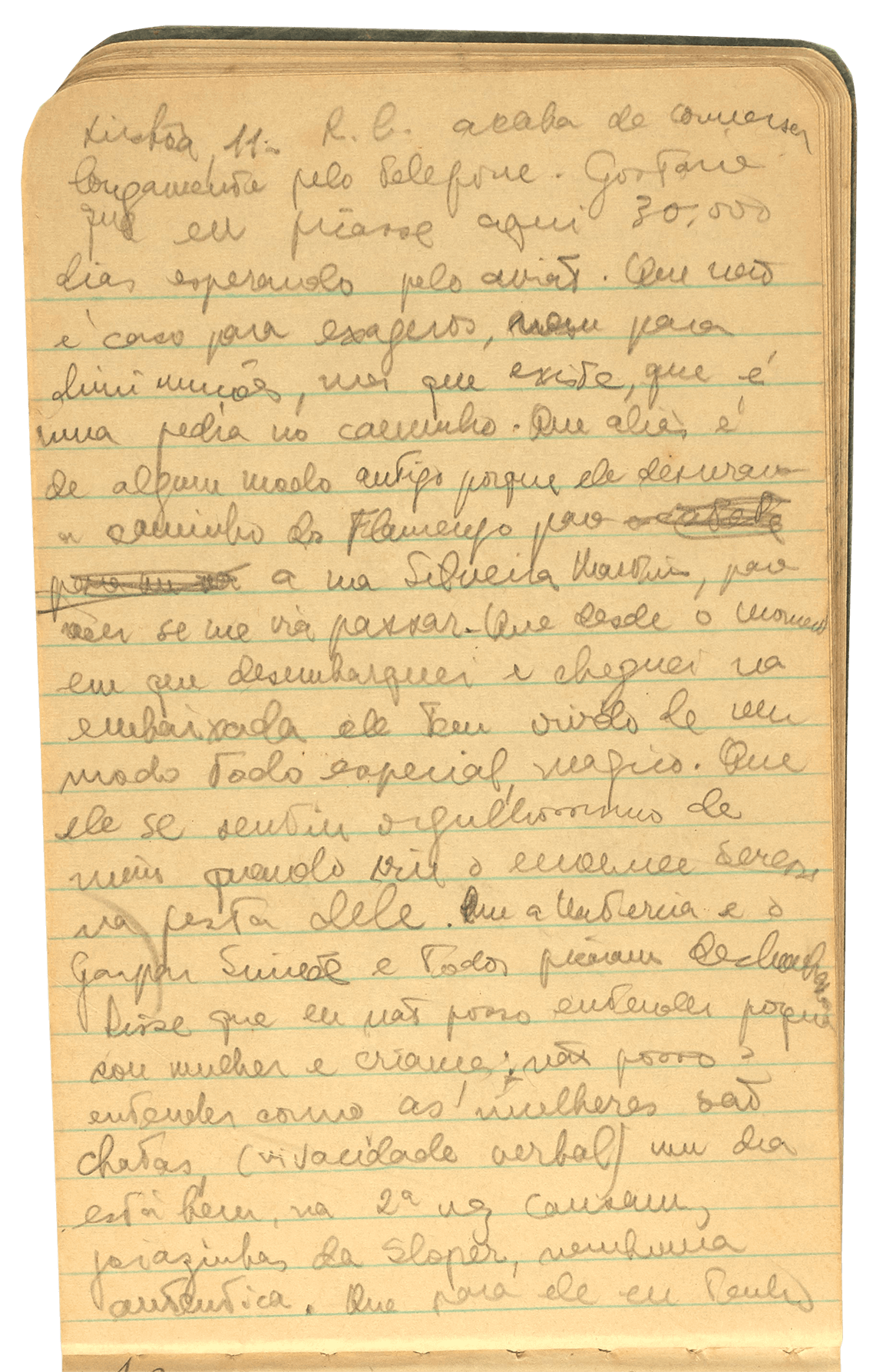
Lisboa, 11 [de agosto de 1944] / R.C. acaba de conversar longamente pelo telefone. Gostaria que eu ficasse aqui trinta mil dias esperando pelo avião. Que não é caso para exageros, nem para diminuições, mas que existe, que é uma pedra no caminho. Que, aliás, é de algum modo antigo porque ele desviava o caminho do Flamengo para a rua Silveira Martins, para ver se me via passar. Que desde o momento em que desembarquei e cheguei na embaixada ele tem vivido de um modo todo especial, mágico. Que ele se sentiu orgulhosíssimo de mim quando viu o [ilegível] na festa dele. Que a Natércia e o Gaspar Simões e todos ficaram deslumbrados. Disse que eu não posso entender porque sou mulher e criança: não posso entender como as mulheres são chatas, (vivacidade verbal) um dia está bem, na segunda vez cansam, joiazinhas da Sloper, nenhuma autêntica. Que para ele eu tenho
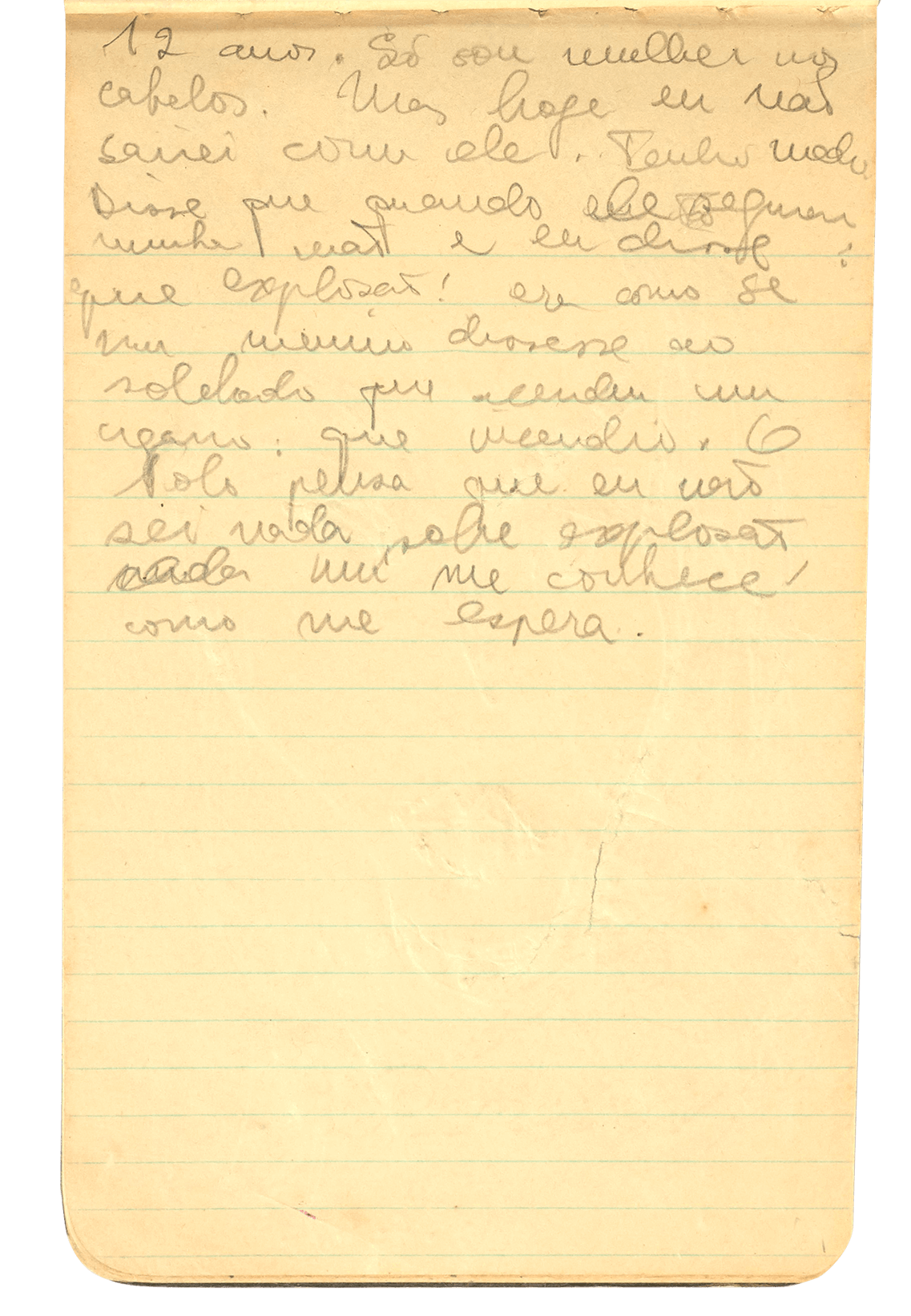
doze anos. Só sou mulher nos cabelos. Mas hoje eu não sairei com ele. Tenho medo. Disse que quando ele segurou minha mão e eu disse: que explosão! era como se um menino dissesse ao soldado que acendeu um cigarro: que incêndio. O tolo pensa que eu não sei nada sobre explosão, nem me conhece como me espera.
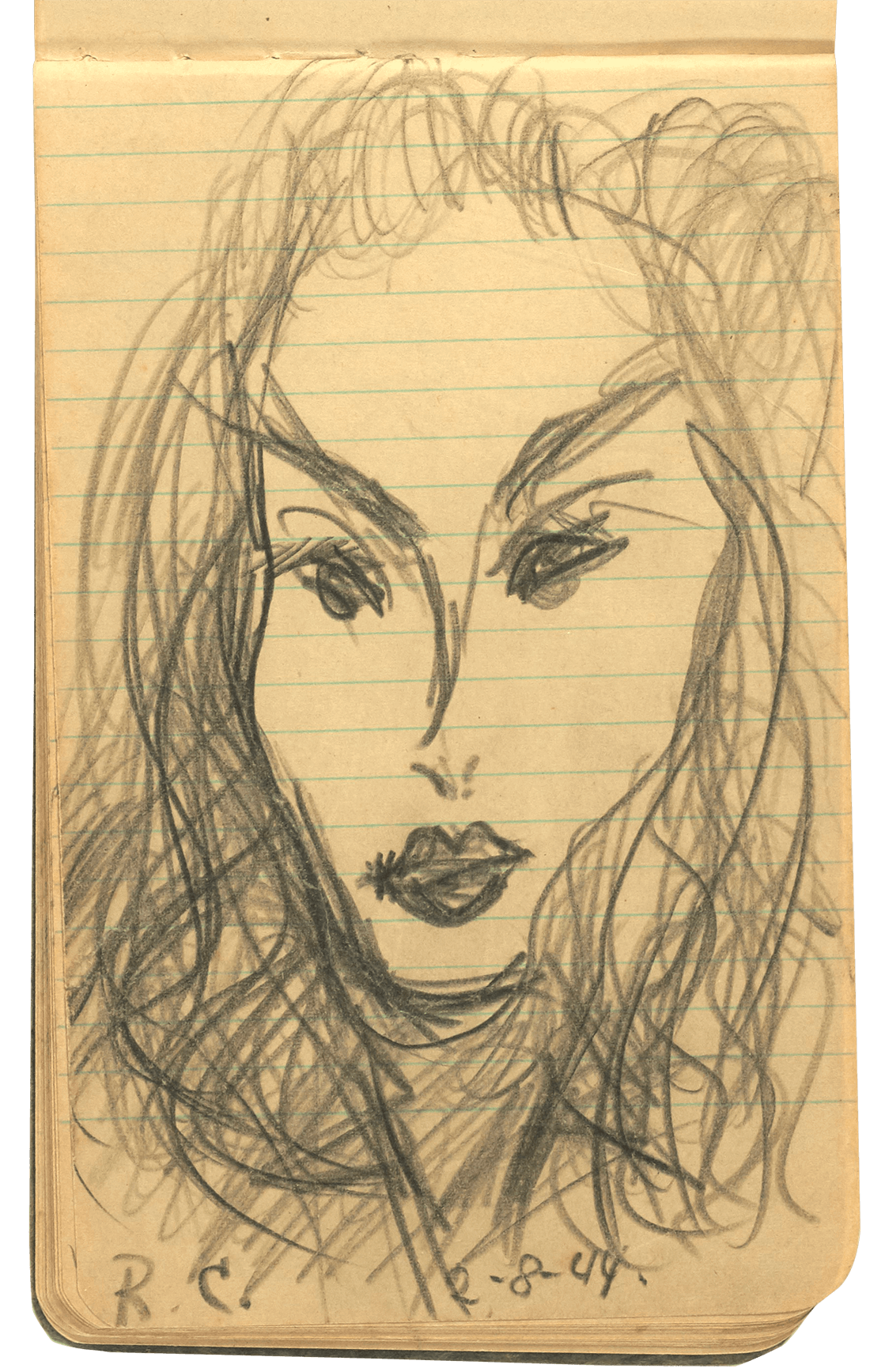
[retrato de Clarice Lispector assinado por Ribeiro Couto datado de 02 de agosto de 1944]
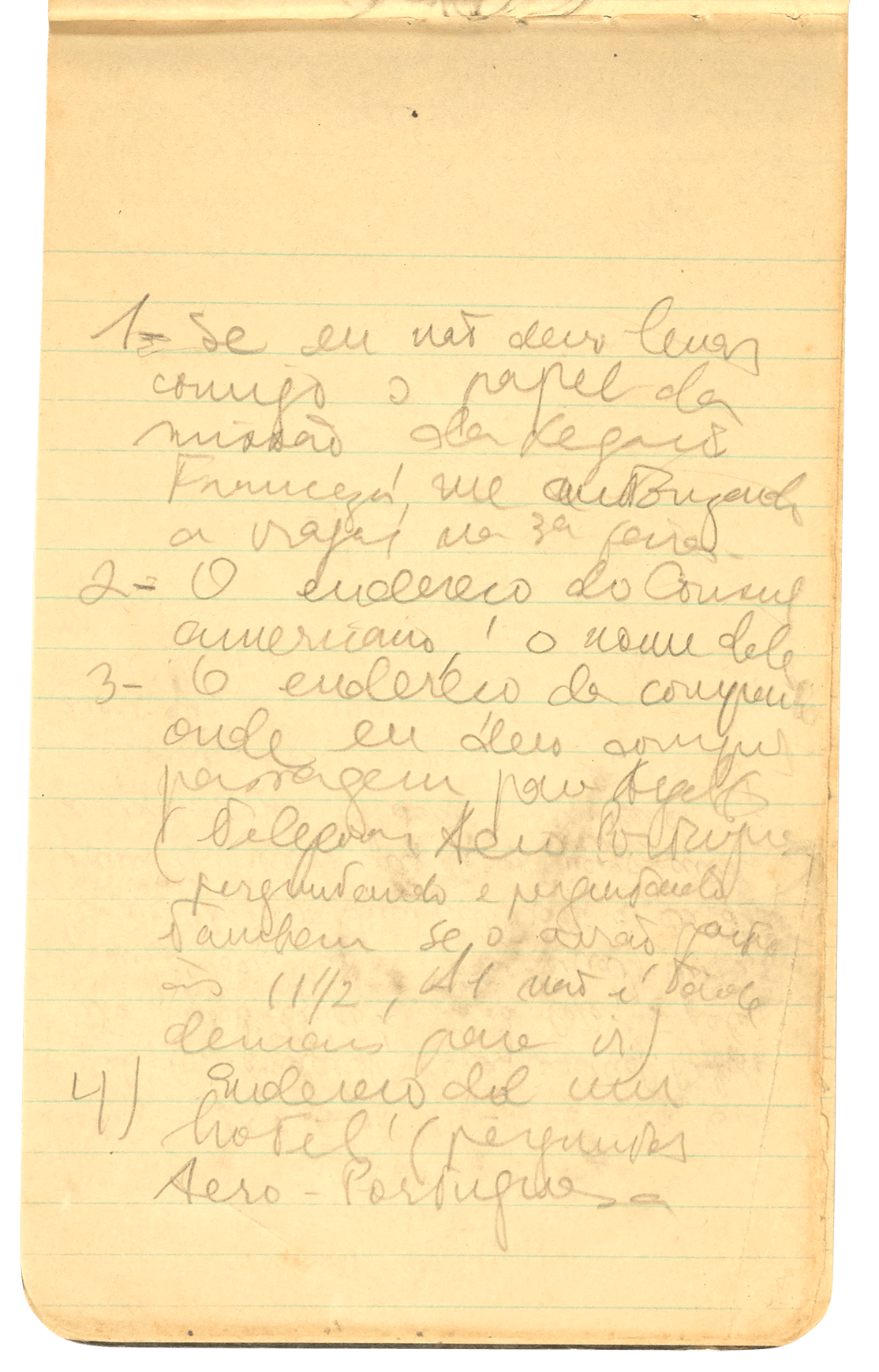
1 – se eu não devo levar comigo o papel da missão da legação francesa me autorizando a viajar na terça-feira. / 2 – o endereço do cônsul americano, o nome dele / 3 – o endereço da companhia onde eu devo comprar / passagem para Argel (telefonar aeroportuguesa perguntando e perguntando também se o avião parte às 11:30h, 11 não é tarde demais para ir.) / 4 – endereço do meu hotel (perguntar aeroportuguesa)
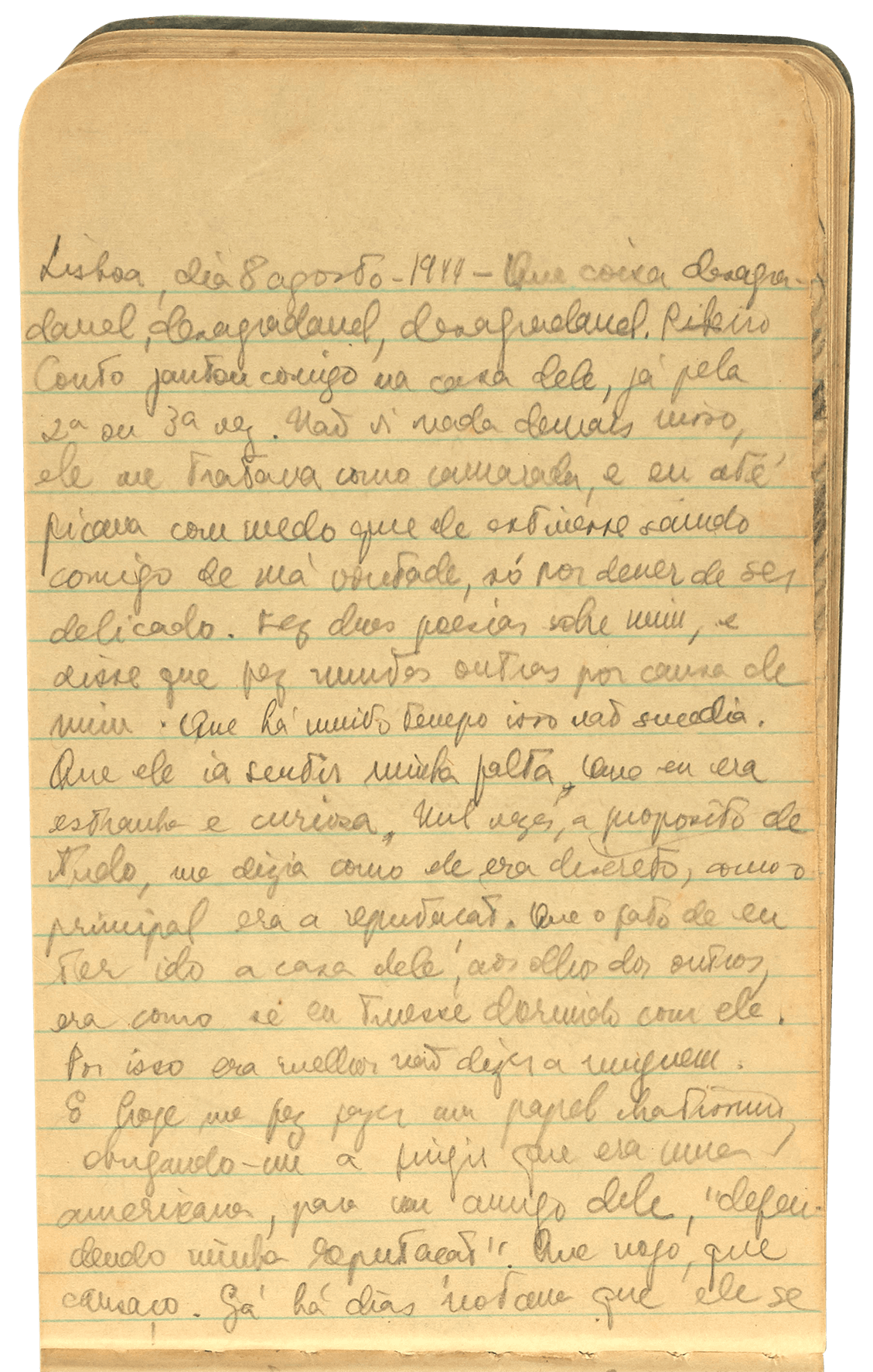
Lisboa, dia 8 de agosto de 1944 / Que coisa desagradável, desagradável, desagradável. Ribeiro Couto jantou comigo na casa dele, já pela segunda ou terceira vez. Não vi nada demais nisso, ele me tratava como camarada, e eu até ficava com medo que ele estivesse saindo comigo de má vontade, só por dever de ser delicado. Fez duas poesias sobre mim, e disse que fez muitas outras por causa de mim. Que há muito tempo isso não sucedia. Que ele ia sentir minha falta. Que eu era estranha e curiosa. Mil vezes, a propósito de tudo, me dizia como ele era discreto, como o principal era a reputação. Que o fato de eu ter ido à casa dele, aos olhos dos outros, era como se eu tivesse dormido com ele. Por isso era melhor não dizer a ninguém. E hoje me fez fazer um papel chatíssimo, obrigando-me a fingir que era uma americana, para um amigo dele, “defendendo minha reputação”. Que nojo, que cansaço. Já há dias notava que ele se

aproximava um pouco de mim. Hoje andou de braço comigo – tão desagradável meu papel. E depois, enquanto na feira esperávamos a roda, segurou-me em mão, procurou encostar não na fazenda mas no pulso. Retirei-a discretamente. Disse que sou complicada e austera, que é horrível que ele se sinta atraído por pessoas diferentes dele. Que poderia ficar comigo três dias sem parar até eu morrer de cansaço. Eu já previra indistinta [a] isso, mas ele insistiu tanto para dançarmos. No carro, segurou minha mão, beijou-a muitas vezes, encostou-a ao rosto. Eu fiquei fria de aborrecimento. Eu disse: que explosão. Ele disse: só interna e mais coisas. Que ele não tinha dormido por minha causa (ele tinha antes contado apenas a insônia). Depois de outras tentativas, que eu repelia vexada, ele disse que sentia muita ternura por minha vida, uma vida difícil. Depois viu mesmo o meu silêncio, e disse: mais tarde você vai ver, vou me vingar. Eu disse: como?! Ele disse: sem gestos
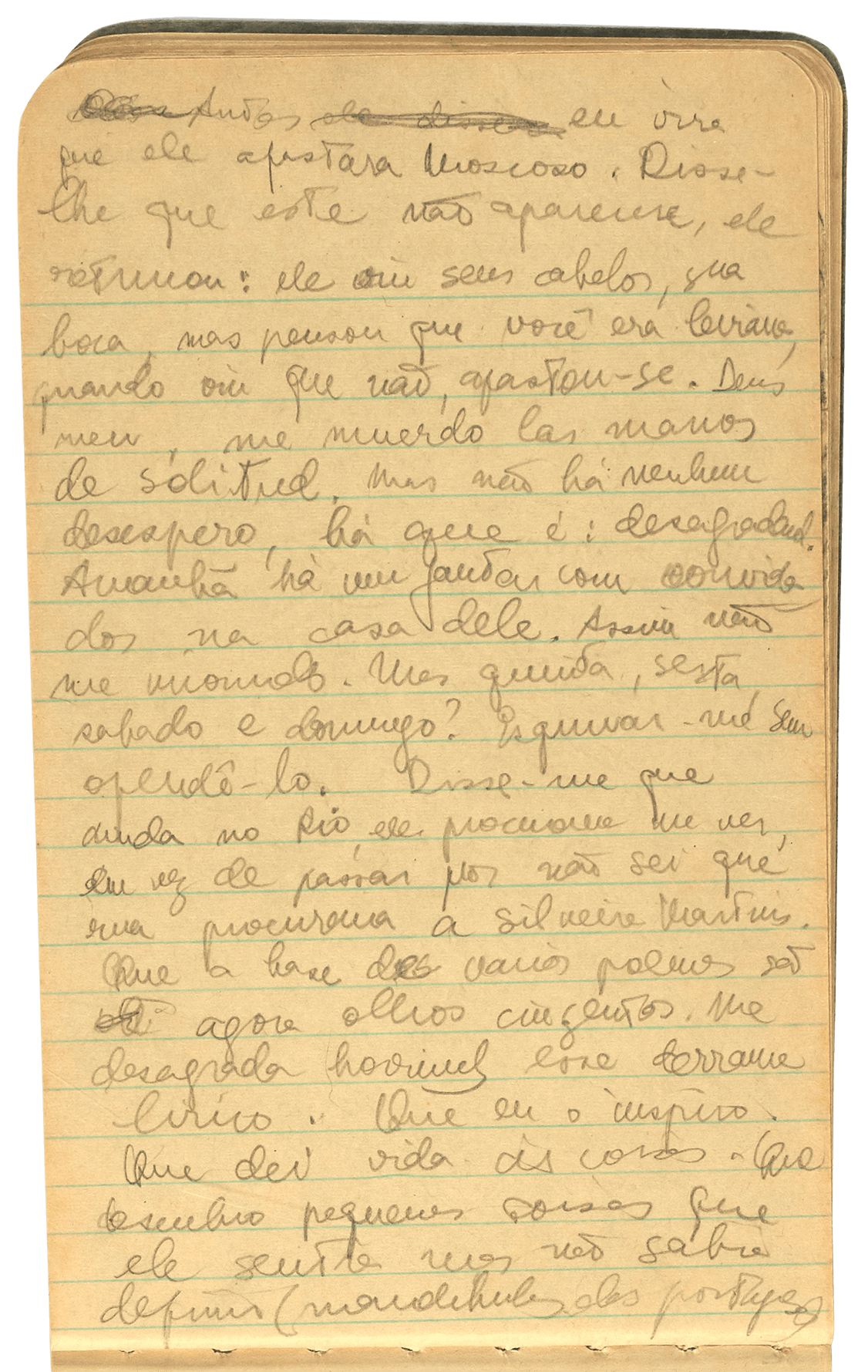
Antes eu vira que ele afastara [Moscoso]. Disse-lhe que este não aparecera, ele retrucou: ele viu seus cabelos, sua boca, mas pensou que você era leviana, quando viu que não, afastou-se. Deus meu, me muerdo las manos de solitud. Mas não há nenhum desespero, há que é: desagradável. Amanhã há um jantar com convidados na casa dele. Assim não me incomodo. Mas quinta, sexta, sábado e domingo? Esquivar-me sem ofendê-lo. Disse-me que ainda no Rio, ele procurava me ver, em vez de passar por não sei que rua procurava a Silveira Martins.18 Que a base de vários poemas são agora olhos cinzentos. Me desagrada, horrível esse derrame lírico. Que eu o inspiro. Que dei vida às coisas. Que descubro pequenas coisas que ele sentia mas não sabia definir (mandíbulas das portuguesas).
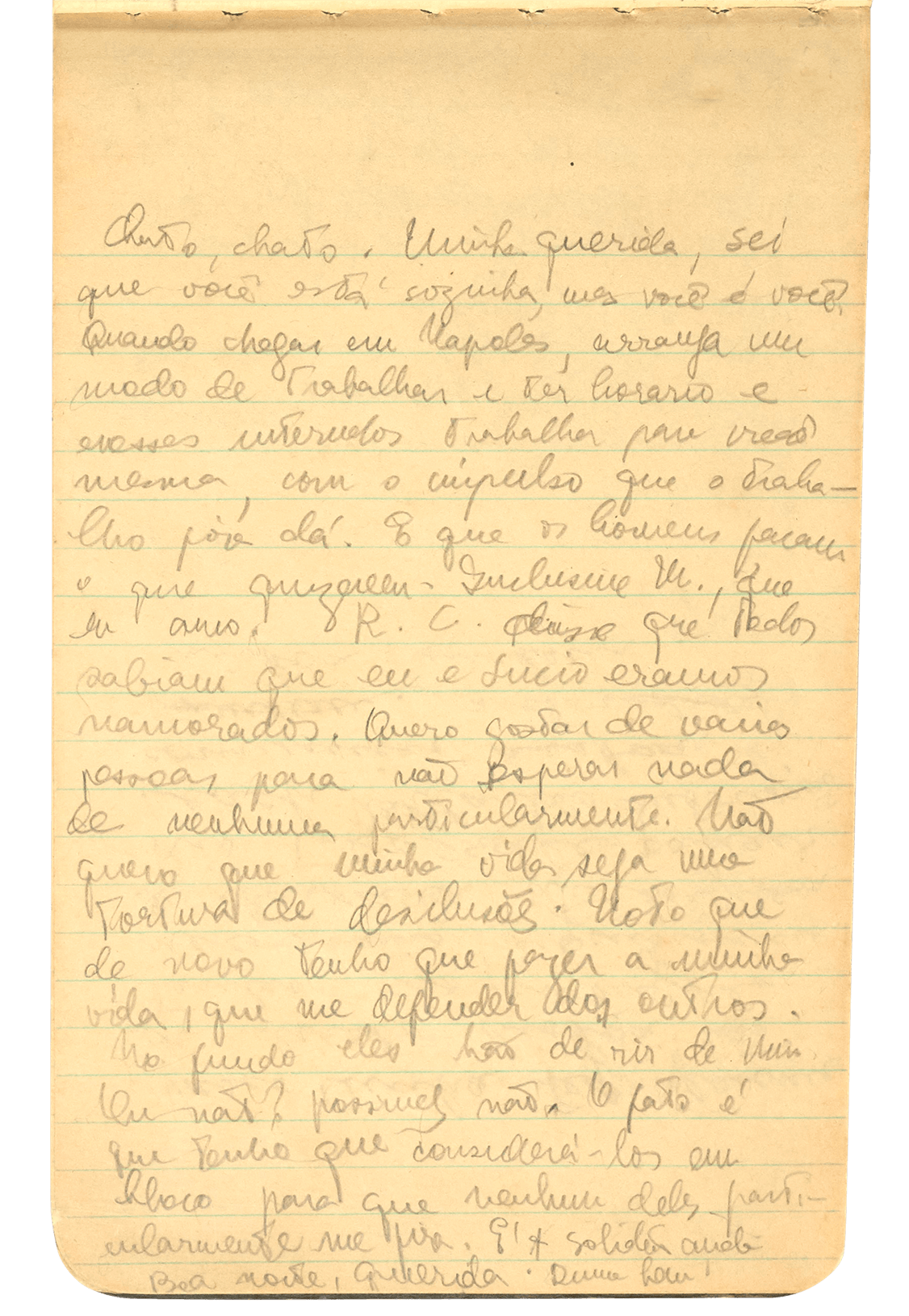
Chuto, chato. Minha querida, sei que você está sozinha, mas você é você. Quando chegar em Nápoles, arranja um modo de trabalhar e ter horário e nesses intervalos trabalhar para você mesma, com o impulso que o trabalho fora dá. E que os homens façam o que quiserem. Inclusive m., que eu amo. Ribeiro Couto disse que todos sabiam que eu e Lúcio éramos namorados. Quero gostar de várias pessoas para não esperar nada de nenhuma, particularmente. Não quero que minha vida seja uma tortura de desilusões. Noto que de novo tenho que fazer a minha vida, que me defender dos outros. No fundo eles hão de rir de mim. Ou não? Possível não. O fato é que tenho que considerá-los em bloco para que nenhum deles particularmente me fira. É, a solidão anda. Boa-noite, querida. Durma bem!
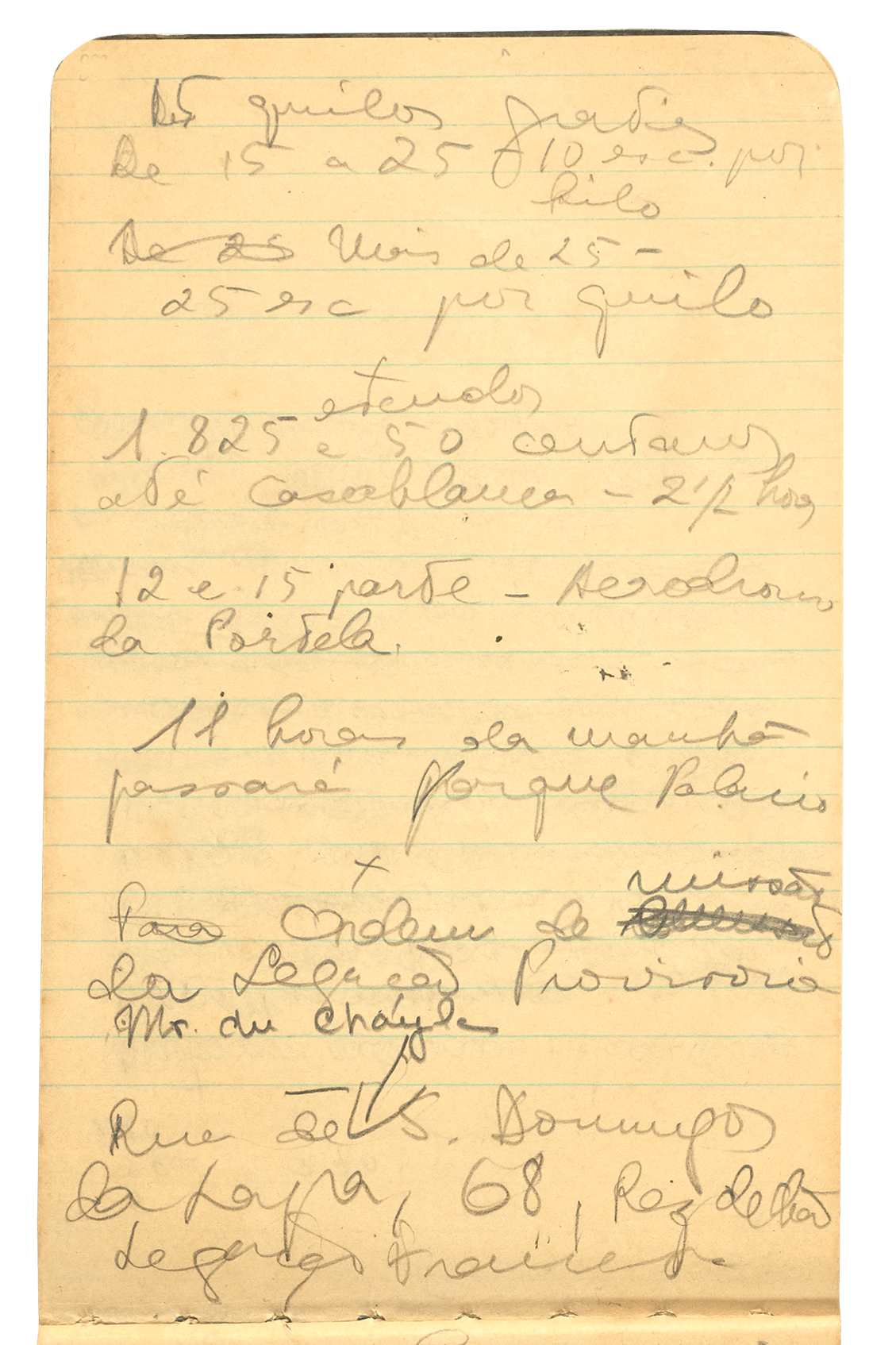
15 quilos grátis / De 15 a 25 – 10 escudos por quilo / Mais de 25 – 25 escudos por quilo / 1.825 escudos e 50 centavos até Casablanca – 2h e meia 12 e 15 parte – Aeródromo da Portela. / 11 horas da manhã passará Parque Palácio. / Ordem de missão da Ligação Provisória Mr. Du Chàyla / Rua de São Domingos da Lapa, 57, Rez de Chão / Legação francesa
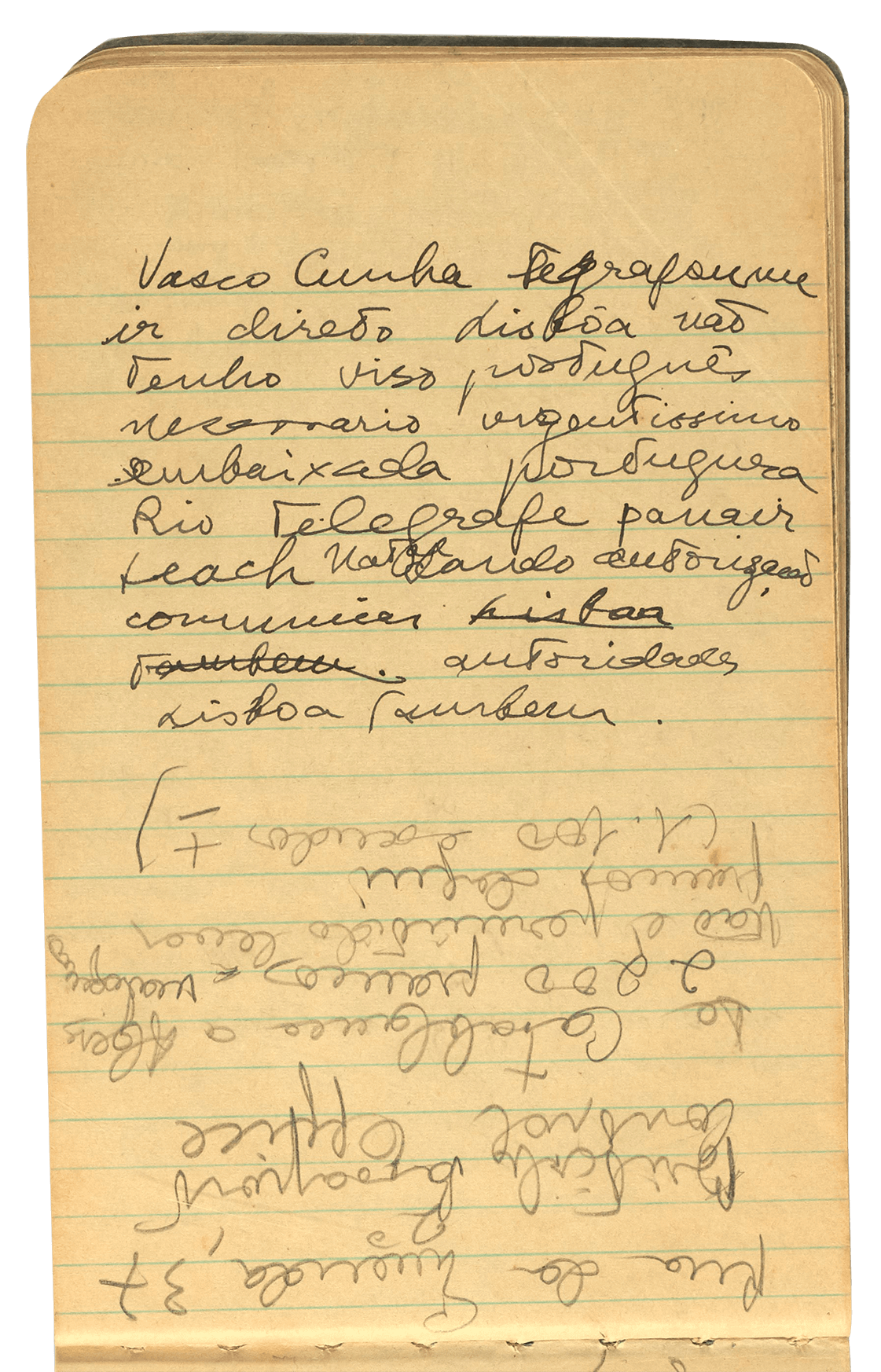
Rua da Emenda, 37 / British passaport control office / De Casablanca a Alger – 2200 francos-marroquinos / Não é permitido levar francos daqui (1.100 escudos, mais ou menos). /// x/30 /// Vasco Cunha telegrafou-me ir direto Lisboa não tenho *viso português necessário urgentíssimo embaixada portuguesa Rio telegrafe Panair beach Natal dando autorização comunicar autoridades Lisboa também.
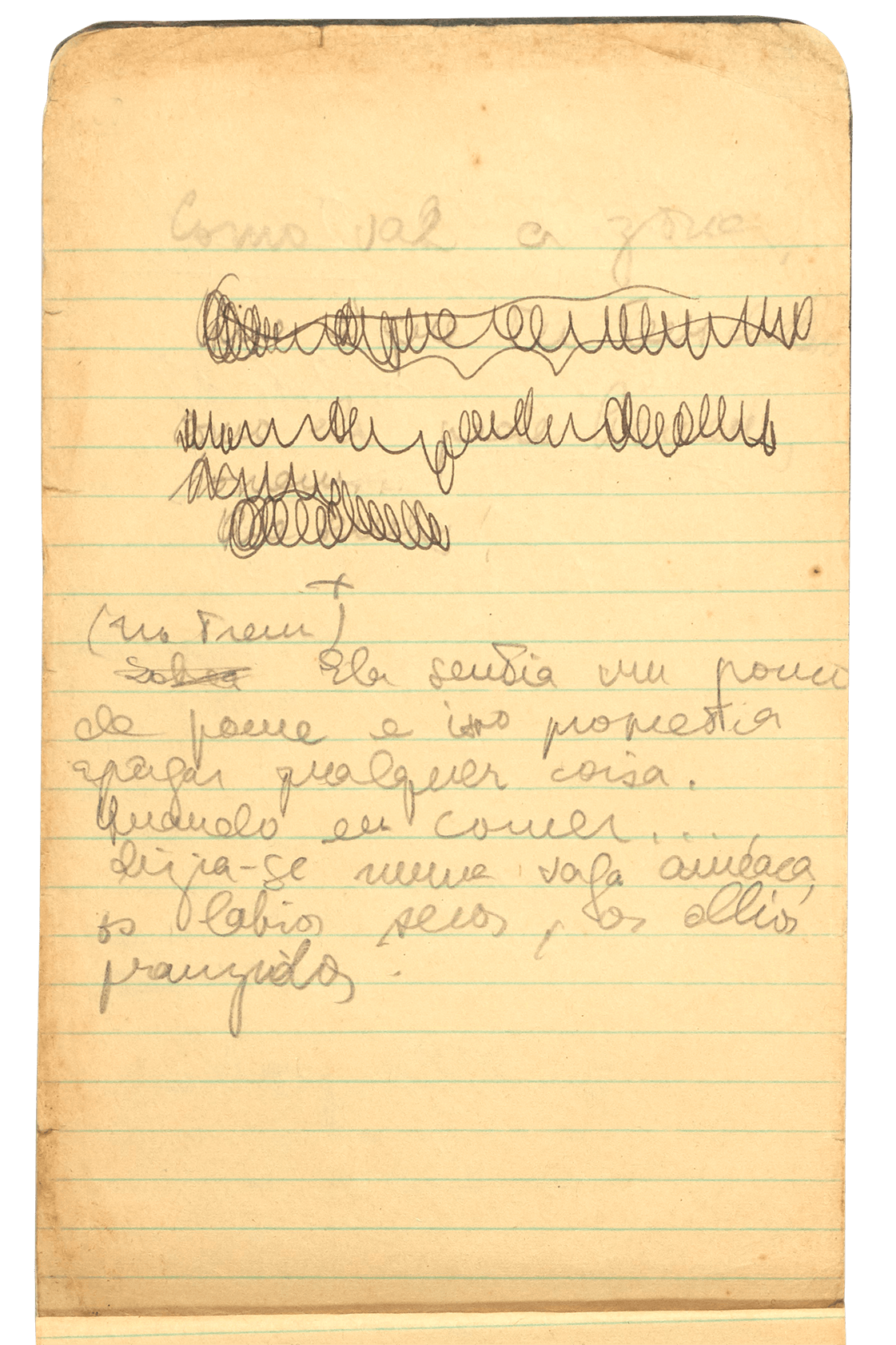
Como vai a zona? / (No trem) Ela sentia um pouco de fome e isso prometia apagar qualquer coisa. Quando eu comer… dizia-se numa vaga ameaça, os lábios secos, os olhos franzidos.
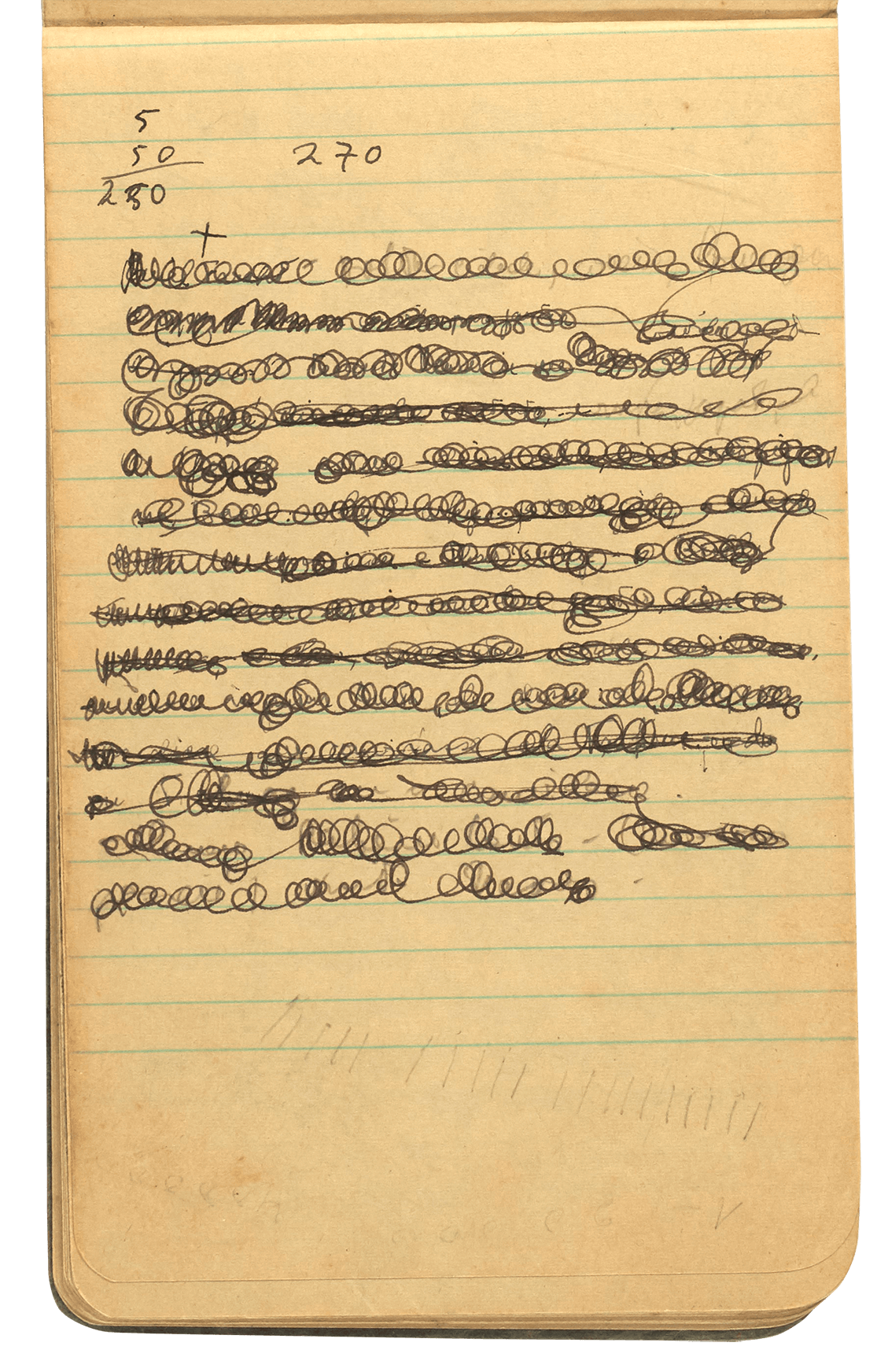
[conta]
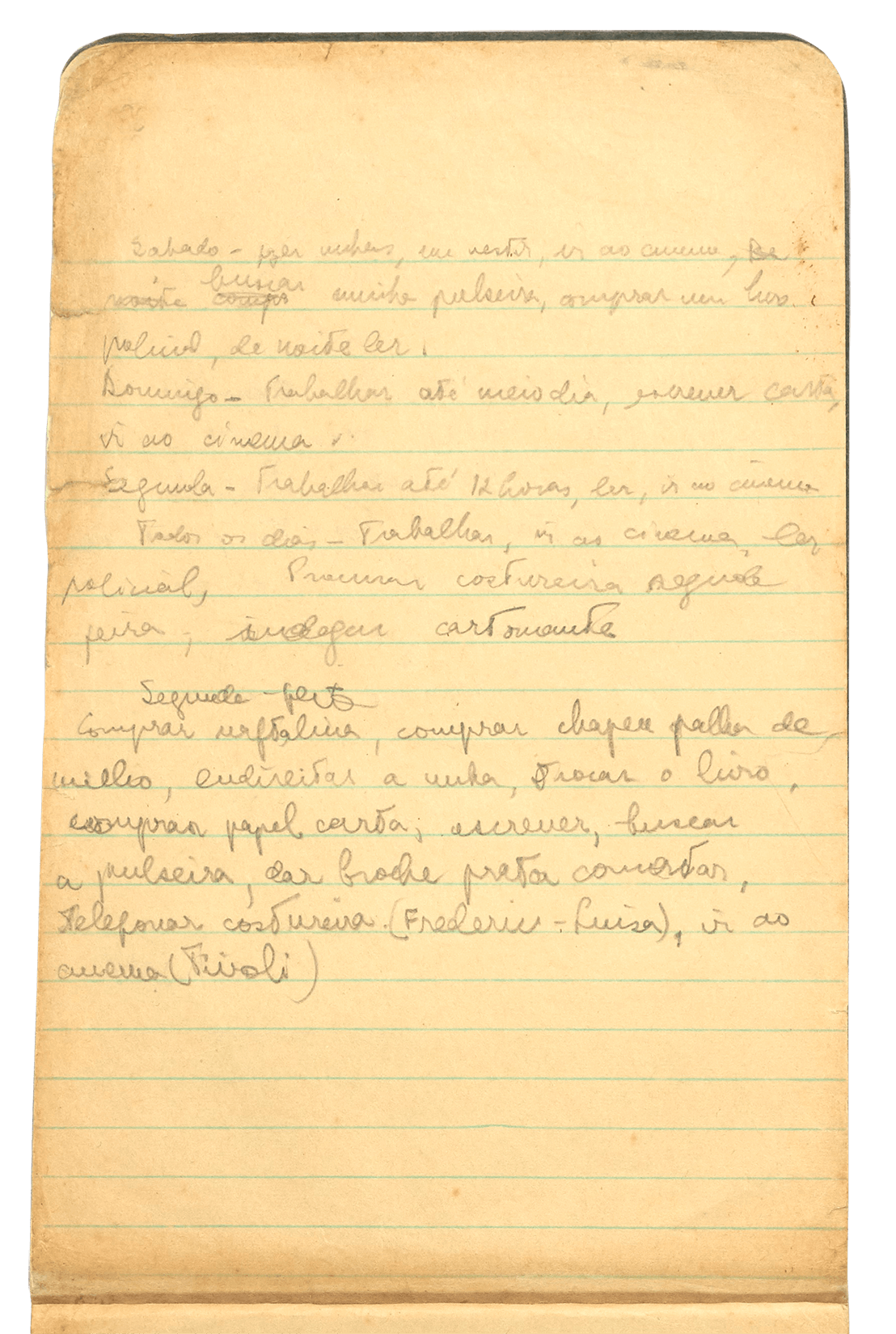
Sábado – fazer unhas, me vestir, ir ao cinema, buscar minha pulseira, comprar um livro policial, de noite, ler. Domingo – trabalhar até meio-dia, escrever carta, ir ao cinema. Segunda – trabalhar até às doze horas, ler, ir ao cinema. Todos os dias – trabalhar, ir ao cinema, ler policial, procurar costureira segunda-feira, indagar cartomante. Segunda-feira: comprar naftalina, comprar chapéu palha de milho, endireitar a unha, trocar o livro, comprar papel-carta, escrever, buscar a pulseira, dar broche prata consertar, telefonar costureira (Frederic-Luisa), ir ao cinema (Tivoli).
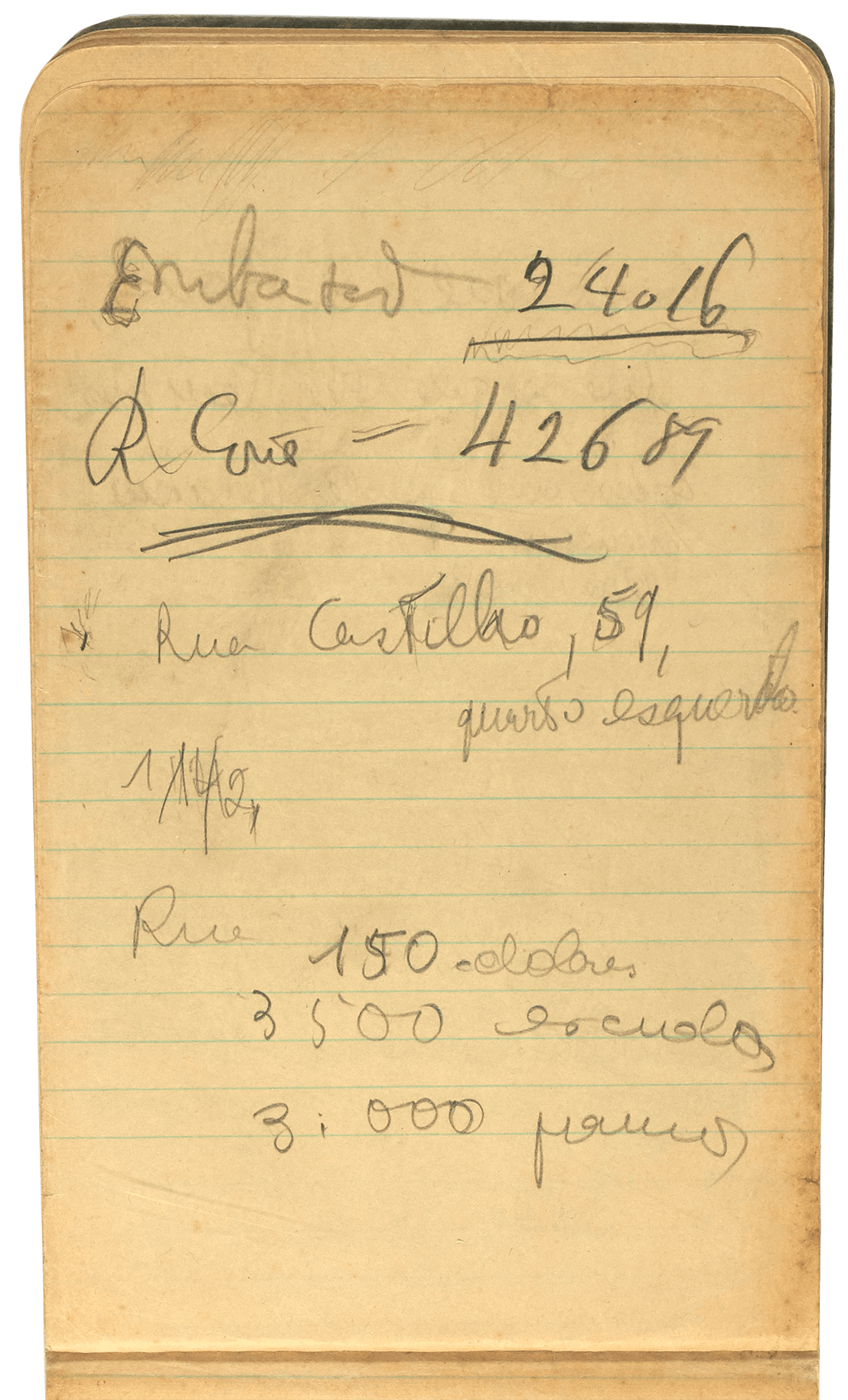
Embaixada 24016 / R. [ilegível] – 42689 / Rua Castilho, 59, quarto esquerdo / RU / 150 dólares / 3.500 escudos / 3.000 francos
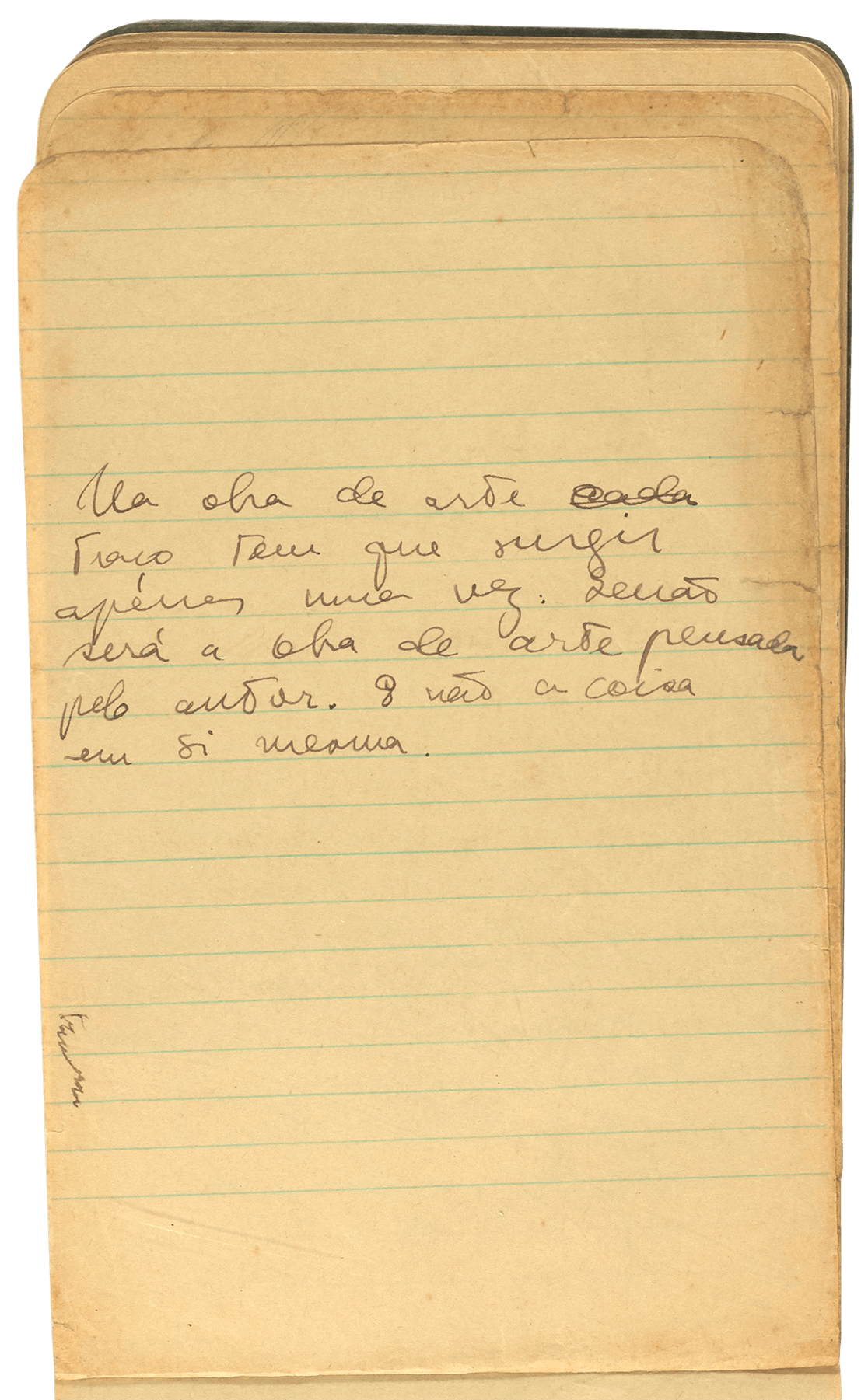
Na obra de arte cada traço tem que surgir apenas uma vez. Se não será a obra de arte pensada pelo autor. E não a coisa em si mesma.
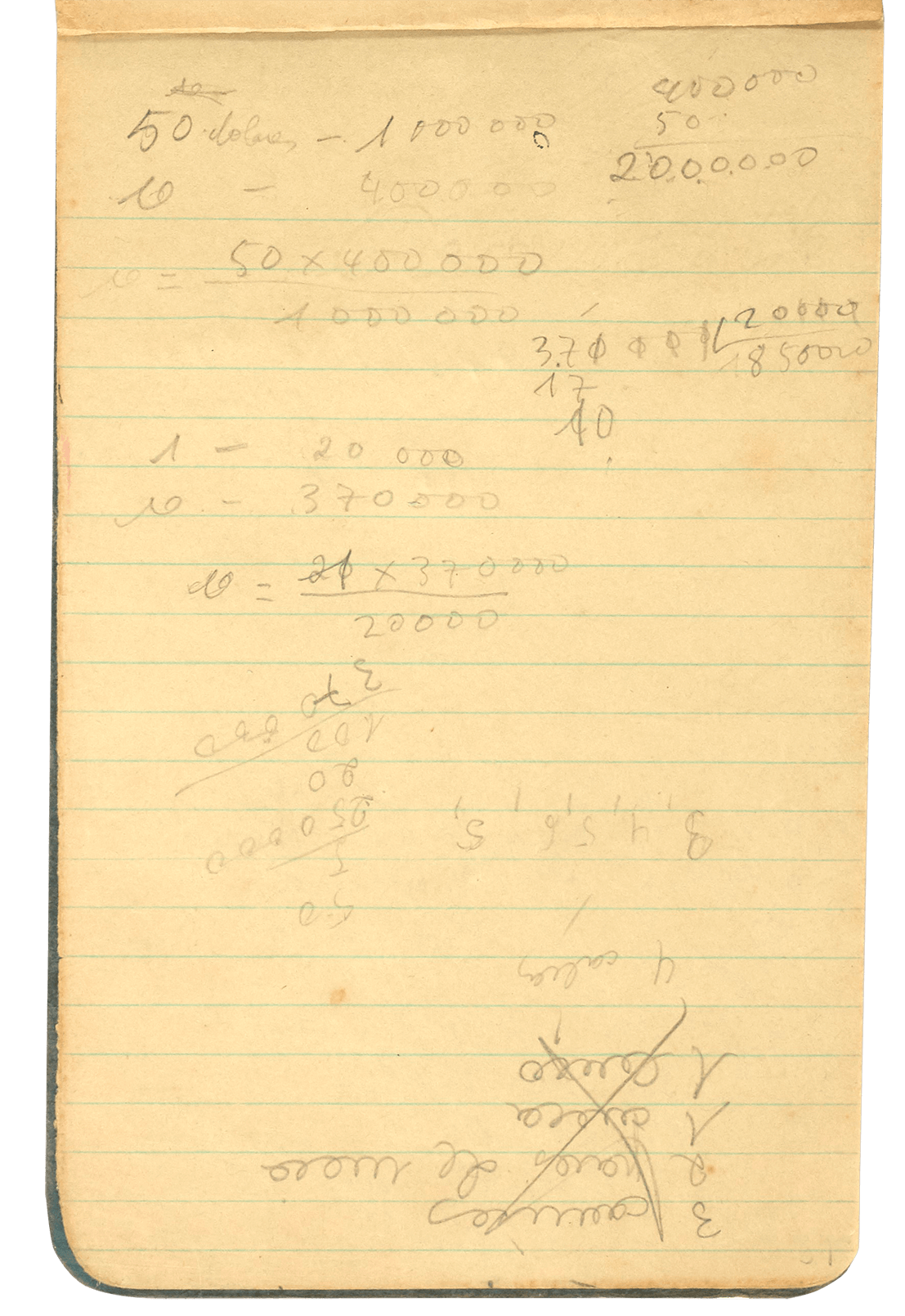
[contas]
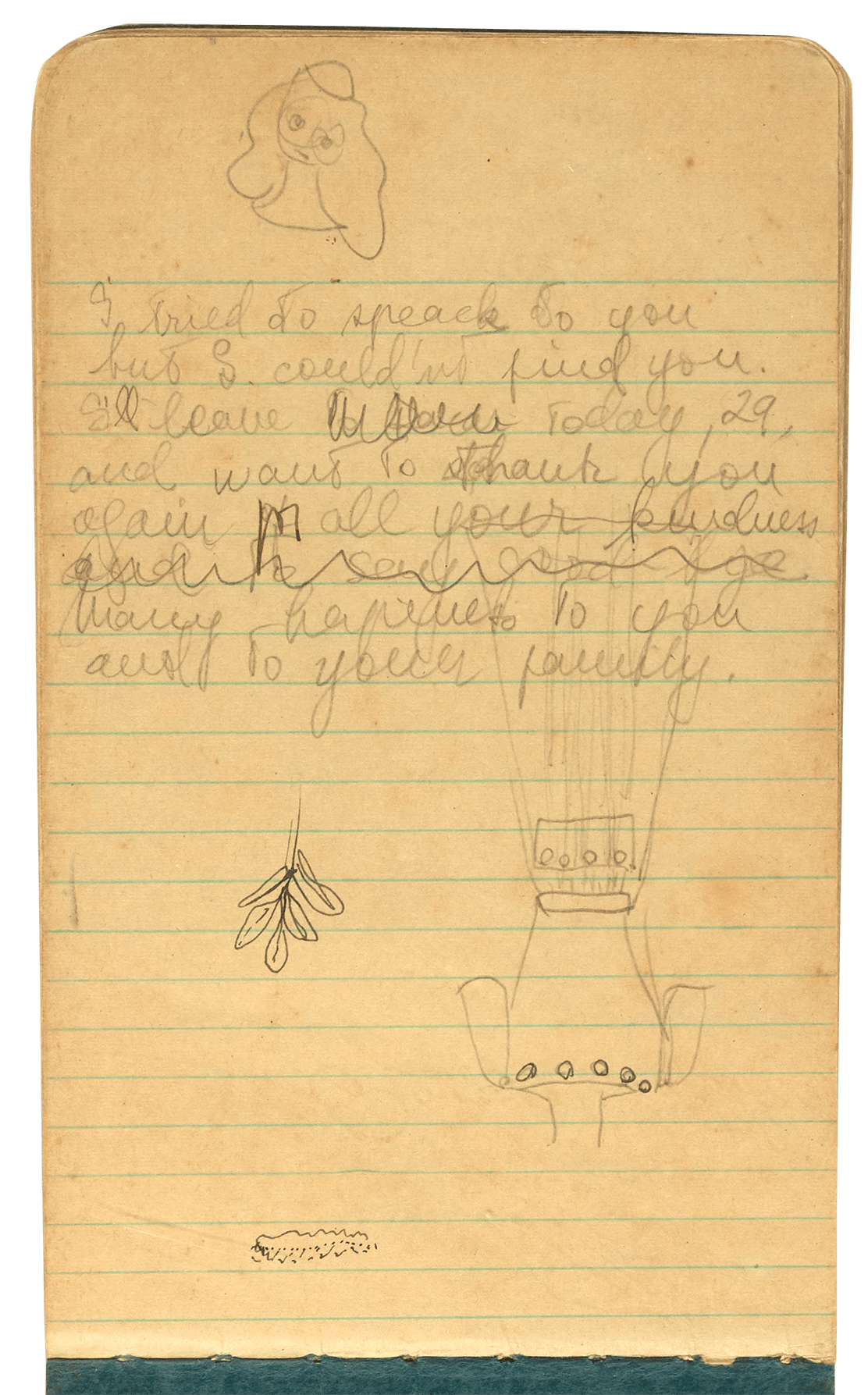
[desenhos] I tried to speak to you but I couldn’t find you. I’ll leave today, 29, and want to thank you again for all your kindness. Many happiness to you and to your family.

Clarice Lispector’s notebook – measuring exactly 17 cm x 10,5 cm and 58 pages – is made available here in full, for the enjoyment of researchers and readers of her work. The logbook, as it came to be called by the Literature team at the Moreira Salles Institute, was donated by the son and heir of the author, Paulo Gurgel Valente, in January 2012. After going through the process that is common for all documents deposited under our care, such as cleaning and cataloging, the notebook was digitized in high resolution and its content transcribed.
Throughout the reading, we will have countless moments of happiness to accompany, more than the recording of small details during the months of July and August 1944 during Clarice Lispector’s journey to Naples with stops at Fisherman’s Lake at Lisbon. One of the surprises is due to the passages, still in a rudimentary phase, from her second novel, O lustre [The Chandelier], which would be published in 1946, when the author was already in Switzerland, the country where she also wrote A cidade sitiada [The Besieged City]. We read in the notepad that working on the hitherto unnamed book was one of Clarice’s daily activities until she reached her final destination. Some characters from The Chandelier, such as Adriano and Vicente, are mentioned in the notebook – this can therefore be considered a valuable document for those dedicated to genetic literary criticism.
Another happy find in the yellowed but preserved pages is one of her notes that would echo in the short story “The Smallest Woman in the World”, included in Laços de família [Family Ties], of 1960. Clarice records on July 31, 1944 the mutual astonishment generated from the meeting between her and the “beautiful, clean” black people of some villages in Liberia, “where the missionaries did not arrive”. It goes into the description of women and men, of the looks, of a small shop, and she confides: “How I liked those black people”. The fact seems to have provided inspiration for the aforementioned story, and the annotation is an almost ready text that would unfold into two others: “Africa”, included in Fundo de Gavetae [Back of the Drawer], of 1964, and “Corças negras”, published on April 5, 1969 in Jornal do Brasil and later collected 1984 for the collection of chronicles A descoberta do mundo [published as English as Selected Crônicas].
Clarice Lispector was also in Lisbon for 12 days and recorded in this block of notes her days in the Portuguese capital, closely accompanied by the Brazilian diplomat and poet Ribeiro Couto. Motivated by the annotations in Lusitanian lands, Elvia Bezerra looked more closely at the relationship between the two in the text “Caderno de Lisboa”.
Still leafing through the pages, we recognize the authentic naturalness when we come across a note in which the urgency is revealed by the frequently illegible handwriting, numerous erasures, torn pages and lapses. To safeguard the reading from possible misunderstandings, there are words indicated in brackets, which, although somewhat legible, cannot be affirmed by us. The original punctuation was maintained, but the spelling was updated in accordance with the Portuguese Language Spelling Agreement of 1990, in force in Brazil since 2009.
We would like to express our special thanks to the Clarice Lispector researcher Nádia Batella Gotlib for the kindness of assisting in the transcription and preparation of the notes and to Paulo Gurgel Valente for choosing the Moreira Salles Institute as the guardian for this small and valuable logbook.
Elizama Almeida


The hour of the star: notes
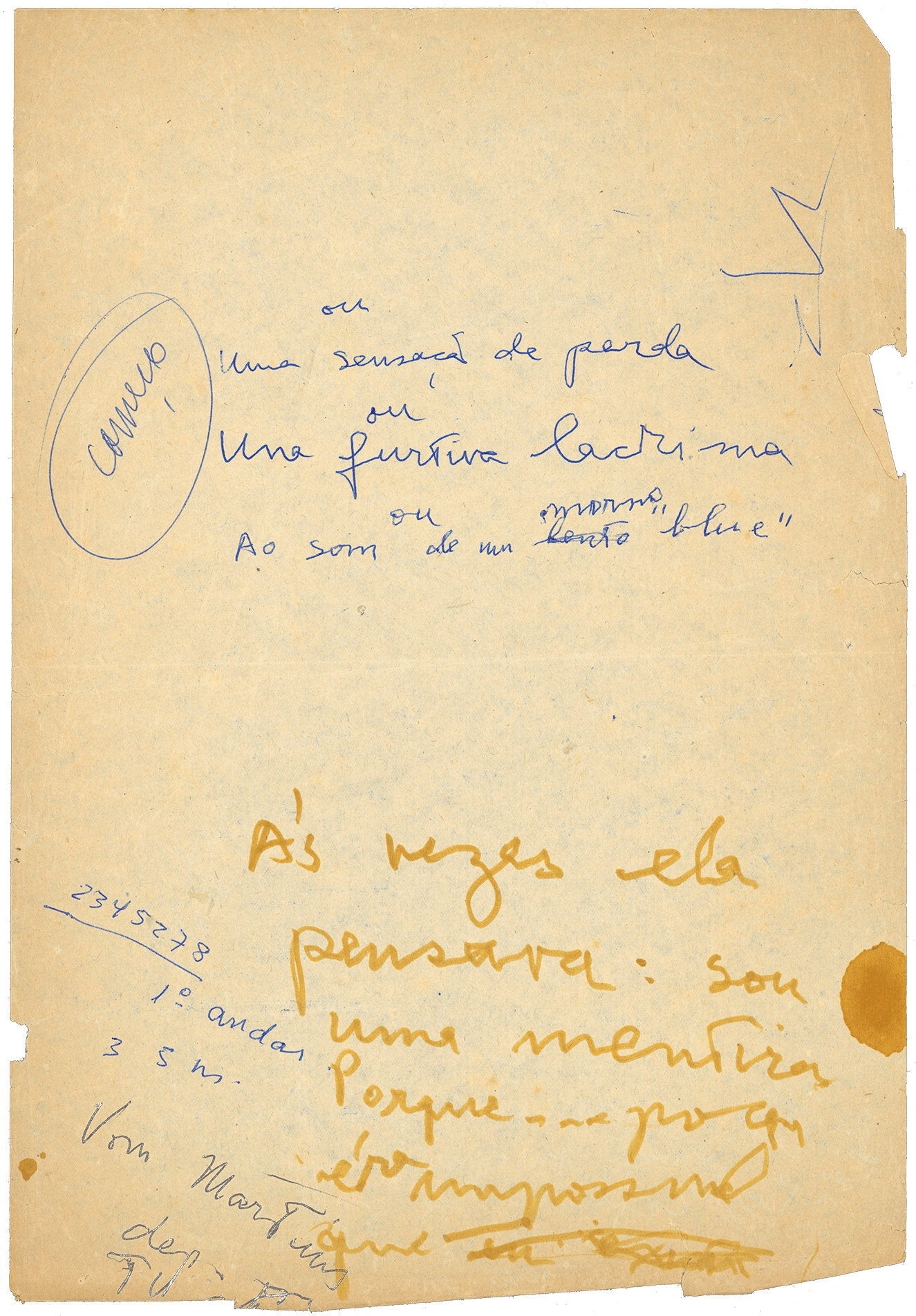
Note for the titles of The Hour of the Star*. The handwriting is by Clarice and by Olga Borelli (observation circled, on the left).
*All quotes taken from The Hour of the Star, translated by Benjamin Moser.
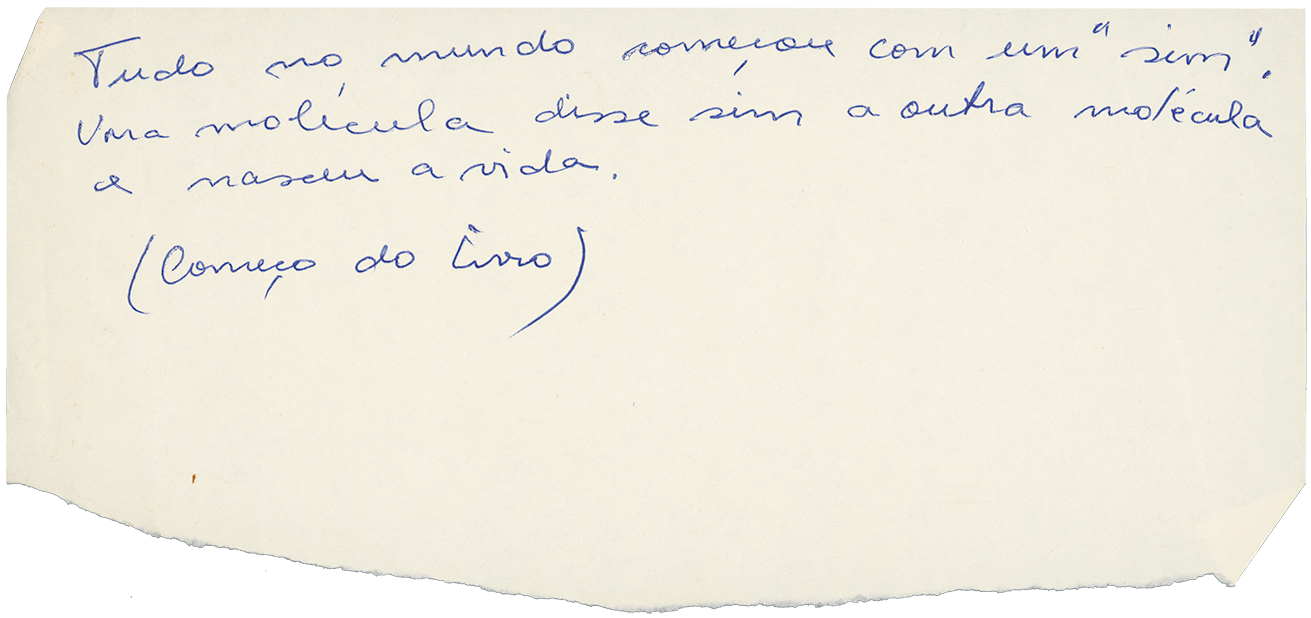
“Everything in the world began with a yes. One molecule said yes to another molecule and life was born. But before prehistory there was the prehistory of prehistory and there was the never and there was the yes. It was ever so. I do not know why, but I do know that the universe never began.”
Note used in the 1st paragraph of The Hour of the Star. The handwriting is by Olga Borelli.
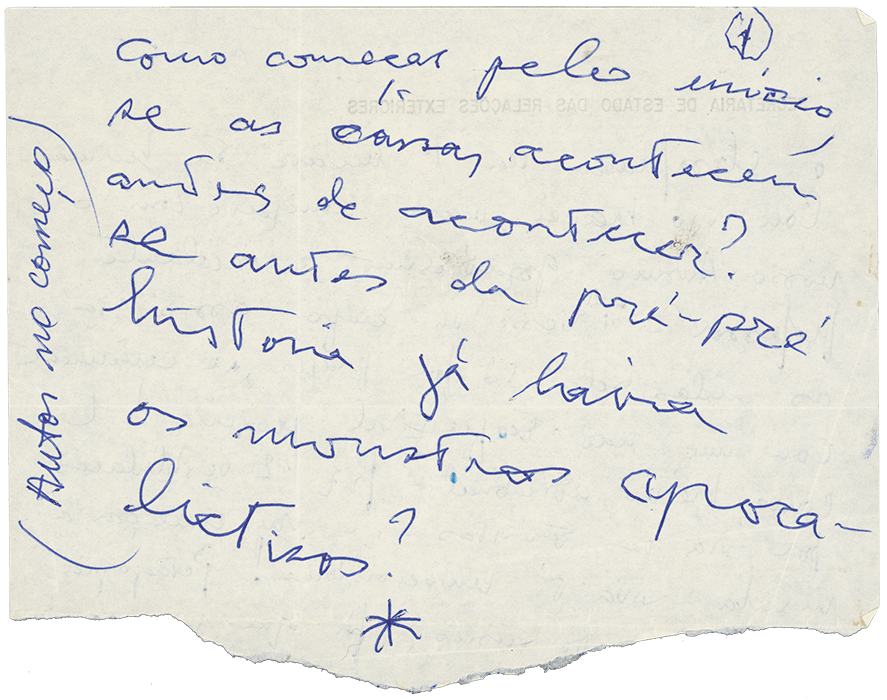
“So long as I have questions to which there are no answers, I shall go on writing. How does one start at the beginning, if things happen before they actually happen? If before the pre-prehistory there already existed apocalyptic monsters? If this history does not exist, it will come to exist. To think is an act. To feel is a fact. Put the two together—it is me who is writing what I am writing. God is the world. The truth is always some inner power without explanation. The more genuine part of my life is unrecognizable, extremely intimate and impossible to define. My heart has shed every desire and reduced itself to one final or initial beat. The toothache that passes through this narrative has given me a sharp twinge right in the mouth. I break out into a strident, high-pitched, syncopated melody. It is the sound of my own pain, of someone who carries this world where there is so little happiness. Happiness? I have never come across a more foolish word, invented by all those unfortunate girls from north-eastern Brazil.”
Note used in the 3rd paragraph of The Hour of the Star. The handwriting is by Clarice and by Olga Borelli (observation between parentheses, on the left).
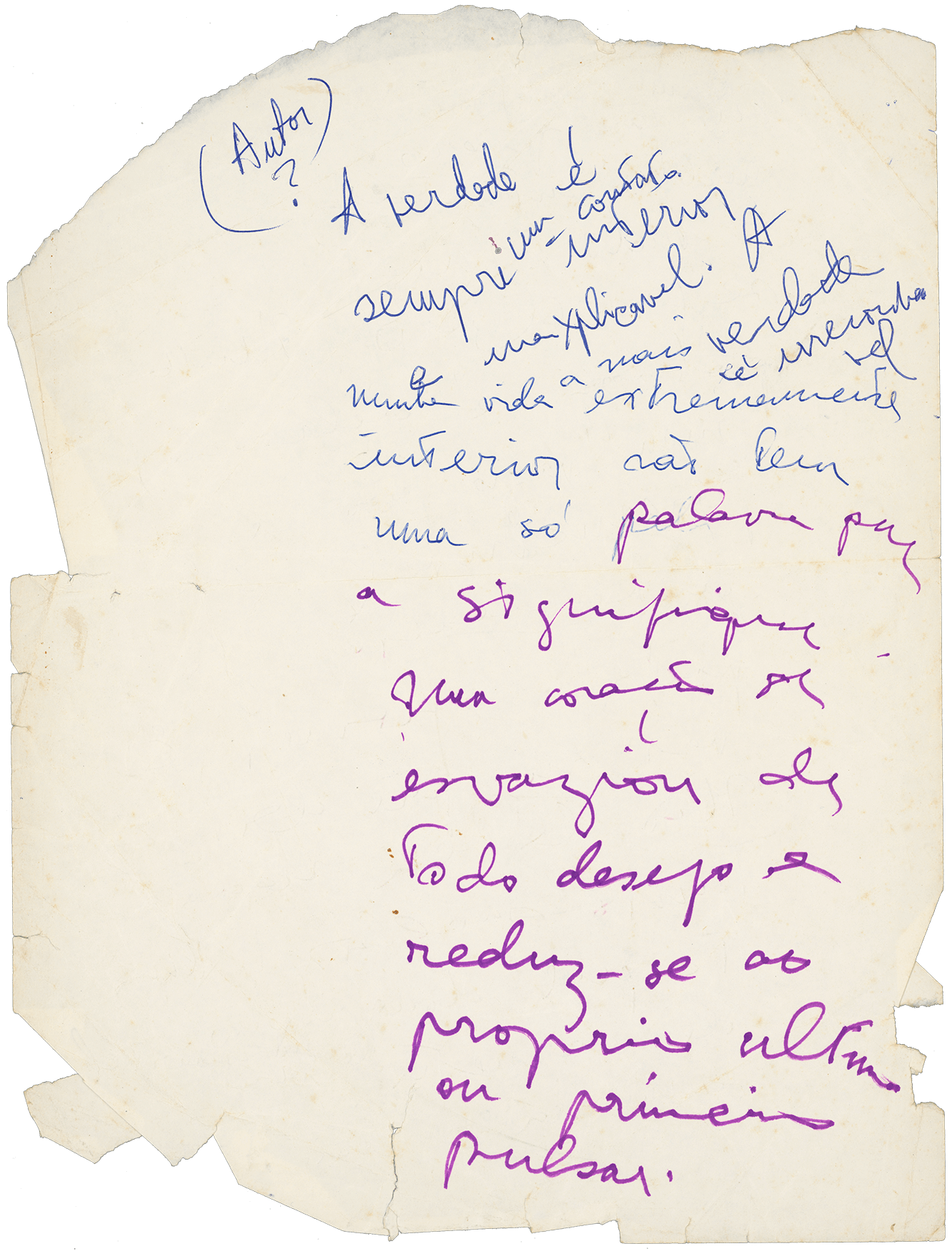
“So long as I have questions to which there are no answers, I shall go on writing. How does one start at the beginning, if things happen before they actually happen? If before the pre-prehistory there already existed apocalyptic monsters? If this history does not exist, it will come to exist. To think is an act. To feel is a fact. Put the two together—it is me who is writing what I am writing. God is the world. The truth is always some inner power without explanation. The more genuine part of my life is unrecognizable, extremely intimate and impossible to define. My heart has shed every desire and reduced itself to one final or initial beat. The toothache that passes through this narrative has given me a sharp twinge right in the mouth. I break out into a strident, high-pitched, syncopated melody. It is the sound of my own pain, of someone who carries this world where there is so little happiness. Happiness? I have never come across a more foolish word, invented by all those unfortunate girls from north-eastern Brazil.”
Note used in the 3rd paragraph of The Hour of the Star. The handwriting is by Clarice and by Olga Borelli (observation between parentheses, up high, on the left).
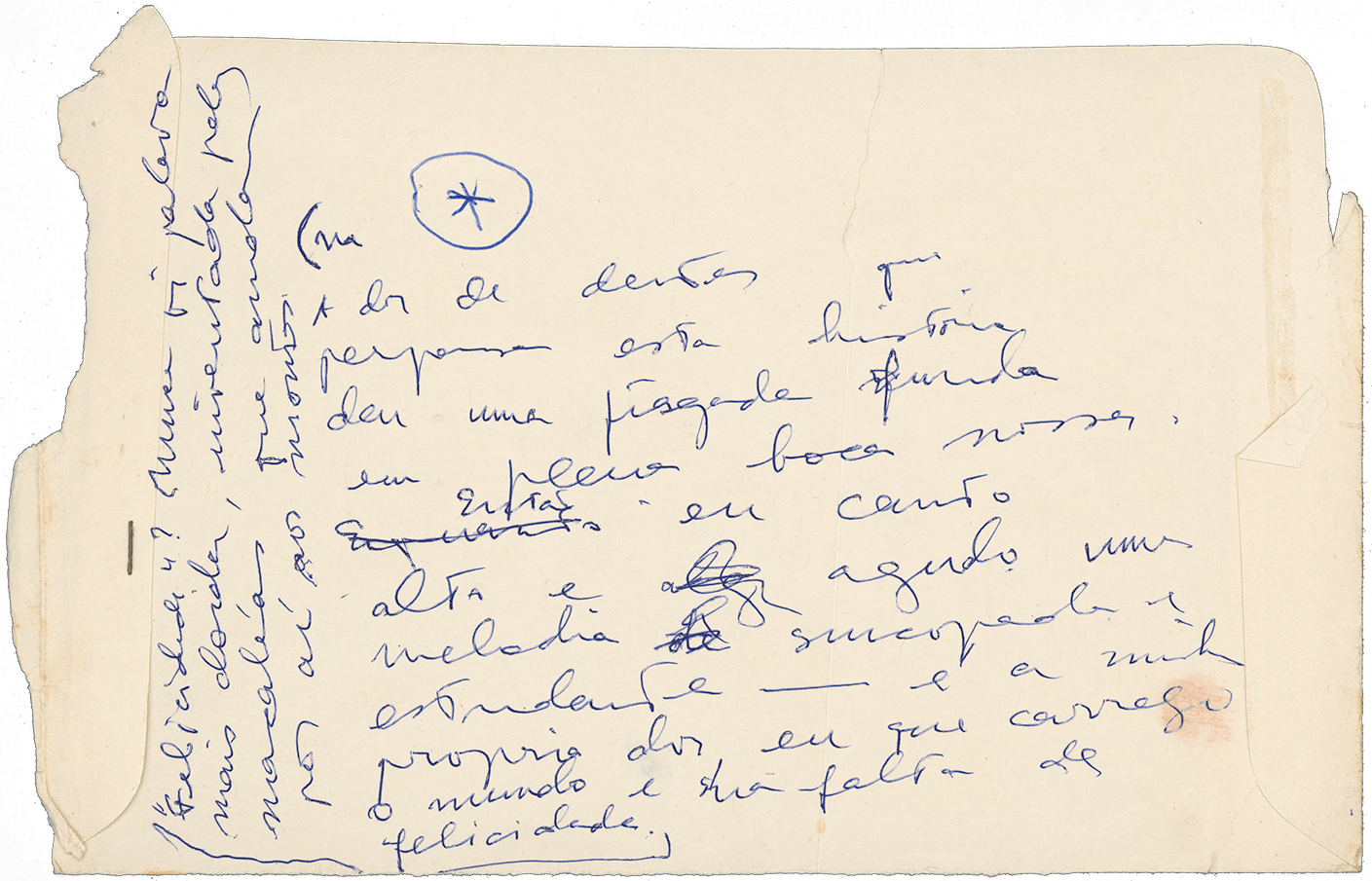
“So long as I have questions to which there are no answers, I shall go on writing. How does one start at the beginning, if things happen before they actually happen? If before the pre-prehistory there already existed apocalyptic monsters? If this history does not exist, it will come to exist. To think is an act. To feel is a fact. Put the two together—it is me who is writing what I am writing. God is the world. The truth is always some inner power without explanation. The more genuine part of my life is unrecognizable, extremely intimate and impossible to define. My heart has shed every desire and reduced itself to one final or initial beat. The toothache that passes through this narrative has given me a sharp twinge right in the mouth. I break out into a strident, high-pitched, syncopated melody. It is the sound of my own pain, of someone who carries this world where there is so little happiness. Happiness? I have never come across a more foolish word, invented by all those unfortunate girls from north-eastern Brazil.”
Note used in the 3rd paragraph of The Hour of the Star. The handwriting is by Clarice.
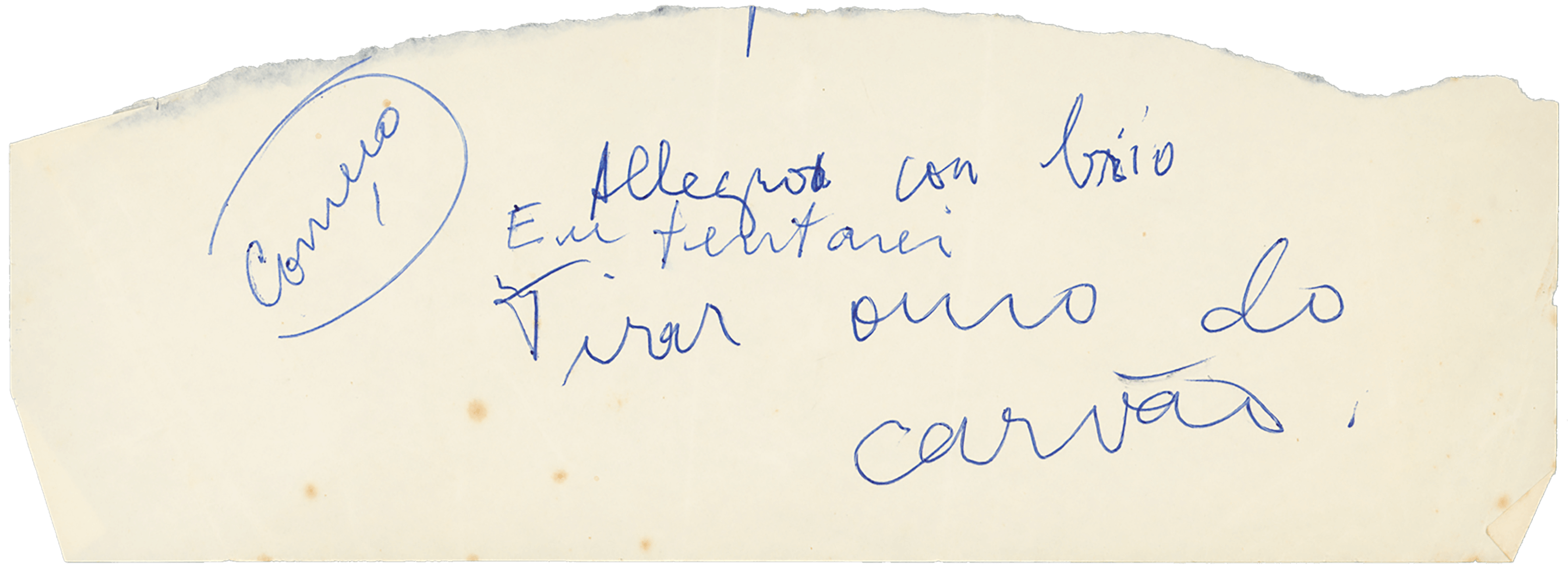
“In writing this story, I shall yield to emotion and I know perfectly well that every day is one more day stolen from death. In no sense an intellectual, I write with my body. And what I write is like a dank haze. The words are sounds transfused with shadows that intersect unevenly, stalactites, woven lace, transposed organ music. I can scarcely invoke the words to describe this pattern, vibrant and rich, morbid and obscure, its counterpoint the deep bass of sorrow. Allegro con brio. I shall attempt to extract gold from charcoal. I know that I am holding up the narrative and playing at ball without a ball. Is the fact an act? I swear that this book is composed without words: like a mute photograph. This book is a silence: an interrogation.”
Note used in the 21st paragraph of The Hour of the Star. The handwriting is by Clarice and by Olga Borelli (observation circled, on the left).
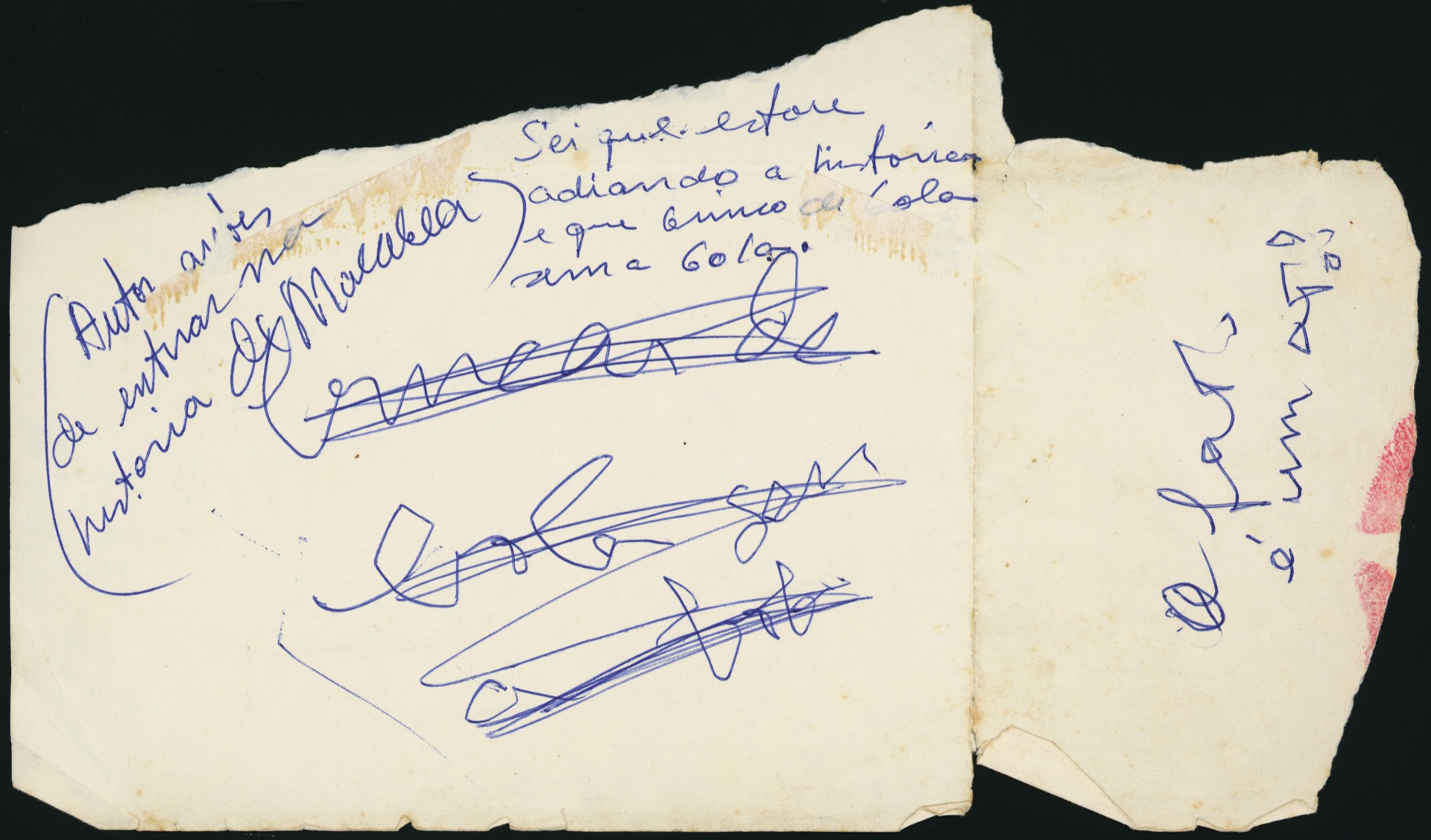
“In writing this story, I shall yield to emotion and I know perfectly well that every day is one more day stolen from death. In no sense an intellectual, I write with my body. And what I write is like a dank haze. The words are sounds transfused with shadows that intersect unevenly, stalactites, woven lace, transposed organ music. I can scarcely invoke the words to describe this pattern, vibrant and rich, morbid and obscure, its counterpoint the deep bass of sorrow. Allegro con brio. I shall attempt to extract gold from charcoal. I know that I am holding up the narrative and playing at ball without a ball. Is the fact an act? I swear that this book is composed without words: like a mute photograph. This book is a silence: an interrogation.”
Note used in the 21st paragraph of The Hour of the Star. The handwriting is by Clarice and by Olga Borelli (observation between parentheses, on the left, and note beside it).
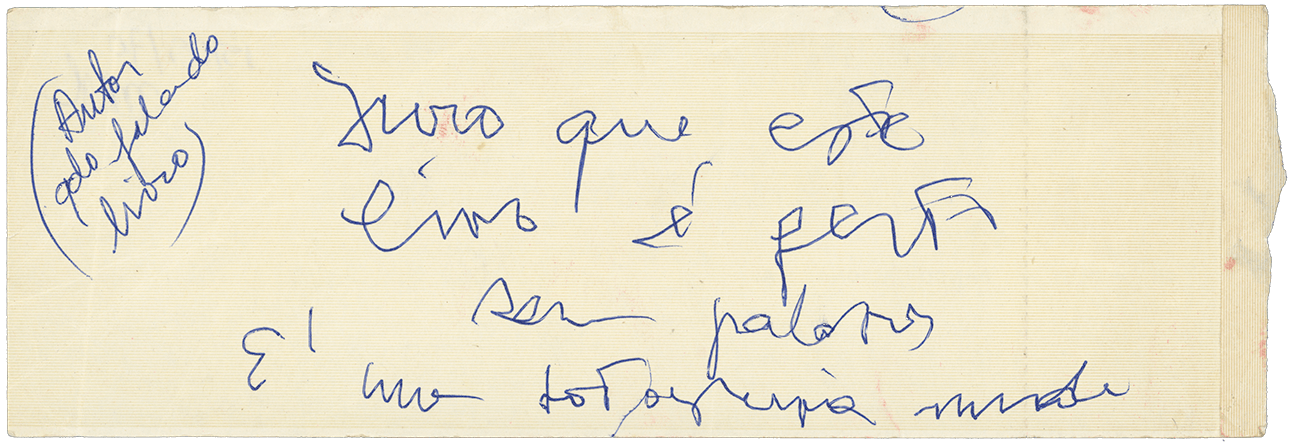
“In writing this story, I shall yield to emotion and I know perfectly well that every day is one more day stolen from death. In no sense an intellectual, I write with my body. And what I write is like a dank haze. The words are sounds transfused with shadows that intersect unevenly, stalactites, woven lace, transposed organ music. I can scarcely invoke the words to describe this pattern, vibrant and rich, morbid and obscure, its counterpoint the deep bass of sorrow. Allegro con brio. I shall attempt to extract gold from charcoal. I know that I am holding up the narrative and playing at ball without a ball. Is the fact an act? I swear that this book is composed without words: like a mute photograph. This book is a silence: an interrogation.”
Note used in the 21st paragraph of The Hour of the Star. The handwriting is by Clarice and by Olga Borelli (observation between parentheses, on the left).
“I write because I have nothing better to do in this world: I am superfluous and last in the world of men. I write because I am desperate and weary. I can no longer bear the routine of my existence and, were it not for the constant novelty of writing, I should die symbolically each day. Yet I am prepared to leave quietly by the back door. I have experienced almost everything, even passion and despair. Now I only wish to possess what might have been but never was.”
Note used in the 40th paragraph of The Hour of the Star. The handwriting is by Clarice.
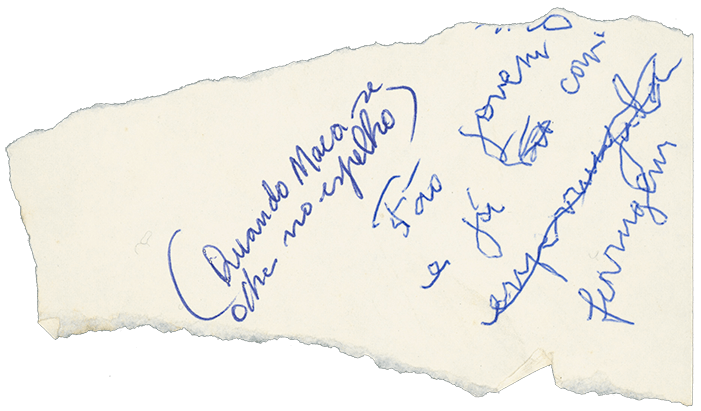
“After receiving this warning she went to the bathroom to be alone because she was all shaken. She mechanically looked at herself in the mirror atop the filthy and cracked sink, full of hairs, which matched her own life so well. It seemed to her that the dark and tarnished mirror didn’t reflect any image. Could her physical existence have vanished? This illusion immediately passed and she made out her face entirely distorted by cheap little mirror, her nose as huge as a clown’s papier-mâché nose. She looked at herself and lightly thought: so young and already so rusted.”
Note used in the 58th paragraph of The Hour of the Star. The handwriting is by Clarice and by Olga Borelli (observation between parentheses).
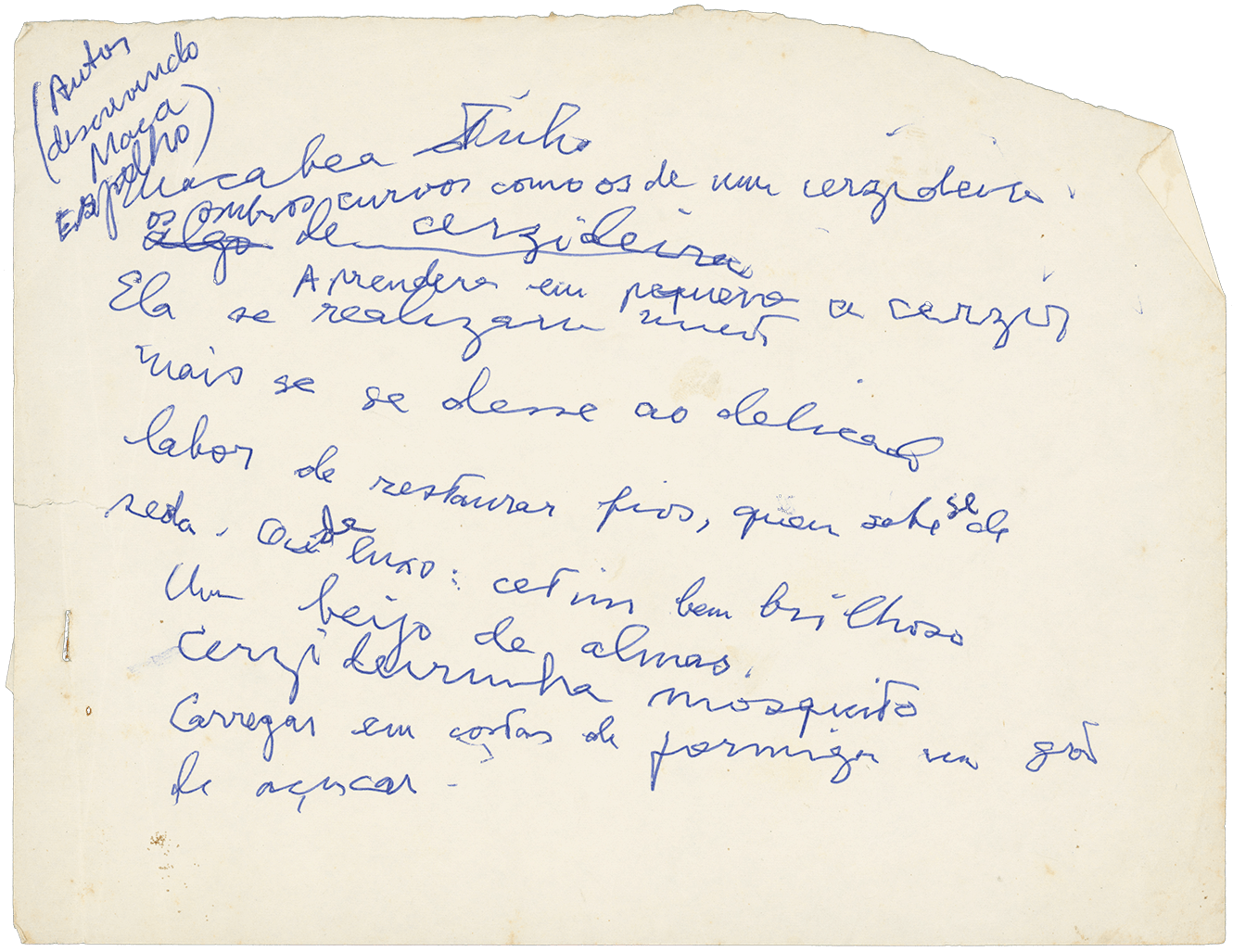
“The girl had slumped shoulders like those of a darning-woman. She’d learned to darn as a child. She might have come farther in life if she had devoted herself to the delicate task of mending, maybe even mending silk. Or luxurious fabrics: nice shiny satin, a kiss of souls. Little darning mosquito. A grain of sugar carried on an ant’s back. There was something slightly idiotic about her, but she wasn’t an idiot. She didn’t know she was unhappy. That’s because she believed. In what? In you, but you don’t have to believe in anyone or anything — you just have to believe. That sometimes gave her the state of grace. She’d never lost faith.”
Note used in the 61st paragraph of The Hour of the Star. The handwriting is by Clarice and by Olga Borelli (observation between parentheses, up high, on the left).
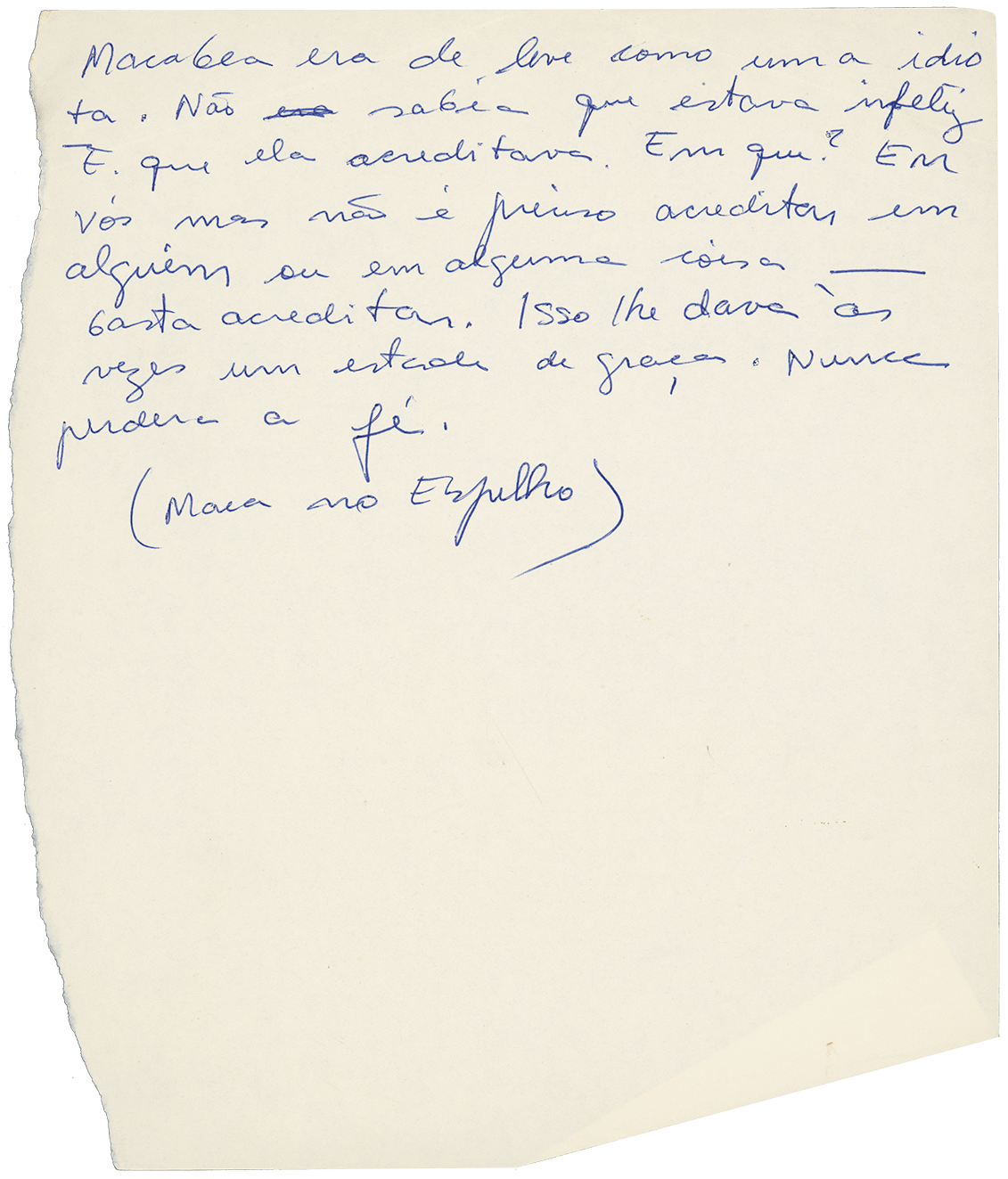
“The girl had slumped shoulders like those of a darning-woman. She’d learned to darn as a child. She might have come farther in life if she had devoted herself to the delicate task of mending, maybe even mending silk. Or luxurious fabrics: nice shiny satin, a kiss of souls. Little darning mosquito. A grain of sugar carried on an ant’s back. There was something slightly idiotic about her, but she wasn’t an idiot. She didn’t know she was unhappy. That’s because she believed. In what? In you, but you don’t have to believe in anyone or anything — you just have to believe. That sometimes gave her the state of grace. She’d never lost faith.”
Note used in the 61st paragraph of The Hour of the Star. The handwriting is by Olga Borelli.
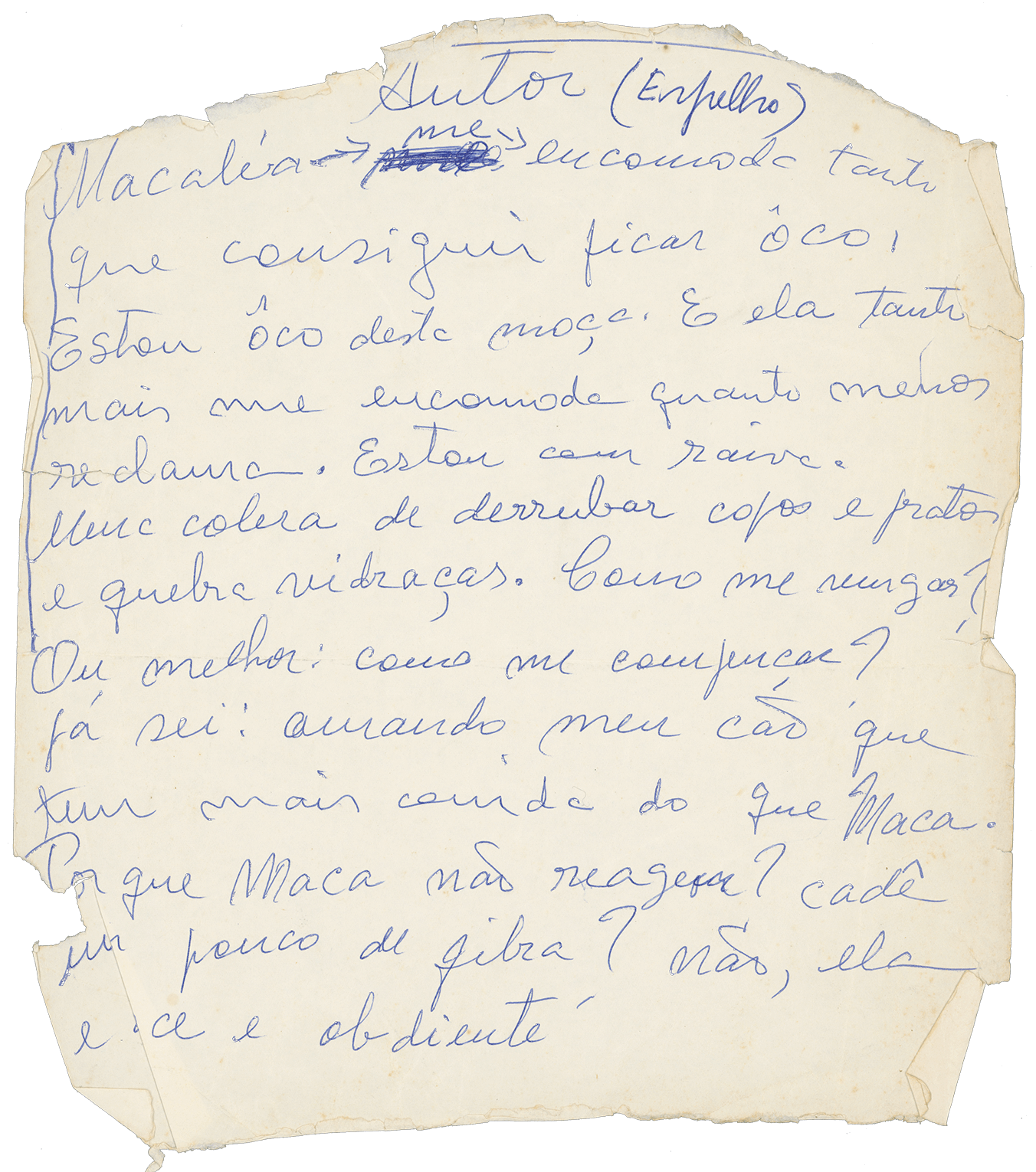
“(She makes me so uncomfortable that I feel hollow. I’m hollow of that girl. And the more uncomfortable she makes me the less she demands. I’m angry. So enraged I could smash cups and dishes and break windows. How can I avenge myself? Or rather, how can I make up for it? I’ve got it: by loving my dog who has more food than that girl. Why doesn’t she react? Can’t she grow a backbone? No, she is sweet and obedient.)”
Note used in the 62nd paragraph of The Hour of the Star. The handwriting is by Olga Borelli.
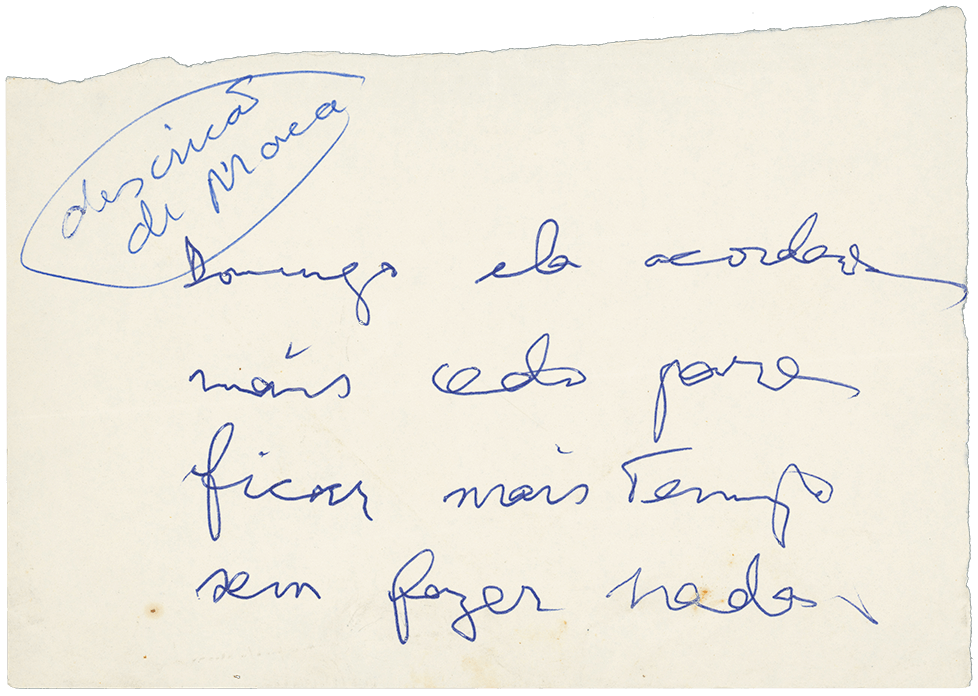
“On Sundays she got up early in order to have more time to do nothing.”
Note used in the 91st paragraph of The Hour of the Star. The handwriting is by Clarice and by Olga Borelli (observation circled, up high, on the left).
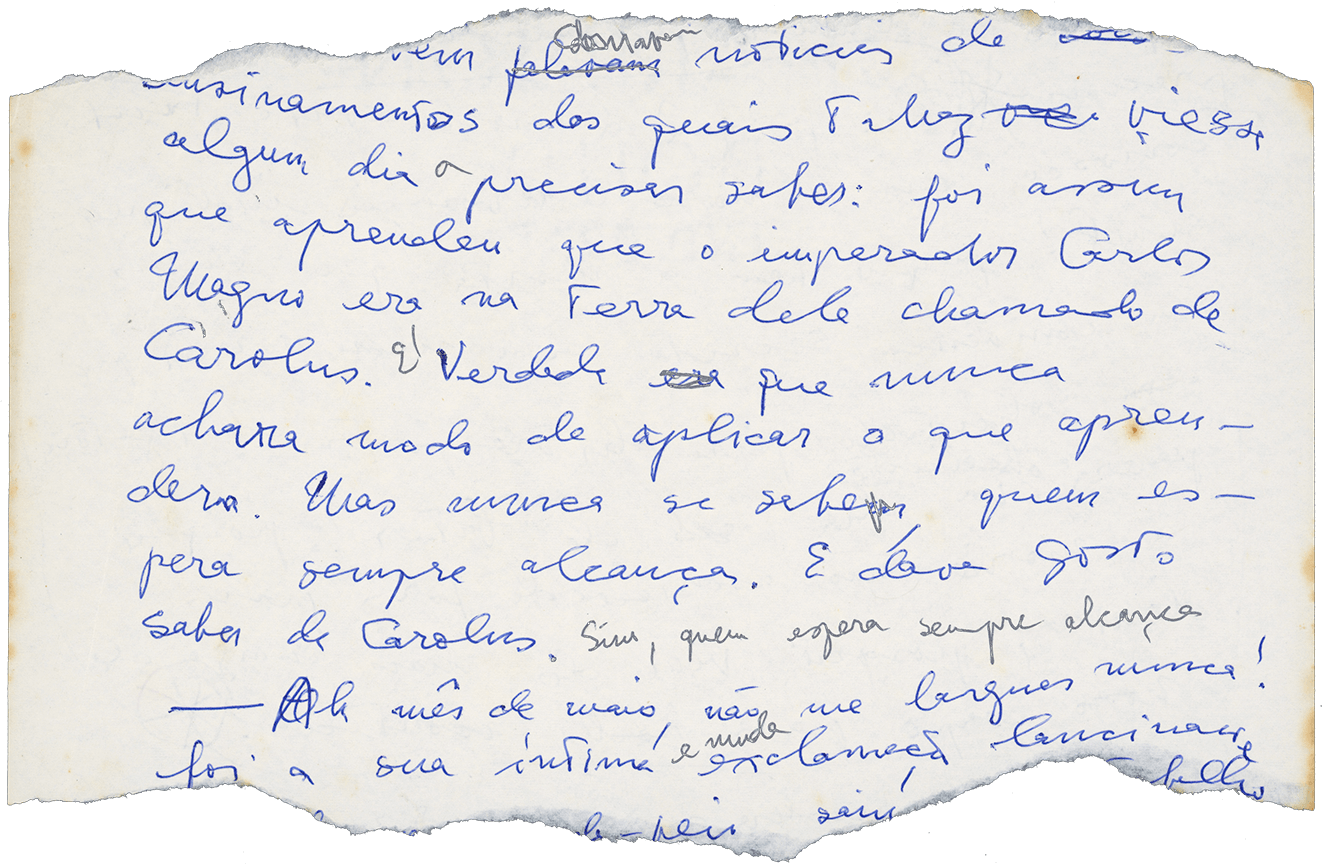
“Every morning she turned on the radio lent by one of her roommates, Maria da Penha, turning it on as low as possible so as to not disturb the others, turning it on to Clock Radio, which broadcast ‘the right time and culture,’ and no music, just dripping in sound of falling drops — each drop a minute that passed. And especially this station used those drops of minutes to run ads — she loved ads. It was the perfect station because also amongst the drops of time it gave short teachings about things she might one day need to know. That’s how she learned that the Emperor Charlemagne was called Carolus in his own land. Admittedly she never found any use for this information. But you never know, patience always patience always pays off in the end. She’d also heard that the only animal that doesn’t mate with its own offspring is the horse.”
Note used in the 102nd paragraph of The Hour of the Star. The handwriting is by Clarice.

“Since she didn’t want to rest her back for a day? She knew that if she said this to her boss he wouldn’t believe her ribs hurt. So she used a lie that was more convincing than truth: she said to her boss that she couldn’t work the next day because having a tooth pulled was very dangerous. And the lie worked. Sometimes only a lie can save you. So, the next day, when the four tired Marias went to work, she had for the first time in her life the most precious thing of all: solitude. She had a room all to herself. She could hardly believe that all this space was hers. And not a word was heard. So she danced in an act of absolute courage, since her aunt couldn’t hear her. She danced and twirled because being alone made her: f-r-e-e! She enjoyed everything, of this arduously obtained solitude, the radio as loud as it would go, the vastness of the room without the Marias. She got, as a favor, a little instant coffee from the landlady, and, as another favor, she asked her for some boiling water, drank it all licking herself and in front of the mirror so as not to miss any of herself. The encounter with herself was a good she had not yet known. I don’t think I’ve ever been so happy in my entire life, she thought. She owed nothing to anyone and no one owed her a thing. She even allowed herself the luxury of boredom — a quite unusual boredom.”
Note used in the 117th paragraph of The Hour of the Star. The handwriting is by Clarice.
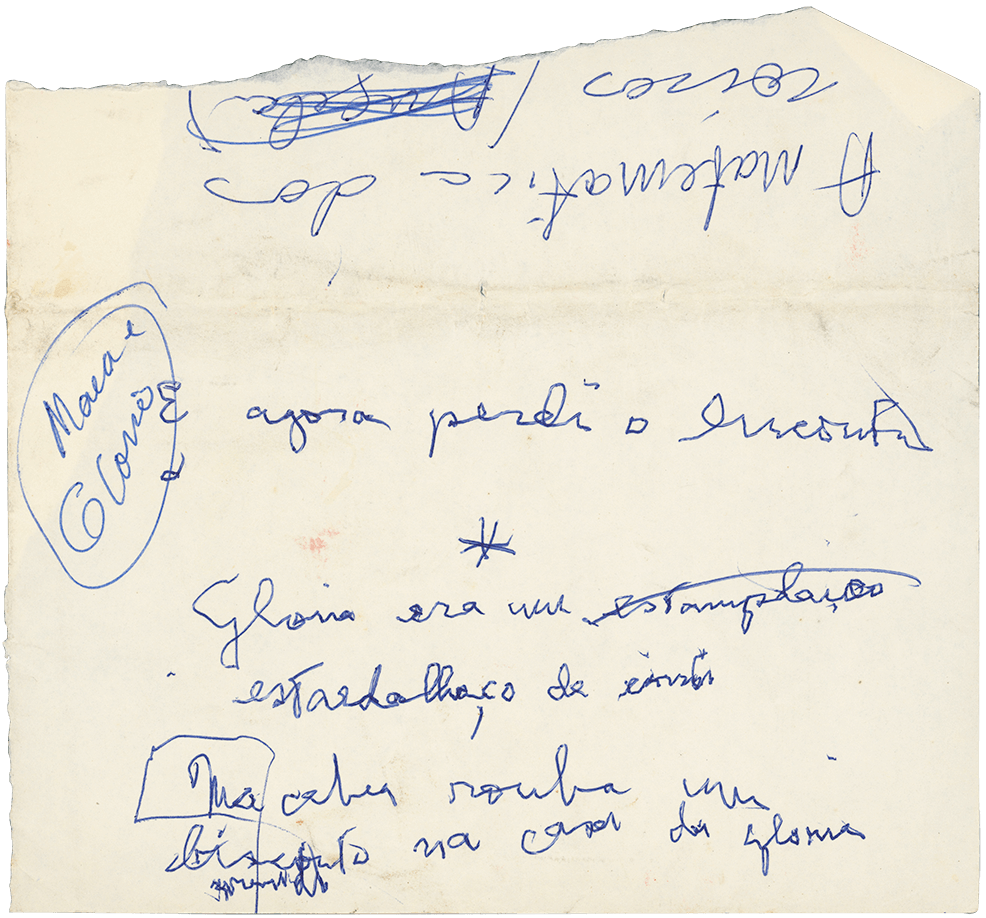
“Macabéa understood one thing: Glória was a fanfare of existence. And it must have been all because Glória was fat. Fat had always been Macabea’s secret ideal, since in Maceio she’d heard a guy say to a fat girl walking down the street: ‘your flesh is fresh!” From then on she’d aspired to fleshiness and that was when she made the only request of her life. She asked her aunt to buy her cod liver oil. (Even then she had a thing for ads.) Her aunt asked her: you think you’re some rich man’s daughter wanting luxuries?”
Note used in the 315th paragraph of The Hour of the Star. The handwriting is by Clarice and by Olga Borelli (observation circled, on the left).
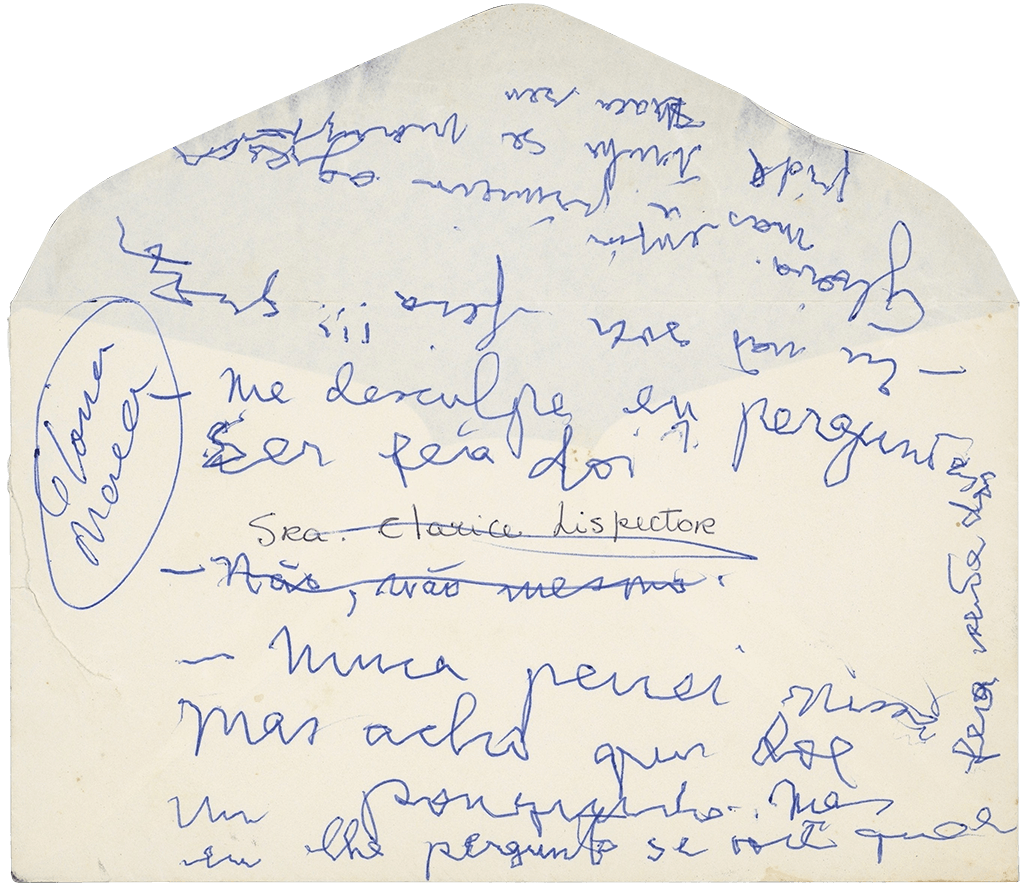
“— Sorry for asking: does being ugly hurt?
— I never thought about it, I think it hurts a little. But I should ask you if you hurt because you’re ugly.
— I’m not ugly!!! — Glória howled.”
Note used in the 320th, 321st, and 322nd paragraphs of The Hour of the Star. The handwriting is by Clarice and by Olga Borelli (observation circled, on the left).
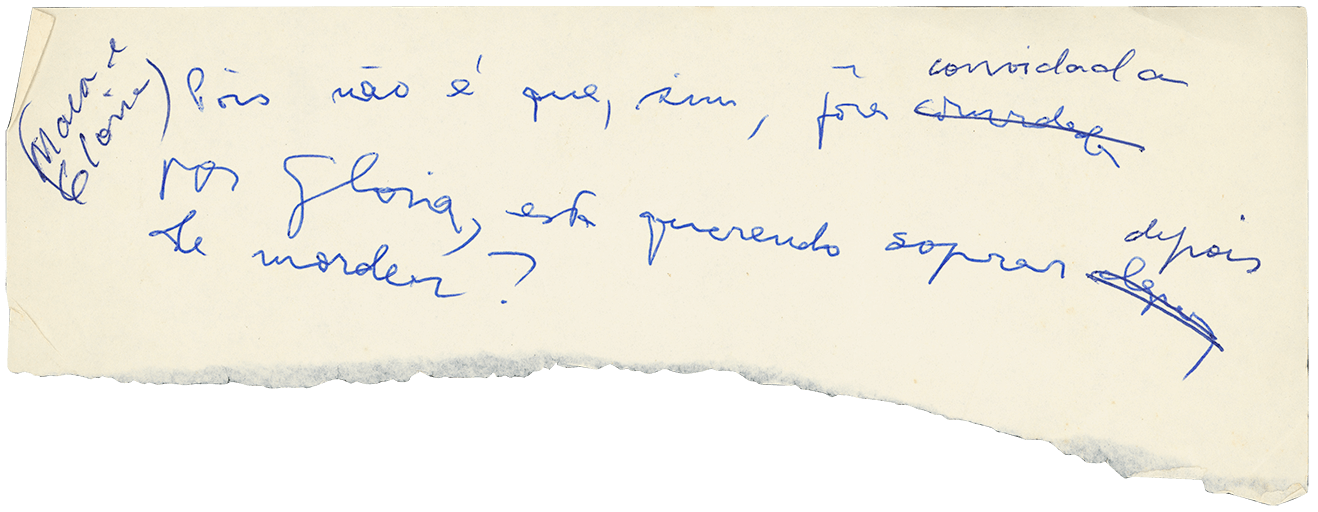
“Glória, wanting to make up for stealing the other girl’s boyfriend, invited her for a snack one afternoon, Sunday, at her house. To treat the wound she herself had inflicted? (Ah what a boring story, I can hardly stand writing it.)”
Note used in the 348th paragraph of The Hour of the Star. The handwriting is by Clarice and by Olga Borelli (observation between parentheses, on the left).
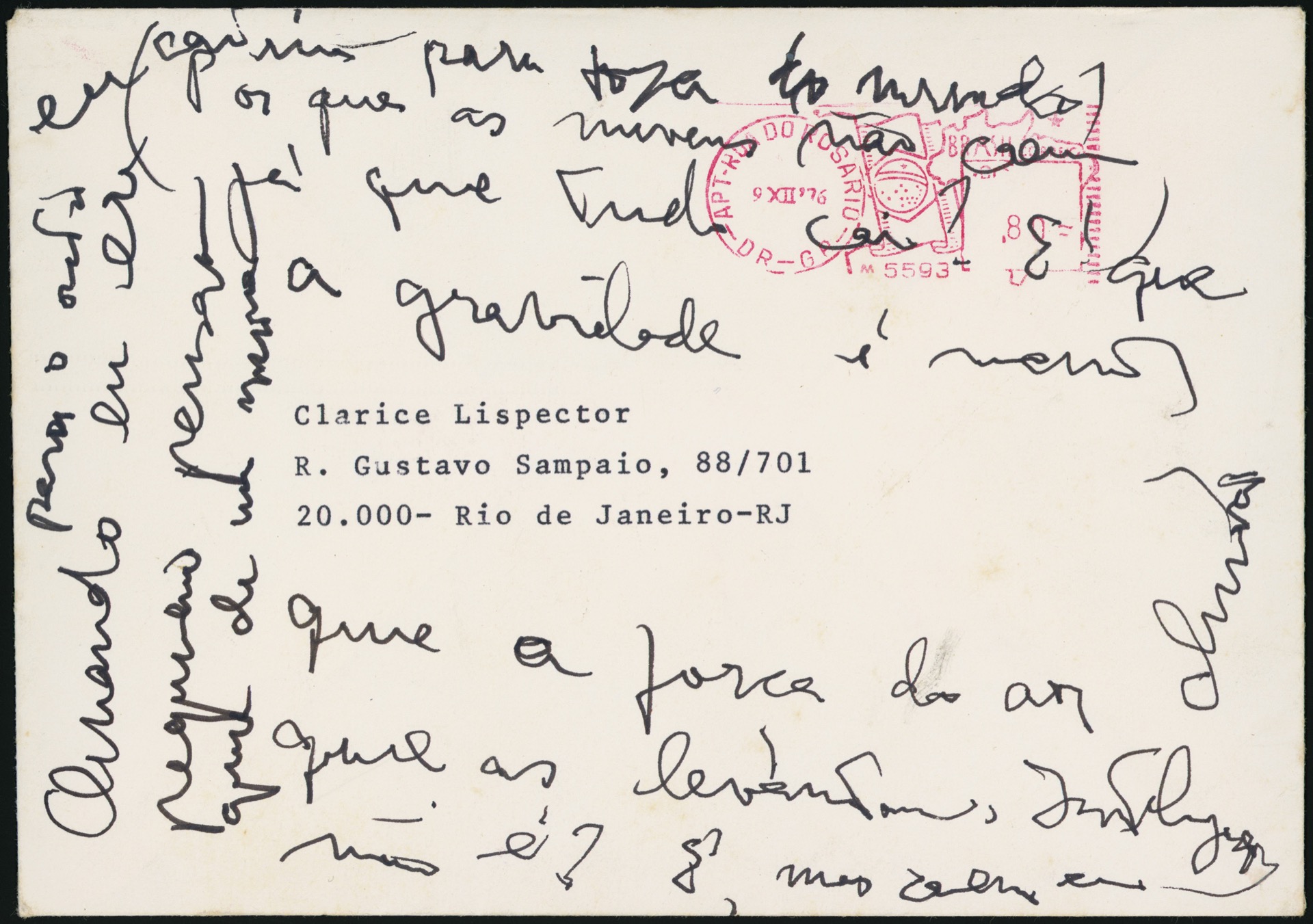
“As for me, I’m only truthful when I’m alone. When I was a little boy I thought that from one minute to the next I could fall off the face of the earth. Why don’t clouds Why don’t clouds fall, since everything else does? Because gravity is less than the strength of the air that keeps them up there. Clever, right? Yes, but one day they fall as rain. That is my revenge.”
Note used in the 382nd paragraph of The Hour of the Star. The handwriting is by Clarice.

“In the sudden gush (explosion) of a vivid impulse Macabéa, half ferocious, half clumsy, planted a cracking kiss on Madame Carlota’s cheek. And she felt again that her life was already getting better, right then and there: because it was good to kiss. When she was little, since she didn’t have anyone to kiss, she’d kissed the wall. When she caressed someone else she was caressing herself.”
Note used in the 447th paragraph of The Hour of the Star. The handwriting is by Olga Borelli.

“You could tell perfectly that she was alive from the constant blinking of her big eyes, from the thin chest that was rising and falling in perhaps difficult breathing. But who can tell if she wasn’t needing to die? Because there are times when a person needs a little bitty death and doesn’t even know it. As for me, I substitute the act of death for a symbol of it. A symbol that can be summed up in a deep kiss but not on a rough wall but mouth-to-mouth in the agony of pleasure that is death. I, who symbolically die several times just to experience the resurrection.”
Note used in the 470th paragraph of The Hour of the Star. The handwriting is by Clarice.
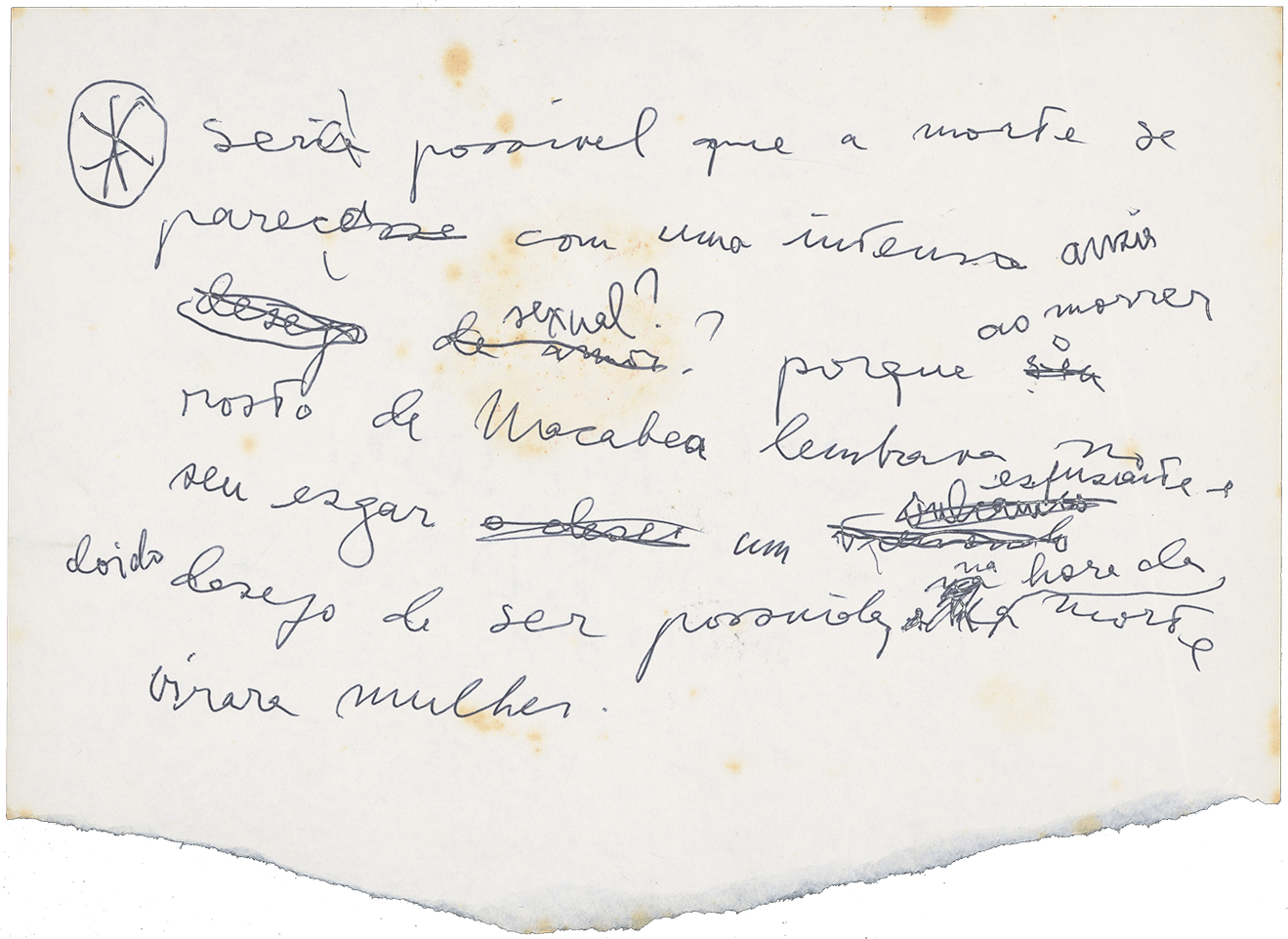
“Then — lying there — she had a moist and supreme happiness, since she had been born for the embrace of death. Death which is my favorite character in this story. Was she going to say farewell to herself? I don’t think she is going to die because she wants to live so much. And there was a certain sensuality in the way she’d huddled up. Or is it because pre-death resembles intense sensual throes? Because her face looked like a grimace of desire. Things are always days before and if she doesn’t die she is like us on the day before her death, forgive me for reminding you because as for me I can’t forgive my clairvoyance.”
Note used in the 474th paragraph of The Hour of the Star. The handwriting is by Clarice.
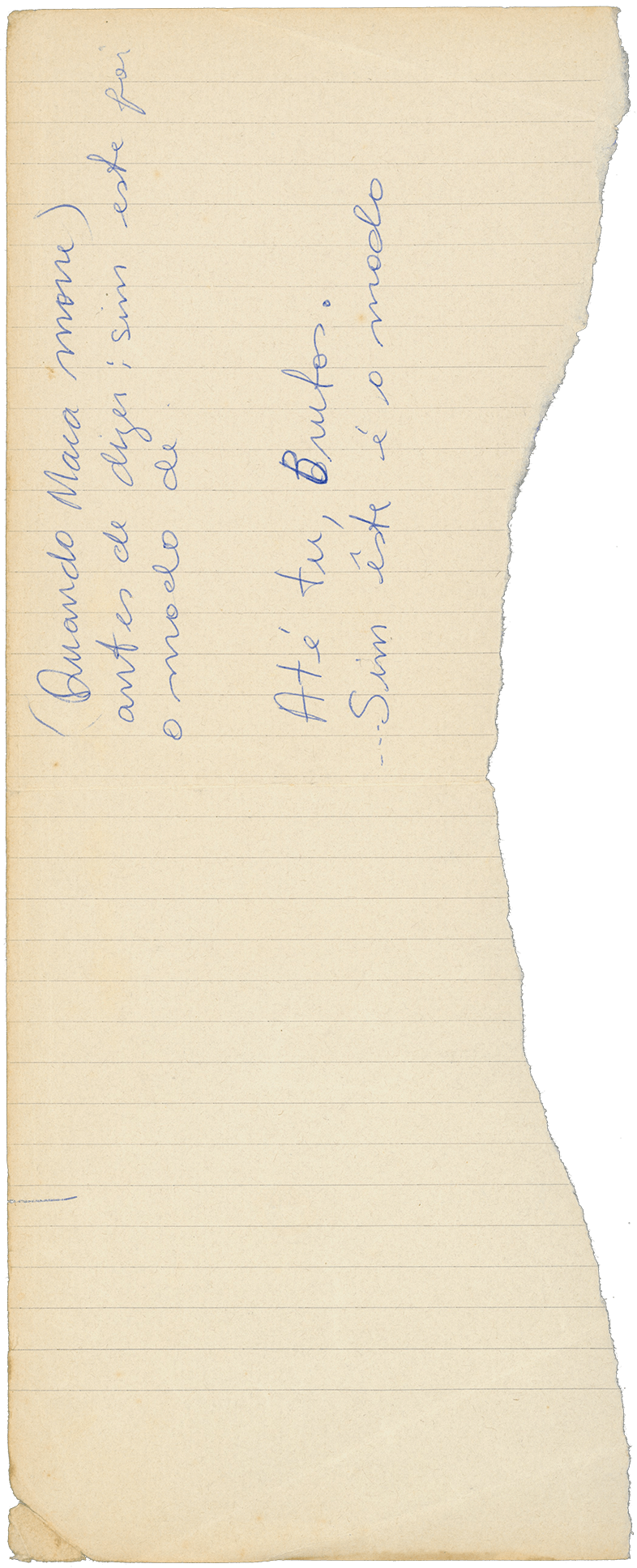
“Et tu, Brute?! Yes, that’s how I wanted to announce that — that Macabéa died. The Prince of Darkness won. Finally the coronation.”
Note used in the 481st and 482nd paragraphs of The Hour of the Star. The handwriting is by Olga Borelli.
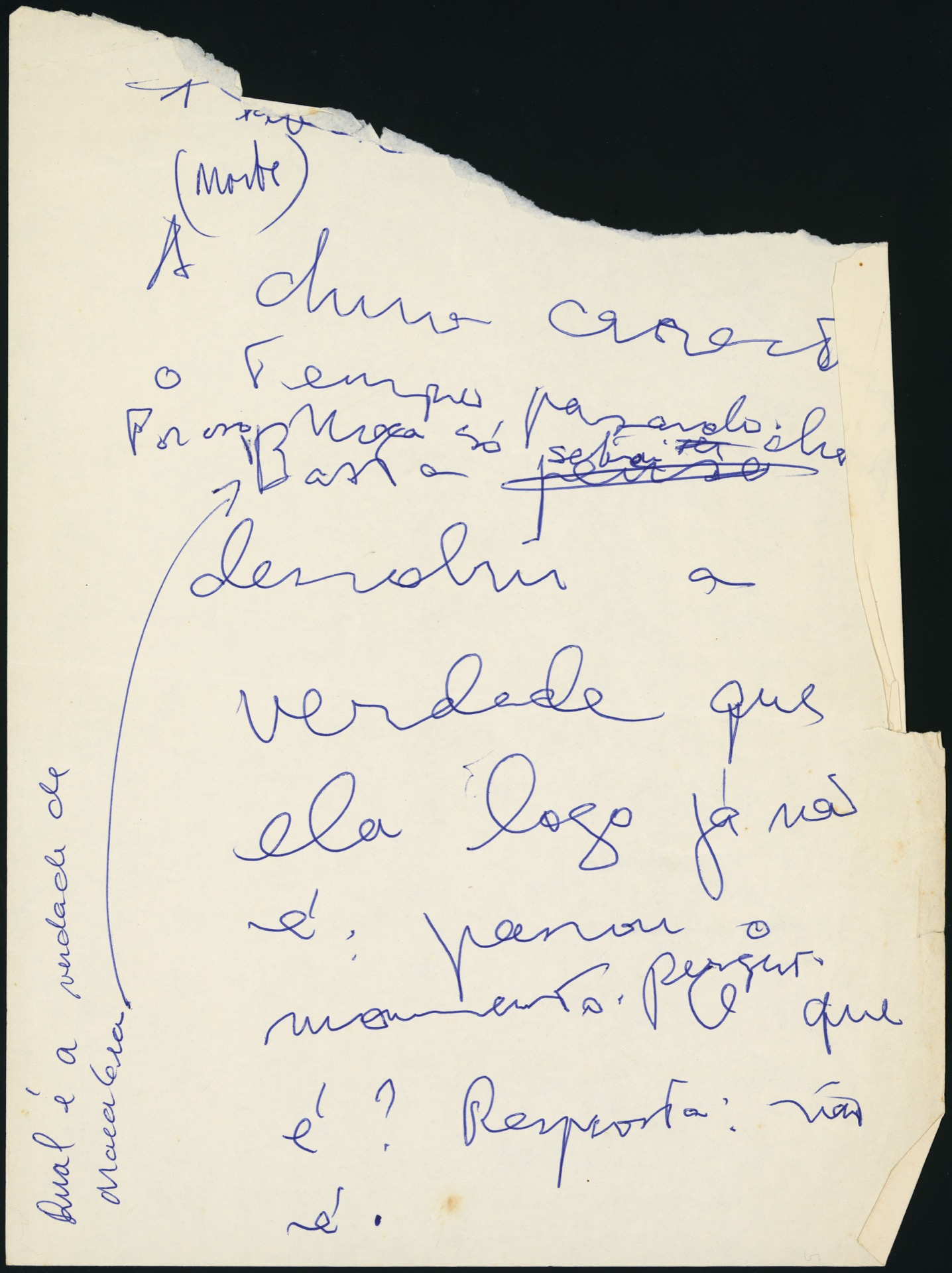
“What was the truth of my Maca? As soon as you discover the truth it’s already gone: the moment passed. I ask: what is? Reply: it’s not.”
Note used in the 483rd paragraph of The Hour of the Star. The handwriting is by Clarice and by Olga Borelli (observation between parentheses, up high, and note below, on the left).

“But do not mourn the dead: they know what they are doing. I was in the land of the dead and after such black terror I resurged in pardon. I’m innocent! Don’t consume me! I am not saleable! Woe to me, all is lost and it’s as if the great guilt was mine. May they wash my hands and feet and then — then may they daub them with oils sacred from so much perfume. Ah such will for happiness. I’m now forcing myself to laugh in a great burst. But I don’t know why I’m not laughing. Death is an encounter with oneself. Lying there, she was a big as a dead horse. The best thing is still this: not to die, because dying is insufficient, it doesn’t complete me, I who need so much.”
Note used in the 484th paragraph of The Hour of the Star. The handwriting is by Olga Borelli.
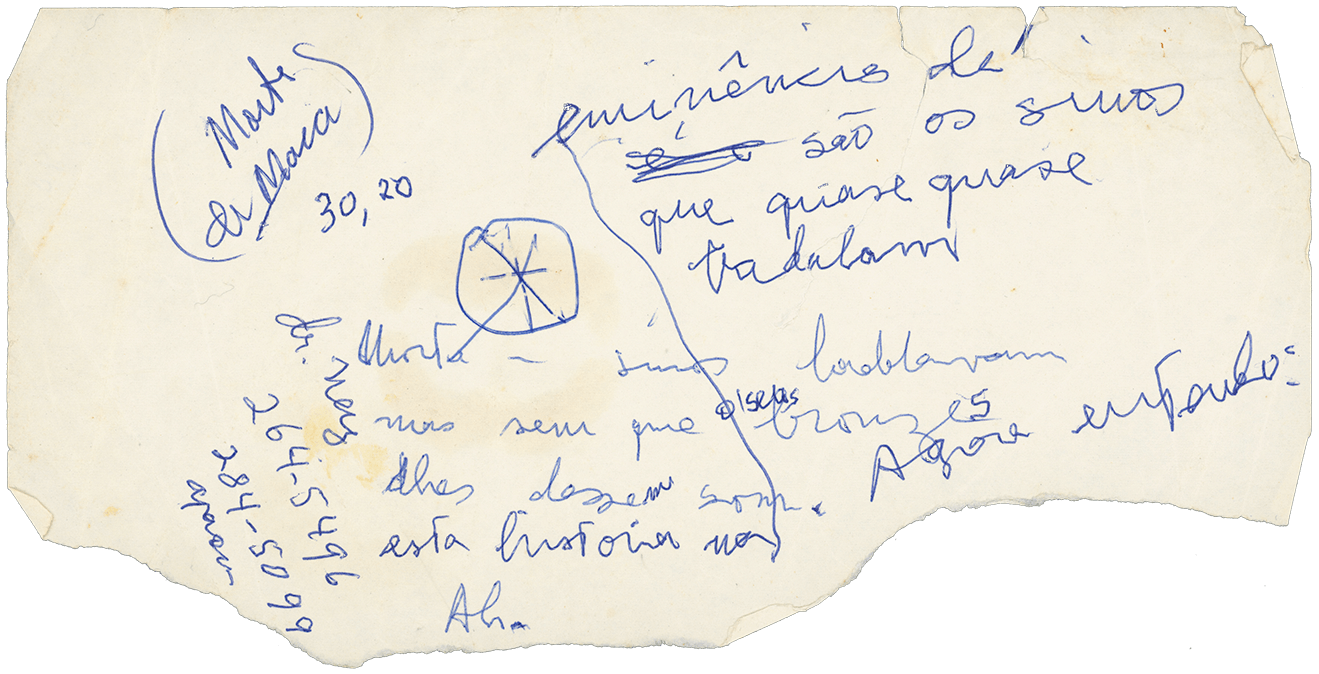
“With her dead, the bells were ringing but without their bronzes giving them sound. Now I understand this story. It is the imminence in those bells that almost-almost ring.”
Note used in the 488th paragraph of The Hour of the Star. The handwriting is by Clarice and by Olga Borelli (observation between parentheses, up high, on the left).
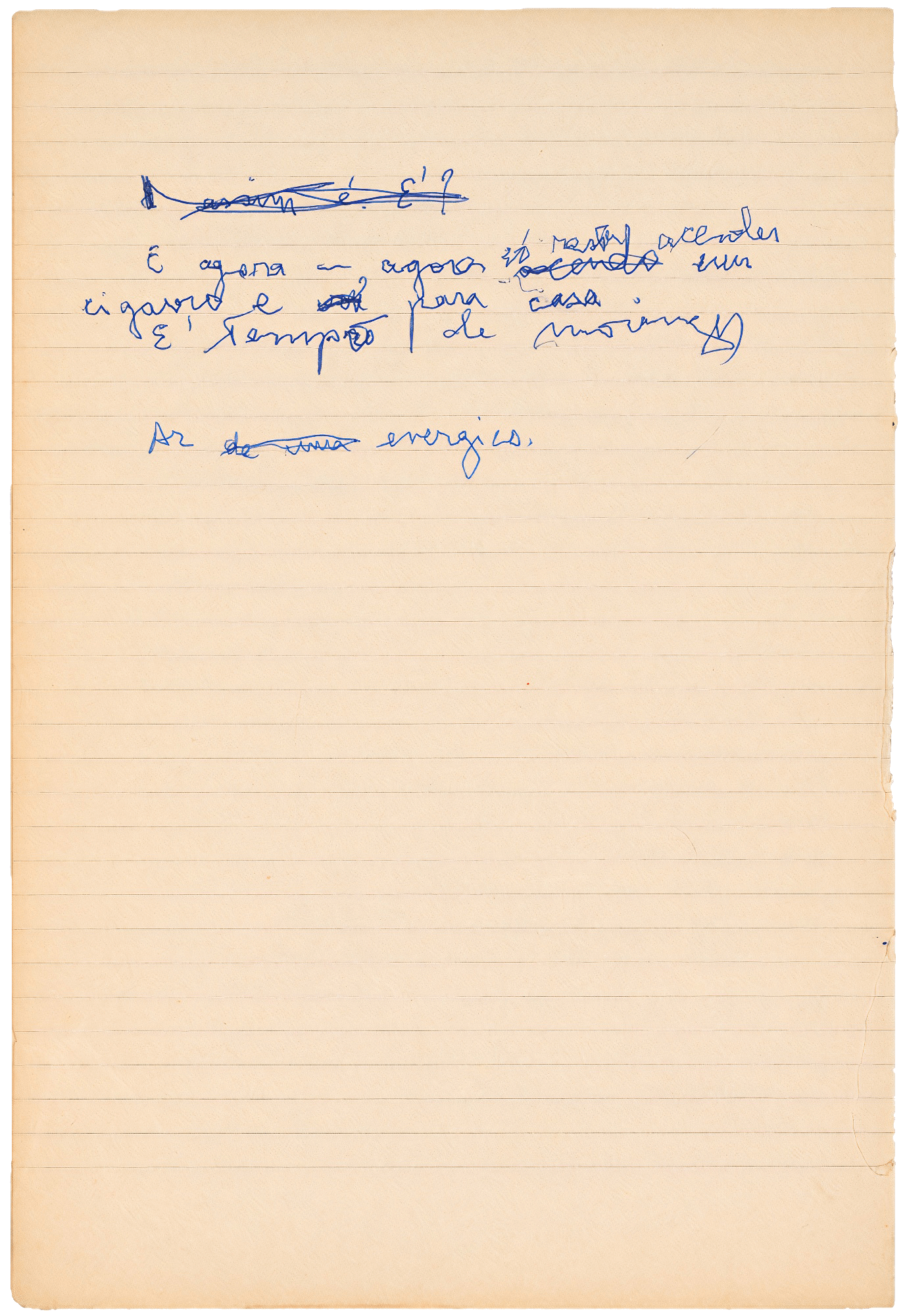
“And now — now all I can do is light a cigarette and go home. My God, I only remembered that we die. But – but me too?! Don’t forget that for now it is strawberries.”
Note used in the 495th and 496th paragraphs of The Hour of the Star. The handwriting is by Clarice.
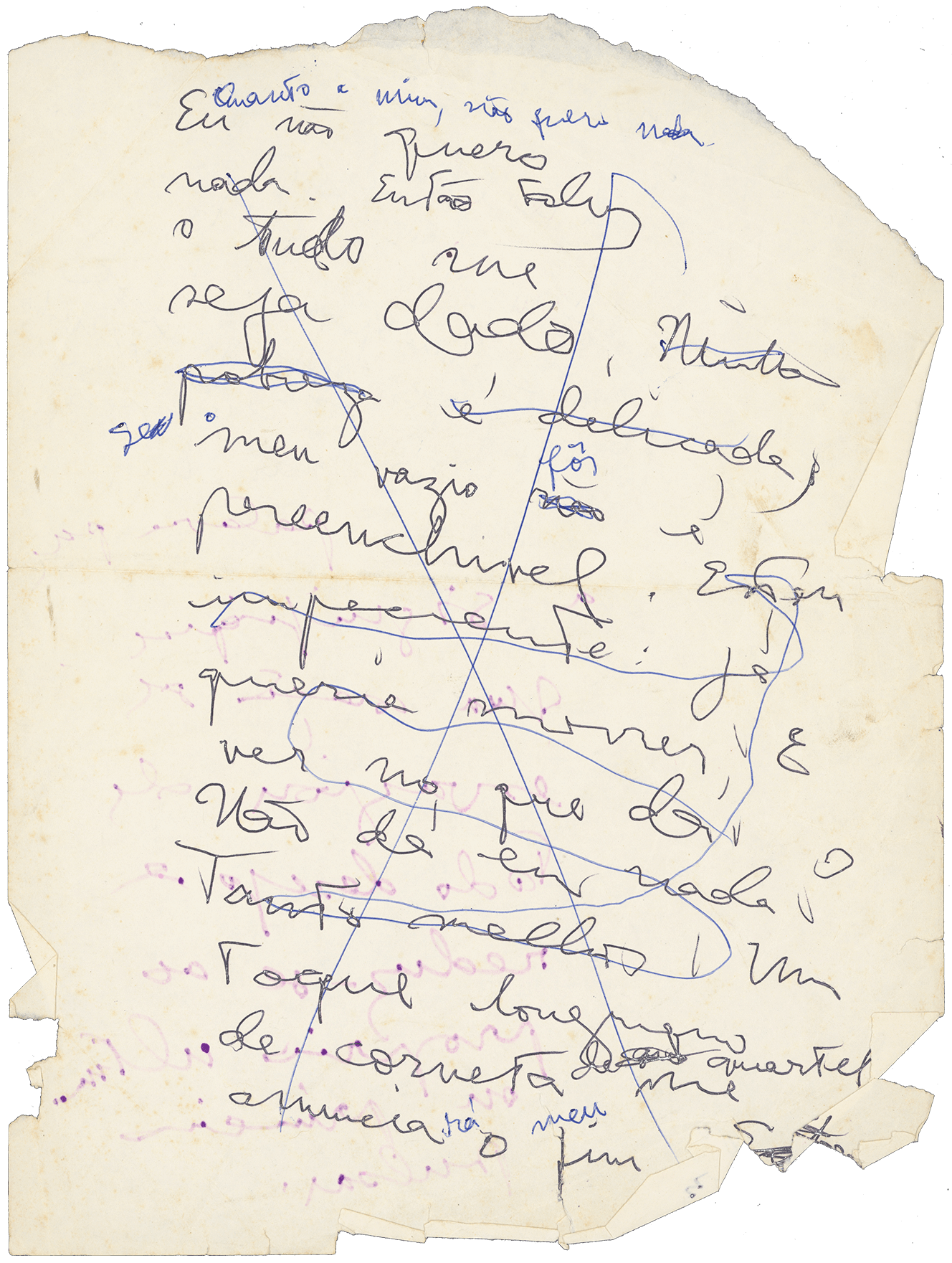
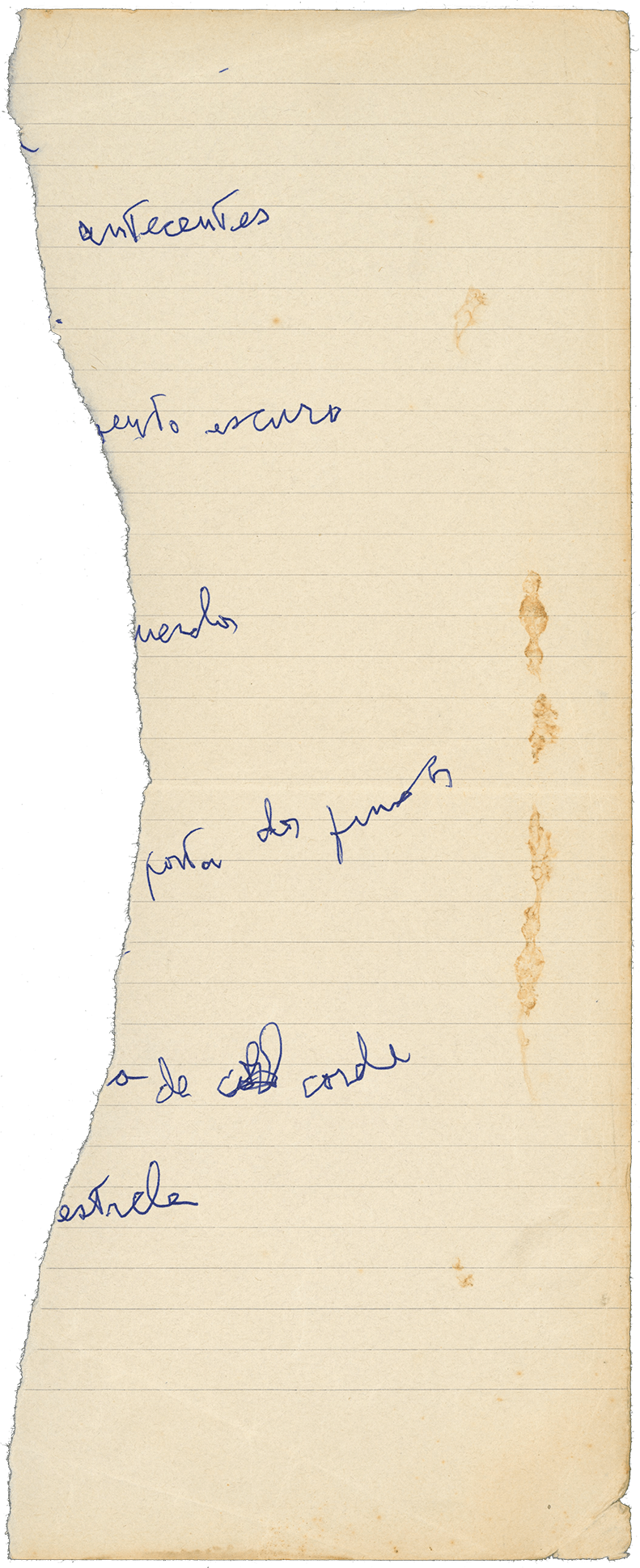
Note for The Hour of the Star not used. The handwriting is by Clarice.
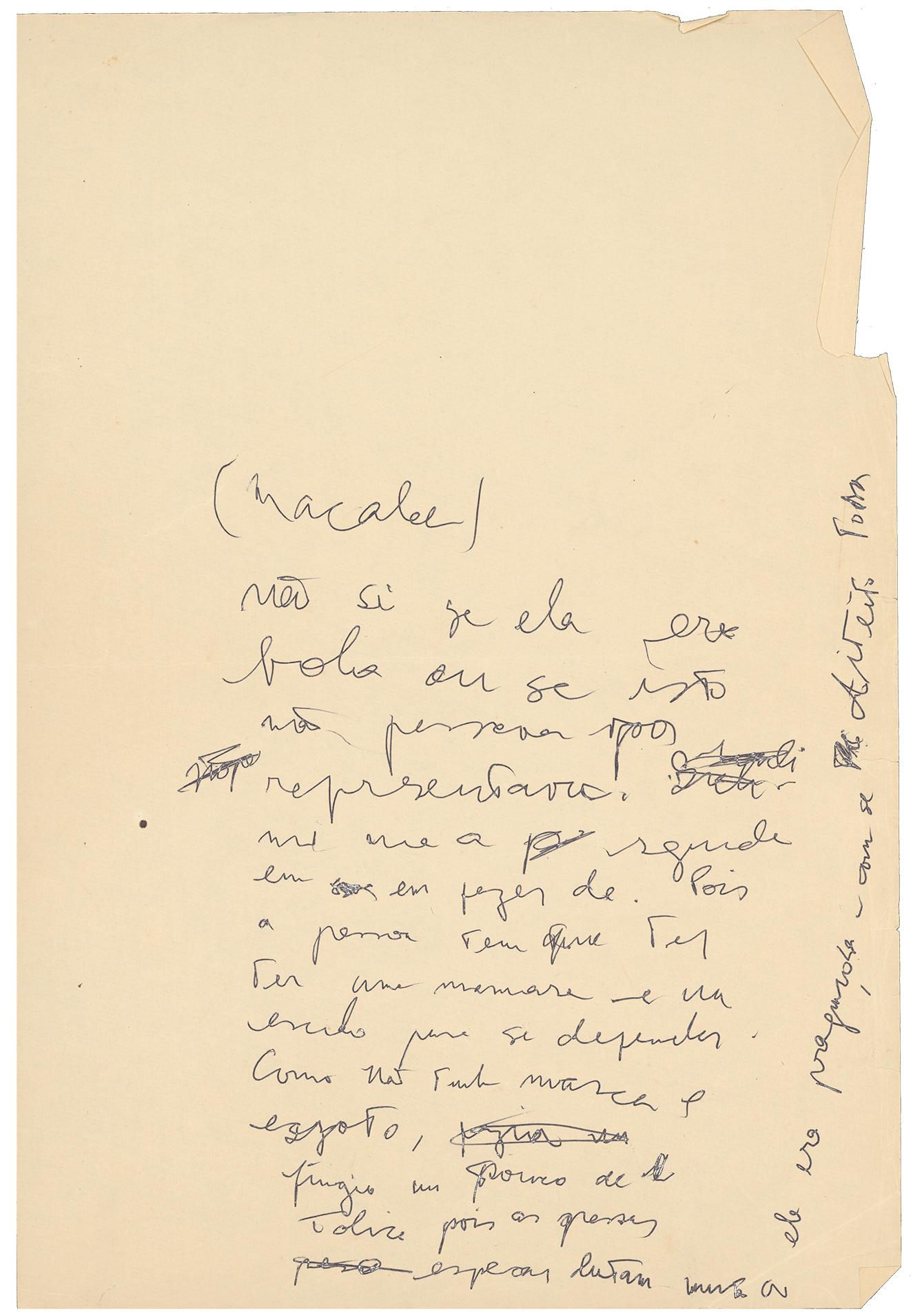
Note for The Hour of the Star not used. The handwriting is by Clarice.
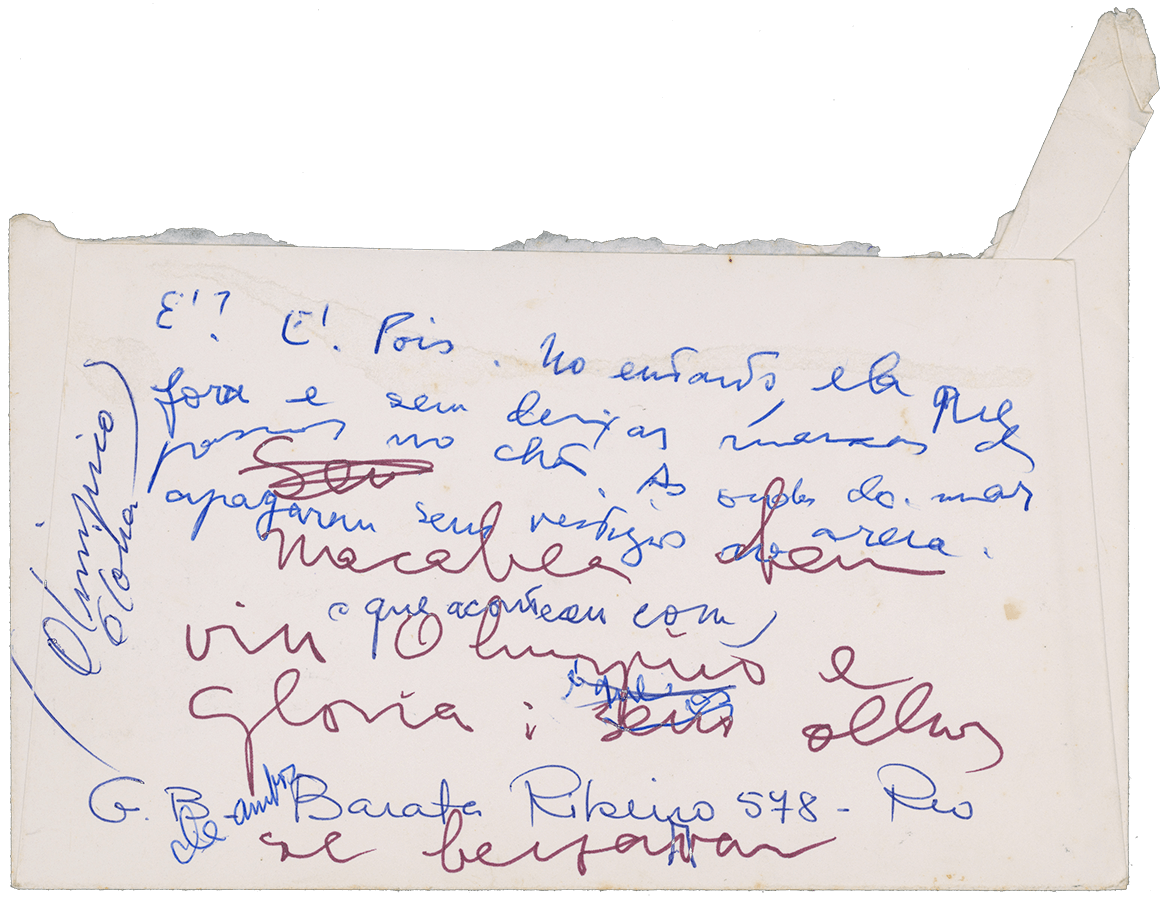
Note for The Hour of the Star not used. The handwriting is by Clarice and by Olga Borelli (observation between parentheses, on the left).
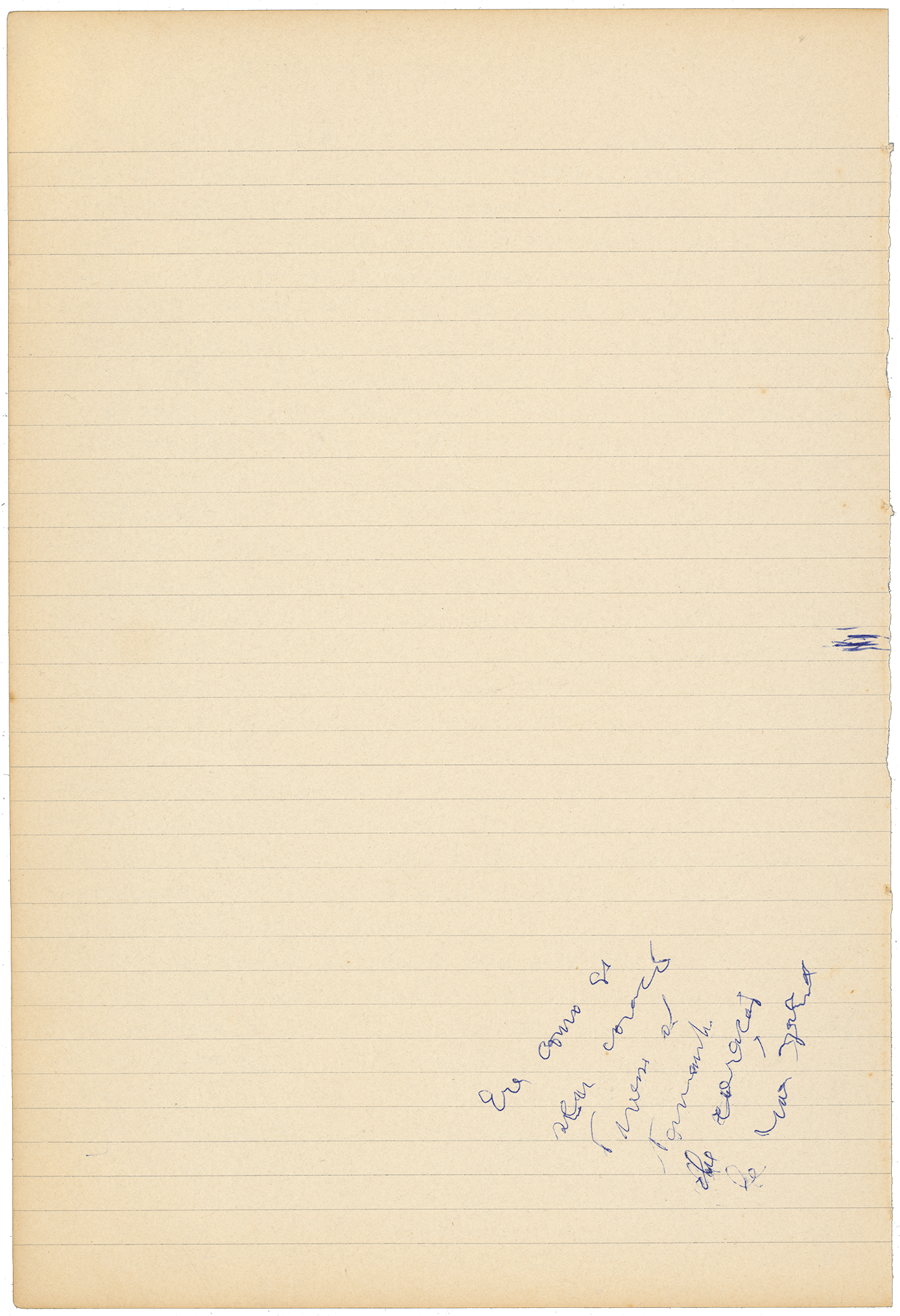
Note for The Hour of the Star not used. The handwriting is by Clarice.
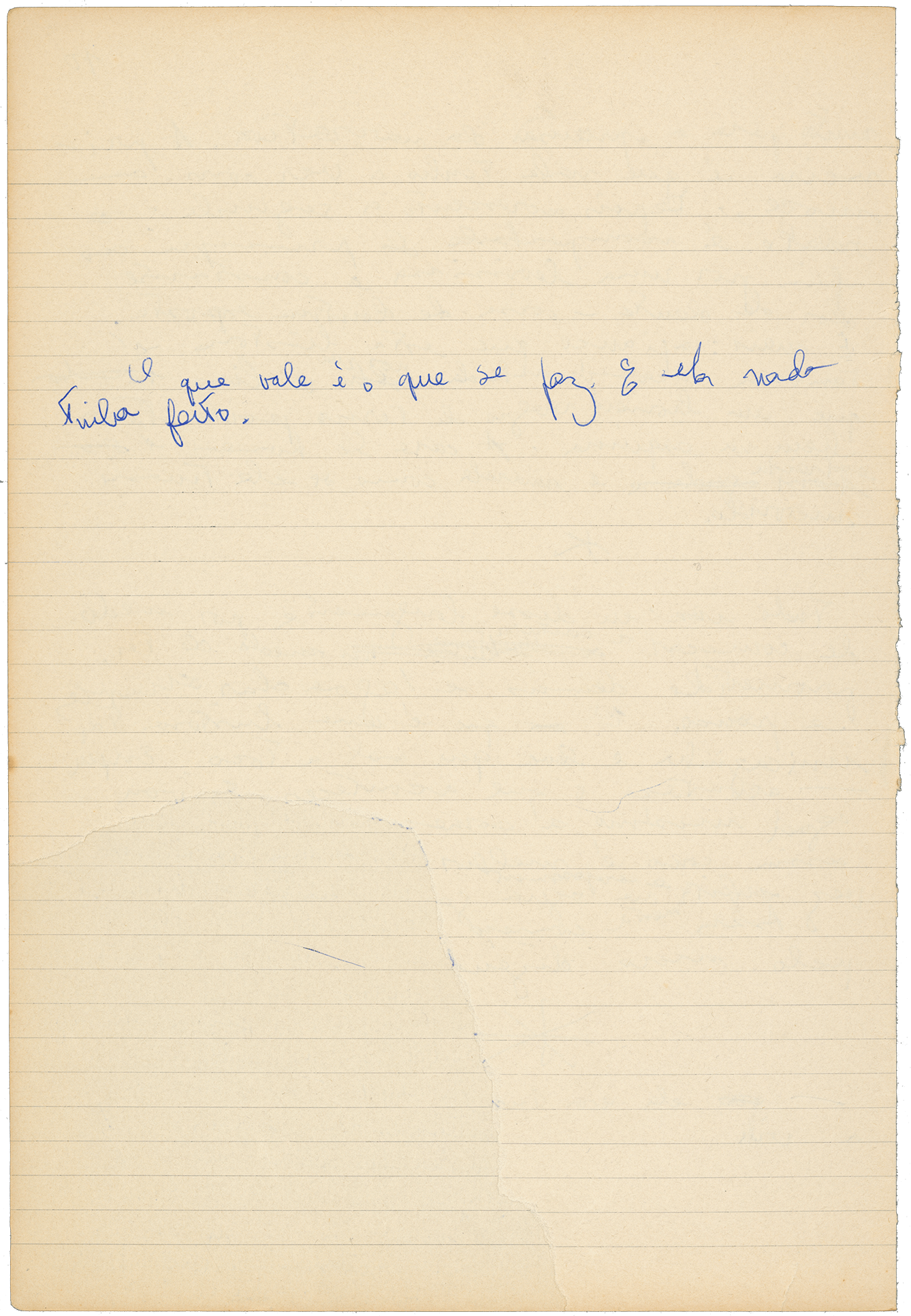
Note for The Hour of the Star not used. The handwriting is by Clarice.
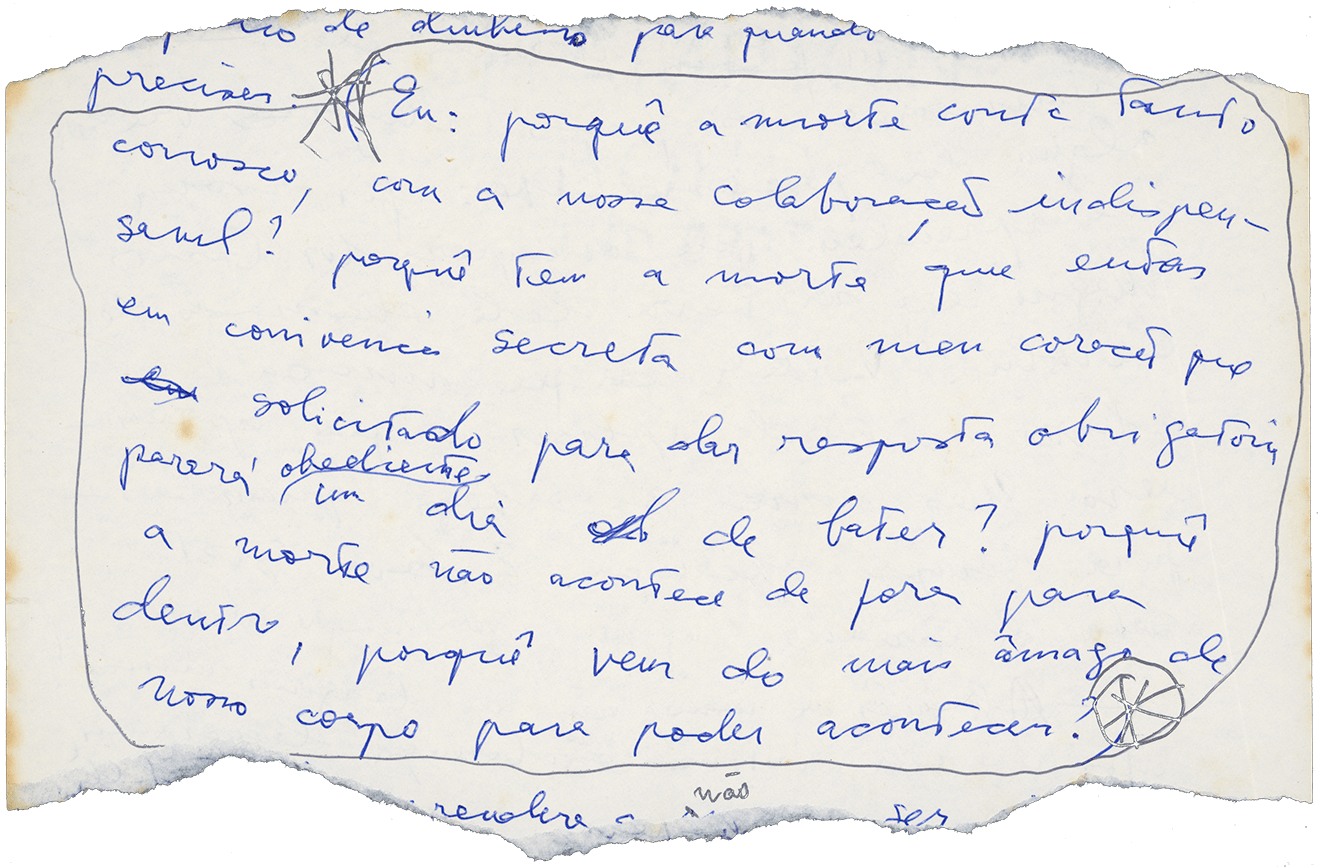
Note for The Hour of the Star not used. The handwriting is by Clarice.
Inspirations or notes?
In 2004, the manuscripts for Clarice Lispector’s novel The Hour of the Star arrived at the Moreira Salles Institute (IMS), important documents not only for their rarity, but also for documenting Clarice’s writing process. From the earliest works, the writer had adopted the method of immediate annotation. Thus, according to Nádia Battella Gotlib, her biographer, “she starts carrying a notebook, where she takes notes. It is from this large quantity of loose notes referring to the same subject that her novel will be constituted (…).”
Over time, notes are made on any type of paper easily at hand, and even by someone else whom Clarice asked for help when unable to write. Olga Borelli says that sometimes during a film session she wrote down an idea or phrase for the writer. She also says that Clarice, in the midst of domestic chores, would suddenly ask the maid to take notes for her. Thus, we see notes from The Hour of the Star on paper fragments, check sheets and envelopes. In addition to this diversity of supports, we also observe Olga’s handwriting in the majority of documents reproduced here, as she was the one who helped Clarice organize and type the manuscripts of The Hour of the Star.
In interviews, Clarice explained how her writing process took place in basically two stages:
When I’m writing something, I take notes anytime day or night, things that come to me. That’s called inspiration, right? Now, when I’m in the act of concatenating the inspirations, then I’m forced to work daily.
In the initial phase of writing, therefore, Clarice would write down “inspirations”, that is, ideas and phrases that came ready to her. When she reached a satisfactory volume of material, the writer would embark on the second stage of creation – she would concatenate the “inspirations”. If the first phase could take months or years, the next moment was uninterrupted work. In this manner the manuscripts of The Hour of the Star archived at IMS reflect Clarice’s stages of creation to the extent that these documents present both Clarice’s “inspirations” and more developed texts, products of that concatenation.
What we present in this catalogue are the “inspirations” harvested by Clarice for The Hour of the Star, which in the organization of the writer’s collection were given the technical term of notes. The pages of the catalogue, produced especially for this site, show reproductions of these notes containing information such as observations about differences of handwriting in the note and identification of notes taken by Olga Borelli.
Fabio Frohwein