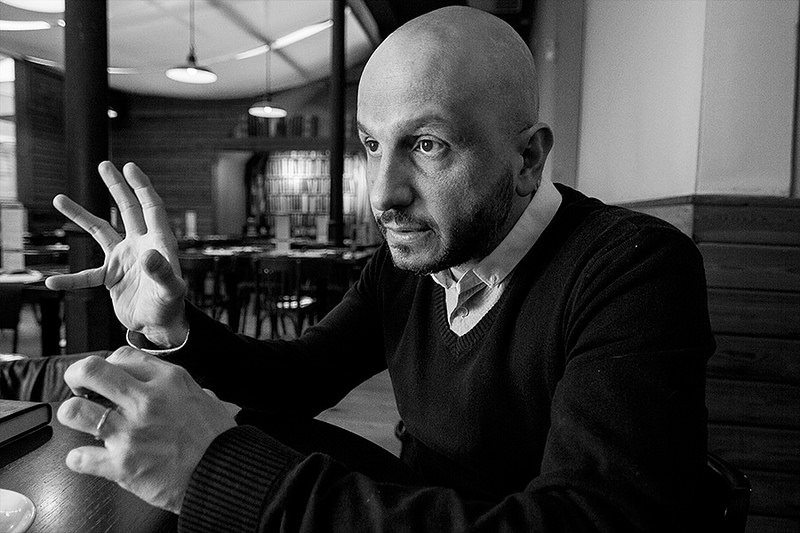
, Clarice Lispector by Jorge Carrión. IMS Clarice Lispector, 2018. Disponível em: https://site.claricelispector.ims.com.br/en/2018/01/19/clarice-lispector/. Acesso em: 16 March 2026.
The Spanish writer and critic Jorge Carrión recently published in The New York Times an essay about the life and work of Clarice Lispector (“La pasión según Clarice Lispector”). Starting from a reading of Por qué este mundo, the biography of Clarice written by Benjamin Moser and recently released in Spanish translation by the Siruela publishing house, the author addresses broader issues related to Clarice’s work:
“She did not like interviews and fiction – in her case – is much more important, incisive, and eloquent than nonfiction. By reading her novels and short stories, one might conclude that she is a hermetic author, close to mysticism. However, I believe, on the contrary, that she is an absolutely contemporary artist, who resolved in her work one of the great literary problems of our time: how to write, with abstract ambition, mental landscapes with figurative language.”
That is, for Carrión, Clarice’s work is “corporeal, totally vital, and bloody,” although it is curdled with metaphors and mysteries. This characteristic brings her prose closer to poetry, according to the critic. That is why, perhaps, she wrote as if it were to save someone’s life, perhaps her own, as she said in A Breath of Life.Read Carrión’s essay, in Spanish, by clicking here.
See also
by Elizama Almeida
In the times of social networks, Clarice “cultivates” thousands and thousands of “followers”, of “apps”, and “pages”.
by Rafael Juliao
“I wanted to announce the following: the person I love most in life is named Clarice Lispector.” This affirmation was made by Cazuza.
by Bruno Cosentino
Clarice’s connection with politics does not take place on the surface of public life, or in the texts that directly address the issue. This is due to the writer’s understanding of the rift between art and politics, which is addressed in two related texts, “Literature and Justice” and “What I Would Like to Have Been,” in which she observes with disconcerting lucidity the uselessness of her literature as a political instrument.
by Elizama Almeida
Paulo Gurgel Valente, Clarice's son, spoke with Eucanaã Ferraz and Elizama Almeida and recalls, for example, the personalities who frequented his home.
by Victor Heringer
The year 2017 marked the 40th anniversary of The Hour of the Star, the last book written by Clarice Lispector, which was published in the year of her death.
by Yudith Rosenbaum
The word “unfamiliar” is used by Clarice Lispector in several of her works. To be precise, in the original Portuguese, Clarice employed the neologism infamiliar, which is not in the dictionary, though it cannot be affirmed that the author is the source of this term in Brazilian literature. Nonetheless, by mentioning the word “unfamiliar” at least sixteen times, whether in novels, short stories, or chronicles, the author makes this unique signifier an object of greater attention.