Little Readings

IMS, Equipe. Little Readings. IMS Clarice Lispector, 2025. Disponível em: https://site.claricelispector.ims.com.br/en/2025/12/10/pequenas-leituras/. Acesso em: 03 April 2026.

In the 2025 edition of Clarice’s Hour, we will celebrate, through the voices and presentations of kids, the children’s story “Laura’s Intimate Life,” published as a book by Clarice Lispector in 1974. In this film, six children retell, act, illustrate, and co-direct the story of Laura the hen, her husband Luís, and their son Hermany in Dona Luísa’s henhouse.

The short film is the fruit of work that took place during the 2025 school year and involved professionals from the Literature Department and students from the Rio de Janeiro municipal school system, combining education, literature, and art, in three stages. In the preparation phase, each child received a copy of the book (donated by the publisher Rocco) and participated in a shared reading activity; next, they discussed the story with their parents at home; and in the third stage – which was creative and artistic – they acted out a few passages from the story and illustrated three scenes. These are the drawings that bring color to the film in a unique retelling of the story of Laura the hen.

A vida íntima de Laura (Laura’s Intimate Life) was conceived by Bruno Cosentino and Eucanaã Ferraz, directed by Laura Liuzzi and Bruno Cosentino, edited by Laura Liuzzi, produced by Bruno Cosentino, and supported by the Rocco publishing house.

Notes

Clarice Lispector and the Invention of Judeity

Bernardo Fuks, Betty. Clarice Lispector and the Invention of Judeity. IMS Clarice Lispector, 2025. Disponível em: https://site.claricelispector.ims.com.br/en/2025/09/25/clarice-lispector-and-the-invention-of-judeity/. Acesso em: 03 April 2026.

Benjamin Moser, one of the most significant biographers of Clarice Lispector, said in an interview that one of his goals in writing Why This World, published in the United States and translated into Portuguese as Clarice, uma biografia, was to make space for a theme rarely explored by literary critics, commentators, and biographers: the writer’s “Judeity.”1 Most tend to limit themselves to reflecting on her “Brazilianness,” “as if one had to choose between being Jewish and being Brazilian.” Moser argues that the absence of overt Jewish identity in Lispector’s writing is itself a profound expression of Jewishness, since “the great Jewish writers usually do not speak openly, or only rarely, about Judaism.” 2 To illustrate, he points to the works of two writers of Jewish origin: Marcel Proust and Franz Kafka.

What makes the Jewish presence stand out in literature written in non-Jewish languages? Bertha Waldman poses this question in “Por linhas tortas: o judaísmo em Clarice Lispector” [Through crooked lines: Judaism in Clarice Lispector]. To address this question, the author draws on the ideas of German philosopher Franz Rosenzweig:

A Jewish book is not one that deals with “Jewish things,” because if that were the case, Protestants who refer to the Old Testament would be writing Jewish books […]. For the Jewish writer, the old Jewish words return to say something new, for they carry an eternal youth and are capable of renewing the world, provided that a window of opportunity is made for them. 3

In other words, the utterance of a writer of Jewish origin must be tied to the work of drawing from collective memory a singular statement capable of overriding what has been said. Waldman also notes, like Moser, that readers of Franz Kafka do not find Jewish themes in his works. And referring to a passage taken from one of the diaries of the Czech writer who wrote in German, the author points out that no Jewish code — religious foundations and signs, clothing, or ritualistic scenes — would, on its own, have the capacity to bring Judaism to the fore in the work of a Jewish author. For Kafka, “it would be necessary to extract the internal elements [of the text] to bring out a bundle of meanings that point to a question that is not manifest in the work but that somehow imposes itself on the reader.” 4

The questions posed by Moser and Waldman are particularly useful to the aim of this essay: to search, in the margins, in the silences, and between the lines of Clarice Lispector’s writing, for the ways in which she invented her Judeity and how that invention shaped a singular literary voice emerging from multiple cultural coordinates.

Before moving forward, I would like to introduce the distinction established by Albert Memmi in his book Dominated Man between the terms “Judaism” (the set of cultural and religious traditions), “Jewishness” (the set of Jewish people scattered throughout the world), and “Judeity” (the way in which a Jew subjectively and objectively views the fact of being Jewish). 5 According to this distinction, I understand Judeity to be a project that goes beyond the simple observance of Jewish religious precepts, escapes the contingencies of mere birth, and determines the subject’s insertion into the future. In this sense, I also draw on Jacques Derrida’s definition of the term Judeity: an expression that establishes the act of becoming another. It is a category that cannot be enclosed without hindering its future. Rodrigo Ielpo, reflecting on the way novelists Georges Perec and Patrick Modiano invent their Judeity, rightly points out that in Derrida, “Judeity” has a creative character. “The future that will constitute its network of meanings will depend on an experience of invention that is both prophetic, insofar as it is not knowable as such, and poetic.” 6

This statement echoes the text “Abraham, the Other,” in which Derrida revisits the work Anti-Semite and Jew (1946) and deconstructs Sartre’s simplistic logic in determining the profile of what would become the “authentic” Jew and the “inauthentic” Jew in the following terms: “Me, I am jew […] in knowing and meaning what one appears to be saying.” 7 For Derrida, such a solution is, in principle, completely mistaken, given that in the absence of an essence from which to derive the term “being Jewish,” the act itself precedes any knowledge. Derrida does not limit himself to deconstructing Sartrean logic and, for the sake of the memory of a people in exile, allows himself to say, “I am Jewish, but I don’t want to know what that means.” The emotional movement underlying this testimony is radical: to say one is Jewish is to accept a vertigo, an undecidability, the risk of a denomination beyond any identity. This would be the inventive principle of “Judeity.”

A year before her death, Clariced Lispector wrote in an article for O Globo: “I am Jewish, you know. But I don’t believe in this nonsense about the Jewish people being God’s chosen people […]. After all, I am Brazilian, and that is that.” This twofold belonging was not an easy task for the defiant author of “Belonging.” “I am certain that right from the cradle my first desire was to belong. For reasons of no importance here, I must have  somehow felt that I did not belong to anything or anyone.”8 Being Jewish and being Brazilian, and at the same time carrying, from birth, the feeling of also being outside of any community. How can this paradox be interpreted?

Let’s see. In a letter to her two sisters, Elisa and Tânia, shortly after confessing the boredom she felt in the quiet Swiss capital of Bern, Lispector writes, “It’s funny that, when you think about it, there is no real place to live. Everything is someone else’s land, where others are happy. It’s so strange to be in Bern, and this Sunday is so boring. It’s like Sunday in São Cristóvão [Rio de Janeiro].”9 A feeling of foreignness pulsed within her and was recorded countless times when the terms “strange”, “foreigner”, and “foreignness” appear in her short stories and novels.10 Antônio Callado once made a perceptive comment, based on his close contact with his friend, about the unsettling strangeness (Unheimlich) that Lispector’s texts produced in the reader. “Clarice was a stranger on earth. She gave the impression of walking through the world as if she had arrived late at night in an unfamiliar city where there was a general transport strike.”11 Carlos Drumond de Andrade, in turn, poetized the mystery of her foreignness on the day of his great friend’s death:

Clarice

issued from some mystery and departed for another.

We cannot fathom its essence.

The mystery was not essential,

it was Clarice travelling inside.12

Elisa Lispector, Clarice’s older sister, recounts how the family fled the pogroms that took place in Russia in 1917 and came to northeastern Brazil in her autobiographical novel No Exílio: Romance (In Exile: Romance). Elisa’s work, according to Moser’s observation, echoes the refrain “Fun vonen is a yid?” (Where does the Jew come from?), a particular way Jews have of asking a fellow Jew about their origins in Yiddish. A fusion language, a Hebrewized Romance language from Lorraine, Middle High German, as well as several Slavic languages, the extremely hybrid nature of Yiddish is evident in the following example proposed by Max Weinreich: “Nokkn bentshn hot der zeyde gekoyfte a seyfer” is a phrase in Yiddish that means, “After the blessing that followed the meal, the grandfather bought a religious book.” In this simple sentence, the word “seyfer” comes from Hebrew, the word “bentshn” comes from Romance, the words “nokkn,” “hot,” “der,” and “gekoyft” are of Germanic origin, and finally, “zeyde” is a Slavic word.13 “Yiddish was widely spoken in the ‘small towns’ (shtetlakh, in Yiddish), generally inhabited by Jews living in poverty and oppression, settled in rural areas in the East.

The Lispector sisters’ paternal grandparents lived in one of these villages, and their maternal grandparents in a nearby town. They communicated with their children and members of the community in Yiddish, speaking little Russian. When Lispector’s parents arrived in Brazil, they carried on the tradition of speaking Yiddish among themselves. On this subject, there is an important piece of information reported personally by Elisa Lispector to Claire Varin, one of the best-known scholars of Clarice’s work. As a child, her sister understood the Yiddish spoken by her parents at home and heard both Yiddish and Portuguese at once.“I live ‘by ear’; I live by having heard it spoken” is what caught Varin’s attention in a Clarice manuscript she found among other documents. It is interesting to stress her conclusion regarding this phrase: Lispector had a “hidden bilingualism,” the result of her auditory experiences from childhood. Yiddish was the decisive mother tongue in her mastery of the countless languages she spoke.14 In addition to hearing the language spoken among her family members, parents, and uncles, Lispector studied at the Colégio Hebreu Ídiche (Recife) 15, where she probably took classes in Yiddish, and perhaps even Hebrew, since schools in the Jewish community at that time were, at the very least, bilingual. However, it is in the language of the Brazilian diaspora, Portuguese, that Lispector finds the place for her language: writing.

The case of Jews as a minority apart from a society of equals dates back to their exile over several millennia—Babylonian in the sixth century BC, Roman, and finally post-Roman—which threw Jews into the experience of the Diaspora, a word of Greek origin meaning “to be scattered among peoples,” “to be outside of,” or rather, “not to belong to.”16 A word that contains the idea of rupture, which touches on the foundations of the Jewish people’s existence. In “The Indestructible,” Maurice Blanchot insists: “‘What does being Jewish signify? Why does it exist?’ […] it exists so the idea of exodus and the idea of exile can exist as a legitimate movement; it exists, through exile and through the initiative that is exodus, so that the experience of strangeness may affirm itself close at hand as an irreducible relation; it exists so that, by the authority of this experience, we might learn to speak.”17

I was […] born to write. The written word helps me to dominate the world. […] I started writing at the age of seven in the hope that one day I should be able to master language. Yet each time I raise my pen it is as if I were about to write for the first time. Each book I write is a tortuous yet blissful debut. This ability to renew myself as time passes is what I would call living and writing.18

Curse and blessing alike, writing keeps Lispector alive.

To Blanchot’s insistence that the Jew exists so that one may learn to speak, one must add Derrida’s insistence that, from the perspective of a certain Judaism, the act of learning to write reveals itself as both birth and passion for writing, the love and suffering of the Letter. As he observes in an essay interpreting the Judeity of Edmond Jabès, the Jewish poet expelled from Egypt and exiled to France, where he started writing in French, “The Jew is split, and split first of all between the two dimensions of the letter: allegory and literality”19, both unfolding through the language of another place, of the foreigner. Since writing is itself a form of exiling oneself, a journey toward an “inner foreign land”20, it becomes clear why Lispector insists that living and writing are acts of continual self-renewal.

The letter occupies a central place in Judaism, right from the strange and astonishing idea of spelling out the name of God, the tetragrammaton YHWH, a word that cannot be read. A god that is pure letter, who cannot perform the function of likeness in the mirror because of his radical otherness. The prohibition in the second commandment against making any graven image that could represent Him (Exodus 20:4) imposed and continues to impose absence on the human spirit, which never tires of seeking to organize itself in terms of images and figured presence. In this sense, the reading of the graph that marks language, YHWH, caused a retreat in culture from the visible to the legible-audible, forcing the Jewish people to keep turning toward the Unknowable and listen to Silence. Blanchot did not hesitate to say that when one thinks of this unapproachable and transcendental God, distant and utterly foreign, one generally marks only His absolute absence, leaving aside the fact that His revelation is coupled with “the manifestation of the word as the place where men relate to the one who excludes all relation: the infinitely distant (…).” 21

​​The words of the Jewish poet Edmond Jabès help to illuminate this proposition.

To His people, God commands, ‘Hear, O Israel.’ But hear what? Hear the words of your God; yet God is absent, and His words, stripped of voice, lie severed from their sounds. Hear the silence, for it is within this silence that God speaks to His creature […]. The primal interdiction bestows upon non-representation its sacred character. The language of God is the language of absence.22

In fact, listening is one of the senses that occupies a prominent place in Jewish liturgy. The text is read aloud, and what we in the West understand as scripture in the expression “Holy Scriptures” is called “mikra,” or “reading,” in Hebrew. Those who founded the Jewish canon passed on the tradition of reading and writing the Word not as revelation, but as creation of meaning.23 In the passage from seeing to writing, the reader hears the wandering of letters that combine infinitely before the silence of YHWH.

Lispector’s writing undoubtedly relies on this tradition, but that doesn’t imply a simple submission to the past. The external resolve—listening to Silence—will only be brought to life through the author’s poetic invention. Let us remember the verses of Goethe quoted by Freud in Totem and Taboo: “What thou hast inherited from thy fathers, acquire it to make it thine.”24 The author’s poetic invention reflects the process of inventing her Judeity: she dramatizes her own story as fiction in the present, for instance, in A Breath of Life. And, of course, Angela, the character in this “silent book,” is the protagonist of Lispector’s Judeity.

I invented God—and don’t believe in Him. It’s as if I had written a poem about the nothing and then suddenly found myself face-to-face with the nothing itself. Is God a word? If so then I’m full of Him: thousands of words crammed inside a jar that’s shut and that I sometimes open—and I am dazzled. God-word is dazzling.25

“I am Jewish, you know… After all, I am Brazilian,” she declared, “and that is that.” If, on the one hand, the void at the center of Judaism is the silent and dizzying presence that feeds Lispector’s writing, on the other hand, being Brazilian was a choice that determined, as many of her commentators say, the reinvention of Brazilian literature. Benjamin Moser, her American biographer quoted at the beginning of this essay, recognized that Lispector is the greatest modern writer in Brazil without being, in a sense, a Brazilian writer. A paradox captured by poet Lêdo Ivo: “This borderland prose, of immigrants and emigrants, has nothing to do with any of our illustrious predecessors. … You could say that she, a naturalized Brazilian, naturalized a language.” We will see in greater detail later on that, for Lispector, Judeity and Brazilianness are experiences foreign to her own self. Her writings are living proof of the famous Freudian aphorism, “The ego is not master in its own house.”

It is possible that our author was shaped not only by the weight of anti-Semitic persecution, which drove her family into exile and displacement, but also by the enduring presence of the foreigner in the Old Testament. “But thou shalt remember that thou wast a bondman in Egypt, and the LORD thy God redeemed thee thence: therefore I command thee to do this thing.” (Deuteronomy 24:17). The very Covenant, the pact between the Hebrews and YHWH that secures their identity, already contains within it a sense of estrangement, of the Unheimliche, that unsettling familiarity that blurs and destabilizes its certainty. Structurally, certain narratives in the Hebrew Bible suggest that nomadism, so central to biblical sociology and to the ethics of the Torah, is nothing less than the enduring expression of an identity marked by multiplicity and becoming. What stands out in the book is not merely the precedence of a nomadic experience over a settled one, but more crucially, the continuation of wandering through the desert and the ever-renewed repetition of Exodus. It is this inexhaustible mobility, this deep inscription of nomadism and errancy in the history of the Jewish people that resurfaces in Lispector’s female characters.

Joana, the protagonist of Near to the Wild Heart, initiates, through the journey she undertakes at the end of the novel, the restless search that other characters will embark on, each in their own way. Virginia, the main character of The Chandelier, will leave her place of birth to confront life in the big city. Lucrécia, from The Besieged City, is driven by a desire to abandon the outskirts of São Geraldo. […] Macabéa, from Hour of the Star, is from Alagoas and comes to Rio de Janeiro in search of a better life. This search for a place of belonging is characteristic of both the characters and the author herself.26

Each of these women also enacts Lispector’s permanent exile from herself, which allows her to encounter the unknown in a real lesson in otherness. The invention of Jewishness in Lispector would then be confused with the biblical logic of choosing strangeness—“becoming Jewish”—intrinsic to God’s Covenant with his people. Abraham, the Hebrew patriarch, introduces a notion of exile that is not related to punishment, such as that of Adam and Eve, the Tower of Babel, or Oedipus, but which is a departure from “being in the face of oneself,” a departure from “someone who, armed with his experience of freedom and opposition, integrates it into something that transcends it. To Abraham, God does not only say ‘Go,’ but ‘Go for yourself’” (Genesis, 12:1).

And Lispector goes! And she goes in the opposite direction to the crowd: “She was a brutal example of the singularity of the human person.” wrote Otto Lara Resende when she died.27

Now, the paternal grandfather of the Lispector girls, Shmuel Lispector, was a great reader and interpreter of the Old Testament and the great sacred books that originated from it—the Midrash and the Talmud. Because of his passion for Scripture, he rose to the status of a wise and holy man. This earned him the admiration of many scholars. Shmuel passed on to his son Pinkhas (Pedro) the custom of reading the Tanakh, the first five books of the Old Testament, every day. It is likely that Clarice and her sisters heard many of the stories that populate these books from their father. Peter left Europe, taking with him, even if only symbolically, the “portable homeland of the Jews,” the Book of books. In general, the relationship of the Jewish people with the God of intolerable absence was structured around the Torah (Pentateuch) or Revelation. This served as a spoken and written code of communication between men and between man and the divine. Over centuries, this book and tradition became both the main axis of the religion, ethics, and politics of the Jewish people, and the space in which Jews developed a unique praxis of interpretation. This interpretive practice proved capable of sustaining the transmission of Judaism and the reconfigurations of emerging “Judeities.”

Nomads, like Hebrew letters clustered on the white of an ancient parchment, doctors of law and commentators of the Text dared to say more than what appeared in the Book, making it, since time immemorial, a territory that welcomed emerging subjectivities. Thus, wandering the world through the centuries and generations, with letters and words overflowing with meaning, the Jewish people knew to make interpretation a practice of leaving it to the letters to be letters and to take advantage of the blank spaces in the text as a reservoir of meaning always available to the reader/interpreter. This constantly renewed mission of reading the letters, multiplying the combinations, and rewriting them in a continuous movement of unique, meaningful constructions on the origin, value, and meaning of life and death ended up—as Sigmund Freud and Jacques Lacan sometimes said—designating the Jew as the one who knows how to read. And if it is true that religion begins where reading ends28, it must be said that there is in Judaism an atheism to be extracted: it requires the interpreter of the Scriptures to commit to desacralizing it, giving it new birth, recreating it, and inventing it as on the day of creation.

It can be said that the Talmudist is, in principle, a “traitor” to any and all immutable “readings,” that is, religious ones, which prevent the elaboration of thoughts. He questions what he reads and, by doing so, extracts different meanings, never the same ones. As Henri Atlan points out, it is a matter of ensuring the second commandment’s anti-idolatrous law and the atheism of scripture. The fight against idolatry prevents the illusion of ownership of meaning. The text is unconquerable and incomprehensible. In other words: “The paradoxes of language and its meanings are such that a discourse on God that is not idolatrous, that refrains from grasping or conquering his Name, is inevitably an atheistic discourse.”29

Does Lispector’s writing contain this atheism that is marked by the absence of meaning?

Reality is the raw material, language is the way I go in search of it—and the way I do not find it. But it is from searching and not finding that what I did not know was born, and which I instantly recognize. Language is my human effort. My destiny is to search and my destiny is to return empty-handed. But—I return with the unsayable. The unsayable can only be given to me through the failure of my language. Only when the construction fails, can I obtain what it could not achieve.30

In this passage from The Passion According to G.H., Lispector expresses the failure of language in naming the unnameable. A failure that paradoxically reconciles her with life in the word to come, the other who will decide what “Jewish,” “Judaism,” and “Judeity” will mean. Especially because Lispector’s writing comes from the “land of refuge,” in Freud’s words, which one carries inside.31

Taking up Rosenzweig’s idea that the presence of Judaism in a writer’s work can be discerned only when ancient Jewish words return to express something new and thereby renew the world, one can recognize in Lispector’s writing the stature of an author who, by reinscribing the traces of an archaic heritage and drawing on Scripture imbued with the memory of a people in exile, was able to transform that legacy into modern fiction. 

In a similar vein, Sigmund Freud, in his return to the Old Testament to write Moses and Monotheism, crafts what can be called a “theoretical fiction”—a narrative that, while bearing the hallmarks of imaginative writing, remains rigorously tethered to the demands of scientific inquiry. Freud, in his reading of the Exodus, proceeds like an old Talmudist, that is, multiplying the combinations between the letters, cutting words and phrases, and searching the margins and blanks of the texts of historians and Egyptologists for signifiers that could illuminate his hypothesis: that Moses was an Egyptian. Through this, Freud champions the notion that the identity of a people comes from the Other, from the foreigner in relation to oneself. Lispector, in Hour of the Star, takes the Books of the Maccabees as a reference and turns the hero, Judas Maccabeus, into a northeastern anti-heroine destined to go unnoticed because “Nobody smiles back because they don’t even look at her.”32 One might argue that, much like Freud, Lispector engages with an ancient mode of textual reading—a unique interpretive approach that seeks not only within the text but also beyond it, venturing outside the written line itself. Unlike exegesis, Talmudic interpretation involves creation and transformation, never deciphering through a symbolic key that replaces a verse with something more intelligible. It is a task akin to what is attributed in psychoanalysis to the “work of the dream”: a process of elaboration where the activity of a thought without qualities is neither thinking nor calculating nor, in general, judging, but solely transforming. A work yet to come, that is, “prophetic […] and poetic,” to paraphrase Derrida, quoted at the beginning of this essay.

Macabéa, the protagonist of Hour of the Star, bears a name rooted in the folkloric tradition of Northeastern cordel literature. The author, however, links her to the Books of the Maccabees, two apocryphal texts of the Hebrew Bible. These books were written in Greek, although the first was likely originally composed in Hebrew. Both works center on themes of resistance to oppression by a dominant power. The first volume recounts the persecution of the Jews by a Greek king in 175 BC. He prohibited Jewish religious practices and the reading of the Torah, imposing worship of the Olympian god Zeus. While some people converted, Mattathias, an elderly priest, and his five sons remained loyal to the law of Moses. After Mattathias’ death, his son Judas Maccabeus led a rebellion against the Greeks. He restored the community’s right to observe the law of Moses and reclaimed the Temple of Jerusalem. Despite this victory, which led to the Jewish celebration of Hanukkah, Judas Maccabeus was later killed in battle. The new king again cast the Jewish people as outsiders and enemies.

The text requires interpretation of implicit elements. Clarice Lispector, influenced by the socio-political urgencies of her era, particularly the severe social injustices experienced by Northeastern populations excluded from Brazilian progress, revisits the ancestral scroll. She engages with the narrative of the Books of the Maccabees, participating in the historicization of Judaism by allowing the past to coexist with the present as a form of virtuality. In this framework, the past emerges as a collection of singularities that lack meaning until a significant interpretive act occurs. Macabéa, a young woman living in extreme poverty, leaves Alagoas in pursuit of improved living conditions in a southeastern metropolis. Like her, other Macabéas suffer misery and abandonment in a foreign land and accept the suffering imposed on them by others, as they know no other possible reality. “On a street in Rio de Janeiro,” reports the narrator, “I glimpsed in the air the feeling of perdition on the face of a northeastern girl. Not to mention that I as a boy grew up in the northeast.” 33

Nelson Vieira, in “A expressão judaica na obra de Clarice Lispector” [The Jewish Expression in the Work of Clarice Lispector], argues that Macabéa demonstrates a form of resistance analogous to that of the sons of Mattathias by maintaining adherence to the law of Moses. In contrast, her boyfriend, Olímpico de Jesus, whose name alludes to Olympian Zeus, is attracted to the capitalist allure of Rio de Janeiro, whereas Macabéa rejects these influences. She is “firm in her opposition to the falsehood of the world. Her intuitive faith and stubbornness oppose the lost souls she encounters on the streets of Rio.”34 The narrative further introduces Dona Carlota, a fortune teller and prostitute, who deceives Macabéa by predicting a prosperous future involving marriage to Hans, a wealthy foreigner with a German name and owner of a Mercedes, as highlighted by Pedro Gurgel Valente in the afterword to a Brazilian edition of the book. At this juncture, Lispector’s narrative establishes a parallel between the suffering of two marginalized groups, both of whom are familiar with the animosity of an Other that defines itself through sameness. Ultimately, the fate of the unnamed northeastern protagonist is depicted as equally tragic as that of Judas Macabeu. Macabéa, Lispector’s Jewish girl from the northeast, is fatally struck by a yellow car, which is symbolically described as enormous as an ocean liner, as she attempts to cross the street.

Then Macabéa said a phrase that none of the passersby understood. She said clearly and distinctly:

—As for the future.

Would she have longed for the future?

Macabéa died. The Prince of Darkness won.

Two months before her death, Lispector demonstrates the impossibility of dissociating the meanings of Judeity and Brazilianness. Hour of the Star is a tribute to both cultures and, at the same time, a recognition that if the story she writes does not exist, it will come to exist: “This story takes place during a state of emergency and a public calamity.”35 And what can be done?

That’s when I enter into contact with inner powers of mine, I find through myself your God. Why do I write? What do I know? No idea. Yes, it’s true, I sometimes think that I’m not me, I seem to belong to a distant galaxy because I’m so strange to myself. Is this me? I am frightened to encounter myself.36

  1. This essay was originally published in the book Lispectator, organized by Marco Antonio Coutinho Jorge and Tarcísio Greggio, and edited by 7 Letras. []
  2.  Benjamin Moser, “Aspectos judaicos de Clarice,” Museublog: Arte, Cultura, September 24, 2009, https://museujudaicorj.blogspot.com/2009/10/aspectos-judaicos-de-clarice-lispector.html (retrieved February 14, 2024). []
  3.  Berta Waldman, “Por linhas tortas: o judaísmo em Clarice Lispector,” Arquivo Maaravi: Revista Digital de Estudos Judaicos da UFMG 5, no. 8 (March 2011): 1. []
  4.  Ibid. []
  5.  Albert Memmi, Dominated Man: Notes Toward a Portrait (Boston: Beacon Press, 1971). []
  6.  Rodrigo Ielpo, “Judeidade e a criação da memória potencial em Georges Perec e Patrick Modiano,” Scripta Uniandrade 16, no. 3 (2018): 326–42. []
  7.  Bettina Bergo, Joseph Cohen, and Raphael Zagury-Orly, eds., Judeities: Question for Jacques Derrida, trans. Bettina Bergo and Michael B. Smith; Peterborough ((ON: Trent University Library, 2007), 28. []
  8.  Clarice Lispector, Too Much of Life: The Complete Crônicas, trans. Margaret Jull Costa and Robin Patterson (New York: New Directions, 2022) []
  9.  Olga Borelli, Clarice Lispector: esboço para um possível retrato (Rio de Janeiro: Nova Fronteira, 1981), 111, letter of May 5, 1944. []
  10.  Yudith Rosenbaum, “The Unfamiliar,” Clarice Lispector IMS, Feb. 22, 2024, https://site.claricelispector.ims.com.br/2024/02/22/o-infamiliar/. []
  11.  Nadia B. Gotlib, Clarice Lispector: Uma vida que se Conta (Rio de Janeiro: Rocco, 2009), 52. []
  12.  Carlos Drummond de Andrade, “Vision of Clarice Lispector”, trans. Giovanni Pontiero, PN Review 60 (March–April 1988). []
  13.  Max Weinreich, apud Marc-Alan Ouaknin e Dory Rotnemer, A Bíblia do Humor Judaico (Rio de Janeiro: Editora José Olympio, 2002), 25-26. []
  14.  Claire Varin, interview with journalist Ubiratan Brasil, Jornal de Poesias, http://www.jornaldepoesia.jor.br/ubrasil1.html (retrieved Feb. 20, 2024). []
  15.  Pedro Gurgel Valente, afterword to A Hora da Estrela (Rio de Janeiro: Editora Rocco, 2019), 85. []
  16.  Susana Rotker, Isaac Chocrón y Elisa Lerner: los transgresores de la literatura venezolana: reflexiones sobre la identidad judía (Caracas: FUNDARTE, 1991), 21. []
  17.  Maurice Blanchot, The Infinite Conversation, trans. Susan Hanson, Theory and History of Literature, vol. 82 (Minneapolis and London: University of Minnesota Press, 1993), 125, “The Indestructible.” []
  18.  Clarice Lispector, Discovering the World, trans. Giovanni Pontiero (Manchester: Carcanet Press, 1992), 134, “The Three Experiences”. []
  19.  Jacques Derrida, “Edmond Jabès and the Question of the Book,” in Writing and Difference, trans. Alan Bass (Chicago: University of Chicago Press, Reissue Edition, 2017), Gianni Vattimo. []
  20.  As Freud defined the unconscious. []
  21.  Maurice Blanchot, op. cit., 187. On the question of “listening to silence” in Judaism, see also chapter IV of my book Freud e a judeidade: a vocação do exílio (Rio de Janeiro: Zahar, 2000), 99–114. []
  22.  Edmond Jabès, “Judaïsme et écriture,” in L’écrit du temps, ed. Marie Moscovici and Jean-Michel Rey (Paris: Minuit, 1984), 8. My translation. []
  23.  The theme of reading-writing in Judaism is further developed in chapter V, Interpretação: errância e nomadismo da letra, of my book Freud e a judeidade: a vocação do exílio, op. cit., 9. []
  24.  Johann Wolfgang von Goethe, Faust. Part I, lines 682–683, quoted in Sigmund Freud, Totem and Taboo: Some Points of Agreement Between the Mental Lives of Savages and Neurotics, trans. James Strachey (London: Routledge, 1999), 158. []
  25.  Clarice Lispector, A Breath of Life (Pulsations), trans. Johnny Lorenz, ed. Benjamin Moser, preface by Pedro Almodóvar and Benjamin Moser (New York: New Directions, 2012), 127. []
  26.  Berta Waldman, “O Estrangeiro em Clarice Lispector.” In Entre passos e rastros, 15–30. São Paulo: Perspectiva, 2002. []
  27.  Otto Lara Resende, “Mãe, filha, amiga,” O Globo, Dec. 10, 1977, quoted in Benjamin Moser, Why This World: A Biography of Clarice Lispector (Oxford: Oxford University Press, 2009). []
  28.  J.-P. Winter, “Transmisión y Talmude,” Bulletin interne de l’EFP, vol. II (June 1979). []
  29.  Henri Atlan, “Niveaux de signification et athéisme de l’écriture,” in La Bible au présent: Données et débats. Actes du XXIIᵉ Colloque des intellectuels juifs de langue française, ed. Jean Halpérin and Georges Levitte (Paris: Gallimard, 1982), 86. []
  30.  Clarice Lispector, The Passion According to G.H., trans. Idra Novey, ed. Benjamin Moser, introd. Caetano Veloso (New York: New Directions, 2012). []
  31.  Lydia Flem, Freud the Man: An Intellectual Biography, trans. Susan Fairfield (New York: Other Press, 2003). []
  32.  Clarice Lispector, Hour of the Star, trans. Benjamin Moser, intro. Colm Tóibín (New York: Penguin Classics, 2014). []
  33. Ibid. []
  34.  Nelson H. Vieira, “Clarice Lispector,” Remate de Males: Revista do Departamento de Teoria Literária (Campinas: Universidade Estadual de Campinas, 1989), 207–9. []
  35.  Clarice Lispector, idem, ibid. []
  36.  Idem. []

Notes

Always Roses for Clarice

Colasanti, Marina. Always Roses for Clarice. IMS Clarice Lispector, 2025. Disponível em: https://site.claricelispector.ims.com.br/en/2025/05/29/always-roses-for-clarice/. Acesso em: 03 April 2026.

The day I met Clarice was not the same day she met me. I was all adoration, observing her. She had no reason to even lay eyes on me. 1

Leaving the Jornal do Brasil newsroom together, the journalist Yllen Kerr, a great friend of mine, said he was going to visit Clarice and asked if I wanted to go. Did I ever! Ever since the first issue of Senhor magazine, I’d been reading her short stories voraciously. I’d already been left spellbound by Family Ties, and that same year I’d gone to one of her book signings. Yes, I wanted to go. And off we went, to Leme neighborhood.

She didn’t come to greet us at the door. Either she was still getting ready or she was keeping her diplomatic habits. The room was dark, with only a lamp lit next to the sofa. It was in this darkness that she made her entrance.

I found her stunning. She seemed even taller than she really was. Her face was exotic and made up – in the following years I’d never see her without make-up –, her high cheekbones outlining the Slavic shape of her eyes. She was dressed in dark clothes, with warm tones, wearing a long-sleeved dress or sweater. I remember the long sleeves because they made her supple hands stand out, so light in the semi-darkness, and the twin, cuff bracelets of hammered copper she wore on both wrists.

With me in respectful silence, the conversation between Clarice and Yllen began. It didn’t seem comfortable, it wasn’t flowing, there were gaps, as if the two were dancing an unrehearsed choreography. Clarice interrupted herself mid-sentence as her interlocutor remained in suspense, without knowing whether to give her time to continue or whether it was up to him to think of something else to say.

We didn’t stay long. The time of a normal visit, not the time of two friends indulging in a carefree conversation. We drank something or we drank nothing, and left. But the encounter marked me deeply. I held on to the image of her on that afternoon like someone who holds on to a photograph, without knowing that this image was close, so close to changing.

In September 1966, a fire broke out in her apartment, started by Clarice when she fell asleep smoking in bed. Not wanting to put her children at risk, she tried to put it out with her hands, which would have disastrous effects on her health.

As soon as I heard, I sent two dozen roses to the hospital, aware that even if she received them, she wouldn’t know who was sending them. I suffered for her as we learned of the threat that her right hand would be amputated. I recalled her pale hands over her dark clothes, framed by the copper bracelets, and it seemed to me impossible that this would happen. Fortunately, it didn’t.


A year later, when she had already undergone several operations on her hand and leg, from where tissue was removed for the grafts, Clarice was invited by Alberto Dines, then editor-in-chief of the Jornal do Brasil, to write weekly chronicles for the Caderno B. Dines had already invited Clarice earlier, when he was the director of the Diário da Noite, to write the column that Ilka Soares would sign. 2 This time, however, she would sign under her own name and manage the space as she saw fit, in the same way that she had done in Children’s Corner, in Senhor magazine. It was a change that, over the course of seven years, would greatly boost the recognition of her writing and her name.

When she finally came to the JB newsroom, where I was a sub-editor, I was surprised to see that she had taken advantage of so many interventions to have a facelift, a way to keep her beauty intact and counter the deformity in her hand. Whether because of the respect she inspired, or because of her undeniably foreign air, although she so wanted to be Brazilian, or because of her femininity, it was understood that, from that day on, I would attend to her, I would make the necessary communications, I would take care of her texts. That’s when our relationship began to take shape.

Countless times Clarice would ask me not to lose her texts. She would say she didn’t have a copy because the carbon paper wrrrrinkled, and she would roll her Rs due to her tongue-tie – a phenomenon denied by the speech therapist and writer Pedro Bloch, who attributed it to childhood imitation of her parents’ speech. Clarice was quite right about her difficulty with the carbon paper. Her burned right hand didn’t allow her to fit it properly between the two sheets, which was the only way to obtain copies in the pre-computer era. But the phrase ended up becoming her nickname. Whenever she called the newsroom, whoever answered would say: Marina, it’s for you, the carbon wrrrrinkled! and I would answer, delighted to take care of her.

The phone calls were merely professional, or not. Several times she asked me to instruct the reviewers not to change her punctuation: My punctuation is my breathing, she would say. And once she called to ask if I knew where to buy nice loafers.

Soon she began sending the chronicles through an employee, who was responsible for asking me each time not to lose the texts, because Clarice didn’t have a copy. In order to convince her they were completely safe, I had to take her behind the editor’s desk and show her the box where the revised texts were received – even though there was so little to revise –, ready to go down to the pressroom.

They were, in fact, precious. Clarice was right about that, too. Reading her next books, how often I recognized texts that I knew so well, that felt so familiar. Everything she wrote, whether scribbled on lined newsroom paper, a napkin, or a movie ticket, sprung from the same source and would eventually find its place.

We never met outside the newsroom.

Until a new factor came to strengthen our ties and gave a different character to our relationship.

In 1971, Affonso and I got married. Affonso had known Clarice since 1963, when, due to an essay on The Apple in the Dark written when he was still a student, he had been invited to introduce her at her book signing in Belo Horizonte.


We started visiting her home, the same room where I had gone for our first encounter, now well-lit. Our conversations flowed easily, in complete intimacy, unlike the one I kept in my memory. We talked about everything and nothing, about what she was doing, friends, life in the city, even food. The conversations were carefree and not at all intellectual, which often made us laugh. I remember that there was always a book or two left on an armchair or table, although in interviews she avoided giving her literary opinions, saying that she wasn’t reading anything.

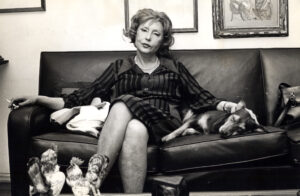
There was a new addition: Ulisses, the dog. On several occasions, Clarice declared that his name did not refer either to Homer or to Joyce, and in her statement for the MIS [Museum of Image and Sound], she said that she had named him after a philosophy student who had fallen in love with her when she was still married, in Switzerland. Although he became a statue, 3 Ulisses was neither nice nor beautiful. He was antisocial, he didn’t let visitors pet him, and he growled. But his loyalty to his owner must be acknowledged.

In 1973, right after Alberto Dines was fired from the Jornal do Brasil, Clarice was also fired. Nascimento Brito had never liked her chronicles. That’s maybe why there was no scheduled meeting, no phone call, no gesture at all. She was dismissed with a note, which was extremely rude, above all considering her prestige as a writer.

Faithful to Alberto Dines, I was also fired.

And in the same year, upon publishing Laura’s Intimate Life, Clarice dedicated it, among other children, to our daughter Fabiana.

It must have been around this time that the dinner episode happened. Affonso and I liked to entertain friends and did so often. One day, to my great surprise, Nélida brought me a message. Clarice was upset because we’d never invited her. I replied that it was only because we imagined that Clarice, who was averse to this type of event, wouldn’t wish to be invited. I immediately asked her over for dinner.

“She eats dinner very early, added Nélida, as if it were a problem.”

“No worries, we can have dinner whenever she wants.”

I told our mutual friends that the time was set for 6:30 p.m. Too early for the Rio crowd, really. Don’t be late, please, I asked. No one was late. Clarice was the last to arrive. And how beautiful she looked! It must have been winter, because over her clothes she was wearing a kind of black and white, zebra-print overcoat, which I remember complimenting. And she was all smiles! She exuded happiness, for feeling beautiful, for having allowed herself to be there.

Busy, because at these dinners I was the head cook, going up and down the stairs, I didn’t catch the moment when her smile disappeared. I went upstairs between appetizers, ready to also have a sip of wine, and she came to meet me, already without the spark she’d shown on arrival, to say she had a bad headache and wanted to leave.

Dinner would be served soon, but I realized in a flash that some spell had been broken and she wouldn’t wait. I discreetly called Affonso and asked him to take Clarice home, since she had a headache. Without understanding, he offered her aspirin and said the pain would soon go away. I gave a meaningful look, and the two of them left. Clarice didn’t say goodbye to anyone. Our friends, all of them close, waited for Affonso to return and for dinner.

She had come seeking lightness, to have a drink and laugh like everyone else, to be carefree for a few hours. But at some point, a disconnect had formed — she was not like everyone else, and for that night at least, lightness was forbidden to her. Better, then, to go home, where she didn’t have to be like anyone else, where she could be herself.


A little before or a little after that, we told Clarice we had gone to a fortune teller and were spellbound by her predictions – which would come true later. It was like plugging her in! She immediately got very excited, she really wanted us to take her. The sooner, the better.

The deepest secret, that which can’t be proven and which the most sensible suspect, was definitely her territory.

The fortune teller, named Nadir, lived in Méier. A few days later, with an appointment booked, there went the three of us in Affonso’s Beetle, following the railroad tracks and watching the train pass by. We talked a lot on the way there, and a certain excitement about diving into the unexpected came with us.

The house had a porch with pots of anthuriums, and the floor was made of those old-fashioned patterned tiles. There was a brief pause for introductions, minimal conversation, and the coffee was already waiting in the thermos. And the two of them went in. They took the time needed to scrutinize the future dictated by the cards. Finally, the door opened. Clarice had a thoughtful expression.


And so she remained on the return trip. The atmosphere in the Beetle had changed, and now the mystery was riding with us. Clarice didn’t say a single word about what Nadir had predicted. But she certainly liked it, because she continued to consult the cards until the end of her life, and made Nadir into her character in The Hour of the Star.


In 1973, Affonso became director of the Department of Letters at the Pontifical Catholic University of Rio de Janeiro (PUC-Rio). And in 1975, he invited Clarice to the 2nd National Meeting of Literature Professors at PUC-Rio. There are photos of the auditorium at this meeting: Clarice in the center, Nélida [Piñon] and I on each side, the three of us focused. What is not in the photo is her reaction, reported later by Nélida, and by herself in a phone call with Affonso.

The panel discussions were eminently theoretical, a duel of knowledge and quotations was underway between two scholars in literature. In the interval that followed the crossing of swords, Clarice got up and left. According to what Nélida told me, and what Clarice repeated in almost the same words to Affonso, the panel presentations were incomprehensible to her and had made her terribly hungry. She would go home to eat roast chicken. That’s what she did. 4


Two years passed, and in April we were together again, this time in Brasília. She had gone to receive the lifetime achievement award from the Cultural Foundation of the Federal District, and Affonso would receive another award. 5 I remember that she seemed to me very different from the still steadfast woman who had killed her theoretical incomprehension by eating chicken. Sitting next to me in the hotel’s garden area was a fragile lady, needing support and asking her companion for her white shawl to protect herself from the non-existent cold. I was impressed by her physical delicacy, as if any breath could knock her down or hurt her.

When she received the award, she said the famous phrase: I don’t deserve this award. This is an award for professionals and I’m not a professional. Professionals write every day, because they need to. I write when I want to, because it gives me pleasure. Modest and proud at the same time, the phrase did not correspond to the truth. Clarice needed writing more than many professionals, she needed it to find herself, she needed it like the air she breathed, she needed it to live. And when she thought she had lost it, she’d call her friends in despair.


In October 1976, invited to give a statement by João Salgueiro, who was then director of the MIS, she agreed. But she asked for Affonso and I, along with João, to be her interviewers. She was terrified of pompous situations, of pretentiously intelligent questions, and she knew that with us she would be free from both.

For some reason that I can’t remember now, we didn’t pick her up at home but arranged to meet downtown at Praça XV, in front of the MIS. I saw her arrive, happy and recovered. And elegant. She was wearing what appeared to be a suede coat. We chatted for a couple of minutes without her giving us any recommendations about what to ask or not to ask, and we walked to the Museum.

The statement lasted around two hours. 6 We began with her biography, her remembering Recife and speaking about her family’s poverty, her mother’s illness, and her childhood. Then we jumped from one topic to another. Clarice, much at ease, spoke about her novels, her writing process, and loneliness. She claimed to be a bold shy person, spoke about her intimacy with chickens, agreed when I compared her to felines, retold the story about the white doves, asked for a cigarette and a Coca-Cola, and lost her train of thought more than once, not because she had forgotten, but because she was relaxed and confident.

When we left the MIS, the three of us felt refreshed. It had been a memorable afternoon.

A year later, we had our final encounter. As had been the case the first time, only I saw her, because her eyes were closed. She was sedated, dying slowly at the Lagoa Hospital. To me, she looked like a little bird under the sheet, despite the swelling. We stayed only a few minutes, time to ask the nurses a few questions. And to say goodbye, which she could no longer do.

Rio de Janeiro, August 2020.

  1. Statement sent to Nádia Battella Gotlib on August 11, 2020 and published in the book Clarice na memória dos outros, in 2024. We would like to thank the publisher Autêntica for authorizing its reproduction on the Clarice Lispector website.[]
  2. The column Just for women signed by Ilka Soares and actually written by Clarice Lispector, in the newspaper Diário da Noite, lasted exactly 11 months, since it was published from April 19, 1960 to March 29, 1961, with a total of 287 weekly contributions.[]
  3. She is referring to the bronze sculpture with a replica of Clarice Lispector and her dog Ulisses installed at the end of Leme beach, in Rio de Janeiro, which was created by Edgar Duvivier and inaugurated on May 15, 2016.[]
  4. Clarice Lispector attended the 2nd National Meeting of Literature Professors, which took place from July 30 to August 3, 1975, in the auditorium of the Rio Data Center (RDC), an event coordinated by Affonso Romano de Sant’Anna, who was then director of the Department of Letters and Arts, now the Department of Letters at PUC-RJ. Clarice Lispector, seated between Nélida Piñon and Marina Colasanti, abruptly left the auditorium because she could no longer bear to listen to the speakers Luiz Costa Lima and José Guilherme Merquior discuss issues of literary theory.[]
  5. Clarice Lispector received the Vladimir Murtinho Award on April 23, 1976, on the occasion of the Tenth Writers’ Meeting, held at the Brasília Park School, located in Blocks 307/308 Sul.[]
  6. The interview given by Clarice Lispector to the MIS on October 20, 1976 was first published in 1991: IMAGE AND SOUND MUSEUM FOUNDATION. Clarice Lispector. Rio de Janeiro: Image and Sound Museum Foundation MIS-RJ, 1991. Statements Collection 7 (interview given to Affonso Romano de Sant’Anna, Marina Colasanti, and João Salgueiro); it was also published in: LISPECTOR, Clarice. Outros escritos. Edited by Teresa Montero and Lícia Manzo. Rio de Janeiro: Rocco, 2005. p. 135-171; and in: SANT’ANNA; COLASANTI. Com Clarice, p. 201-250. In Com Clarice, the authors report, in detail, not only some of the episodes written especially to be published here, but also others related to memories of their time spent with Clarice Lispector, in addition to a chronicle by Marina Colasanti and three articles by Affonso Romano de Sant’Anna about the writer.[]

Notes

Clarice, Mistress

Roncador, Sônia. Clarice, Mistress. IMS Clarice Lispector, 2025. Disponível em: https://site.claricelispector.ims.com.br/en/2025/04/01/clarice-patroa/. Acesso em: 03 April 2026.

The lunch was exquisite, a million miles from any idea of hours spent laboring in the kitchen: before the guests arrived all the scaffolding had been removed. (LISPECTOR, 2022)

I

In August 1967, Clarice Lispector (1920-1977) would accept a proposal from her journalist colleague Alberto Dines, who was aware of her precarious financial situation (“Clarice jornalista,” p. 8), to write chronicles on varied subjects for a weekly column in the Jornal do Brasil.1 Journalism had already served as an opportune way (sometimes the only one) to promote and publish part of her fictional work for almost two decades. Furthermore, according to her biographers, her journalistic activity guaranteed some financial support, above all in the years following her definitive return to Brazil, after fifteen years in exile married to a diplomat. Nonetheless, her “parallel career” as a chronicler and her participation in the lucrative business of columns written by celebrities represented a source of moral stress for the author – who was at the same time concerned about her intellectual reputation and about her form or “style” of writing fiction, which, in her view, the exercise of chronicling could corrupt. In one of her first chronicles for the Jornal do Brasil, “Undying Love” (September 9, 1967), one observes, above all, the author’s discomfort in “writing as a way of earning money” (Too Much of Life), which would compromise her dilettante view of literature and, above all, the myth of the non-professional woman writer, which many intellectuals of her generation, for one reason or another, ended up reinforcing. Such factors, therefore, would reinforce a kind of “rhetoric of self-disqualification” as a chronicler in several of her contributions throughout her six years at that newspaper (1967-73), in addition to the need to separate her “true” literary vocation from the “new” role of chronicler.

In this text about Lispector’s former domestic servants who were regularly part of the “little conversations” or “light impressions” in her written column (her terms), Lispector’s conflicts as a chronicler would gain a thematic nuance that is especially revealing of her positionality as a white, middle-class woman, who was at the same time aware of the role of her employer class in preserving the culture of domestic servitude that has persistently and profoundly shaped the modus operandi of paid domestic service in Brazil. As sociologists Raka Ray and Seemin Qayum (2009) argue: “Those living in a particular culture of servitude accept it as the given order of things, the way of the world and of the home […] servitude is normalized so that it is virtually impossible to imagine life without it, and practices, and thoughts and feelings about practices, are patterned on it” (Cultures of Servitude, p. 4). Lispector takes a critical stance towards the culture of servitude that structures the family life of the Brazilian middle class; at the same time, she makes use of these personal narratives about her intersubjective relationships with former domestic servants as a means of revealing her uncomfortable social position due to enjoying privileges that are morally incompatible with the position of a politically committed intellectual with which she and many writers of her generation identified. In some of these chronicles, as we will see, Lispector tries to compensate for such conflicts by associating herself with an ethics of care as a way of relating to her maids. Nonetheless, this affective gesture never materializes into concrete actions aimed at improving the degrading conditions of her maids, thus revealing a truth expressed in other chronicles of hers about domestic servants: conflicts can be mitigated, but never resolved.

II

Latin American chroniclers have been studied in their mediating role in the processes of formation, problematization, and consolidation of social practices and identities in urban spaces, especially based on their interest in “commenting on the way that we live, the customs and moral values in the social contract of big cities” (“Lispector, cronista,” p. 98).2 The chronicle in Brazil having established itself as a “writer’s genre,” but without losing the epistemological authority of journalism, chroniclers are equally recognized for “standing out in their recording of the everyday in all of its urgency, in their sensitivity to the fascinating diversity of life, in their construction of complete scenes instead of dryly reporting the news” (“Lispector, cronista,” p. 98). In the particular case of Lispector’s chronicles, I am particularly interested in the “construction of complete scenes” of everyday intersocial/racial relations in urban and bourgeois domestic spaces. The set of her chronicles republished in the collection Discovering the World (1984) reveals that, among her experiences of sociocultural diversity in the urban context of Rio de Janeiro, those that were most often recorded in her weekly column were her relationships with distinct former domestic servants (at least ten chronicles in the aforementioned collection are dedicated to the topic).

The frequent allusion to domestic servants in the urban environment of her chronicles demonstrates what is a reality for many middle-class families in the country: incorporated into the intimate environment of the home in the condition of a “domesticated outsider” (CLIFFORD, 1988), the domestic servant constitutes the most lasting and personal relationship that a member of the middle class allows themselves to establish with poverty. The fact that Lispector made use of the space of her Saturday column to produce her public image as a Brazilian intellectual in the face of unresolved social tensions and traumas certainly had an impact on the repertoire of the domestic characters selected for these chronicles. In a sense, her written column served to negotiate and justify her fame as an introspective and formally experimental writer, in a period of cultural history when writers felt compelled to produce texts with explicit political themes – a result, as we know, of the authoritarian military regime that was established in the country for 21 years. On the other hand, as I seek to demonstrate, the author faced the challenge avoided by other writers of her generation and social class: that of exemplifying, through her personal chronicles about former domestic servants, the contradictions inherent in her self-promotion as a socially responsible intellectual in the face of her position of authority and socio-racial privileges.

In a chronicle from her collection The Foreign Legion (1962), “Literature and Justice” – a response to the accusations received in those years for the lack of social and political commitment in her literature –, Lispector argues that the fact that she did not know how to approach “‘the social thing’ in a ‘literary’ way” did not reflect, in her case, a lack of feelings of “justice,” obligation, and social responsibility. “For as long as I’ve known myself,” writes the author, “social issues have been more important to me than anything else: in Recife, the shantytowns were my first truth” (Too Much of Life). The argument is not new that Lispector, contrary to her own self-defense, actually knew how to approach the social problem “in a ‘literary’ way,” although this theme was more frequent and relevant in her literary work in the 1970s. In another chronicle published in the Jornal do Brasil, “What I Would Like to Have Been” (November 2, 1968), Lispector would once again associate the impact of the social drama of the poor with her childhood forays into the outskirts of Recife, as she would also dissociate her literature from her inner feeling of social justice. In this second chronicle, however, she introduces the mediating figure of a domestic servant, without whom her trips to the shanty towns would not have taken place: “In Recife, on Sundays, I would go and visit our maid in her house in the slums. And what I saw made me promise myself that I would not allow that to continue. I wanted to act” (Too Much of Life). As both chronicles reveal, the ethical awareness acquired in childhood (which earned her the nickname “the protector of animals” in her family, p. 217) would keep compelling her to “social action” as an adult – a compulsion transformed into a sense of responsibility (and, as we will see, a maternal obligation) that her activity as a writer, according to her, did not allow her to alleviate: “And yet what did I end up being, and from very early on too?  I ended up being a person who seeks out her deepest feelings and finds words to express those feelings. That is very little, very little indeed” (Too Much of Life).3

Moving between two socially opposed worlds, the domestic servant emerges in many historical and subjective circumstances as a threat to the family and social order of the employer class.4 In Lispector’s chronicles, the domestic servant acts as a double-edged sword: she is the intermediary figure – the “domesticated outsider” – who leads the author to a traumatic, yet edifying, social revelation (a role that Lispector knew how to explore so well in the figure of the maid Janair, in the novel The Passion According to G. H.). On the other hand, although she herself is a woman of social and cultural origins distinct from the author, the domestic servant is also the one who injects the drama of social exploitation into the “protected” domestic world. Furthermore, as Lucia Villares argues, the figure of the domestic servant likewise forces the author to confront herself with the problem of racial difference and hierarchy; that is, to place herself in “a position where her whiteness becomes visible” (“Welcoming,” p. 80).

In one of the many chronicles in which Lispector alludes to domestic servants, “Dies Irae” (October 14, 1967), she writes: “And having maids—let’s be honest here and call them servants—is an offense against humanity” (Too Much of Life). The tone of  “rage” in this passage reveals the difference between the treatment given to domestic servants in the “women’s” columns that she wrote (1952/1959-61) and that which was predominant a few years later in the weekly column of the Jornal do Brasil.5 In both contexts, the author focuses on the difficulties inherent in the mistress-maid relationship, or the domestic disencounters between women of two classes, who were generally of distinct races, although she presents opposite reasons for such conflicts: unlike her columns for women, in these later chronicles, Lispector associates the difficulty of the relationship not with the defects in the maid’s personality and services, but precisely with her servile condition.

In another chronicle in the Jornal do Brasil, “What Lies Behind Devotion” (December 2, 1967), Lispector problematizes the idealized view of “devotion,” or servility, as an expression of love, gratitude, and loyalty from the working class; one can, as she herself argues, be devout while feeling “hatred.” In the chronicle in question, Lispector refers specifically to the domestic characters in Jean Genet’s play The Maids, which she had just seen. “It really upset me,” the author emphasizes, thus revealing to her readers the trauma of this experience: “I saw how maids feel inside, I saw how the devotion we often receive from them is filled with a mortal hatred” (Too Much of Life). According to Lispector, “their long enslavement to masters and mistresses is too ancient to be overcome,” and therefore, “[s]ometimes that hatred remains unexpressed, and takes the form of a very particular kind of devotion and humility.6 Such a reflection makes her think, for example, of the “unexpressed” hatred of a former domestic servant, the previously mentioned Argentine Maria Del Carmen: “She pseudo-adored me. Precisely at those moments when a woman is looking her worst—for example, getting out of the bath with a towel around her head—she would say: ‘Oh, you look lovely, Senhora.’She overflattered me.” (Too Much of Life).7

Nonetheless, without diminishing the value of narratives of social hatred and the censored forms that this feeling may take (pseudo-adoration, excessive flattery), I agree with Marta Peixoto (2002) that the author “reserves for her fiction – especially A paixão segundo G.H. – a view of that relationship that is more critical and fraught with negative emotions” (“Fatos,” p. 111). Perhaps out of attention to the “conventions” of the chronicle genre (for her, “light impressions,” or entertainment narratives), and above all to free herself from possible embarrassments that the role of mistress reserved for her, Lispector elaborates in her weekly column distinct strategies to “attenuate differences and bring out unexpected similarities” with her (former) maids (“Fatos,” p. 113). Accepting her sister Tania Kaufmann’s humorous suggestion that “we all get the cook [or maid] we deserve” (Lispector, Too Much of Life), the author gifts her readers’ Saturdays with some fun facts about her clairvoyant cook, the former maid who “was having psychoanalysis—I mean it” (Too Much of Life), or “[a]nother maid, who went with me to the United States, stayed on when I left in order to marry an English engineer” (Too Much of Life). Furthermore, according to Peixoto (2002), Lispector’s “lyrical and gentle portraits” of the domestic servant – who “accepts differences of experience and values ​​and pardons discreet thefts” (“Fatos,” p. 115) – likewise reveal the predominant treatment of maids in her chronicles for the Jornal do Brasil: the writer speaks of the “[g]uilt, tensions and estrangement” (“Fatos,” p. 115) arising from her countless relationships with maids, although she tries to overcome them through humor or lyricism.

To “attenuate” the social differences brought into her domestic world by a “maid,” she tends to highlight certain eccentricities in her the personality of her maids that divert the focus from the exploitative relationship to less embarrassing areas of this daily intersocial/racial interplay. However, if on the one hand she frees her maids from certain negative stereotypes (some of which are used in her columns for women), on the other, she ends up fixing them in a new taxonomy of personalities and quirks. Types such as the comic cook, maids with an artistic vocation and a keen sense of human psychology, or even “unconscious” ones (due to psychotic episodes or brief “distractions”) end up integrating themselves more into the fictional universe of her characters than into the embarrassing domestic space of social differences. Lispector’s attempts to “attenuate” such differences and “bring out unexpected similarities,” however, do not always seem to her like a project that is possible to undertake. In a passage from her manuscript “Objeto gritante” [Screaming Object], Lispector, for example, anticipates the shock of incomprehension that her “backcountry” maid, Severina, would feel when she sees the sea for the first time: “She may feel bad. Because the sea is not understandable. It is felt and is seen. I am putting myself in the shoes of this maid named Severina. And being her, I get really frightened. I must have seen the sea for the first time. But I don’t remember [….]” (“Objeto gritante,” p. 71).8 As is known, the sea constitutes an important motif in Lispector’s work; in her writing, a simple act of entering the sea can become a solemn ritual. Among other factors, the sea exerted a true fascination on the author by stimulating her reflections on the possibilities of maximum self-expansion and of true contact with non-human existences. In the aforementioned passage, Lispector projects onto her maid’s unprecedented encounter with the sea a reaction similar to her own or that of her literary characters, only to later abandon this projection: “I will fire Severina: she’s too empty. I didn’t have the courage to take her to see the sea: I was afraid of feeling for her what she didn’t feel. She’s from the Northeast and is empty from so much suffering.” (“Objeto gritante,” p. 74).9

It is, therefore, from the accounts of the “surprisingly” talented, perceptive, and sagacious maids that the author creates the typical panorama of the domestic servants who frequent her chronicles. On the one hand, Lispector highlights the poetic meaning and effect of phrases said by the domestic servants in their daily interactions, as is the case, for example, of her maid Rosa, in “The Italian Girl” (April 4, 1970; previously published in The Foreign Legion as “An Italian woman in Switzerland”): “I really don’t know why I like autumn more than the other seasons, I think it’s because in the autumn things die so easily [….] She also says: ‘Have you ever bawled your eyes out for no reason? Well, I have! And she roars with laughter” (Too Much of Life).10 In “One Thing Leads to Another” (May 16, 1970), Lispector is moreover surprised by her cook “humming a lovely tune, a kind of harmonious plainchant. I asked her who had written it. She replied: oh, it’s just some nonsense I came up with myself.” (Too Much of Life). Nonetheless, as happens with other projects to increase the aesthetic value of popular expression, in these chronicles, Lispector has to make use of her artistic authority to add to the “creative” words or “harmonious” melodies of her employees a symbolic value unrelated to their intention. As she herself admits, with respect to this cook whose “mouth can sing,” “she [the maid] didn’t know she was creative” (Too Much of Life).

In one of her most interesting chronicles on the subject of domestic servants, “Sunday Tea” (March 7, 1970; published in The Foreign Legion under the title “The tea-party”), Lispector also highlights the poetic impact (albeit involuntary) of several isolated phrases that she attributed to the maids that she had had throughout her life. In this chronicle, the author imagines herself as the host of a tea party offered to “all the maids who have ever worked for me” – “[a]lmost like a tea for ladies, except for there would be no complaints about maids” (Too Much of Life). Aside from the ironic tone of the comparison, the narration of this imagined social gathering does not intend to realistically portray this quasi “tea for ladies.” First of all, the imagined setting for the tea party would be Rua do Lavradio, where her character Macabéa would later walk in The Hour of the Star (1977). Furthermore, it mixes elements of a peripheral urban setting (the port area of ​​Rio) with “a certain air of theater of the absurd” (Arêas, “Peças,” p. 563):11 at first the maids “would sit, hands folded on their laps [….] Silent” (Too Much of Life), and then, “brought back to life, the living dead,” they would begin to “recite” phrases that were once said spontaneously and that, through the effect of humor, beauty, banality, revelation, or even discomfort, were retained in the author’s memory: “Silent – until the moment when each one would speak and then—brought back to life, the living dead, would recite what I remember them saying” (Too Much of Life).

Lispector, for example, once again “remembers” what the aforementioned Italian maid, Rosa, had said to her upon hearing the comment of a stranger on the street about the simultaneous fall of the last autumn leaves and the first snow: “‘It’s raining gold and silver.’ I pretended not to hear him, though, because, if I’m not careful, men can do whatever they like with me.” (Too Much of Life). Sometimes, however, she confesses that a single banal phrase, such as “I like movies about hunting” was “all that remains to me of an entire person” (Too Much of Life).

It is likely, on the other hand, that from her daily interactions with domestic servants, the author learned that in the banality of certain phrases are found hard truths, such as “When I die, a few people will miss me. But that’s all” (Too Much of Life). One observes in another phrase “recited” by one of her former domestic servants the revelation that maternal love can manifest itself in the form of a violent desire, which is not always repressed (a theme in her famous short story “The Foreign Legion”): “He was such a lovely little boy that I almost felt like spanking him” (Too Much of Life). But it is from the “oldest of them all,” the maid whose “tenderness always had a bitter edge,” that Lispector seems to draw the most profound lesson – “to forgive cruelty lovingly”—, which is for her a product of her humiliating servile condition:

Here comes Her Ladyship,” and the oldest of them all stands up, the one whose tenderness always had a bitter edge and who taught us early on to forgive cruelty lovingly. “Did Her Ladyship sleep well? Her Ladyship likes her luxuries. She knows what she wants too—she wants this, she doesn’t want that. Her Ladyship is white. (Too Much of Life)

The aesthetic effect of a “certain air of theater of the absurd,” as well as the emphasis on the performance of reciting the phrases, demonstrate that, if on the one hand the author proposes to “give voice” to the maids by quoting phrases such as the aforementioned ones, on the other, she introduces such phrases in a decontextualized way – which intensifies their poetic force but dilutes their practical and, in some cases, political function. Furthermore, limited by her memory, Lispector recuperates from her interactions with various domestic servants only those phrases that would manage to reduce her uncomfortable and guilt-ridden social distance. In a sense, she “resurrects” through this curious tea party of ghostly maids the (verbal) fragments of this interaction that constitute the general picture of the domestic servants that the author would have liked to have, and to “deserve.” The singularity of Lispector’s domestic servants did not go unnoticed by the writer Paulo Mendes Campos, in whose chronicle “Minhas empregadas” [My Maids] he comments, with a certain jealousy, on the “subtleties” (p. 186) or “a certain finesse of psychological reactions” in his friend’s domestic servants, when he, on the contrary, saw himself “unfortunately destined to have maids who were a bit, so to speak, feeble-minded” (Campos, “Minhas empregadas,” p. 185). According to Campos, “often saying things that recall her characters,” many of Lispector’s domestic servants end up “imitating her art” (“Minhas empregadas,” p. 185).12 The last paragraph of “Sunday Tea,” actually a long collage of parts of the phrases recited at this pseudo “tea for ladies,”  can be applied to Campos’ comment: on the one hand, Lispector highlights, through the speech of her maids, certain invisible aspects of their “psychological conditions;” on the other, she manipulates the speech of the domestic servant (by selection, composition, cuts, decontextualization) in such a way as to emphasize her own aesthetic and thematic preferences much more than the possible tensions that this speech would certainly generate in its real context:

Food is all a matter of salt. Food is all a matter of salt. Food is all a matter of salt. Here comes Her Ladyship: I hope you get what no one can give you, but only when I die. It was then that the man said it was raining gold, yes, what no one can give you. Not unless you’re afraid of standing in the dark, bathed in gold, but alone in the darkness. Her Ladyship likes her luxuries, but the poor variety: leaves or the first snow. Savor the salt that you eat, don’t harm any lovely little boys, don’t giggle when you ask for something, and never pretend that you didn’t hear if someone should say: Listen, woman, it’s raining gold and silver. Yes. (Too Much of Life)

In her weekly chronicles about domestic servants, Lispector thus recognizes the tensions of this intersocial/racial domestic coexistence, and although she is overcome with embarrassment and guilt, she tries to dissolve such tensions through the narration of very humorous situations. In addition, the author values ​​the perceptive and creative potential of domestic servants as a means of diverting to aspects of this daily relationship that could alleviate the embarrassing social inequality and their servile condition. Nonetheless, she sometimes resents not being able to perform this “redeeming” gesture, as is the case with the aforementioned domestic servant Severina, the “empty” Northeastern woman, who, perhaps for reinforcing (instead of diminishing) her guilt, she ends up firing: “I want a maid who’s completely alive even if she gives me more work,” the author justifies. “I can’t have a dead thing at home” (“Objeto gritante,” p. 75).13

III

Various chronicles by Lispector reveal, however, that a “maid who’s completely alive” can be equally problematic, not only because she “gives me more work,” but also because she disrespects the protocols of servile behavior and the social boundaries that the author, although guilty, is not interested in breaking. For example, in the chronicle “The Silent Girl from Minas Gerais” (November 25, 1967), the maid Aninha seems to overcome her “empty,” half-dead state by means of an unusual interpellation of her author/employer; in this case, a request to Lispector to lend her one of her books. The sequence of scares, hesitations, pretenses, and finally, refusals on the part of the author reveals that she also does not wish to replace a relationship of social exploitation (despite the embarrassment that this imposed on her) with a less “hierarchical” social contract between author and reader: “I didn’t want to give her one of my books to read, because I didn’t want to create an overliterary atmosphere at home, and so I pretended I had forgotten” (Too Much of Life).

At the beginning of the chronicle, mistress and maid silently perform the domestic activities that at the same time define them in the hierarchical organization of domestic service and separate them physically and socially: “One morning, she [the maid] was tidying a corner of the living room, and I was in another corner, doing some embroidery” (Too Much of Life). The aforementioned request from the maid, although made in a “muffled” voice, nonetheless comes not only to disturb the comfortable silence of that morning, but also to bring to light the embarrassing social difference: “I felt embarrassed,” reveals the author. “I was frank though: I told her that she wouldn’t like my books because they were rather complicated.” (Too Much of Life). The use of humor at the end of the chronicle reveals, I repeat, that the author’s recognition of the tensions and disencounters inherent in her day-to-day life with the maids does not take place without, at the same time, her trying to attenuate (but not resolve) such tensions: “It was then, as she continued her tidying, and in an even more muffled voice, that she said: ‘I like complicated things. I don’t like sugared water.’” (Too Much of Life). Lispector would reserve the narration of the continuation of this brief interlude with her maid Aninha for the aforementioned chronicle “What Lies Behind Devotion,” published on the Saturday following “The Silent Girl from Minas Gerais.” To compensate for her refusal to comply with her maid’s request, “because I didn’t want to create an overliterary atmosphere at home,” the chronicler, “[i]nstead, I gave her a detective novel I had translated” (Too Much of Life). However, despite the author’s prejudices, the chronicle reveals that the maid Aninha’s literary preferences did not seem to include a type of literature that Lispector considered more accessible: “I’ve finished reading that book,” says Aninha, referring to the detective novel translated by Lispector. “‘[I] liked it, but I did find it a bit childish. I’d like to read one of your books.’ She’s persistent, the girl from Minas Gerais. And she actually used the word ‘childish’” (Too Much of Life). It is possible, without a doubt, to relate these passages about Aninha’s literary tastes to the negative criticism that Lispector received about the hermetic nature of her literature; in other words, the author may have used the responses, invented or not, of a maid to ironically retaliate against the opinion then current among readers and some critics that her books were excessively obscure and unpopular. Nonetheless, her refusal to share her literary production with a maid reveals, on the other hand, that the author, although resentful of the critical attacks, also did not seem interested in promoting herself as a writer who was read and appreciated by members of different social classes.14

The maid Aninha would be the theme of two more chronicles for her column in the Jornal do Brasil: “God’s Sweetnesses” and “More of God’s Sweetnesses” (December 16, 1967). But, unlike the previous chronicles about this “silent girl from Minas Gerais” who liked to read complicated texts, here humor and irony are substituted by lyricism. Lispector would choose the same lyrical tone for another chronicle about (former) maids, “Gentle as a Fawn” (January 27, 1968). In both chronicles, the change or substitution of tone constitutes, in my opinion, the materialization of a maternal feeling, which the author would reserve only for a few maids, particularly those who are associated with the aforementioned “unconscious” type. In “Gentle as a Fawn,” the “unconsciousness” of the maid in question, named Eremita, is associated with her moments of mental “repose” or “distraction:” 


For [Eremita] had moments of distraction. Her face took on a smooth mask of impassive sadness. A sadness more ancient than her nature. Her eyes became vacant; one might even say a little cold. Anyone near her suffered without being able to help. All one could do was to wait. (Selected Crônicas, p. 19).
 

In “God’s Sweetnesses,” as I will demonstrate, the mental “distraction” of the maid Aninha acquires a pathological aspect, although at the same time “sweet” and “crude.”

It is valid, on the one hand, to associate Lispector’s special interest in her “unconscious” domestic servants with her long trajectory of exploring and valuing irrational modes of experience, or in the terms of the narrator of Água Viva, what one experiences when one courageously frees oneself from the limits imposed by “reasoning” to acquire, “beyond thought,” the paradoxical vision of the formless: “but now I want the plasma – I want to eat straight from the placenta” (Lispector, Água Viva, p. 3). In the context of her chronicles about domestic servants, on the other hand, this experience inspires a particular interest because it is presented as a possibility of redemption from the servile condition of this social group. Perhaps this is the reason why, contrary to the expectations of her employer class, the chronicler, in “Gentle as a Fawn,” shows herself more interested in the almost not at all productive “distractions” or “reposes” of the maid Eremita than in her services. Furthermore, even when reintegrated into the order of capitalized domestic chores (e.g. washing clothes, mopping the floor, hanging the laundry), Eremita remains above her status as a servant, given that such tasks are transformed, in this text, into a simulacrum of a primitive ritual of worship “to other gods.” In confluence with other chronicles, Lispector describes the distracted moments of Eremita, “this strange infanta,” as a dangerous descent into her inner depths, or rather, to the “profundity” and “darkness” (Selected Crônicas, p. 12) of herself (“Yes, she had hidden depths”).

In the chronicle “State of Grace—A Fragment” (April 6, 1968), this descent constitutes an “entrance to that paradise” (Too Much of Life); here, it is a “short cut into the forest” (Selected Crônicas, p. 12). According to the chronicler, upon returning from the “forest,” Eremita set herself to subversively performing her duties, since by appearing (simulating?) obedience to her mistress, she actually “took care to serve from a much greater distance, and to serve other gods:” “For anyone looking closely would have noticed that she washed clothes in the sun; that she mopped the floor – drenched by the rain; that she hung the sheets – out in the wind” (Selected Crônicas, p. 12). “Gentle as a Fawn” is, in this sense, one of her most transgressive representations of the social order, where the hierarchical mistress-maid relationship is established; at the same time, ironically, this text constitutes one of the most comfortable types of domestic servant in her chronicles, where even the social signs associated with Eremita – hunger, “the rudeness typical of maids,” fear, and “petty theft” – are naturalized, or devoid of a political-ideological meaning, to serve the mysterious and insubjugable image of the girl: “There was nothing hard about her, there was no suggestion of any perceptible law. ‘I was afraid,’ she would say quite naturally. ‘Boy, was I hungry!’ she would exclaim, and for some strange reason there was never any more to be said” (Selected Crônicas, p. 12).

It is only in the chronicle “God’s Sweetnesses” that Lispector, on the contrary, reveals the frustrations and failures implied in the attempt to compose an empowered image, redeemed from guilt, of her maids. At the beginning of “God’s Sweetnesses,” Lispector addresses her readers, in an almost accusatory tone, to point out their indifference to, and neglect of, her maid Aninha, despite only two weeks having passed since the publication of “What Lies Behind Devotion:” “You will probably already have forgotten my maid, Aninha, the silent girl from Minas Gerais, the one who wanted to read one of my books even if it was complicated, because she didn’t like ‘sugared water.’” (Too Much of Life). I am drawn by the ambivalence of this passage by Lispector, which denounces the neglect of her readers (a reflection, certainly, of a dominant culture of indifference to domestic servants), while acknowledging, on the other hand, their admiration and loyalty as constant readers of her columns; such a passage reveals that Lispector, a few months after her first chronicle in the Jornal do Brasil, assumed that she had achieved a loyal readership, who regularly followed the texts of her column on Saturdays. At the same time, it caused her some embarrassment to benefit from a social system in which writers received the affection and loyalty of a public that, for its part, was incapable of treating its maids in the same way. Furthermore, the author denounces the forgetfulness of the readers, which contrasts with her qualities as an affectionate mistress and the dominant lyricism in this text: “what I did not perhaps mention was that, in order for her to exist as a person, she needed you to like her. You may have forgotten her, but I will never forget her” (Too Much of Life).

The chronicler “will never forget” a morning when Aninha had returned home from a supposed trip to the market, with the money still crumpled in one hand, and her shopping bag full of bottle caps and pieces of dirty paper in the other, to “decorate my [her] room.” Examined by a resident doctor at the Pinel Institute, the girl was promptly diagnosed as a victim of a psychiatric episode and committed, not without the intervention of some of the author’s influential friends. The unique way in which Aninha’s pathology is described reveals that, despite the affection and care of her mistress, it was necessary for the maid to go crazy in order to effectively “exist as a person.” First of all, Aninha (whom the author, without knowing why, insisted on calling “Aparecida,” or the one who “appeared”) “was somehow a little more aparecida, as if she had taken a step forward” (Too Much of Life). Furthermore, “now her very expression was childish and clear:” “I’ve never seen such sweetness,” the author reinforces (Too Much of Life). The brief dialogue between Lispector and the psychiatrist, “whom I later learned was Professor Artur” (Too Much of Life), nevertheless, snatches the author away from her world of “childish expressions” and “sweetnesses” to the social reality of that which only to her “was somehow a little more aparecida:” Aninha, actually, was nothing but a servant to the others. Upon learning of the author’s identity, the resident psychiatrist – himself a reader of Lispector – was “far more interested in me than in Aninha” (Too Much of Life). There is a repetition, at the level of the story, of the same feeling of discomfort that sometimes admiration (in this case, from her readers) can cause, above all when it is based on an unfair social hierarchy: “he added politely, effusively, far more interested in me than in Aninha: ‘It’s such a pleasure to meet you.’ And foolishly, mechanically, I responded:’Oh, me too.’” (Too Much of Life). On the other hand, as Debra Castillo (2007) argues, this unbalanced exchange of effusions and sympathies (on the part of the doctor) and mechanical and shaken responses (from Lispector) makes evident the author’s own unstable social position, which is conditioned by “suppositions of social class and gender” (Castillo, “Lispector, cronista,” p. 105).15 In fact, the question “Are you a writer?” – first asked by the maid Aninha and then by the resident doctor – generates two distinct responses, depending on the social position occupied by Lispector: “Authoritarian in the first case, confused and subordinate in the second” (“Lispector, cronista,” p. 105).16

In addition to giving her the “childish and clear” expression of a person who was, still in Lispector’s terms, “partially awake” (Too Much of Life), Aninha’s “crazy sweetness” was, so to speak, contagious: “I, too, felt a kind of sweetness inside, which I can’t explain. Yes, I can. It was love for Aninha” (Too Much of Life); or even: “The apartment was filled with the kind of crazy sweetness that only the now vanished Aninha could leave behind” (Too Much of Life). But this is not the first time in her chronicles that the author highlights the “contagious” component of “sweetness:” “The sweetness is contagious: I grow still and sweet too,” writes Lispector in “Black Doe” (April 5, 1969; published in The Foreign Legion as “Africa”) when “surrounded by skinny, black, half-naked girls” (Too Much of Life), during her brief stay in Liberia. In this chronicle, Lispector describes a series of frustrated attempts to communicate with the residents of the “towns of Tallah, Kebbe and Sasstown, in Liberia” (Too Much of Life), where a sign of goodbye (“They love waving goodbye”) can be answered with “obscene gestures” (Too Much of Life), a very long sentence in which “I cannot hear a single r or s, just variations on the scale of l” (Too Much of Life) is summarized by the interpreter with a very brief “She likes you,” and even the English poorly assimilated by the natives sounded like “another local dialect” (Too Much of Life). For, to contrast with these lapses of language and gestures, or precisely at the moment when the author, feeling “awkward,” tries to show the use of her headscarf to an indifferent group of young black women, she becomes contaminated by the “sweetness,” whose only concrete manifestation consisted, as in the case of the “crazy and gentle” maid, in a certain expression on her face: “In their opaque faces, the painted stripes are looking at me. The sweetness is contagious [….]” (Too Much of Life). The state of sweetness is as mysterious as it is frequent in Lispector’s chronicles and fiction. This obviously does not concern the subaltern “sweetness” idealized by the employer class (synonymous with absolute devotion, as is the case in the mammy myth), although it is generally associated in Lispector’s work with those who are in a position of subalternity (animals, in “State of Grace—A Fragment” a peasant woman, in “Such Gentleness;” fools, in “On the Advantages of Being a Fool”). Sweetness, in this case, is the crucial (utopian?) state for the contact, literally the tact, between women of distinct sociocultural conditions, since it dispenses with the desire for “comprehension” and language: “One of them steps lightly forward, and as if partaking in a ritual—movement and gesture are everything to them—she very intently touches my hair, strokes it, feels it. They all watch. I don’t move, so as not to frighten them.” (Too Much of Life).

In the chronicle “God’s Sweetnesses,” Lispector likewise narrates her “ritual” of contact with a domestic servant: here, it had been necessary for the maid to have “appeared” in her gentle madness, or contagious sweetness, and no longer through the disturbing desire to read her mistress’ books. Nonetheless, for such a state of “sweetness,” or of “love,” Lispector’s reactions following the departure of her maid Aninha are somewhat “fierce:” “[S]he didn’t like ‘sugared water’ and she certainly wasn’t that,” writes the author, finally realizing a less ironic meaning, or effect, for such a cliché-expression. “Neither is the world, as I realized again that night when I sat up into the small hours, smoking fiercely. Oh, how fiercely I smoked! Sometimes I was filled with anger, then horror, then resignation” (Too Much of Life). According to Castillo, such reactions result from the experience of self-awareness, or revelation, in which the maid Aninha “serves as Lispector’s mirror, exposing the ugliness of her social preconceptions” (“Lispector, cronista,” p. 104).17 In my view, nevertheless, instead of a narcissistic attention focused on oneself, where the other acts only as a “mirror,” such “fierce” reactions reveal, on the contrary, a “troubled sense of maternal obligation” (“Fatos,” p. 109), which is more consistent with the author’s other social chronicles. In general, her encounters with the precarious reality of subjects who circulate in the immediate spaces of her chronicles are narrated as traumatic experiences of a renewed awareness of unresolved social wounds: “Neither is the world [‘sugared water’], as I realized again [….]” (Too Much of Life)

On the other hand, no matter how traumatic this view of precariousness is, Lispector likewise feels/expresses a compulsion to “social action,” which in some texts she defines as a duty to “take care of the world.” In the chronicle “I’m Taking Care of the World” (March 4, 1970), she writes:

Before I go to sleep and take care of the world in the form of my dreams, I make a point of checking that the night sky is full of stars and is navy blue, because there are nights when it appears to be navy blue not black [….] I observe the boy who must be about tem, terribly skinny and dressed in rags. A tubercular future awaits him, if it hasn’t already arrived [….] Is taking care of the world hard work? Yes. And I remember the terrifyingly inexpressive face of a woman I saw in the street. I take care of the thousands of people living in the favelas on the hillsides [….] You might well ask why I take care of the world: it’s because that’s the job I was given when I was born. And I’m responsible for everything that exists [….]. (Too Much of Life)

If “taking care of” means “checking” on or being “responsible for” something or someone, this expression can likewise be read as “caring for” and “protecting” the other whose capacity for agency is perceived as null or precarious. Lispector then feels called to respond maternally to the sight of the malnourished, tubercular boy, or to the difficult memory of an anonymous and “terrifyingly inexpressive” woman’s face. In other words, she adopts a “maternal thinking” (in Sara Ruddick’s terms)18 when she speaks of these anonymous, precarious subjects and “people living in the favelas on the hillsides” to justify her continuous and exhausting task of “taking care of the world” and of feeling “responsible for everything that exists.” I leave out of the discussion the impossibility of such an incumbency and, certainly, the maternalist implications of her role as “protector of the poor and animals,” to highlight the fact that such an attitude makes reference to the sui generis form of social commitment based on an “ethics of care.”19 On the other hand, as Marta Peixoto (2002) argues, Lispector’s “activity of taking care proves to be no more than a careful observation of the visual surfaces of the world and is thus completely self-enclosed, in no way affecting, for better or for worse, the objects of care, which include the dispossessed” (“Fatos,” p. 109). In the chronicle in question, Lispector tries to give the maid Aninha a better place in the world, where even her “ugliness” (“I forgot to mention that Aninha was very ugly”), or her “lack of taste” in dressing, “was another of her sweetnesses” (Too Much of Life). However, her maternal “activity” is limited to recording Aninha’s sweetness, even for an audience that, she knew very well, would forget her in a short time: “Dear God, who could possibly love her? The answer: dear God” (Too Much of Life).

IV

Acting in Lispector’s chronicles as a mediator between two socially opposed worlds and, on the other hand, as a sign of socio-racial otherness in the chronicler’s family universe, the domestic servant therefore acts on the self-constitution of the ethical subject in an ambivalent manner: she is the pretext for the chronicler’s traumatic but morally edifying incursions into peripheral urban areas, although she likewise acts in these chronicles as a source of guilt and embarrassment. Lispector recognizes her conflicts and the tensions inherent in the mistress-maid relationship, but she is unwilling to answer to the demand that the presentation of these conflicts produces. This is perhaps why such conflicts and tensions are manifested as a state of attention (versus a “social action”). On the other hand, despite her oscillations between “seeing” and “not seeing” (“Fatos,” p. 119) the conflicts generated by this affective-labor relationship of social exploitation, the chronicler proposes something original in the history of Brazilian literature. In the first place, she introduces the class trauma and guilt triggered by the encounter with poverty. As Jean Franco (2002) argues, “[a]lthough apparently motivated by the modernist desire to represent and control dangerous material [in the form of cultural fields], Lispector’s encounter with the low is invariably shattering” (Franco, “Seduction of Margins,” p. 204). Furthermore, from the social disencounters in her domestic family universe, Lispector extracts an aspect – the maid’s imaginary gaze at her mistress, or her “censored resentment” – that for obvious reasons challenges the mythologized appropriation of the domestic servant as a symbol of interracial fraternization (the mammy, the seductive mulatto).

Such reflections unfold in her 1970s narrative in a series of questions about the power of the intellectual, and of literature, to intervene in the state of things in the world. Certainly, her inquiries are somehow integrated into the “culture of defeat” (FRANCO, 2002), a characteristic of the post-utopian, or post-revolutionary, Brazilian literature of those years; in the terms of Renato Franco, a literature forced to “narrate the impasses of the writer who could not decide if it was more necessary to write or to become involved politically, thus constituting a type of novel that was disillusioned both with the possibilities for society’s revolutionary transformation and with his or her own condition” (“Literatura e catástrofe” [Literature and Catastrophe], p. 358).20 In her own way, Lispector would arrive at similar impasses in those years. For example, in The Hour of the Star (1977), the narrator is willing to tell “the lame adventures” of the northeastern migrant woman Macabéa, although he does not expect to overcome, through literary mediation, the social distance between himself and his character: “This book is a silence. This book is a question.”

The various testimonies of domestic servants that emerged from the 1980s onwards in Brazil are a sign that, for one reason or another, the “silence” or the “question” did not meet the new political pressures imposed by the emergence of popular social movements. Nor did the “silence” serve as a response for the emerging domestic servant authors who saw their cultural practices as an unprecedented exercise in citizenship. Therefore, despite confronting the contradictions between her positionality as a mistress and her opposition to the culture of domestic servitude, Lispector is generally close to other canonical Brazilian writers. Her chronicles about domestic servants seem to be more at the service of building her public image than of the interpretative struggle to revise the stereotypes that have been producing stigma and injustice against domestic workers in modern Brazilian society.

  1. This essay was originally written for the book O cuidado em cena: Desafios políticos, teóricos e práticos, 2018, edited by UDESC, from Florianópolis. We are grateful to Marlene Tamanini and Francisco Gabriel Heidemann for granting us permission to republish it.[]
  2. [Translator’s note: the original quotes in Portuguese read: “comenta[r] a forma como vivemos, os costumes e valores morais no contrato social das grandes cidades;” “gênero de escritor;”  “sobressair-[se] no registro do cotidiano em toda a sua urgência, na sensibilidade à fascinante diversidade da vida, na construção de cenas completas em vez de, secamente, recontar as notícias.”[]
  3. It is worth highlighting the fact that her sense of social responsibility and condescending attitude as a “protector of animals” ends up reinforcing a certain maternalist ideology, which, according to Judith Rollins, tends to define the relationships between employers and their domestic servants.[]
  4. The maid as a sign of mediation between opposing worlds (house/street; living room/back of the house; etc.) appears frequently in literature, above all in childhood memoirs. See Leonore Davidoff’s study on the domestic servant in children’s memoirs of the British Victorian period, “Class and Gender in Victorian England” (In: Worlds Between: Historical Perspectives on Gender and Class. Cambridge: Polity Press, 1995); also see the analysis of the domestic servant in the shaping of the child Walter Benjamin’s desire in Peter Stallybrass & Allon White, “Below Stairs: the maid and the family romance” (In: The Politics and Poetics of Transgression. Ithaca: Cornell University Press, 1986). In Lispector, one of the most interesting examples of the domestic servant in her role as mediator between the bourgeois universe and that of poverty appears in a passage, still unpublished, from her manuscript “Objeto gritante” [Screaming Object] (on the passage in question, see my essay “Nunca fomos tão engajadas: Style and Political Engagement in Contemporary Brazilian Women’s Fiction.” In: Anne J. Cruz et al. (ed.). Disciplines on the Line: Feminist Research on Spanish, Latin American, and U.S. Latina Women. Newark, DE: Juan de la Cuesta Press, 2003).[]
  5. Her little-known production as a columnist on issues “for women” in some Rio de Janeiro newspapers was partially published after the exhaustive work of Aparecida Maria Nunes, who selected and edited her women’s chronicles in three collections: Correio feminino (2006), Só para mulheres: conselho, receitas e segredos (2002), and Clarice na cabeceira: jornalismo (2012) – all published by the Rocco publishing house.[]
  6. Her reference to domestic slavery constitutes one of the rare passages in her chronicles in which race is treated as a relevant factor in the structuring of relationships between mistresses and maids.[]
  7. As Vilma Arêas reveals in “Peças avulsas” [Individual Pieces], the view of the “ódio censurado” [censored hatred] of domestic servants appears in her literature based on the personal reading of a newspaper article, “Un ‘prolétariat’ en Tablier Blanc,” written by Elvire de Brissac and published in Le Monde on March 14, 1963. According to the article in question, the “condições psicológicas” [psychological conditions] of this social group, or the feelings that constitute their relationship with their mistresses, are precisely repressed resentment, humiliation, and alienation.[]
  8. LISPECTOR, Clarice. “Objeto gritante.” Clarice Lispector Archive. In: Archive-Museum of Brazilian Literature at the Rui Barbosa House Foundation, Rio de Janeiro, 1971. [Translator’s note: the original quotes in Portuguese read: “sertaneja;” “É capaz de sentir-se mal. Porque o mar não é compreensível. É sentido e é visto. Estou me pondo na pele desta empregada que se chama Severina. E eu sendo ela fico toda assustada. Devo ter visto uma primeira vez o mar. Só que não me lembro…”] []
  9. [Translator’s note: the original quote in Portuguese reads: “Mandarei embora Severina: ela é oca demais. Não tive coragem de ir levá-la a ver o mar: temia sentir por ela o que ela não sentisse. É nordestina e é oca de tanto sofrimento.”] []
  10. As the author explains in this chronicle, it concerns an immigrant maid from Italy during her years in Berne, Switzerland.[]
  11. [Translator’s note: the original quote in Portuguese reads: “um certo clima de teatro do absurdo.”[]
  12. [Translator’s note: the original quotes in Portuguese read: “sutilezas;” “certas finuras de reações psicológicas;” “bastante fatalizado a ter empregadas um pouco, como se diz, sôbre a débil mental;” “a falar frequentemente coisas que lembram as personagens;” “imita[r]-lhe a arte.”[]
  13. [Translator’s note: the original quotes in Portuguese read: “Quero empregada toda viva embora me dê mais trabalho;” “Não posso ter coisa morta em casa.”] []
  14. Lispector would once again mention the use by a domestic servant of erudite, sophisticated words, that is, words “proper” to the employer class, to narrate a situation of social “enigma.” In the chronicle in question, “Enigma” (April 26, 1969), she accidentally meets a woman in the elevator of her building who “spoke like the mistress of the house, her face was that of the mistress of the house,” (Too Much of Life), but who had entered “her” apartment “by the service entrance” and, moreover, “was wearing a uniform.” Nevertheless, since it concerned someone else’s maid, this shaking of social boundaries does not “embarrass” her; the final mood of this chronicle appears more out of obedience to its generic “conventions” than out of a need on the part of the author: “‘And—I swear—she added this: ‘Life has to have a sting in the tail, otherwise you’re not really living.’ And she used that expression ‘a sting in the tail,’ which I really like” (Too Much of Life).[]
  15. [Translator’s note: the original quote in Portuguese reads: “pressupostos de classe e sexo.”] []
  16. [Translator’s note: the original quote in Portuguese reads: “autoritária no primeiro caso, confusa e subordinada no segundo.”] []
  17. [Translator’s note: the original quote in Portuguese reads: “serve de espelho para Lispector, expondo a feiura de seu preconceito social.”] []
  18. RUDDICK, Sara. Maternal Thinking: Toward a Politics of Peace. 2nd ed. Boston: Beacon Press, 1995.[]
  19. Despite the controversies surrounding her proposal to dissociate the “work” of maternity from the figure of the biological mother, in addition to a somewhat bourgeois view of this maternal work, Sara Ruddick’s book, Maternal Thinking (1st edition, 1989) inaugurated an important debate on the ethical implications of maternal care. According to Peta Bowden, in Caring: Gender-Sensitive Ethics (New York, London: Routledge, 1997), “Ruddick attempts ‘to identify some of the specific metaphysical attitudes, cognitive capacities, and conceptions of virtue [….] that are called forth by the demands of children [adopted, biological, or raised]’ (MT, p. 61), with the aim of ‘honouring’ ideals of reason that are shaped by responsibility and love rather than by emotional detachment, objectivity and impersonality. Her claim is that the practices arising from mothers’ responses to ‘the promise of birth’ have the potential to generate and sustain a set of priorities, attitudes, virtues and beliefs that inform an ethics of care and a politics of peace” (Bowden, Caring, p. 24–5).[]
  20. [Translator’s note: the original quotes in Portuguese read: “cultura da derrota;” “narrar os impasses do escritor que não sabia decidir se era mais necessário escrever ou fazer política, constituindo assim um tipo de romance desiludido tanto com as possibilidades de transformação revolucionária da sociedade como com sua própria condição.”] []

Referências

ARÊAS, Vilma. “Peças avulsas.” In: O mestre. São Paulo: Green Forest do Brasil Editora, 1997. p. 560-569.

BOWDEN, Peta. Caring: Gender-Sensitive Ethics. New York; London: Routledge, 1997.

CAMPOS, Paulo Mendes. “Minhas empregadas.” In:_____. O cego de Ipanema: Crônicas. 2nd ed. Rio de Janeiro: Editora do Autor, 1961. p. 185-88.

CASTILLO, Debra. “Lispector, cronista.” In: Clarice Lispector: Novos aportes críticos. Ed. Cristina Ferreira Pinto Bailey et alii. Pittsburgh: Instituto Internacional de Literatura Ibero-americana/Universidade de Pittsburgh, 2007. p. 95-108.

CLIFFORD, James. The Predicament of Culture: Twentieth-Century Ethnography, Literature, and Art. Cambridge, MA; London: Harvard University Press, 1988.

DAVIDOFF, Leonore. “Class and Gender in Victorian England.” In:______. Worlds Between: Historical Perspectives on Gender and Class. Cambridge, UK: Polity Press, 1995.

FRANCO, Jean. “The Seduction of Margins.” In: The Decline & Fall of the Lettered City: Latin America in the Cold War. Cambridge, MA; London: Harvard University Press, 2002. p. 201-219.

FRANCO, Renato. “Literatura e catástrofe no Brasil: Anos 70.” In: História, memória, literatura: O testemunho na era das catástrofes. Ed. Marcio Seligmann-Silva. Campinas: Editora UNICAMP, 2003. p. 355-74.

LISPECTOR, Clarice. Água Viva: Translated by Stefan Tobler. New York: New Directions, 2012.

———. Correio feminino. Comp. Aparecida Maria Nunes. Rio de Janeiro: Rocco, 2006.

———. “Objeto gritante.” Clarice Lispector Archive. Arquivo-Museu de Literatura da Fundação Casa de Rui Barbosa, Rio de Janeiro, 1971.

———. The Foreign Legion: Stories and Chronicles. Translated by Giovanni Pontiero. New York: New Directions, 1986.

———. The Hour of the Star. Translated by Benjamin Moser. New York: New Directions, 2011. eBook edition.

________. The Passion According to G.H. Translated by Idra Novey. New York: New Directions, 2012.

———. Too Much of Life: The Complete Crônicas. New York: New Directions, 2022. eBook edition.

———. Selected Crônicas: Translated by Giovanni Pontiero. New York: New Directions, 1996.

———. Só para mulheres. Comp. Aparecida Maria Nunes. Rio de Janeiro: Rocco, 2006.

PEIXOTO, Marta. “‘Fatos são pedras duras’: Urban Poverty in Clarice Lispector.” In: Closer to the Wild Heart: Essays on Clarice Lispector. Ed. Claudia Pazos Alonso and Claire Williams. Oxford, UK: Legenda; European Humanities Research Center/University of Oxford, 2002. p. 106-121.

RAY, Raka, SEEMIN Qayum. Cultures of Servitude: Modernity, Domesticity, and Class in India. Stanford, CA: Stanford University Press, 2009.

RONCADOR, Sônia. Domestic Servants in Literature and Testimony in Brazil, 1889-1999. New York: Palgrave Macmillan, 2014.

———. “Nunca fomos tão engajadas: Style and Political Engagement in Contemporary Brazilian Women’s Fiction”. In: Anne J. Cruz et al. (ed.). Disciplines on the Line: Feminist Research on Spanish, Latin American, and U.S. Latina Women. Newark, DE: Juan de la Cuesta Press, 2003. p. 21-36.

RUDDICK, Sara. Maternal Thinking: Toward a Politics of Peace. 2nd ed. Boston: Beacon Press, 1995.

STALLYBRASS, Peter, and Allon White. “Below Stairs: The Maid and the Family Romance.” In: The Politics and Poetics of Transgression, Ithaca, NY: Cornell University Press, 1986. p. 149-170.

VILLARES, Lucia. “Welcoming the Ghost: Haunting in A paixão Segundo G. H.” In: Examining Whiteness: Reading Clarice Lispector through Bessie Head and Toni Morrison, 80-98. Oxford, UK: Legenda, 2011. p.80-98.

“In the Name of My Father”

, "In the Name of My Father". IMS Clarice Lispector, 2025. Disponível em: https://site.claricelispector.ims.com.br/en/2025/02/13/in-the-name-of-my-father/. Acesso em: 03 April 2026.

Clarice Lispector wrote deliberately political texts. To name a few, “A Letter to the Minister of Education,”1 in which she defends student access to vacancies at public universities; “The Killing of Human Beings: the Indians,”2 in which she repudiates the murder of indigenous people for the exploitation of natural resources and advocates for the demarcation of their territories; and “Mineirinho,” in which she censors the action of the police in murdering a criminal with thirteen gunshots. Clarice also participated in a few gatherings against the dictatorship and was present at demonstrations, including the March of the One Hundred Thousand, which was recorded in photographs in which she appears in the middle of the crowd in front of the Rio de Janeiro City Council Building, or alongside Carlos Scliar, Glauce Rocha, Oscar Niemeyer, and Milton Nascimento, among other public cultural figures. 

Despite this, Clarice was accused of being alienated by the patrol at Pasquim, a cultural tabloid formed by illustrious men from the upper-class areas of Rio de Janeiro, more specifically by the cartoonist Henfil. The spat had negative repercussions and the cartoonist, with caricatured reasoning, defended himself: “I placed her in the Cemetery of the Living Dead because she places herself inside a Little Prince dome, to remain in a world of flowers and birds, while Christ is being nailed to the cross. In times like these, I only have one word to say about people who keep talking about flowers: they are alienated.”3 The writer’s burial promoted by the cartoonist (in his column called “Cemetery of the Living Dead”) happened in 1972, therefore a few years after the political texts published by Clarice during Institutional Act No. 5 (AI-5) and the March of the One Hundred Thousand. Teresa Montero shows in Clarice’s biography that the writer was registered by the National Information Service (SNI), a spy agency of the dictatorial government.

But the fact is that Clarice’s connection with politics does not take place on the surface of public life, or in the texts that directly address the issue. This is due to the writer’s understanding of the rift between art and politics, which is addressed in two related texts, “Literature and Justice” and “What I Would Like to Have Been,” in which she observes with disconcerting lucidity the uselessness of her literature as a political instrument. In the former, she says:

[…] my tolerance in relation to myself, as someone who writes, is to forgive my inability to deal with the “social problem” in a “literary” vein (that is to say, by transforming it into the vehemence of art). Ever since I have come to know myself, the social problem has been more important to me than any other issue: in Recife the black shanty towns were the first truth I encountered. Long before I ever felt “art”, I felt the profound beauty of human conflict. I tend to be straightforward in my approach to any social problem: I wanted “to do” something, as if writing were not doing anything.  

Clarice says that she would like to “deal with the ‘social problem’ in a ‘literary’ vein (that is to say, by transforming it into the vehemence of art).” She therefore dissociates two dimensions, which are irreconcilable for her: the aesthetic and the social. She says that she wishes her literature could reach an expression – a “vehemence” – that would bring it closer to the truth with which she felt the “social problem,” which was even prior to the truth with which she felt art. She declares the failure of her literature as a political instrument, which she rightly deems innocuous for the production of effective changes in the social reality, but she also hesitates regarding the aesthetic-formal strength of her literature in dealing with the social, since, according to her, the expression of her writing falls short of that of the “social problem.” In other words, she would have wished to provoke in the reader a rapture similar to the one that she felt in the face of the blatant injustice of wretched families living in shacks built with scrap wood and floating precariously on sticks in the mangrove of her city, Recife; but she declares herself incapable of giving form to this feeling.

Once literature and the “social problem” have been dissociated, she confesses to feeling ashamed for doing nothing. Here, she is no longer speaking of literature and no longer addressing the desire for a vehement writing, but the desire for action: “I wanted ‘to do’ something, as if writing were not doing anything.”  

In the second text, which is titled “What I Would Like to Have Been,” Clarice once again addresses the feeling of injustice that assailed her when she visited the slums of Recife and how, in the face of such injustice, she made a commitment to defend people’s rights – “And what I saw made me promise myself that I would not allow that to continue. I wanted to act.” She also observes in this text that as a girl it is as if she had before her two paths to follow, two vocations, and asks herself: “Why did fate determine that I should write what I’ve written, rather than developing in me the that fighting quality?”

It is important to note that in both texts, the word fighting appears repeatedly. She says “profound beauty of human conflict,” in which, curiously, the attribute of beauty, as confronted as it is associated with the work of art, is transposed to qualify struggle and not literature, which is yet another indication of the co-movement that Clarice finds both in the “social problem” and in art. And she ends the text by showing herself to be dissatisfied with the ineffectiveness of literature in the field of political transformations: “What I would like to be is a fighter. I mean, someone who fights for the good of others. […] I ended up being a person who seeks out her deepest feelings and finds words to express those feelings. That is very little, very little indeed.” 

The two astonishments of the young Clarice become manifest: the truth of the “social problem” and the truth of art; two truths like two divergent paths to follow: one collective, the other individual; one exterior, the other interior; one concrete, the other abstract; one conscious, the other unconscious; one political, the other artistic; one of action, the other of imagination; one real, the other fictional. Two truths that create an unceasing tension in her work, the culmination of which will be the story – “exterior and explicit” – of Macabéa, in The Hour of the Star, which was published by Clarice shortly before her death.

It is important to emphasize that struggle, whose seed is revolt, will be the guide for Clarice’s feeling of justice. Before choosing the truth of art and becoming a writer, between the two paths that moved her, she followed the path of struggle and entered the National School of Law. As she said in an interview: “my idea was to study law to reform the penitentiaries.”4 During her undergraduate studies, she published an essay in the school journal called  “Observações sobre o direito de punir” [Observations on the Right to Punish], in which she traces the genesis of the emergence of law, the conclusion of which will be that law is born of revolt and institutionally guarantees its perpetuation:

In the beginning, there were no rights but powers. Since man was able to avenge the offense directed at him and certified that such a revenge satisfied him and discouraged second offenses, he only stopped exercising his strength in the face of a greater force. […] The weak united; and it was then that the plan properly began […] the weak, the first clever and intelligent people in the history of humanity, sought to submit those relations that until then had been natural, biological, and necessary to the domain of thought. As a defense, the idea arose that despite not having power, they had rights. […] And in the mind of man what corresponded to that revolt was being formed.5

Law is thus “what corresponded,” in its form, to “that revolt” of the weakest against the strongest. Revolt, as the actual etymology of the word suggests, is at the beginning and end of law, never ceasing to return, to revolve; it is raw material and a work in progress. It is like lighting a fire in a fire, not to let it be extinguished once it is controlled. It is worth observing, in the story told by Clarice, the occurrence of a significant change between the first moment, when the revolt is individual (or transindividual), the ferment of law, and the second moment, when it is fixed in the impersonal form of law, which guarantees the right to fight, which then becomes political. Between one and the other, the status of the revolt changes, from individual to collective.

Nonetheless, Clarice ponders, the whim of judges can infiltrate the impersonal application of law, thus making it dysfunctional. This is where the snake bites its tail. Because, if law is impersonal, the application of law, which is in the power of people designated for such a purpose, is not. That being the case, revolt – we could also call it “civil disobedience” with Thoreau – is the driving force of justice, that is, it renews, in a dynamic that successively goes from the individual to the collective and from the collective to the individual, the health of a political system. Such an individual dimension of revolt – against a dysfunctional justice system that oppresses, punishes, maintains the privileges of certain social strata, and, in short, eliminates the possibility of struggle – is ingrained, as we will see, in Clarice’s work.

*

Let us look at individual revolt – or its annihilation – in two of Clarice’s characters who are unexpectedly similar. The first, Joana, is from her debut novel Near to the Wild Heart, which was written when the author was 20 years old, and the second, Macabéa, is from The Hour of the Star, the last book published during her lifetime. Between the former and the latter books, the author’s entire adult life passed.

The character Joana, after her father’s death, comes to live with her aunt. One day, when she was accompanying her shopping, while she was leaving the store she puts a book under her arm and leaves without paying. Her aunt turns pale and then they have the following conversation:

“Do you even know what you did?”

“Yes . . .”

“Do you know . . . do you know the word . . .?”

“I stole the book, isn’t that it?”

“But, Dear Lord! Now I’m at a complete loss, as she even confesses to it!”

“You made me confess, ma’am.”

“Do you think it’s alright . . . it’s alright to steal?”

“Well . . . maybe not.”

“Why then . . .?”

“I can.”

“You?!” shouted the aunt.

“Yes, I stole because I wanted to. I’ll only steal when I want to. There’s no

harm in that.”

“Lord help me, when is there harm in it Joana?”

“When you steal and are afraid. I’m neither happy nor sad.”

Her aunt gazed at her in distress.

“My dear, you’re almost a woman, soon you’ll be all grown up . . . In no

time we’re going to have to let down your dress . . . I beg you: swear you won’t

do it again, swear, swear for the love of our heavenly Father.”

Joana looked at her curiously.

“But if I’m saying that I can do anything, that . . .” Explanations were

useless. “Yes, I swear. For the love of my father.” 

The revolt here is a youthful experiment, a mere petulant exercise in disobedience, but I would like to retain its potency. The feeling of being able to say no to the law is equivalent to saying yes to oneself; a self-affirmation. In this sense, we will see how Joana is different from Macabéa, although both share some similarities in personality. I will take advantage of a detail in the dialogue to make a brief detour and discuss the importance of Clarice’s father for her notion of justice, which is linked to the value of the human person.

Although the standard translation into English reads “for the love of my father,” the original phrase in Portuguese, “em nome do pai,” should rather read “in the name of the father,” a Christian formula that coincidentally served Jacques Lacan to forge his metaphor of the law – “the name of the father,” whose sound, in French, is le nom du père, which also sounds like “the no of the father.” For the French psychoanalyst, it is this no from adults that establishes in the child the superego with which its self will have to negotiate during group life. In the dialogue created by Clarice, the superego, which is embodied in the figure of her aunt, a follower of conventions, says that one cannot steal, but Joana’s unruly self disagrees and steals because she can and is not afraid. Once the girl realizes that her aunt would never understand her arguments, she cynically accepts her plea and promises not to steal anymore, “in the name of my father.” Joana’s dead father, unlike her aunt, did not represent the figure of imposing law for the character; when he was alive, Joana, in reciting verses to him, received the answer yes: “Lovely, darling, lovely. How do you make such a beautiful poem?” Thus, when she promises to no longer steal in “the name of my father,” although she seems to cede to her aunt’s request, she refuses and remains loyal to her paternal affiliation, in opposition to the Lacanian metaphor, that is, by singularizing the figure of her father.

Clarice’s father was a Ukrainian immigrant with a penchant for the arts, mathematics, and spiritual things, but for being Jewish, when he was young he was rejected by the universities where he wanted to study. Once in Brazil, he worked in a soap factory and as a peddler. As Clarice wrote in the column “Persona,” the greatest compliment given to someone by her father was to say that he or she was “a person;” “To this day I still say it, as if it were a maxim to be applied to anyone who has won a fight, and I say it with a heart that is proud to belong to the human race: he or she is a person. I’m grateful to my father for having taught me early on to distinguish between those who are truly born, live and die, from those who, as people, are not persons.” Pedro Lispector died when Clarice was 18 years old. In a letter to her friend Fernando Sabino, she said that her father had once told her: “if I wrote, I would write a book about a man who realized he had lost his way;” and she concluded: “I can’t think about it without feeling unbearable physical pain.”6

Pedro Lispector’s life was not what one wished due to his situation, in this case, being Jewish in Ukraine, at a time when one’s people were being persecuted. For someone like Clarice, who scrutinizes the materiality of life with such acuity that she dedicated all of her literature to trying to get closer to its mystery, this is the greatest injustice: a human being prevented, by social and material conditions, from being what one wants. Clarice’s view coincides with that of another Jewish woman, Hannah Arendt, who pursues the value of the singularity of the human being based on the idea of ​​natality (an idea made philosophically important by Christianity). As Arendt says in The Human Condition:

[…] the new beginning inherent in birth can make itself felt in the world only because the newcomer possesses the capacity of beginning something anew, that is, of acting. In this sense of initiative, an element of action, and therefore of natality, is inherent in all human activities.

What social and material conditions can repress is precisely the possibility of action, necessarily political action; in other words, the flowering of revolt and of the possibility of struggle. In the case of an unjust society, the no of the capricious and personal law is a no to the political action of those in need. Macabéa, for example, a character in The Hour of the Star, had her life assailed by the impersonal machine of the economic and political system. Let us remember her story, which is narrated by another character, Rodrigo S.M. (actually Clarice Lispector); this is how, with her own name in parentheses, the writer introduces the author-narrator, thus confusing herself with him.

Rodrigo S.M. is a middle-class intellectual (although he says that he does not belong to any class) and he tells the story of a northeastern girl (like him) whose “feeling of perdition” on her face he caught at a glance on a street in Rio de Janeiro. He makes a point of emphasizing that she is a fictional creation of his, even though she looks like “all those northeastern girls out there.” Macabéa is a disturbing character. She is dreamy, poetic, and sensual; nonetheless, these qualities do not germinate in her. As Clarice said in an interview, Macabéa has “a trampled innocence.” The narrator, at one point, says that the character “had what’s known as inner life and didn’t know it.” Mistreated by the author, even though he oscillates between hatred and love for his creation, Macabéa is massacred by the big city and humiliated by people close to her. She did not react to anything.

Joana, from Near to the Wild Heart, is also dreamy, poetic, and sensual. It is as if the material from which the two were made – manifested in the booming “inner life” – was the same, but, in Joana, this original material “could be perfected,” the result of which will be a reflective, confident and active woman, while, in Macabéa, this same matter atrophied – like her “ovaries shriveled as a cooked mushroom” – and produced the deformed fruit “of a cross between ‘what’ and ‘what.’” The theme of perfecting and learning permeates many of Clarice’s books; for her, this means the self-discovery of evil, of disobedience, of insubmission, of the affirmation of desires against the castrating and unjust superego. In other words, it means revolt against the law. And why do Macabéa and Joana, although made of the same material, become the opposite of each other?

The Hour of the Star begins with the phrase: “all the world began with a yes.” This was Macabéa’s first “yes,” her birth. After all, her life was conceived. With this yes of natality, the character introduces the germ of “the capacity of beginning something anew, that is, of acting,” using the words of Hannah Arendt. But – and this is the consternation of the book – Macabéa, between the first yes, that of birth, and the second, that of her death, was riddled – as was the criminal Mineirinho with thirteen bullets – by noes: she did not have a father, she did not have a mother, she was not pretty, she was not intelligent, she was not attractive, she was not loved. On the contrary, she was only mistreated by her aunt, her work friend Glória, her boyfriend Olímpico, and the big, impersonal city. Macabéa was marked by the insignia of no. Like cattle, anonymous, among so many others, her destiny was the slaughterhouse; or like Clarice’s chickens, the pan.

What Clarice does in The Hour of the Star is install an inexorability regarding Macabéa’s destiny, which founded on the immobilizing inequality of Brazilian society, whose slaveholding origin is permeated by an unequal and punishing economic system for the poorest. Macabéa does not have “the right to scream” – this is one of the possible titles for the book, among the 13 that Clarice lists. A life born of yes, yet despoiled by noes. Any of Macabéa’s desires, from the beginning, was reprehended and scorned. Even the ones that she allowed herself to nourish were not hers, but from advertisements heard on the radio, in the cinema, in store windows. In other words, the market even alienated her from what could have been most vital, her desires; “she like a stray dog was guided,” a plaything of a logic that deindividuated her, thus making her one more of the servile masses – “She didn’t even realize she lived in a technical society in which she was a dispensable cog.”

Clarice, in her merciless and ironic text, emulates the oppression of the system and its noes, even taking common-sense phrases such as: “She wanted more because it really is true that when you give that sort an inch they want the whole mile, your average Joe dreams with hunger of everything. And he wants it but has no right to it, now does he?” Her writing, in The Hour of the Star, seeks to exacerbate a discourse that already exists diffusely in society, thus triggering, without value judgment, from its overexposure, the sadism, oppression, and racism of the middle and upper classes.

An exception should be made for the narrator (actually Clarice Lispector), who occupies an in-between space, and who, despite identifying and sympathizing with the life of that miserable woman, does not abandon his comfort nor can he do anything to save the life of his creation. Rodrigo S.M. spends a large part of the book not knowing how Macabéa’s end will be, whether she dies or not, trying to save her, but without having control over her destiny. In the text, reality speaks louder than fiction. The creator having to kill his creature is a testament to the impotence of an apathetic middle class, but also a confession of class crime, since doing nothing (“as if writing were not doing anything”) is similar to becoming an accomplice of necropolitics; he did not kill her, but he let people kill her. An alternative title of The Hour of the Star is precisely “It’s All My Fault.”

While political struggle is, for the wronged people, a requirement, because life and death depend on it, for the intellectual middle class, which is represented by Rodrigo S.M., it is a choice, about which Clarice says she is ashamed of doing nothing (the privilege of being able to choose between fighting or paying for the service of private security, education, health services, etc.). The shame for doing nothing, in The Hour of the Star, turns into guilt. Despite the identification of Rodrigo S.M. with Macabéa – “I just died with the girl,” he says – this does not prevent him from thus ending the book and saying goodbye to the reader:

And now — now all I can do is light a cigarette and go home. My God, I just remembered that we die. But — but me too?! Don’t forget that for now it’s strawberry season. Yes.

The novella begins with a yes and ends with a yes. The final yes marks both the apotheotic death of Macabéa, who is run over by a luxury car, and the hedonism of the intellectual narrator: “Don’t forget that for now it’s strawberry season.”

*

In 2023, the writer Conceição Evaristo published the book Macabéa: Flor de Mulungu [Macabéa: Mulungu Flower], composed of a short story and illustrations (by Luciana Nabuco), in which the narrator, identifying herself with the character, saves her life: “Macabéa was going to give birth to herself. A mulungu flower had the power of life. The driving force of a people who resiliently frame their scream.”7 The word scream resonates here with one of the alternative titles of Clarice’s novella, as we have already seen, which in this case was denied to Macabéa and is claimed by Evaristo. The choice of the author from Minas Gerais returns to us the question posed at the beginning of this text: the relationship between literature and politics.

Saving a fictional character’s life or not will not, of course, have an effect on preserving the life of a real person. But Evaristo’s intention seems to suggest something more: that the erasure of the original story, which is told by Rodrigo S.M., an author who, although driven by an avid and somewhat frustrated desire to identify with the character, is living in the bourgeois comfort of his home, could, by appropriating the narrative voice, promote effects in reality. In this regard, the title of one of her most discussed short stories, “A gente combinamos de não morrer” [“We Did Agreed To Not Die”], published in the book Olhos d’água [“Eyes of Water”], is exemplary. Macabéa: Flor de Mulungu is also part of a writing project that somewhat seeks to unsay Clarice’s formulations in “Literature and Justice,” that is, it is marked by the porosity between fiction and reality, individuality and collectivity, poles that coexist in the concept of escrevivência [“writing-living”]. To quote Evaristo:

Escrevivência [“writing-living”] can be as if the subject of writing were writing itself, it being the fictional reality, the very inventiveness of its writing, and it often is. But, in writing itself, its gesture expands and, without escaping itself, it collects lives and stories from its surroundings. And that is why it is a writing that does not exhaust itself, but deepens, expands, encompasses the history of a collective.

The writing of Clarice Lispector in the voice of Rodrigo S.M. starts from a different place. There is also porosity between fiction and reality, but the two dimensions are entangled in the text and, supposedly, from there they do not escape. For Clarice, however, it is the transit between the individual and the collective, or between the work and its impact on the reader, that prevents literature from being a political instrument, since the writer writes from an isolated place, without the ballast of belonging to a collective, for its part replaced by the idea of ​​the citizen-consumer, a cog in the gears of the capitalist economic system and of minimalist democracy. Since the struggle can only be collective, the narrator’s feeling of impotence is unavoidable.

Evaristo, on the contrary, writes based on the experience of someone who had society and the state and police apparatus against her: she is black, she lived in a favela, she was a domestic worker. Just like the greater part of the Brazilian Afro-diasporic population, she was socialized in ways of life inherited from her African ancestry, in enclaves of counter-colonial resistance founded on bonds of affective and political belonging, which were carried out, for example, in quilombos, terreiros, and favelas (which were not incidentally called communities). Thus, to save Macabéa in fiction is related to the affirmation of her own existence and that of so many black women writers who today, as a result of a struggle waged collectively over many decades, enjoy a more systematic opening in the publishing market to tell their own stories, which were previously expropriated by writers from the ruling classes.

The appropriation of the self-narrative had a paradigmatic milestone in Brazilian literature with the publication, in 1960, of the book Child of the Dark, by Carolina Maria de Jesus, which was translated into 14 languages. There is a photo in which Carolina and Clarice appear side by side. On the occasion, they were autographing their respective books at a literary event. Carolina would have told Clarice that she wrote elegantly, and Clarice, that Carolina wrote truthfully. Somehow, truth for Clarice can be translated by her own desire to write with the vehemence of the “social problem.” Vehemence should be understood as a writing pregnant with reality, a writing made of words at the same time extracted from the ground, from things, from bodies, with all of their harshness, as if they bore fragments of life that could hurt the reader; and enchanted, capable of making the physical property of their sounds resonate in the rib cage, thus (re)creating what is concrete in the world, that is, giving aesthetic form to revolt, to the “beauty of struggle.” As Chico César sings in “Béradêro,” they are words that “are sounds, are sounds that say yes, are sounds, are sounds that say yes, are sounds [….].”8

But if Carolina in her time was a solitary trailblazer, a representative of the exceptional value of the poor black woman who managed to write against the grain of the city, today, the fact that Evaristo and other black women, as well as writers from other historically silenced representations, are able to write is due less to literature itself than to the struggle of black social movements for public State policies that created conditions for artistic singularities to flourish in the heart of the collective, public policies that were put into practice in more or less recent years, in any case, over thirty years after the publication of The Hour of the Star.  This shows us that such changes, even though they suffer too much resistance from the ruling classes, occur as indispensable sutures in the Brazilian social fabric. To list a few: Bolsa Família (Family Allowance), affirmative action in public universities, University For All (PROUNI), the creation of federal institutes, the substantial increase in the number of federal universities, and Law 10,639/03, which regulates the teaching of Afro-Brazilian history and culture in elementary, middle, and high schools. These policies have had and still have an effective impact on people’s lives; they are the ones that effectively save Macabéas, in fiction and in real life, as seems to have been the unattainable wish of the intellectual Rodrigo S.M.

Thus, the fact that Evaristo was able to save the life of her Macabéa is proof, now yes, of a writing that is like a doing, since the act of writing or of making oneself heard literarily was achieved at the heart of collective and individual revolt, of the transformative power of natality, a driver of yeses, from which it is inseparable. But we can also think about Clarice’s own life, at 18 years old, a poor immigrant orphan, seeing herself in the image of her father, “a man who saw he had lost himself,”9 prevented from being what he wished to be by the stigma of being Jewish. After all, she could have become Macabéa. We can even hear the words of Rodrigo S.M. (actually Clarice Lispector) resonating: “When I think that I could have been born her [Macabéa] — and why not? — I shudder. And it seems to me a cowardly avoidance the fact that I am not, I feel guilty as I said in one of the titles.” It is not a rhetorical question: how not to associate the “watery orangeade and stale bread,”10 which Tânia, Clarice’s sister, said had been the family meal at their poorest moment, with the “hot dogs [….] and soft drinks,” the basis of Macabéa’s diet?

Clarice wrote her story at a mature age (she was 56 years old), a period in which she was still resented the accusation of being an alienated writer. Already far from the poverty of her childhood, living in her upper-middle-class apartment in the Leme neighborhood and having only writing as an instrument of action in the world, she felt politically powerless. The author’s unsuccessful attempt to save Macabéa seems to be the result of a nihilistic disbelief in the possibility of achieving the radical otherness for which she yearned in the context of a society split by extreme injustice. Alone with her writing – and based on the understanding that political struggle is done collectively – she saw no other ethical solution for her literature than to kill her character: “And the word can’t be dressed up and artistically vain, it can only be itself.”

If Clarice, as we saw in the text “What I Would Like to Have Been,” having wished to be a fighter, finds that it is “very little, very little indeed” to be someone “who seeks out her deepest feelings and finds words to express those feelings,” in the same vein, as José Miguel Wisnik well disagrees, in the podcast Clarice Lispector: visões do esplendor (“Clarice Lispector: Visions of Splendor”), it is necessary to understand that

this writer who is so internalizing, so focused on issues of subjectivity, as we would say, actually does what literature does when it is powerful, which is in the same dimension as the subjective having an ontological survey of the world where the social appears with full force.

Somehow, Clarice made use of her right to scream, which is manifest in her writing, whose expressiveness originates in the vehemence of reality, the very one which she complained about not having attained, but which The Hour of the Star bears witness to the contrary. Art may not be political action itself, but it is a political object and source for an ethical apprenticeship that achieves consequential political actions which are pregnant with effects in reality. Furthermore, for Clarice, the true creator of Macabéa, “any cat, any puppy is worth more than literature.”

  1.  [Translator’s note: The original in Portuguese is titled “Carta ao Ministro da Educação.”] []
  2.  [Translator’s note: The original in Portuguese is titled “A matança de seres humanos: os índios.”] []
  3. [Translator’s note: the original quote in Portuguese reads: “Eu a coloquei no Cemitério dos Mortos-Vivos porque ela se coloca dentro de uma redoma de Pequeno Príncipe, para ficar num mundo de flores e de passarinhos, enquanto Cristo está sendo pregado na cruz. Num momento como o de hoje, só tenho uma palavra a dizer de uma pessoa que continua falando de flores: é alienada.”] []
  4.  [Translator’s note: the original quote in Portuguese reads: “minha ideia era estudar advocacia para reformar as penitenciárias.”] []
  5.  [Translator’s note: the original quote in Portuguese reads: “De início, não existiam direitos, mas poderes. Desde que o homem pôde vingar a ofensa a ele dirigida e verificou que tal vingança o satisfazia e atemorizava a reincidência, só deixou de exercer sua força perante uma força maior. […] Os fracos uniram-se; e é então que começa propriamente o plano […] os fracos, os primeiros ladinos e sofistas, os primeiros inteligentes da história da humanidade, procuraram submeter aquelas relações até então naturais, biológicas e necessárias ao domínio do pensamento. Surgiu, como defesa, a ideia de que apesar de não terem força, tinham direitos. […] E no espírito do homem foi se formando a correspondente daquela revolta.”][]
  6. Translator’s note: the original quotes in Portuguese read: “se eu escrevesse, escreveria um livro sobre um homem que viu que se tinha perdido;” “não posso pensar nisso sem que sinta uma dor física insuportável”.[]
  7.  [Translator’s note: the original quote in Portuguese reads: “Macabéa ia se parir. Flor de Mulungu tinha a potência da vida. Força motriz de um povo que resilientemente vai emoldurando o seu grito.”[]
  8.  [Translator’s note: the original quote in Portugueses reads ““são sons, são sons de sim, são sons, são sons de sim, são sons (….).”] []
  9.  [Translator’s note: the original quote in Portuguese reads “um homem que viu que se tinha perdido.”] []
  10.  [Translator’s note: the original quote in Portuguese reads: “laranjada aguada e pão amanhecido.”] []

Notes