• 09/12/2019

Clarice in a new reedition

, Clarice in a new reedition. IMS Clarice Lispector, 2019. Disponível em: https://site.claricelispector.ims.com.br/en/2019/12/09/clarice-em-nova-reedicao/. Acesso em: 13 December 2025.

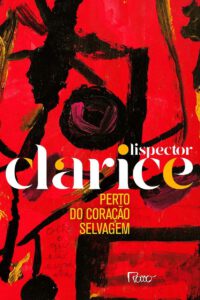
In 2020, Clarice Lispector would turn 100 years old. A series of events has been scheduled to celebrate the occasion. The Rocco publishing house, which is responsible for the publication of her works, has already begun the commemorations with the reedition of the writer’s first three novels, written in the 1940s, when Clarice had not yet turned 30 years old: Near to the Wild Heart, The Chandelier, and The Besieged City. The rest of her complete works will be completely reedited by the end of next year.

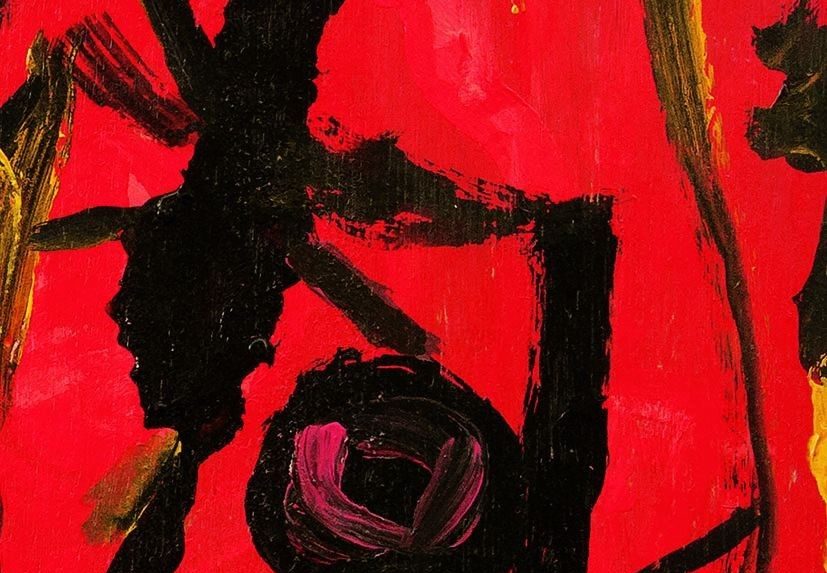
The graphic design is under the care of Victor Burton, an award-winning book designer. The covers are illustrated with images and paintings by Clarice, most of which were done in 1975. The writer’s relation to visual art was never intended to be more than a pastime that expanded her creative processes; nonetheless, her production totals 22 paintings – two of which belong to the Moreira Salles Institute (IMS) collection – and earned a long reflection by the Portuguese critic Carlos Mendes de Sousa in the book Clarice Lispector: pinturas (Clarice Lispector: Paintings), which is also edited by Rocco. 

The new editions also include new afterwords, written by specialists in Clarice’s work, such as Nádia Gotlib, Clarisse Fukelman, Benjamin Moser, Aparecida Maria Nunes, Ricardo Iannace, Marina Colasanti, Eucanaã Ferraz, Teresa Montero, Arnaldo Franco Junior, and the author’s son, Paulo Gurgel Valente. The director of this project, Luiz Fernando Carvalho, who recently adapted the book The Passion According G.H. to the screen (with a premier set for next year), also wrote one of the texts.   

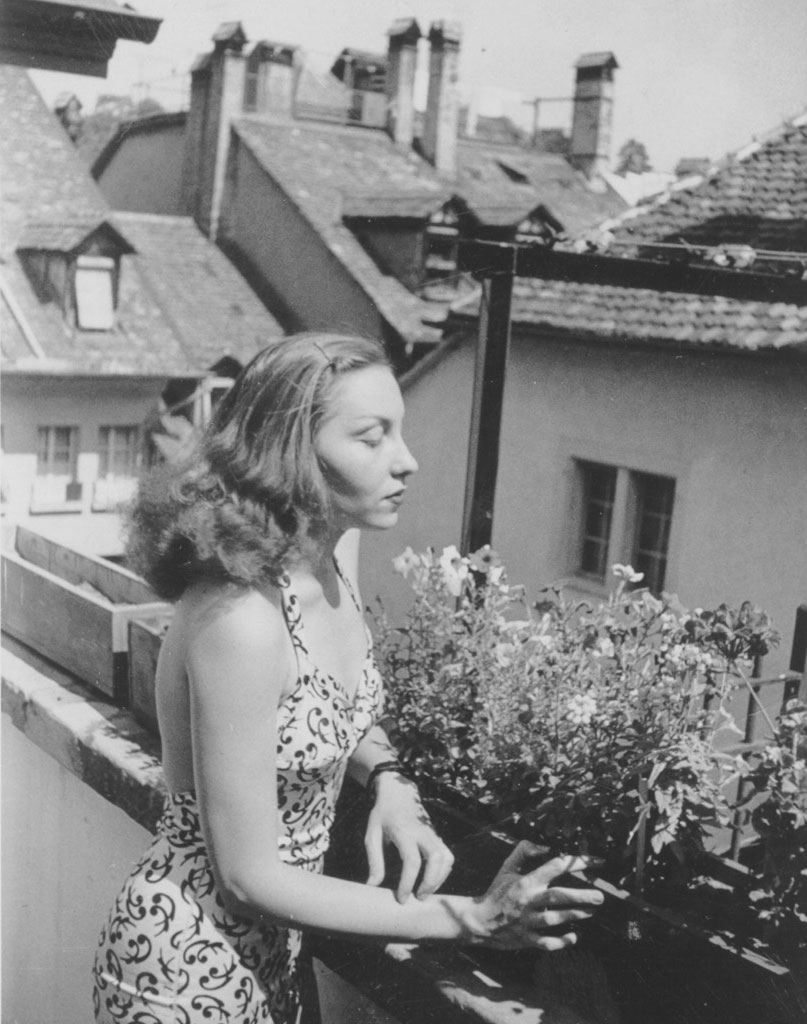
This first reedition, in 2019, contemplates Clarice’s first novel, Into the Wild Heart, which was a huge critical success, having received many positive reviews, including by the writer Antonio Candido, who at the time praised the author’s debut for the Folha de S. Paulo: “in our literature, it is a performance of the highest quality. The author – who seems to be a young novice – seriously considered the problem of style and expression.” The Chandelier (1946), her second book, on the contrary, had a lukewarm reception, which marked the beginning of the writer’s difficult relationship with publishers throughout her career. Lastly, The Besieged City (1949), which was written in Bern, Switzerland, when the young Clarice was accompanying her husband Maury Gurgel Valente on a diplomatic mission.  

Clarice’s early literature, which now arrives at bookstores with a new look, demonstrates in the themes, narrative techniques, humor, style, and existential disquiet the same qualities that – reiterated by critics and the public – would be the trademark of the great writer’s successful career.

Notes

Conversion through hatred

, Conversion through hatred. IMS Clarice Lispector, 2019. Disponível em: https://site.claricelispector.ims.com.br/en/2019/12/04/a-conversao-pelo-odio/. Acesso em: 13 December 2025.

Caetano Veloso says that when he played his song “Odeio” (I hate), which would be included on the album, for his friend and composer Jorge Mautner, while still at his guitar the latter cried and told him that it was the most beautiful love song that he had ever heard. The refrain, which repeats “I hate you, I hate you, I hate you, I hate,” when sung in a low voice, suggests a feeling of gentleness instead of the expected aggressiveness: “it seems sweet,” he explains. Caetano himself declared that when he composed “Odeio,” he was in fact thinking about how love and hate can easily be converted into each other: “when you have a love fight, you get very angry,” he commented in an interview for Rolling Stone magazine at the time of the album’s release, in 2012.

Based on this observation, it is possible to think of an axis in which love and hate are located at two extremes of a single affective mobilization. In other words, hate is love that recedes, despite being equally radical in its passion, while indifference is its opposite. Caetano’s refrain takes advantage of this ambivalence by synthesizing in just one verse — “I hate you” — both the anger of hatred (in words) and the sweetness of love (expressed in the melody and in the “grain” of the singer’s voice). The effect, according to the composer, is to be able “to express love as ‘I hate.’”

This is the theme of the short story “The Buffalo,” by Clarice Lispector, whom Caetano has been reading since adolescence, when the writer’s first texts were published in the Senhor magazine. The story, included in the book Family Ties, begins inadvertently, as if the facts were already in progress: “But it was spring. Even the lion licked the lioness’s smooth forehead.” Little by little, we find out that the protagonist had been to the Zoological Gardens to learn with the animals how to hate, and she intended to kill. About the motive for the unusual mission, there are two vague and sparse indications in the text. The first, when the narrator briefly describes the submissive posture of the woman before her boyfriend or husband: “everything was caught in her chest. In her chest that knew only how to give up, knew only how to beg forgiveness […].” The second, in a quick flashback, when she finally gathers the courage to tell him that she hated him – “‘I hate you’, she said in a rush;” however, “she didn’t even know how you were supposed to do it. How did you dig in the earth until locating the black water?”

The couple’s fight unleashed the woman’s murderous impetus. Did she go to vent tyrannically at the animals the contained anger to which she was unable to give free reign in her amorous relationship? We also do not know why she believes that the lesson of hatred could be learned from the animals. Is it because they only have instinct? Whatever the reason, she goes from cage to cage and, at each attempt, gets frustrated: the lions licked each other and loved each other exhaustively; the giraffe, like whatever is “large and nimble and guiltless,” was foolish and innocent; the “moist hippopotamus” conveyed a “humble love in remaining just flesh;” in the monkey cage, a mother breastfed her child and an old monkey with cataracts stared at her sweetly – the woman, upset, looks away and escapes. The bestiary continues with the sweet elephant whose strength is overwhelming but not crushing; the patient camel with “dusty eyelashes,” and the coati with a childish and questioning gaze.     

Until the spiral guard rail makes the woman lose her center; one no longer knows whether she is outside or inside the cages. She then trades places with the animal and goes from subject to object: “Her forehead was pressed against the bars so firmly that for an instant it looked like she was the caged one and a free coati was examining her.” In concert with animal behavior, the movement of nature only inspired in her notions of freedom and offering: “everything being born, everything flowing downstream;” “out of pure weeds sprouted between the tracks in a light green so dizzying […].” All around, everything therefore opposed her desire for revenge. 

Dissatisfied, she walks aimlessly. She then realizes that she is in the amusement park of the Zoological Gardens, in line for the rollercoaster, behind a few couples. Her turn arrives and she sits by herself. The ordinary situation sets off an unsuspected relation with Christian morality: “she looked like she was sitting in a Church.” As the train departs, the character undergoes a physically liberating and sensorially vertiginous experience (which is formally accompanied, in the text, by the sequence of coordinate clauses that list, with repetitions, reminiscences, screams, and situations):            

[…] but all of the sudden came that lurch of the guts, that halting of the heart caught by surprise in midair, that fright, the triumphant fury with which her seat hurtled her into the nothing and immediately swept her up like a rag doll, skirts flying, the deep resentment with which she became mechanical, her body automatically joyful – the girlfriends’ shrieks! – her gaze wounded by that great surprise, that offense, ‘they were having their way with her,’ that great offense – the girlfriends’ shrieks! – the enormous bewilderment at finding herself spasmodically frolicking, they were having their way with her, her pure whiteness suddenly exposed.

While riding on the rollercoaster, she becomes mechanical like the machine; she becomes depersonalized. And she loses her reference to the ground. On this aspect, it is worth mentioning a comment by the Italian writer Giulio Carlo Argan, in his book Storia dell’arte come storia della città (History of art as history of the city). By criticizing the obsession of architects and urbanists for a city of the future built so that life occurred on elevated surfaces, he observes that the relation of people with space and each other presupposes ground level as a humanistic reference. It is only based on a common plane, he argues, that all people, in the act of spinning on their own axis, can locate themselves, simultaneously, at the center of the world and periphery of their fellow human beings, who for their part are also centers of themselves and peripheries of others.      

The character’s dehumanization provoked by the experience on the rollercoaster can likewise be understood through the dilacerations of the body – “that lurch of the guts.” The fragmentation of the image of the human body – characteristic of vanguard movements from the beginning of the 20th century, such as Cubism and Surrealism – is an expression of denial of the elevated view of the human in favor of a low materialism that accepts the obscure forces of nature. That is what Georges Bataille qualified as “evil,” in the well-known book Literature and Evil, that is, the idea of an unmeasured life that is ideally intense and that therefore must be lived in the transgression of goodness and the morality associated with its conservation. 

Not by chance, at the end of the violent experience on the rollercoaster – which totally exposed her! –, the character comes back down to earth and to the humanistic morality of the ground. Pale, “weak and disgraced,” as if she had been “kicked out of a Church,” she “straightened out her skirts primly,” without looking at anyone, like a pariah. Something remains, however, that ferments within her: “the sky was spinning in her empty stomach; the earth, rising and falling before her eyes, remained distant for a few moments, the earth that is always so troublesome.” It is precisely on the troublesome earth – to which she stretches her hands like a “crippled beggar” (still mutilated, therefore) – that she will continue, transformed by evil and by her lesson of hatred alongside the animals. Finally, the link between love and hate is revealed:

Then, born from her womb, it rose again, beseeching, in a swelling wave, that urge to kill […] it wasn’t hatred yet, for the time being just a tormented urge to hate like a desire, the promise of cruel blossoming, a torment like love, the urge to hate promising itself sacred blood and triumph, the spurned female had become spiritualized through her great hope. But where, where to find the animal that would teach her to have her own hatred? the hatred that was hers by right but that lay excruciatingly out of reach? where could she learn to hate so as not to die of love?           

In the hyper-morality achieved by the character, love and hate are equal in intensity and become inseparable. Until then, she only knew how to bear, “have the sweetness of unhappiness.” The hatred for which she so longed was the same that served as raw material for her forgiveness. Between sudden bursts of activity and torpor – which demonstrated her disorientation – she rests her hot face on the cold and rusty iron bar of the railings. The temperature shock and the textures provoke in her the sensation of being hated. There is a symbolic rebirth – “opened her eyes slowly,” “a certain peace at last,” “of someone who had just died.”      

Finally, she arrives at the cage of the black buffalo. She fixes her gaze on it – the animal stares back. Attentive to the slightest movements of that “a body blackened with tranquil rage,” she realizes that she is being noticed and becomes absorbed. A “white thing” spreads within her – a substance that is similar to the vital “white mass” eaten by G.H. and expelled from the cockroach like ripened fruit from the horror, in the book The Passion According to G.H. “Death droned in her ears” like an enticing breath of evil – a metaphor for living a life of risk. From then on, the character reaches a sort of primordial purity. With her face “covered in deathly whiteness,” she painfully feels the “first trickle of black blood” flow within her: hatred, at last. The buffalo has its back turned to her. She grabs a rock on the ground and tosses it inside the cage. It turns around and faces her, motionless. That is when the woman declares her sentence:            

I love you, she then said with hatred to the man whose great unpunishable crime was not wanting her. I hate you, she said beseeching the buffalo’s love.  

The character’s search comes to an end in a paroxysm: not the unconditional, “pure love,” of nature, which brings to life “weeds sprouted between the tracks in a light green,” but the love among people who, to become fully realized, requires its opposite: hatred – according to Freud, the basic human affect, from which love is erected as a construct. Hatred is also the basis of the political theory of Thomas Hobbes, in the Leviathan, when he defines sovereignty. According to his maxim, man, wolf to men, fears violent death, and for that reason, the self-preservation instinct, subsidized by hatred of the other, establishes the regulatory state of collective life. Self-love adds rigor to the relation among equals. However, it is before the buffalo – in a sort of bullfighting ceremony –, and not anyone else, that the character feels threatened and threatening, “trapped in this mutual murder.” This is the moment in which hatred arises as a self-defense impulse and she feels anger at what could destroy her. Here we discover the reason why the lesson on hatred was sought at the Zoological Gardens. If one cannot call hatred that which in animals is merely instinct, it is in the so-called animal instinct of man that hatred resides. And that is how the short story ends: the woman falls on the ground in slow vertigo. One does not know if she dies or faints. But was not death – whether real or metaphorical – the North Star of this love story?

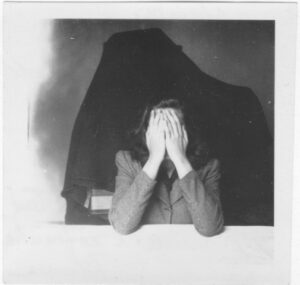
*Image of the title page taken from the book Death in the Afternoon, by Ernest Hemingway. Unidentified author.

The thirst for the other

, The thirst for the other. IMS Clarice Lispector, 2019. Disponível em: https://site.claricelispector.ims.com.br/en/2019/09/24/a-sede-do-outro/. Acesso em: 13 December 2025.

Every year, in the liturgical calendar of the Catholic Church, Carnival is followed by Lent, a period in which the faithful withdraw from mundane life to dedicate themselves to sacrifices, charity, and prayer. In 2018, Pope Francis invited the Portuguese priest and poet José Tolentino Mendonça to give a lecture that would guide the reflections of the Roman Curia on the challenges faced by the Church in that year. The theme chosen by Tolentino, who was named archbishop for the occasion (and proclaimed cardinal on the 1st day of this month of September), was the “thirst of Jesus.” The text of the lecture was published in a book, under the title Thirst (by Paulist Press).     

The presentation begins with the episode, described in the Gospel of Saint John, in which Jesus encounters the Samaritan woman at Jacob’s well (John 4:5-24). Jesus was making the journey between Judea and Galilee, when, tired, he stops at the edge of the well to rest and the woman arrives there to fetch water. He sees her and says: “Give me a drink.” Right from the beginning, Tolentino alerts us that the thirst of Jesus is not for water; it concerns a greater thirst: “a thirst that wants to reach our thirst, to get in touch with our deserts, with our wounds.”

If at Jacob’s well Jesus asks the Samaritan for a drink, at the end of the Scriptures, he does the opposite; he offers himself, as a fountain: “And let everyone who is thirsty come […],” he says. And he makes the metaphor explicit: “Let anyone who wishes take the water of life as a gift” (Revelation 22:17). The theme returns, this time in the form of a plea, in the last words pronounced by Jesus on the cross. He says only this: “I am thirsty.” We may therefore situate Jesus in the middle of the way: he is both the one who satiates thirst – with the “water of life” (his life) – and the one who is thirsty for the other. He crosses and is crossed. He is at the crossroads.  

Even if it is not easy, engaging with our thirst becomes indispensable, Tolentino observes, for spiritual life not to lose its basis in the reality in which personal and biographical life is anchored; rather, courage is necessary to face it head-on, without habits of seeing and free of idealizations. To acknowledge our thirst is, for these reasons, to assume a lack that constitutes us. It is the courage to acknowledge our frailty.   

According to Tolentino, writers and poets are potential mediators among people and their thirsts, for three reasons: literature is presented without fragmented views, as an “integral metaphor of life;” it passes on knowledge that comes from concrete and not conceptual experience; and finally, in opposition to socially forged appearances, it affirms the radical singularity of existence. That being said, to illustrate the reinvigorating effect of literature in spiritual life, he quotes a long passage, of which I reproduce only a small part, from the chronicle “The Gratuitous Act,” by Clarice Lispector, which is included in the book Selected Crônicas (1984):    

 One afternoon, not so long ago, I was typing away under a blue sky flecked with tiny clouds, white as white could be, when suddenly I felt something inside me. A sudden weariness of this perpetual struggle. And I realized I was thirsty. A thirst for freedom had stirred inside me. I was simply weary of living in an apartment. I was weary of extracting ideas from myself. I was weary of listening to my typewriter. And then this strange, deep thirst had appeared.

It is worth observing a coincidence between the scene of Jesus’ encounter with the Samaritan woman and that of Clarice. In both, there is a single point of reflection: it is the exhaustion that makes the thirst arise. Just as the thirst is not only for water, the exhaustion is also not only physical; it gains an existential dimension: a generalized weariness, originating from a routine that, by force of habit, tends to impair the immediate enjoyment of worldly things – and “pleasure is a being’s maximum of veracity. It is the only fight against death,” the character Angela claims, in A Breath of Life (1978). 

The chronicle quoted by Tolentino corresponds with the short story “Love,” published for the first time in the book Family Ties (1960). In both, the Botanical Garden park – with its knotty trunks, flying birds, shifting and secret shadows – is the place of escape from the utilitarian everyday life, which will reconnect Clarice the author (or Ana the character) to the mystery of life and freedom itself. The rapture arises through a disturbance of the senses. In the chronicle, she writes: “Why had I chosen the Botanical Garden? Just to look. To see things. To feel them. Just to live.” The synaesthetic spiral is accentuated until the fusion with the surrounding nature and her depersonalization: “The rest was a moist green rising inside me through unknown roots.”     

By chance, she encounters a fountain with a face sculpted in stone. She not only glues her mouth to that of the statue and eagerly drinks the water that spouts without stopping, but also gets all wet – “Such nonchalance seemed in keeping with the abundance in those Gardens,” she justifies. One notes that the opulence of the garden goes entirely against the founding principle of economic science, that is, the scarcity of resources, whose corollary is the law of supply and demand, a model for the fixing of prices and a driving force in the competitive game of capitalism. In the midst of such an exuberant nature, on the contrary, everything was abundant and free.       

A similar situation occurs in the short story “First Kiss,” in Felicidade clandestina (Covert Joy; 1971). A young couple in the beginning of their relationship is on a bus, on what appears to be a school trip. The atmosphere is nice and they enjoy the fresh presence of each other. At a certain point, the girl asks her boyfriend if he had ever kissed another woman before her. Without further explanation, he says yes. She wants to know whom. He has a hard time answering, and in a sort of escape, he goes into a mode of contemplative suspension – “just feel —was so good.”   

A sudden thirst arises. The discomfort with the lack of water keeps getting stronger: “An enormous thirst. Bigger than he was and that now seized his whole body.” The heat and the wind – which had been transformed into a “desert wind” –, although diligently endured, accentuate the boy’s unease to the same extent that his “animal instinct” intuits the freshness of the water “around the unexpected curve in the highway.” It was a matter of time, “maybe just a few minutes, maybe hours, whereas his thirst had been going on for years” —Clarice takes the thirst beyond the particular motif in the plot. 

Finally, the bus stops and, before his classmates and his girlfriend, he manages to be the first to arrive “at the stone fountain.” He closes his eyes and glues his mouth “to the orifice from which the water was streaming.” He takes his first gulp: “It was life coming back, and it completely soaked his sandy insides until they were quenched.” When he opens his eyes, he notices that his mouth is fixed to the mouth of a statue of a woman and he affirms to himself, confused: “but the life-giving liquid, the liquid seed of life doesn’t come from a woman….”     

In this passage, the water that spouts “from one mouth to another” is transfigured into life, just as in Jesus’ offer to his followers: “And let everyone who is thirsty come […] take the water of life as a gift.” However (and it is this that leaves the boy “confused in his innocence”), in Clarice’s story, “the life-giving liquid” is not male semen, but it sprouts from this sort of archetypal woman – materialized in the hard condition of stone – who is capable of spanning centuries and civilizations unperturbed.       

In discovering the statue in its nudity, he realizes that he had kissed it. He goes into a state of disorientation proper to ecstatic experience: he finds himself perplexed, “he stood, sweetly aggressive,” with his heart beating deeply, “in a fragile balance.” Startled, he feels life transforming. We learn that the truth that emerges from within him is the end of an initiation process: “he had become a man.” Just like the stone woman, the boy also loses his individuality to indifferentiate himself in the figure of the generic man, the same sketched in charcoal next to the woman and the dog, like rock drawings, by the maid Janair in The Passion According to G.H. (1964): “On the whitewashed wall by the door — that’s why I hadn’t seen them before — were charcoal outlines, in about life size, of a nude man, a nude woman, and a dog more nude than dogs really are.” 

*

To offer oneself to the risk of experience is also to place oneself in a position of vulnerability in relation to feelings of joy and sadness to which we are exposed in life. However, if the sadness persists and we are unable to contain it, our vital energy is undermined little by little. Sadness, once circumstantial in nature, becomes acedia, a state of mood that, according to Tolentino’s explanation, can be seen as an “indifference, a lack of presence and interest, a loss of the taste for life, an interior devitalization that results in a closure, making us neglect the appeal of the present.” 

For Tolentino, acedia – or depression, a name used today for the illness – occurs when we renounce thirst; we abandon our desires and therefore go along with death. Although contemporary medicine has come to treat the illness allopathically – and without prejudice to this type of procedure –, it concerns a disorder of an equally spiritual origin, whose “origin is rooted in the mystery of human solitude.”

On this matter, another coincidence can be noted in the stories narrated by Clarice and by John the Evangelist. In both, there are references to the time of day in which thirst appears. It is midday, or the sixth hour – when, as a few priests from the Middle Ages believed, the figure of the “noonday demon” appeared to tempt the good spirits dedicated to moral asceticism. The fear of the religious men was not unfounded, for, as Giorgio Agamben explains in the book Stanzas, one of the notorious characteristics of melancholy was erotic disorder, which assumed, for some, such as the Benedictine monk and doctor Hildegard von Bingen, the “aspect of a feral and sadistic disturbance.”

The Italian thinker moreover observes that since Aristoteles there has been a tradition which used to associate black humor with a bent for poetry and art. Thus, an ambivalent association was established between contemplation and despondency, which based on the philosophy of the first Catholic priests, would gain relevance in the Renaissance imaginary. Melancholy would come to be a reversible sign, like two sides of the same coin, for it would allow opposing propensities under the same diagnosis. Such an identification is, for Agamben, among “the most surprising results of Medieval psychological science,” since “the recessus of the slothful does not betray an eclipse of desire but, rather, the becoming unobtainable of its object: it is the perversion of a will that wants the object, but not the way that leads to it, and which simultaneously desires and bars the path to his or her own desire.”  The paradox therefore resides in the fact that desire does not cease, but the mood to seek its realization does indeed fade – desire “communicates with its object in the form of negation and lack,” he concludes.    

In this game of heads or tails, how to flip to the positive side of melancholy? 

Let us return to midday – “it is the central time of the day, the point that determines the transition from one part of the day to the other. It is the midpoint of time, marking a before and an after, the midpoint of the journey, the critical crossroads of life,” Tolentino affirms, investing the term with a meaning that goes beyond the strictly chronological. It is the moment in which, in the potent image of João Cabral de Melo Neto, “[…] o sol é estridente,/ a contrapelo, imperioso,/ e bate nas pálpebras como/ se bate numa porta a socos” (the sun is strident,/ abrasive, imperious,/ and strikes the eyelids as/ one strikes a door with punches; “Graciliano Ramos”, in Terceira feira [Tuesday], 1961). 

Underlying the Pernambuco poet’s verses is the insurgency of an arousal of mood that, as Agamben explains, remains dormant in the melancholic state. The insidious sun of midday – the meridian demon of the medieval priests – is therefore the same that, “strident, abrasive,” contains the flawless antidote against lethargy – it strikes the fragile eyelids with the unmeasured violence of an ethical imperative: the primacy of joy.     

To make the positive side of melancholy show, José Tolentino recalls the approach developed by Simone Weil of an “education of desire.” She teaches that it is necessary not to cede to the temptation of substitutions and to learn to remain “with absence, incompleteness, emptiness, and expectation.” Tolentino adds that, for Weil, “it is not our desire that reaches God. If we stay thirsty and desirous, God himself descends into our humanity to fill our desire with fullness.” 

One could not help but note the similarity between the image above – of “God himself [who] descends into our humanity to fill our desire with fullness” – and the “state of grace” defined by Clarice in the celebrated chronicle of the same name, which is included in Selected Crônicas (1984). The Brazilian writer speaks of an “annunciation” – “as if the angel of life were coming to announce the world;”     

 […] And there is a physical bliss which cannot be compared to anything. The body is transformed into a gift. And one feels it is a gift because one is experiencing at source the unmistakable good fortune of material existence. […]  In a state of grace, one sometimes perceives the deep beauty, hitherto unattainable, of another person.  […] After experiencing grace, the human condition is revealed in all its wretched poverty, thereby teaching us to love more, to forgive more, and show greater faith. 

Clarice warns that grace cannot be expected: “only come[s] when desired spontaneously.” However, one may say that there is a state of opening, in which the person makes himself or herself available to receive it. Tolentino, in another book, A mística do instante (The mysticism of the instant; 2016), suggest how to do it, at the same time that he unintentionally throws light on one of the most recurrent motifs in Clarice’s work. Unlike the mysticism understood as an auscultation of the mystery (of God) in the interiority of being, Tolentino proposes a mysticism intermediated by the body and open to the imponderable of every instant. The way to access the divine thus passes through direct experience with people and the material and everyday world. It concerns a sensual mysticism, which can only be found in the present moment, which is always the middle of the way, never the end.    

*

As an epilogue, I will transcribe a passage from the chronicle “Prece por um padre” (“prayer for a priest”), in Todas as crônicas (2018). Hypothetically accepting the title of spiritual master conferred by Tolentino upon her and writers in general, Clarice repeats the gesture of the Portuguese priest to his colleagues of the Roman Curia and dedicates to an anonymous priest (who had asked her to pray for him) this religious poultice against death:     

 One night I stammered a prayer for a priest who is dying and is embarrassed for being afraid. I said a bit to God, with some modesty: relieve the soul of Father X…, make him feel that Your Hand is given to his, make him feel that death doesn’t exist because in truth we are already in eternity, make him feel that to love is not to die, that to surrender oneself does not mean death, make him feel a modest and daily joy, make him not ask You too much, because the answer would be as mysterious as the question, make him remember that there is no explanation why a child wants a kiss from his mother, and yet he wants and the kiss is perfect, make him receive the world without fear, because we were created for this incomprehensible world and we too are also incomprehensible […].

When mysteries touch – the erotic plethora of the child kissing the mother – it means that life, beyond any understanding, pulses aimlessly – with joy. 

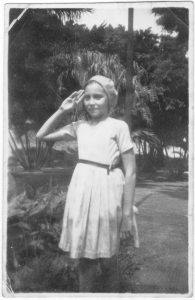
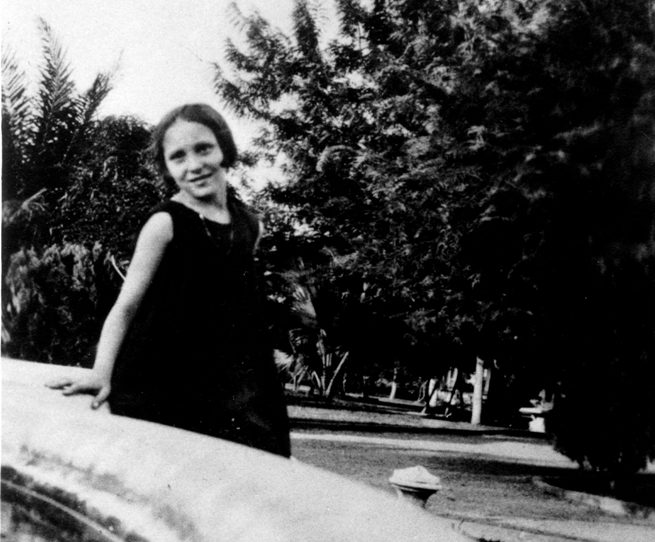
*Photo: A ten-year-old Clarice, at the Derby square garden, wears black because of her mother’s death. Recife, 1930. Clarice Lispector Collection/ IMS.

“Love Smells Like Death”

, "Love Smells Like Death". IMS Clarice Lispector, 2019. Disponível em: https://site.claricelispector.ims.com.br/en/2019/07/23/o-amor-tem-cheiro-de-morte/. Acesso em: 13 December 2025.

Sex

Clarice Lispector wrote about sex only once. It was in the book A via crúcis do corpo (The Via Crucis of the Body). Even so, as her biographer Benjamin Moser observes, “the theme that unites the collection is not, in fact, sex. It is motherhood.” Indeed, based on this comment, it is possible to think that the writer undoes the boundary line that separates maternal love and sexual desire by uniting the two instincts into a conjunction, such as in the female organ common to birth and to copulation.  

Moser also says that some of the writer’s friends considered her “touchingly naive” in matters of sex. Her friend and plastic artist Maria Bonomi, who at the time had separated from her husband to date a woman, was supposedly interrogated with “technical questions” by a curious Clarice. Such an interest was also imprinted in the article “O vício impune da literatura” (The unpunished vice of literature), published in the Folha de S.Paulo, in 1992, in which one reads about a supposed “exchange of imported pornographic magazines” between her and the poet Carlos Drummond de Andrade. 

In any case, it is Clarice herself who is evasive, in the preface to A via crúcis do corpo: “if there’s indecency in the stories, it’s not my fault. Needless to say it didn’t happen to me.” In 1975, in an interview given to the Manchete magazine on the occasion of the book’s release, she reiterates: “Even I was surprised […] how I knew so many things about the topic.” 

If it is true that there is almost no sex in Clarice’s work, it is also a fact that her literature is impregnated with eroticism; an eroticism that touches the limits of matter. The best example of this is the mystical experience that the main character of The Passion According to G.H. undergoes when she eats the white mass of the dead cockroach that she had just crushed against the closet door, in the maid’s microcosmic room. 

The incident with G.H. can be understood in light of what the French thinker George Bataille, in his book Eroticism, classifies as “sacred eroticism,” which is connected to the concrete world, to its objects, and is therefore distinguished from the eroticism of bodies or of hearts – an experience that is thus independent both of sexual and personal relations.

For him, the depersonalization of the erotic fusion can be considered similar to that experienced in sacrificial rituals. In the face of the immolation of the victim – in the case of G.H., the cockroach –, what is revealed to the senses of the participants, who often eat it, is the experience of the sacred. As Bataille affirms: “a violent death disrupts the creature’s discontinuity; what remains, what the tense onlookers experience in the ensuing silence, is the continuity of all existence with which the victim is now one.”

Continuity and discontinuity are terms that must be understood as the reintegration of a mortal and singular being, who is therefore discontinuous, to the general fermentation of life, which is indistinct and impersonal. As in Lavoisier’s maxim, “nothing is lost, nothing is created, everything is transformed,” the body serves as food for bacteria, which participates in the decaying process of human flesh and sets in motion the incessant cycle of life and death.   

The immediate horror experienced with the putrefaction of the corpse reveals to men and women the unavoidable affinity between the “stinking putrefaction” of death and the essence of life itself. Thus, if on the one hand “the horror of death drives us off, for we prefer life; on the other an element at once solemn and terrifying fascinates us and disturbs us profoundly.”    

A disturbance of such an order, Bataille continues, is triggered by the direct contact with that which is commonly called nausea or repugnance. The term he uses, “sovereign disturbance,” perfectly fits that which critics and Clarice herself call “existential moment,” “surprise,” “flash,” “epiphany,” etc., in her work. The overcoming of disgust seen in sacrifice is the same that, in the face of an unexpected event, will cause the disorder that comes from reality-based erotic experience to burst in Clarice’s characters. It is an experience that, since it is not part of our will, always “waits upon chance,” according to the French thinker.        

But if for the writer, as we have seen, sex is not a priority, what is it that is revealed, then, in the blatant eroticism of her texts? In The Passion According to G.H., she herself answers: “Ah, people put the idea of sin in sex. But how innocent and childish that sin is. The real hell is that of love. Love is the experience of a danger of greater sin — it is the experience of the mud and the degradation and the worst joy.”

Love

In the short story “Love,” from the book Family Ties, Clarice Lispector narrates the story of Ana, a housewife who is on the tram, tired, returning from the market to her house, and carelessly thinking about everyday life at home: the broken stove, her children, her husband – to everything, Ana gave “her small, strong hand, her stream of life,” one reads.  

The narrator warns the reader: “A certain hour of the afternoon was more dangerous. […] when the house was empty and needed nothing more from her, the sun high, the family members scattered to their duties.” At this moment, Ana became restless. Before having a family, her life was “restless exaltation,” it was no longer within reach, for she “had created at last something comprehensible, an adult life” — in order.  

Absorbed in her thoughts, Ana is disoriented, all of a sudden, by the sight of a blind man chewing gum: “[…] her heart beat violently, at intervals. Leaning forward, she stared intently at the blind man, the way we stare at things that don’t see us. He was chewing gum in the dark. Without suffering, eyes open. The chewing motion made it look like he was smiling and then suddenly not smiling, smiling and not smiling — as if he had insulted her.”

It is worth observing the original way that Clarice stages some clichés, restoring to them the original meaning of the words. The trivial description of the blind man – eyes open in the dark, which is equivalent to the commonplace “seeing in darkness” – is metaphorically figured as a sort of existential longing on the part of the character: the calm understanding of life in full ebullition, in its intrinsic disorder. The chewing that seemed to make him oscillate between laughter and seriousness evokes, in the same way, the reconciliation “without suffering” between opposites, in a unity that is primordial and “inexpressive,” as G.H. says.      

Suddenly, the tram brakes and the bags that were on Ana’s lap fall on the ground. She yells. The driver stops. She collects what was scattered on the ground. But the eggs had broken: “viscous, yellow yolks dripped through the mesh” of the knit bag. Here, we witness the representation of yet another catch phrase: “the life that slips through your fingers.” The yoke, the egg of a chicken, if fertilized by the male, gives life; if not, it is life that could have been and was not. Thus, once the spoil of life – her own? – has been discarded, all the fragile harmony of Ana’s everyday life also slips away.       

She then perceives an absence of law; she no longer knows where to go – “She had pacified life so well, taken such care for it not to explode. […] And a blind man chewing gum was shattering it all to pieces.” Without realizing it, she missed the stop for her house and, in a rage, gets off the tram. It was getting dark. Little by little, she recognizes the place where she is and walks through the Botanical Garden. Equivalences arise with the Garden of Eden, which, on the one hand shifts the Judeo-Christian mythical paradise to the real park in the city of Rio de Janeiro, but, on the other, describes it in new terms. Contrary to the nice and lovely atmosphere in Genesis, in “Love,” horror and degradation are established:       

 There was a secret labor underway in the Garden that she was starting to perceive. In the trees the fruits were black, sweet like honey. On the ground were dried pits full of circumvolutions, like little rotting brains. The bench was stained with purple juices. With intense gentleness the waters murmured. Clinging to a tree trunk were the luxuriant limbs of a spider. […] it was a world to sink one’s teeth into […]. it was fascinating, the woman was nauseated, and it was fascinating.

Morality

Bataille, in another text, the essay “The Language of Flowers,” published in the magazine Documents in 1929, criticizes the image of the flower as a symbol of the discovery of love. The frequent association would be explained, according to him, by the fact that both the brilliance of flowers and human feelings are “a question of phenomena that precede fertilization.” Nevertheless, for men and women, what becomes a sign of desire, in the flower, is the corolla, its most decorative aspect, and not the sexual organ, a “rather sordid tuft,” covered by the petals. The flower’s appearance is equivalent, therefore, to an ideal of human beauty and, for this reason, says nothing about its real nature – flowers “wither like old and overly made-up dowagers, and they die ridiculously on stems that seemed to carry them to the clouds,” affirms the thinker, for whom “love smells like death.”      

To destroy the impression of harmony in the nature of plants, Bataille continues, it is enough to imagine “the impossible and fantastic vision of roots swarming under the surface of the soil, nauseating and naked like vermin.” To roots, in contrast to stems, could then be attributed the lowest moral value. The similarities between Clarice’s text and Bataille’s arguments are evident (and somewhat unprecedented). She writes: “The erotic impulse of entrails is linked to the eroticism of the twisted roots of trees. It is the rooted force of desire. My truculence. Monstrous viscera and hot lava of burning mud.” [1] The theme reappears in The Passion According to G.H.: “the unclean is the root — for there are created things that never decorated themselves.”

In “Love,” Ana’s experience is therefore the experience of interdiction. The narrator alerts the reader: “The moral of the Garden was something else.” Unlike the biblical garden, where God already dictated orders to the first couple, in Ana’s garden (or Clarice’s), it is the character herself who encounters, without prescription, and with a mix of attraction and repulsion, the erotic depersonalization that reconciles good and evil in an indistinct and amoral totality. In the words of Spinoza, of whom Clarice was an enthusiastic reader, Ana allows herself to be “affected” by the things of the world and learns an ethical lesson that has the body as a seat and real experience as a base. In a manner very close to the Dutch philosopher, Clarice reflects, in The Passion According to G.H., upon morality:      

 Would it be simplistic to think the moral problem with regard to others consists in behaving as one ought to, and the moral problem with regards to oneself is managing to feel what one ought to? Am I moral to the extent that I do what I should, and feel as I should? All of a sudden the moral question seemed to me not only overwhelming, but extremely petty. The moral problem, in order for us to adjust to it, should be at once less demanding and greater. Since as an ideal it is both small and unattainable. Small, if one attains it: unattainable, because it cannot even be attained. […] The solution had to be secret. The ethics of the moral is keeping it secret. Freedom is a secret.

The Secret (or The Ethics)

Ana was breathing in the putrid perfume of the decomposing plants – until she remembers her children. She immediately feels guilty. But why? “What was she ashamed of?” When she left the garden, she was no longer the same. Now, “her heart had filled with the worst desire to live.” And this was incompatible with her previous routine. Still in a trance, she arrives home, receives guests for dinner; the children play in the living room. Everything seemed normal, but she was absent and delirious, and she involuntarily frightens one of her children:     

Mama, the boy called. She held him away from her, looked at that face, her heart cringed. Don’t let Mama forget you, she told him. As soon as the child felt her embrace loosen, he broke free and fled to the bedroom door, looking at her from greater safety. It was the worst look she had ever received. The blood rushed to her face, warming it.

Ana’s senses were saturated and the atmosphere of the house was like an overwhelming shadow. She hears an explosion on the stove. “What happened?!”, she asks her husband, startled. He becomes surprised by his wife’s fear; “‘It was nothing,’ he said, I’m just clumsy.’” He brings her close to him and caresses her. Ana transfers to her husband all the love of one who had come face to face with death and tells him in a serious tone: “I don’t want anything to happen to you, ever!” He finds what she said funny; “Time for bed,” he says. He then leads his wife to bed, “removing her from the danger of living”;  back to the night that follows the day that follows the night – practical life, which, although miserable, nevertheless bears the existence of who knows love.        

[1] The passage, written by hand on the backside of the typescript for “Objeto gritante” (“Screaming Object,” the text that gave rise to the book Água Viva), is quoted by the Angolan critic Carlos Mendes de Sousa, in Clarice Lispector: pinturas (Clarice Lispector: Paintings).

Notes

“Women Are Wild”

, “Women Are Wild”. IMS Clarice Lispector, 2019. Disponível em: https://site.claricelispector.ims.com.br/en/2019/05/13/as-mulheres-sao-selvagens/. Acesso em: 13 December 2025.

1

The “Cultura|s” magazine, from the La Vanguardia newspaper, recently celebrated the Spanish edition of Todos los cuentos, by Clarice Lispector. The book was translated by Cristina Peri Rossi, Elena Losada, Juan García Gayo, Marcelo Cohen, and Mario Morales, and there is a preface by Benjamin Moser, who is also the author of ¿Por qué este mundo?, a biography of Clarice also published by Siruela, in 2017.

In the article “Toda la vida de una mujer” (The whole life of a woman), written by Laura Freixas, the Brazilian writer is acclaimed as a myth, known in Brazil only by her first name. According to the journalist, Clarice not only enjoys academic prestige, but is also popular. Her works inspire songs, television series, theatrical plays, and choreographies. Nonetheless, international fame would only come posthumously, when the French feminist writer Hélène Cixous raised the Brazilian author to the highest exponent of women’s writing and awakened the interest of European publishers and American universities.  

The journalist further stresses the Brazilian writer’s capacity to “explore women’s identity with a depth that no one has achieved until now.” Housewives, bourgeois ladies, matriarchs surrounded by the family clan; for her, Clarice’s female characters, who appear to be conventional and hardly interesting, hide beneath the surface the germ of nonconformity – “the women are wild,” she affirms. They are furthermore “cheerful, free, powerful, happy in their emotional and sensorial symbiosis with nature.”   This feminine way of being in the world can be seen, according to the journalist, ever since Clarice’s first short story, “The Triumph,” which was published in 1940 in Pan magazine.

2

It is worth looking more carefully at this short story.

Luísa, the main character, awakens at her home under an unusual silence, interrupted by the loud and resonant striking of the clock, which sounds like a foreshadowing of what is to come.

From the beginning of the short story, the rhythm and the word choice describe Luísa’s awakening in an erotic communion with the new day. Beginning with the image of the “stain of sunlight,” which advances “little by little over the lawn” and encounters an opening in the window — “penetrates,” she writes. The verb, used in the present tense (which coincides with the second-person imperative, you), sounds potent, virile, all alone in the sentence. The “lawn,” in the Portuguese original “relva,” refers to the image of pubic hair. And when the sunlight reaches the room, the character, still lying in bed, “an arm here, another there, crucified by lassitude,” she curls her eyebrow and grimaces, evoking orgasmic pleasure. The day “enters her body.”     

Luísa, however, perceived an absence: “… what about those domestic noises of every morning?”, she asks herself. For it is in their silencing that new sounds arise. She hears “footsteps in the distance, tiny and hurried,” “dry leaves crunching underfoot;” she thinks of a child running in the road. At this point, she still finds herself on the threshold between being asleep and awake, a state of consciousness called hypnagogia, when the senses are sharp and receptive and we can be stricken by illuminating oneiric visions. 

Suddenly, the silence again, which is “absolute, like the silence of death.”

We find out that her husband had abandoned her the afternoon before, after a fight, another one, to which Luísa had always reacted with fear. Absorbed in the gravity of the empty house, she then goes to Jorge’s table, hoping to find a note for her that said something like: “In spite of everything, I love you. I’ll be back tomorrow.” Instead, she finds a sheet of paper on which he confessed to feeling mediocre for not being able to focus on the book that he was writing. A revealing Freudian slip occurs here. Luísa identifies with Jorge and takes his feeling as her own — “So he knew it, then?”, she asks herself. It was also what “she’d always felt, only vaguely: mediocrity.”   

Before this, we accompany one of the couple’s fights, remembered by Luísa. He accuses her: “You, you trap me, you annihilate me! Keep your love, give it to someone who wants it, someone who has nothing better to do! Got it? Yes! Ever since I met you I haven’t produced a thing! I feel tied down. Tied down by your fussing, your caresses, your excessive zeal, by you yourself! I despise you!”

In previous fights, a pallid Luísa, normally “so full of dignity, so ironic and sure of herself” begged him not to abandon her. But, this time, according to him, Luísa had interrupted him “right when a new idea was stirring, luminous, in his brain. She’d cut off his inspiration at the very instant it was springing forth, with a silly comment about the weather, and concluding with a loathsome: ‘isn’t it, darling?’”

The scene reveals a common incompatibility between men and women. According to Simone de Beauvoir, man wishes to reach transcendence, and to do so, since he was born of a woman, of course, he seeks to detach himself from her to go ahead with the realization of a project. Woman, for her part, is bound to nature; she is the fountain that attracts man to immanence, to the earth. Thus, Luísa’s frugal and devoted love is, for Jorge, the reason for his great indignation; he says that he feels “tied down by your fussing, your caresses, your excessive zeal.”        

Furthermore, for Simone de Beauvoir, the mother-woman has “a face of darkness: she is chaos, where everything comes from and must return to one day; she is Nothingness. (…) He aspires to the sky, to light, to sunny heights, to the pure and crystal clear cold of blue; and underfoot is a moist, hot, and dark gulf ready to swallow him; many legends have the hero falling and forever lost in maternal darkness: a cave, an abyss, hell.”  

Another divergence that appears highlighted in the text is man’s inclination to reason, in contrast to woman’s sensuality. As Kierkegaard affirms, “woman is more sensuous than man.” Based on such a rationale, it would be possible to think that the menstrual cycle (and its possible consequences: pregnancy, childbirth), in concert with the movements of the moon and the tides, is, in itself, an evident manifestation of woman as a sensible part of a cosmic harmony.     

It is also in this sense that Hélène Cixous, quoted in the article from “Cultura|s,” observes the incidence of characters in Clarice’s work who have impaired vision. For her, this aspect indicates a form of approximation to the world that does not occur through rational distancing, but through emotional and sensorial fusion. It is worth recalling that vision, since before Aristotle – even though, in Metaphysics, this had been the motive for deep reflection – has been a sense that is traditionally associated with reason.    

There is, consequently, a praise of sensuality that pervades the whole narrative.

It is worth repeating that the motive for the fight that culminated in the couple’s separation was “a silly comment about the weather” spoken by Luísa. And that she had imprudently interrupted Jorge precisely “right when a new idea was stirring, luminous, in his brain..” Beforehand, the narrator describes the image of a scene with the couple that is often repeated: “She, silent, before him. He, the refined, superior intellectual.”

There are still other indications of this valorization throughout the text. When Luísa notices that Jorge has left, she wipes her head in order to “push away her thoughts.” In another moment, we read: “She seemed to hear his ironic laugh, quoting Schopenhauer, Plato, who thought and thought….”  The act of thinking, which echoes here somewhat ironically – and which is also mirrored in words such as “idea,” “brain,” “thoughts,” and in the names of philosophers –, sounds blatantly opposed to the lack of sensibility of Jorge, who is incapable of receiving his wife’s loving gesture without thinking beyond his selfish interests.   

Such a perspective appears in exemplary fashion in the role reserved for intuition. Intuition – understood as wisdom of the body over which there is no explanation – is the main driving force behind Luísa’s actions and will lead her to erotic ecstasy at the end of the short story. Intuition is a theme in other texts by Clarice, and is even a part of her creative process. In another of her chronicles [“Forma e conteúdo,” (Form and content) Todas crônicas], she writes: “Only intuition touches the truth without need content or form. Intuition is the deep unconscious that does without form, while it itself, works before surfacing.”  

Thus, since waking, touched by the sunlight and absorbed by the street noises, Luísa synaesthetically surrenders herself to the surrounding stimuli. She weeps for her absent husband. Then (and here the short sentences accompany the character’s panting breath), goes to the sink and splashes her face. Sensation of coolness, release. She’s waking. She perks up. Braids her hair, pins it up. Scrubs her face with soap, until her skin feels taut, shiny.” Her gestures are impetuous, just like the movement of nature and of things: “throws open the windows;” “the new air enters swiftly;” “the clock seems to strike more vigorously.”  

Luísa then begins to see with renewed freshness the intimate environment of the house, which seemed obscured, beforehand, by Jorge’s presence: “She’d always lived there with him. He was everything. He alone existed. He was gone. And things hadn’t entirely lost their charm. They had a life of their own.”

Allowing herself to feel swept away by some unknown force, “afraid of thinking” (again “thought” is bad), Luísa grabs a few items of clothing and begins to wash them in the large wash basin in the backyard. The description seems like a sexual act: “She rolled up her pajama sleeves and pants and started scrubbing everything with soap. Bent over like that, moving her arms vehemently, biting her lower lip from the effort, the blood pulsing strong throughout her body, she surprised herself.”   

When she finished her chore, after a short break, a new wave finally leads Luísa to climax:  

 She looked at the large spigot, gushing clear water. She felt a wave of heat… Suddenly an idea came to her. She took off her clothes, opened the spigot all the way, and the cold water coursed over her body, making her shriek at the cold. That improvised bath made her laugh with pleasure.

It is important to note here that the “idea” which comes to her is not of a masculine nature; it is an action-idea, provoked by a consequent gesture that triggers it.

3

The journalist from La Vanguardia highlights the importance of Clarice’s feminine voice in a world in which women are habitually defined by men: “politicians, theologians, scientists, poets,” according to Laura Freixas. And it is precisely in this world of roles and chores defined by masculine authority that Clarice’s writing engenders a possibility of rupture. It is curious to observe, for example, that the most cliché chore of a housewife – washing clothes in a basin – comes to be decisive for the ecstatic experience that will lead the character to emancipation in relation to her husband – Luísa’s triumph. For the fear of being abandoned is a reiterated observation over the course of the narrative: “If he leaves, I’ll die, I’ll die”; or “How would she live now? (…) She kept repeating and repeating: what now?”      

If one cannot say that Clarice was a feminist in the strict sense, the author, in her narratives, brings to the foreground common women who experience the tension between the yoke and autonomy in a society whose laws are predominantly created by men. In the apparent frailty of the female characters, it is possible to see the strength of those who know things through the senses, closely, on the inside.   

This strength arises in an unprecedented manner at the end of the short story. The freedom attained by Luísa does not inspire, as it would be easy to suppose, autonomy or the desire to live alone (even though now it would be possible for her to do so), but rather the opposite, the serene and confident feeling that Jorge would return: “A warm ray of sunshine enveloped her. She laughed. He’d be back, because she was the stronger one.” Thus ends “The Triumph,” a debut writer’s first step.

Notes

Clarice in Paris

, Clarice in Paris. IMS Clarice Lispector, 2019. Disponível em: https://site.claricelispector.ims.com.br/en/2019/03/11/clarice-em-paris/. Acesso em: 13 December 2025.

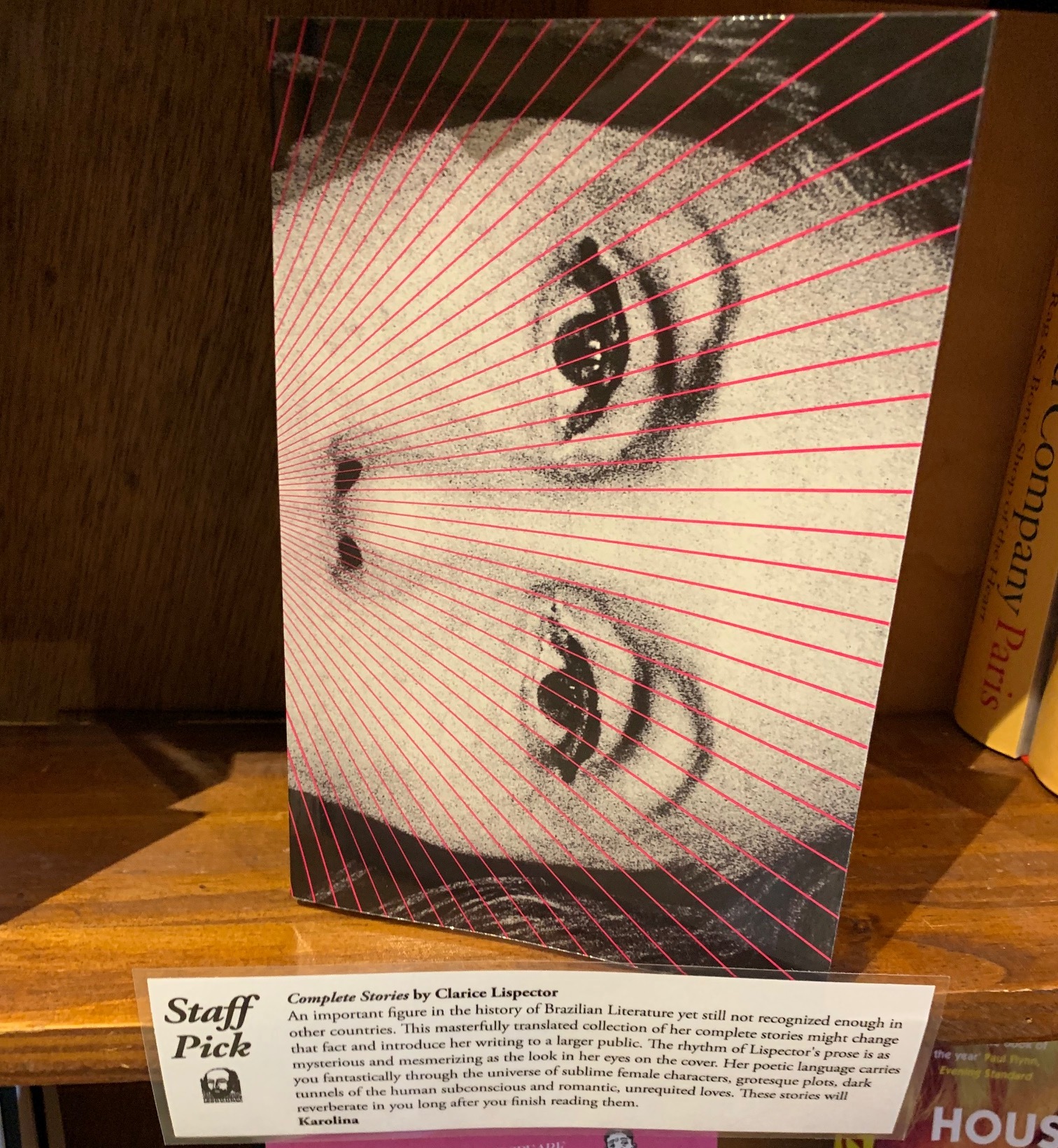
The traditional Parisian bookstore Shakespeare and Company placed on special display the English version of the book The Complete Stories, by Clarice Lispector. Translated by Katrina Dodson, who won the 2016 PEN Translation Prize for her efforts, the edition was one of the reading suggestions made by the store’s team of booksellers, which is specialized in English-language literature.      

Shakespeare and Company Bookstore, in Paris.

The note that accompanied the book on display stressed that the collection of Clarice’s short stories in English was a great opportunity for a larger public to get to know the important Brazilian writer. They described her as possessing a poetic language and hypnotic rhythm, which “carried the reader in a fantastic way through the sublime universe of female characters, the human unconscious, and unrequited love.”  

The bookstore has a long history in the French capital. The first store opened in 1919, by the American Sylvia Beach, and became a meeting place for artists such as Ernest Hemingway, Gertrude Stein, Man Ray, Djuna Barnes, Ezra Pound, and T. S. Eliot. In 1922, Shakespeare and Company published the masterpiece of modern literature Ulysses, by James Joyce, which at the time had been prohibited in the United Kingdom and the United States.    

It is worth recalling that it is from the epigraph of another book by the Irish writer, A Portrait of the Artist as a Young Man (“He was alone. He was unheeded, happy, and near to the wild heart of life.”), that Clarice, without knowing, and accepting a suggestion by her friend Lúcio Cardoso, borrowed the name for her first novel.

The store, which had been located at 12 rue de l’Odéon since its opening, was forced to close in June 1940 during the German occupation in Paris. After the war, another American, George Whitman, opened the bookstore Le mistral at 37 rue de la Bûcherie, which was modeled after Sylvia’s bookstore. After her death in 1964, George, who six years earlier had received authorization to use the original name, changed his sign to Shakespeare and Company.  

Under new direction, the place was frequented at different times by writers such as Allen Ginsberg, Henry Miller, and Anaïs Nin, hosted friends (since it had rooms for this purpose), and housed, between 1978 and 1981, the headquarters of the literary journal Paris Voices. According to the owner’s definitions, the establishment could be considered “a socialist utopia masquerading as a bookstore.”    

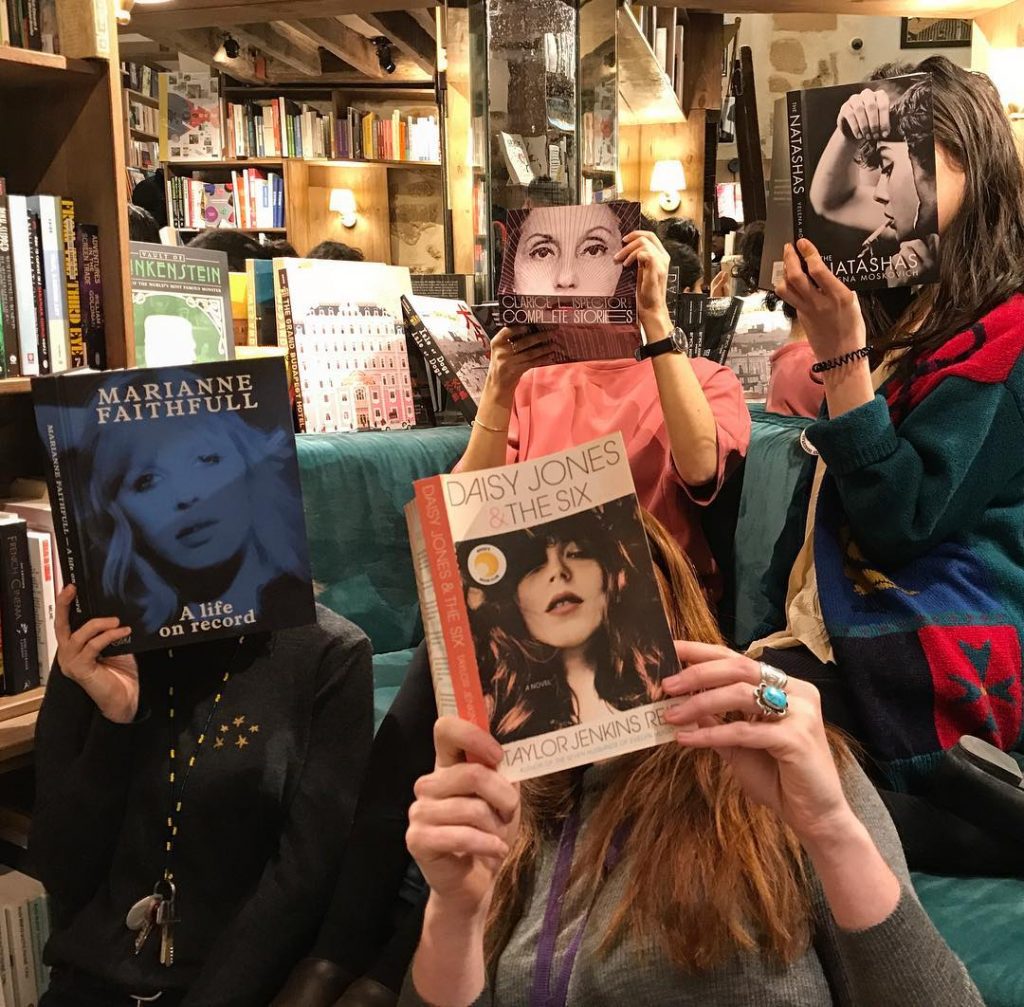
In a photo published on the bookstore’s Instagram page, on March 8, 2019, Clarice’s face appeared next to singer and actress Marianne Faithfull and others, printed on book covers held by store patrons during the celebration of International Women’s Day.

Book cover for The Complete Stories, by Clarice Lispector, at the celebration party for International Women’s Day promoted by the Parisian bookstore Shakespeare and Company.

The emphasis given to the Brazilian writer by a bookstore that specializes in the English language – and that was, as we have seen, the publishing house of an illustrious inventor such as Joyce –, not only reaffirmed the already confirmed quality of Katrina Dodson’s translation and Benjamin Moser’s efforts to promote the author in English-speaking countries, but also gives an idea of the increasing prestige that Clarice has reached outside of Brazil.

Notes

In love with love

, In love with love. IMS Clarice Lispector, 2019. Disponível em: https://site.claricelispector.ims.com.br/en/2019/02/05/amar-o-amor/. Acesso em: 13 December 2025.

Before publishing her first book, while still a law student, Clarice Lispector had worked in the press as a reporter and editor for the National Agency and in periodicals such as the magazine Vamos ler! (Let’s Read) and the newspaper A Noite (Night). At the end of the 1960s, already famous, she accepted the invitation to assume an interview section in the celebrated Manchete. For almost a year and a half, important figures from literature, theater, music, visual art, and sports underwent the writer’s question-and-answer sessions, including friends such as Lygia Fagundes Telles, Rubem Braga, Maria Bonomi, and also Vinicius de Moraes. 

What immediately calls for attention in the conversations with Clarice is a sort of unsuitableness for the job with respect to journalistic technique: she is too personal, she is at times indiscrete, and the worst of heresies, she talks about herself as if she were being interviewed. It could not have been any different, and of course, the magazine knew it – the session would be called “Possible Dialogues with Clarice Lispector.” Instead of possible, it would perhaps be better to say improbable.      

In the interview with Vinicius, published in 1969, the first approach immediately sounds like a provocation: “Vinicius, did you ever really love someone in life?” Now, in theory, that was no question to ask, even more so without warning, to the famous lover of women and great proponent of love lyric in Brazil, author of sonnets that are monuments of the Portuguese language and correspond to those of Camões in importance.

The writer explains that she had telephoned one of the poet’s ex-wives, who had told her that when he is in love he gives his all: to children, women, friendships. That is why Clarice arrived at the idea that what Vinicius really loved was love, and women were included in it. “It’s true that I love love,” he answered, “but that doesn’t mean I didn’t love the women I had. I have the impression that, to those I really loved, I gave my all.”  

Clarice, certainly because she knew the biography of the poet, about to marry for the seventh time, proceeds: “I believe you, Vinicius. I really do. Although I also believe that when a man and a woman are in true love, the union is always renewed, no matter what the fights and disagreements are: two people are never permanently the same and this can create new loves in the same pair.”  

A beautiful reflection on love, however totally in contrast with that of the poet, who argues: “Of course, but I still think that the love which lasts for eternity is passion-love, the most precarious, the most dangerous, certainly the most painful. That love is the only one which is as big as the universe.”  

The interviewer retakes the floor, undismayed: “Do you break up because you meet another woman or because you get tired of the first?” 

In my life it’s as if one woman had placed me in the arms of another. Maybe because this passion-love is unable to survive due to its own intensity. I think this is expressed aptly in the final couplet of my “Sonnet of Fidelity:” “Be not immortal since it is flame/  But be infinite while it lasts.”

The interview continues, but for the meantime let us stop here. With such direct and disconcerting questions, Clarice intuitively touches sensitive points of the amorous personality of Vinicius. Passion-love is one of them. According to the philosopher Alain Badiou [1], romantic love highlights the initial ecstasy of the first encounter, which would not be, for him, the most important moment in an amorous relationship. Such a love is based, rather, on a lasting construction, to which he also gives the name of “stubborn adventure.” Thus, unlike the apprehension of the instant as the only temporal dimension of eternity, he proposes a conception that is “less miraculous and more hard work, namely a construction of eternity within time, of the experience of the Two, point by point.”    

Clarice would agree with Badiou. For Vinicius, however, love should be experienced in paroxysm: “but to love is to suffer, but to love is to die of pain,” he sings in one of his Afro-sambas, “Canto de Xangô,” in partnership with Baden Powell. The poet wishes to merge with his loved one, but the acute awareness of misfortune causes him suffering. Going into the heart’s reasons of which reason itself is unaware, he seeks to make the impossible possible in the rebirth of love in new relationships. The opposite of Clarice’s approach, to create new loves in the same relationship.  

Thus would come the feeling that, for the author of “Sonnet of Fidelity,” his life was as if one woman had placed him in the arms of another. That is also why, in his verses, there is often the analogy between real women and the imagined ideal woman, such that the former assumed the qualities of the latter. No poem better exemplifies such a fusion than “Epitalâmio” (Epithalamium). In this poem, at the end of a long list of women’s names – some of which antithetically reinforce archetypal qualities (Shadow / Dawn, Vandal / Saint, Lofty / Smooth), and others that evoke supposedly real women (Alice, Maria, Nina, Linda, Marina, Maja, Clélia) with whom he had some type of amorous experience – the poet is astonished:       

Vejo chegar alguém que me procura
Alguém à porta, alguma desgraçada
Que se perdeu, a voz no telefone
Que não sei de quem é, a com que moro
E a que morreu… Quem és, responde!
És tu a mesma em todas renovada?

Sou Eu! Sou Eu! Sou Eu! Sou Eu! Sou Eu!

(I see someone arrive looking for me
Someone at the door, some wretch
Who is lost, the voice on the telephone
That I do not recognize, the one I live with 
And the one who died… Who are you, answer me!
Is that you, the same in all of them, renewed?
It’s me! It’s me! It’s me! It’s me! It’s me!)

The “Sou eu!” (It’s me) that emphatically echoes in the last verse of the poem introduces a revealing ambiguity, for it can mean both the answer of a woman and the actual voice of the poet, who is confused with her or even with all of them – in this case, the polyphony would come from as many voices as the women evoked. It is an answer that combines in a single phrase poet, real women, and the ideal woman (“a mesma em todas renovada” [“the same in all them, renewed”]) and it performs in the poem, therefore, the fusion with the loved one that is impossible in real life.

For the poet, the love devoted to women was the most important way to plenitude in love. But it is not the only way. In his first answer to Clarice, he affirms: “I understand this love to be the sum of all loves, that is, the love of a man for a woman, a woman for a man, the love of a woman for a woman, the love of a man for a man, the love of a human being for the community of his or her fellow human beings.” The conversation between them continues, but all of a sudden, they grow quiet.   

Vinicius breaks the silence: “I have so much tenderness for your burnt hand….”

It is worth recalling that, three years earlier, Clarice had started a fire in her house after falling asleep with a lit cigarette. With serious burns on her body and on the brink of death, she spent two months hospitalized at the Pio XII Clinic in Rio de Janeiro, from where she left with sequelae, mainly on her right hand. 

Moved, the writer addresses the reader and acknowledges: “this man involves a woman with tenderness.”

By touching a painful issue in the life of Clarice, the poet corresponds to the emotional intensity established by the writer herself at the beginning of the interview. What the delicate observation by Vinicius reveals here is the amorous game in which both were entangled – for both, love and pain are inseparable feelings.  

A sort of diffused seduction involves the two. Clarice asks Vinicius for a poem. He improvises a precise and impressive portrait of the author of The Passion According to G.H. He reaches the center of her obsession, the incessant search for the “self” in its immanence, and, in the objective condition of Other (as a mirror), he subjectively returns to her the singularity of existence, concentrated in the couplet formed by her own name. He thus says: “You write one word above and the other below because it’s a verse:”   

Clarice
Lispector

 “I think your name is beautiful, Clarice,” he says in praise.

The interview is over, but the writer wishes for further verification; she telephones one of the poet’s ex-wives and asks her: “How do you feel married to Vinicius?” She answers: “Very good. He gives me a lot. And more importantly, he helps me to live, to get to know life, to like people.” She also talks to an “intelligent girl:” “Would you go out with him?” “No (…) I love another man. And Vinicius reveals to me, moreover, that I love that man. His music makes us enjoy love even more. And ‘suddenly, no more than suddenly,’ it becomes something else (…).”  

The epilogue ends up revealing the unavoidable ethical unfolding of Vinicius’ work, which is impregnated with life and at all times overcome by a contagious effect that transforms other lives. These lives, for their part, will not follow his model, but his courage to live.

Clarice ends by saying: “Because there is greatness in Vinicius de Moraes.”

[1] In the book In Praise of Love (2009)

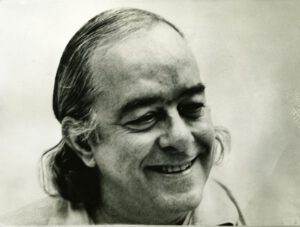
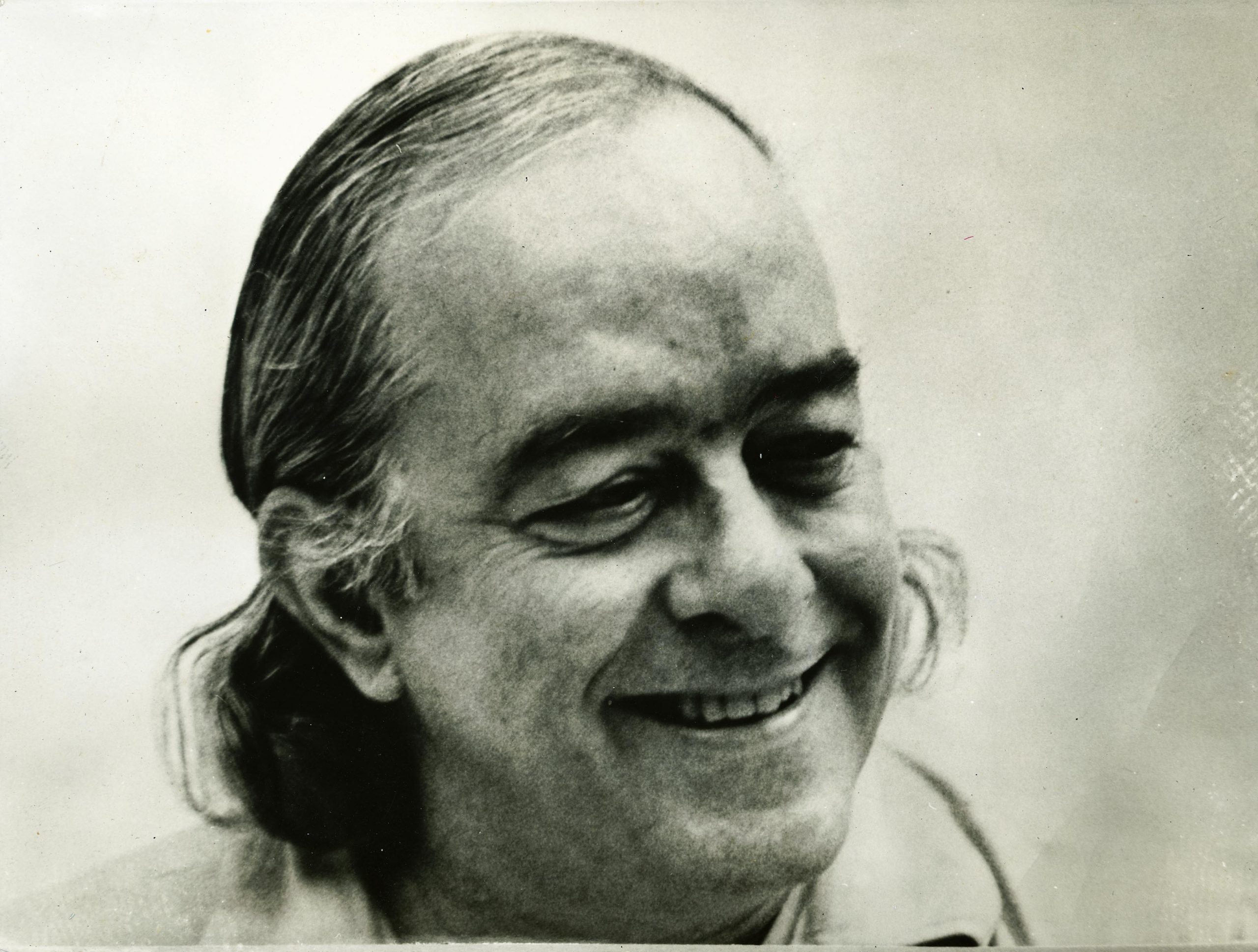
*Highlighted photo: Vinicius de Moraes, 1971. By Alécio de Andrade. Pirelli/MASP Photography Collection.

**Bruno Cosentino is a singer and songwriter. He has released the albums Amarelo (2015), Babies (2016), Corpos são feitos pra encaixar e depois morrer (2017) and Bad Bahia (2020). He is the editor of the music criticism magazine Polivox and a PhD in Brazilian literature at the Federal University of Rio de Janeiro (UFRJ), with research about love and eroticism in the poetry and songs of Vinicius de Moraes.

Notes

Clarice’s Rio de Janeiro – by Mànya Millen

, Clarice’s Rio de Janeiro – by Mànya Millen. IMS Clarice Lispector, 2019. Disponível em: https://site.claricelispector.ims.com.br/en/2019/01/18/rio-de-clarice/. Acesso em: 13 December 2025.

If reading the author of masterpieces such as Family TiesThe Apple in the Dark, and The Passion According to G.H. is an invitation to dive into a guarded and, at times, gloomy world, the vision of the author that emerges from O Rio de Clarice, passeio afetivo pela cidade (Clarice’s Rio, an Affective Stroll Through the City), by Teresa Montero, is definitely sunny. In the pages of the book, published by Editora Autêntica, evident is Clarice Lispector’s pleasure in wandering the streets, forests, parks, and beaches of Rio de Janeiro, where she arrived in 1935 as a 15-year-old. Developed from the strolls that Teresa has been promoting since 2008 through the writer’s favorites nooks and crannies of the metropolis, the work goes further and offers a more detailed view of neighborhoods, streets, and monuments. It interweaves quotes, testimonials, and stories with maps (with QR Codes), period images and others made by the photographer Daniel Ramalho especially for this publication.

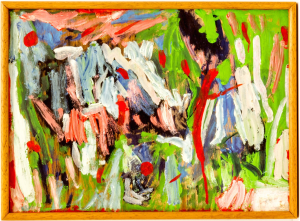
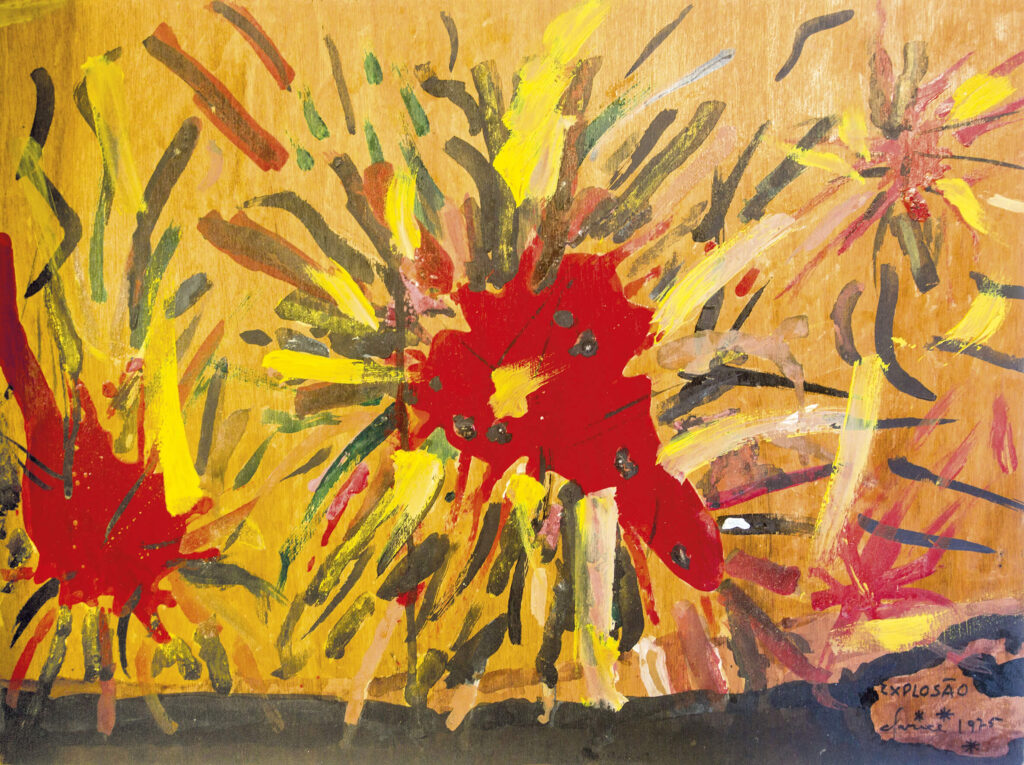
The idea of a Clarice who is more exuberant than the introspective version publicly crystallized over the years is already suggested in the red tone chosen to shade the front cover photo, in which the author, in a diva pose alongside her sons, enjoys the beach in the 1960s. It is also in the vibrant oranges and yellows of a painting signed by Clarice Lispector (Explosion, 1975), selected to illustrate the book’s back cover.

Explosion, 1975. Painting by Clarice Lispector. Photo: Clarice Lispector Collection/ Fundação Casa de Rui Barbosa.

“A guide is more committed to time, the day that begins and ends. The affective stroll is more of an aimless wandering through the city, the freedom to walk; so I’ve always thought the book had to be something in that direction,” says the editor Maria Amélia Mello, from Autêntica. “The idea was to tell a little about the history of the neighborhoods, especially Leme, where she lived most of her life, and not simply point out what each place has for one to see.”

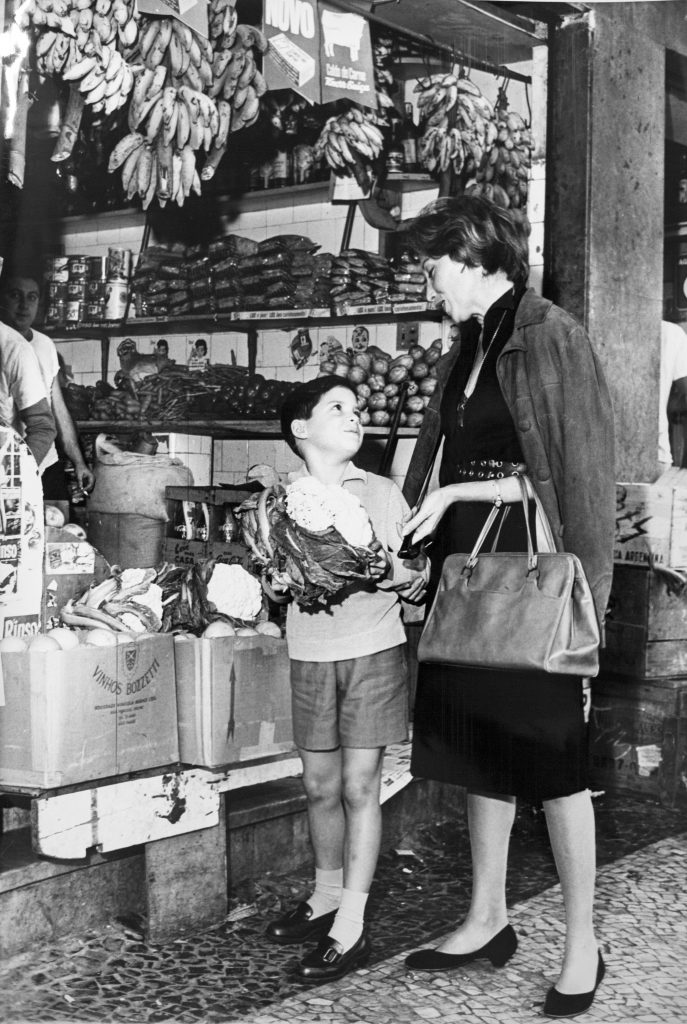
The neighborhood of Leme, which Clarice used to call “my land”– she arrived there in 1959 with her two sons, Pedro and Paulo, having already separated from her husband Maury Gurgel Valente, and remained there until her death in 1977 –, received the most space, which was merited. Since 2016 the writer, with her dog Ulysses, has been immortalized in her neighborhood with a statue by Duvivier. Teresa was something of a godmother for the campaign to install the monument, which quickly became a tourist spot. In the book, both the text and the photos from those times, most of them provided by the Rui Barbosa House Foundation’s Museum-Archive of Brazilian Literature (which, like the Moreira Salles Institute, holds part of the writer’s collection), show a Clarice who liked to walk around the area, go to the market, talk with neighbors, buy cigarettes, batteries, or soda at the tavern in front of her building.

Clarice smiles at her son Paulo Gurgel Valente in front of a greengrocer on Rua Gustavo Sampaio, at the corner of Rua Anchieta in Leme. 1960s. Photo: Clarice Lispector Collection/ Rui Barbosa House Foundation.

“The book reveals another side of her. Even though Clarice was introspective and did not like to socialize, she did stroll through the city,” says Teresa, author of a biography of the writer (Eu sou uma pergunta [I Am a Question], Editora Rocco, 1999). “When I started to research, reports would always appear saying Clarice stayed in her apartment, was not available, etc. The image of a recluse crystallized, and I wondered whether it was really the case.”

Some stories told in the book are proof of a more playful aspect to the writer. One of Clarice’s friends, the visual artist Maria Bonomi, recalls that whenever she came to Rio, they would go to La Fiorentina restaurant in Leme to talk, any hour of day or night. When they felt uncomfortable with other people approaching, at the suggestion of the author they would take their pizza and eat it on the beach sand, a trick celebrated with many laughs.

Pillar with signatures of artists at the La Fiorentina restaurant in Leme. Photo: Daniel Ramalho.

In more in-depth research and interviews with friends and acquaintances, Teresa started to discover an ordinary woman, present in the daily life of the city. “Obviously there were moments when she concentrated on the creative process, but she was the mother of two small boys, she had to move around the neighborhood,” recalls the author. With a degree in literature and theater, she has been working on the idea of a book since she started the tours.

Her dedication to a Clarice Lispector Rio itinerary is such that, in the process of learning more about Leme, Teresa ended up moving there five years ago. “My view of the neighborhood was different; it was of one who only comes on visits. With the move here I gained a series of references from daily life, the material became more affective,” she says. “Residents gave interviews, and even not having known Clarice they spoke about the neighborhood at the time. I think Leme is just like her, truly. It’s an isolated corner, it seems like it’s outside of Rio. We awake to the birds singing.”

Leme Rock, with Post 6, Two Brothers Hill and Gávea Rock in the background. Photo: Daniel Ramalho.

Leme has an obvious starring role, but the work also includes the neighborhoods of Tijuca, Centro, Catete, Botafogo, and Cosme Velho, places where she lived, studied, and worked, in addition to the Botanical Garden, which she loved and visited whenever she could. The first place in the city to be noted as one of the “Clarice Pathways” (the second was the statue in Leme), the Botanical Garden is also present in Clarice’s literature, such as in the beautiful story “Love,” included in Family Ties (1960).

Aleia Barbosa Rodrigues, in the Botanical Garden. Photo: Daniel Ramalho.

“Clarice’s Rio is pure nature,” Teresa claims. In her book she also recalls the marks in the author’s works left by another green part of the city: the Tijuca Forest. Coming from Recife and upon arrival in Rio, the Lispector family settled in Tijuca between 1935 and 1940, and then spent a brief period in Flamengo and São Cristóvão. Clarice, already living in Leme, always came back to stroll through the forest. The beautiful green setting is the stage for the couple Dori and Ulysses in An Apprenticeship or The Book of Delights (1969).

Solitude Weir, Tijuca Forest. Photo: Daniel Ramalho.

Teresa’s work proceeds to sew stories of people and places that were and still are part of the city’s memory. She also highlights curiosities, such as the works by the artist Poty Lazzarotto in a hotel in Leme (at the time it was the Luxor Continental, today it is Novotel) where Clarice stayed when she needed to dedicate herself to a book. “It’s a bit hidden, few people know about this artwork,” says the editor Maria Amélia Mello. “We tell the whole story in order to situate the reader. For the port region of Rio there’s a photo of the A Noite building, where Clarice worked. For Largo do Boticário, in Cosme Velho, there’s the house of the visual artist Augusto Rodrigues, where she would go every Sunday. We gathered a lot of cool stuff, maps, souvenirs, memories, history. The idea is really to enjoy the city, a tribute to Rio itself.”

*Mànya Millen is a journalist.

Notes